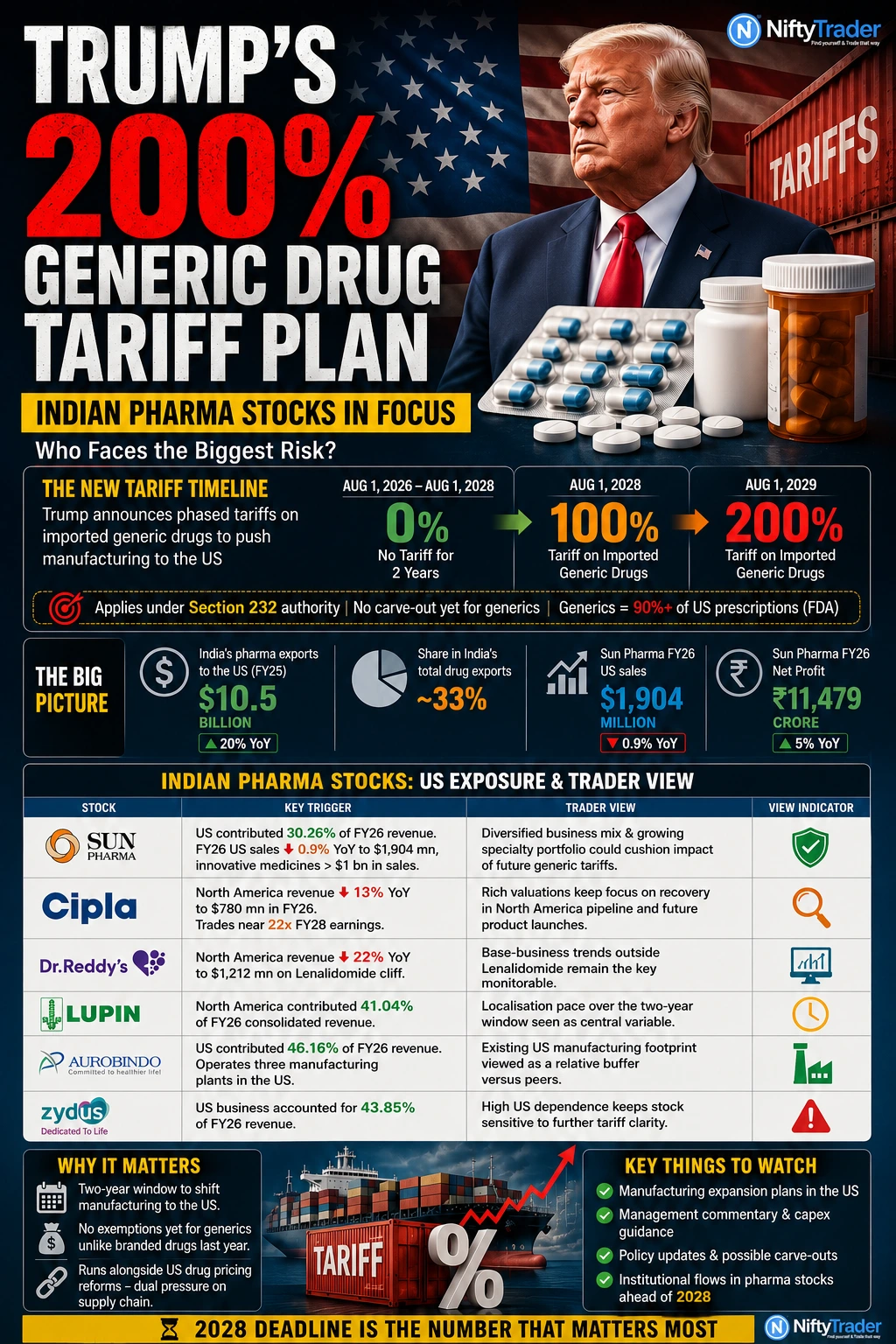
Sun Pharma, Cipla, Dr Reddy’s Laboratories, Lupin, Aurobindo Pharma and Zydus Lifesciences are among the pharma counters in focus on Wednesday after US President Donald Trump used a Truth Social post on Tuesday to lay out a phased tariff timeline for generic drugs entering the US. Generic drugs will carry zero duty for two years starting August 1, 2026, after which a 100% tariff applies from August 2028, doubling to 200% from August 2029.
The tariff plan on branded and patented drugs remains separate and unchanged, and generics account for more than 90% of all US prescriptions, per FDA data. For India’s largest pharma exporters, the generic drug tariff 2028 deadline is now the single number that matters most, even with a two-year runway still on the clock.
Key Highlights
- The tariff timeline runs under Section 232 authority, giving companies a defined window to shift manufacturing before duties rise.
- Last year, several multinational drugmakers signed deals exempting billions of dollars of pharmaceutical imports from tariffs, no comparable carve-out exists yet for this generics timeline.
- Aurobindo Pharma drew 46.16% of FY26 revenue from the US, the highest share among large-cap peers, per Bloomberg data compiled by Business Today; Sun Pharma derived 30.26%, Zydus Lifesciences 43.85% and Lupin 41.04% from North America.
- Sun Pharma’s FY26 US sales fell 0.9% to $1,904 million even as consolidated net profit rose 5% to ₹11,479 crore.
- India’s pharma exports to the US, dominated by generics, rose 20% to about $10.5 billion in fiscal 2025 and account for roughly a third of India’s total drug exports.
What Changed Today
Trump’s post replaces open-ended tariff threats with a specific calendar. The zero-tariff window runs for two years from August 1, 2026, before the rate rises, and the schedule is explicitly framed as an incentive to reshore generic drug manufacturing rather than a blanket trade measure.
Unlike the branded-drug tariff announced last year, where large multinationals already negotiated direct exemptions with Washington, this generics-specific structure carries no comparable carve-out as of now.
The timeline also runs alongside Washington’s most-favoured-nation drug pricing push, which aims to bring US medicine prices closer to those in other developed markets, a second lever the administration is pulling on the same supply chain at the same time.
Also Read: India-US Trade Talks Face New Test as US Bill Targets Russian Oil Buyers
Ownership And Manufacturing Exposure
The two-year window matters more for some companies than others, based on existing US manufacturing footprint. Aurobindo Pharma operates three manufacturing sites in the US, giving it a relative head start versus peers.
Dr Reddy’s, Lupin, Cipla and Zydus Lifesciences hold some existing North American manufacturing presence, while Alkem Laboratories and Torrent Pharmaceuticals remain largely dependent on India-based production with comparatively limited US generics cash flow.
Biocon’s generic and biosimilar output is based out of India and Malaysia.
Senores Pharmaceuticals, a smaller but relevant name in the space, already runs local US manufacturing catering specifically to the American generics market, a positioning that could look increasingly valuable as the 2028 deadline approaches.
NiftyTrader Desk View
| Stock | Key Trigger | Trader View |
|---|---|---|
| Sun Pharma | The US contributed 30.26% of FY26 revenue. FY26 US sales declined 0.9% YoY to $1.904 billion, while innovative medicines generated over $1 billion in annual sales. | A diversified business mix and expanding specialty portfolio could help offset potential pressure from future US tariffs on generic drugs. |
| Cipla | North America revenue declined 13% YoY to $780 million in FY26. The stock is currently trading at around 22x FY28 estimated earnings. | Premium valuations keep investor attention on a recovery in the North American pipeline and upcoming product launches. |
| Dr Reddy’s Laboratories | North America revenue fell 22% YoY to $1.212 billion, primarily due to the Lenalidomide exclusivity cliff. | Investors are expected to focus on the strength of the core business outside Lenalidomide as the key earnings driver going forward. |
| Lupin | North America accounted for 41.04% of FY26 consolidated revenue, making it one of the company’s largest markets. | The pace of US manufacturing localisation during the two-year tariff-free window will be a crucial factor for future stock performance. |
| Aurobindo Pharma | The US contributed 46.16% of FY26 revenue. The company already operates three manufacturing facilities in the United States. | Its established US manufacturing footprint is seen as a competitive advantage over peers that rely more heavily on exports from India. |
| Zydus Lifesciences | The US business contributed 43.85% of FY26 revenue, underscoring its significant exposure to the market. | High dependence on the US market leaves the stock particularly sensitive to any further clarity or changes in the proposed tariff policy. |
Source: Bloomberg data compiled by Business Today, company FY26 annual reports, and Whalesbook.
Financial Performance Check
FY26 numbers show generics pressure pre-dates this announcement. Sun Pharma’s consolidated revenue rose 11% to ₹58,462 crore and net profit rose 5% to ₹11,479 crore for FY26, even as US formulation sales slipped.
Cipla posted record consolidated FY26 revenue of ₹28,162.59 crore, but net profit fell to ₹3,879.23 crore from ₹5,272.52 crore a year earlier.
Dr Reddy’s took the sharpest hit: Q4 FY26 profit crashed 86% to ₹220 crore after its US exclusivity on generic Revlimid ended on January 31, 2026, opening the field to unrestricted competition, while full-year North America revenue fell 22% to $1,212 million.
Valuation And Peer Comparison
Cipla trades at about 22 times projected FY28 earnings, richer than Zydus Lifesciences at 18.4x and Dr Reddy’s at 19.0x, and well above Natco Pharma’s 12.8x. That gap leaves less room for disappointment if the North America recovery slips further, a risk now layered on top of tariff uncertainty running out to 2029.
Check Live: Cipla Option Chain (CIPLA) — Live OI, IV, Greeks & PCR
ZYDUS LIFESCIENCES Ltd Futures — Live Price, OI & Basis
The Expectation Gap
Not every analyst view has caught up with Tuesday’s announcement. As recently as April 2026, Jefferies had estimated that Indian generics would likely stay exempt from major US tariff action, reasoning that price-sensitive American consumers depend on cheap Indian generics.
Trump’s new calendar complicates that base case by putting a hard 2028-29 date on record for the first time, even with a two-year buffer.
The open question markets must now price in: will companies use the runway to build real US capacity, or will this deadline get renegotiated the way the October 2025 branded-drug tariff was.
Generic Drug Tariff 2028: Key Things To Watch
- Capex or plant-groundbreaking announcements from Aurobindo, Lupin, Dr Reddy’s and Zydus over coming quarters
- Implementation rules from the US Trade Representative’s office under Section 232 that could narrow or widen scope
- Q1 FY27 earnings commentary on localisation plans and cost estimates
- Any exemption deals similar to those signed by multinational drugmakers for branded drugs last year
Why It Matters Today
India accounts for roughly 40-50% of the generic medicines imported into the US, and pharma exports to the country rose 20% to about $10.5 billion in fiscal 2025. A 2028 deadline, even with a two-year cushion, changes the capital-allocation conversation at India’s largest exporters starting now, since plant construction and FDA approvals both carry multi-year lead times.
Final Take
The zero-tariff window buys time, not certainty. The next catalyst isn’t the 2028 date itself, it’s how quickly Aurobindo, Dr Reddy’s, Lupin and Zydus signal concrete US capacity plans in upcoming earnings calls.
The sector is more likely to reprice on execution signals than on the tariff headline alone, and expect stocks to trade on individual US-exposure math rather than as a single block until then.
Read Next: Stocks to Watch Today: Maruti, Bandhan Bank, Adani, Indian Hotels in Focus; 20 Q1 Results Due
FAQs
Q1. What is Trump’s new tariff plan for generic drugs?
Generic medicines entering the US will carry zero tariff for two years starting August 1, 2026. After that, a 100% tariff applies from August 2028, rising to 200% from August 2029, under Section 232 authority.
Q2. When does the generic drug tariff 2028 deadline actually kick in?
The tariff-free window runs through July 2028. The 100% duty takes effect from August 1, 2028, and steps up to 200% from August 1, 2029, unless a company has US manufacturing in place.
Q3. Which Indian pharma stocks are most exposed to the US generic drug tariff?
Aurobindo Pharma (46.16% of FY26 revenue from the US), Zydus Lifesciences (43.85%) and Lupin (41.04%) carry the highest US revenue dependence among large-caps, followed by Sun Pharma, Cipla and Dr Reddy’s.
Q4. How is this different from Trump’s earlier pharma tariffs?
The 2025 tariff targeted branded and patented drugs, and several multinationals negotiated exemptions for that. Generics were left out of that round entirely; this announcement is the first tariff timeline specific to generic medicines, which make up over 90% of US prescriptions.
Q5. Which Indian companies already have US manufacturing to cushion the impact?
Aurobindo Pharma runs three US plants, while Dr Reddy’s, Lupin, Cipla, Zydus Lifesciences and Senores Pharmaceuticals hold some existing North American manufacturing presence. Alkem, Torrent and Biocon remain more dependent on India-based (and, for Biocon, Malaysia-based) production.
This article is for informational purposes only and does not constitute investment advice or a recommendation to buy, sell or hold any security. Readers should consult a SEBI-registered investment advisor before making investment decisions.