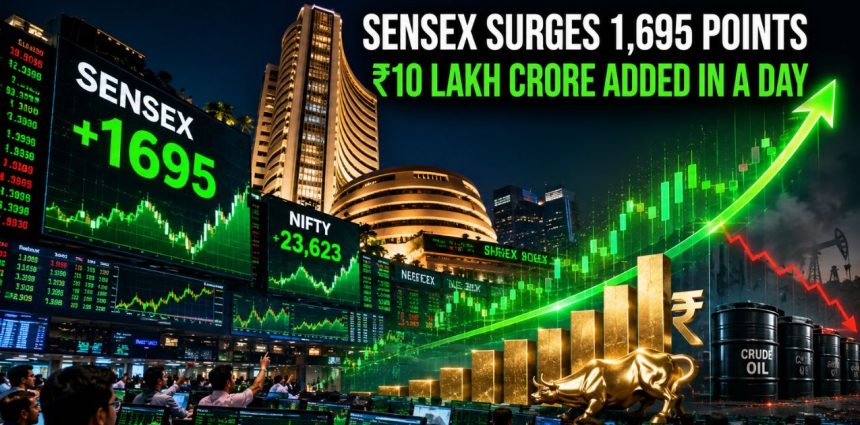
Indian equity markets staged one of their strongest rallies of 2026 on June 12, with the Sensex soaring nearly 1,700 points and the Nifty reclaiming the 23,600 mark. A sharp decline in crude oil prices, easing geopolitical tensions, broad-based buying, and aggressive short covering helped add nearly ₹10 lakh crore to investor wealth in a single session.
Key Takeaways
- Sensex surged 1,695 points to close at 75,527.95, while Nifty jumped 461 points to 23,622.90.
- Hopes of a US-Iran agreement pushed Brent crude below $87 per barrel.
- India VIX fell 5%, signalling easing volatility and improved risk appetite.
- Nearly ₹10 lakh crore was added to the market capitalisation of BSE-listed companies.
- Banking, financial, realty, and oil-sensitive sectors led the rally.
Why Did the Stock Market Rally Today?
After several sessions dominated by concerns over rising crude oil prices and Middle East tensions, Dalal Street witnessed a powerful relief rally on June 12.
The trigger came from signs of a possible diplomatic breakthrough between the United States and Iran, which sparked a sharp decline in crude oil prices and improved global risk sentiment. The resulting rally was broad-based, with gains seen across large-cap, mid-cap and small-cap stocks.
The Sensex surged 1,695 points, or 2.3%, to close at 75,527.95, while the Nifty50 advanced 461 points, or 1.99%, to settle at 23,622.90.
Market Snapshot
Data as of June 12, 2026.
| Indicator | Closing Value |
|---|---|
| Sensex | 75,527.95 |
| Nifty 50 | 23,622.90 |
| India VIX | 14.80 |
| Brent Crude | Below $87/barrel |
| USD/INR | 95.25 |
| Market Cap Addition | ~₹10 lakh crore |
The rally added nearly ₹10 lakh crore to the market capitalisation of BSE-listed companies, taking the total market value close to ₹462 lakh crore.
Market Breadth Shows Rally Was Broad-Based
One of the strongest signals from Friday’s session was the breadth of participation.
| NSE Market Breadth | Count |
|---|---|
| Advances | 2,740 |
| Declines | 564 |
| Unchanged | 86 |
The advance-decline ratio indicates the rally was not restricted to a handful of heavyweight stocks. Participation was visible across sectors and market capitalisations, suggesting stronger conviction among investors.
Top Sensex Contributors
| Stock | Gain |
|---|---|
| Bajaj Finance | +6% |
| Larsen & Toubro | +5% |
| IndiGo | +5% |
| HDFC Bank | +4% |
| Bajaj Finserv | +4% |
| Reliance Industries | +3% |
| Axis Bank | +3% |
| Bharti Airtel | +3% |
Tech Mahindra was among the few major laggards, declining over 2%.
1. US-Iran Deal Hopes Triggered a Global Relief Rally
The biggest catalyst behind today’s move was optimism surrounding a possible diplomatic agreement between the United States and Iran.
US President Donald Trump indicated that a peace agreement could be signed as early as this weekend, while reports suggested discussions around reopening the Strait of Hormuz, a key global oil shipping route responsible for more than 20% of worldwide oil flows.
Markets interpreted the development as a potential de-escalation of one of the biggest geopolitical risks facing global investors.
While Iranian officials stated that discussions remain ongoing and no final agreement has been reached, traders quickly priced in a lower geopolitical risk premium.
This shift in expectations became the primary driver of today’s rally.
2. Crude Oil Prices Crashed Below $87
The second major trigger was the sharp fall in crude oil prices.
Brent crude dropped more than 4% to trade below $87 per barrel, while WTI crude slipped to around $83 per barrel.
Earlier this year, crude oil had surged above $120 per barrel following disruptions linked to the Strait of Hormuz, creating concerns around inflation, current account pressures and economic growth.
Friday’s decline significantly improved India’s macro outlook.
Why Lower Crude Is Positive for India
| Impact Area | Effect |
|---|---|
| Inflation | Positive |
| Current Account Deficit | Positive |
| Rupee Stability | Positive |
| Corporate Margins | Positive |
| Consumer Spending | Positive |
As one of the world’s largest crude importers, India benefits directly from lower oil prices through reduced import costs and lower inflationary pressure.
3. Global Markets Joined the Rally
The rally was not limited to India.
Asian, European and US markets all moved higher as geopolitical concerns eased and energy prices cooled.
| Global Market | Move |
|---|---|
| Nikkei 225 | +3% |
| Kospi | +4% |
| Hang Seng | +1-2% |
| Shanghai Composite | +1% |
| Nasdaq | +3% |
| S&P 500 | +2% |
The synchronised global rally provided additional support to risk assets worldwide and encouraged investors to move back into equities.
4. Rupee Strengthened as Oil Pressures Eased
The Indian rupee appreciated sharply against the US dollar as lower crude prices improved India’s external outlook.
The currency gained nearly 60 paise to trade around 95.25 per US dollar.
A stronger rupee generally reduces imported inflation and improves investor confidence, particularly in domestic-facing sectors such as banking, consumption and financial services.
Analysts believe crude oil will remain the key driver for the currency in the near term, alongside foreign capital flows and global risk sentiment.
5. Short Covering and Falling VIX Amplified the Rally
Beyond the macro triggers, market positioning played a significant role.
Over the past few weeks, traders had built defensive positions amid rising crude oil prices, geopolitical uncertainty and persistent foreign selling.
As oil prices collapsed and risk sentiment improved, many bearish positions were forced to unwind.
This triggered a wave of short covering across the market.
At the same time, India VIX declined 5% to 14.80, indicating a sharp reduction in investor fear.
The combination of lower volatility and aggressive short covering accelerated the market’s gains.
What Institutional Positioning Signalled
| Indicator | Observation |
|---|---|
| FII Cash Activity | Sold ₹1,987 Cr |
| DII Cash Activity | Bought ₹4,225 Cr |
| Net DII Absorption | ₹2,237 Cr |
| FII Nifty Futures | Sold 2.67 lakh contracts |
| Market Interpretation | Bearish positioning before rally |
Despite aggressive FII selling and bearish futures positioning, domestic institutions continued to absorb supply. NiftyTrader data showed DIIs bought ₹4,225 crore worth of equities against FII selling of ₹1,987 crore. FIIs also sold nearly 2.67 lakh Nifty futures contracts, reflecting a cautious stance ahead of the rally.
Friday’s sharp advance suggests investors rapidly repriced geopolitical risks after crude oil prices collapsed and global sentiment improved. The move highlights the expectation gap that had developed between bearish institutional positioning and improving macro conditions. The magnitude of the rally indicates short covering likely amplified gains, particularly in banking and financial stocks that led the market higher.
Sector Scorecard
| Sector | Move |
|---|---|
| Nifty Private Bank | +3% |
| Nifty PSU Bank | +3% |
| Nifty Financial Services | +3% |
| Nifty Realty | +3% |
| Nifty Auto | +2%+ |
| Nifty FMCG | +2%+ |
| Nifty Midcap 100 | +2%+ |
| Nifty Smallcap 100 | +2%+ |
| Nifty IT | Marginally Negative |
Banking and financial stocks emerged as the biggest beneficiaries of improving macro sentiment.
Track Live Market Positioning
Investors can monitor the following tools on NiftyTrader to assess whether today’s rally is receiving support from derivatives and institutional flows:
Key Nifty Levels to Watch
| Level | Significance |
|---|---|
| 23,700 | Immediate Upside Target |
| 23,500 | Breakout Confirmation Zone |
| 23,300–23,350 | Key Support Zone |
| 23,100 | Critical Support |
| 22,900 | Downside Risk Zone |
Analysts believe Nifty’s undertone has improved and the index is likely to remain constructive as long as it sustains above the 23,300–23,350 support zone. A decisive move above 23,500 could accelerate momentum towards 23,700 and higher levels, while a breach below 23,100 may reopen downside risk towards 22,900.
What Could Happen Next?
While sentiment has improved significantly, investors should remain cautious.
The market has quickly priced in expectations of a successful diplomatic breakthrough between the United States and Iran. Any delay, disagreement, or setback in negotiations could lead to renewed volatility.
Similarly, a sharp rebound in crude oil prices would likely reverse part of today’s optimism.
The next few trading sessions will therefore be crucial in determining whether Friday’s rally evolves into a sustained uptrend or remains a relief-driven move.
Bottom Line
Friday’s 1,695-point rally was more than just a relief bounce. Markets aggressively repriced a worst-case oil shock scenario after signs of a possible US-Iran breakthrough reduced geopolitical fears and pushed crude oil below $87 per barrel.
With volatility cooling, the rupee strengthening and short positions coming under pressure, bulls have regained control above the 23,500 mark.
However, the sustainability of the move now depends on whether diplomatic optimism translates into a formal agreement.
If it does, banking, consumption and other oil-sensitive sectors could continue to lead the market higher. If negotiations falter, crude oil and volatility could quickly return to the centre of investor attention.
The next major trigger for markets will be whether easing geopolitical tensions translate into sustained foreign inflows and continued stability in crude oil prices.
Data as of June 12, 2026 market close.