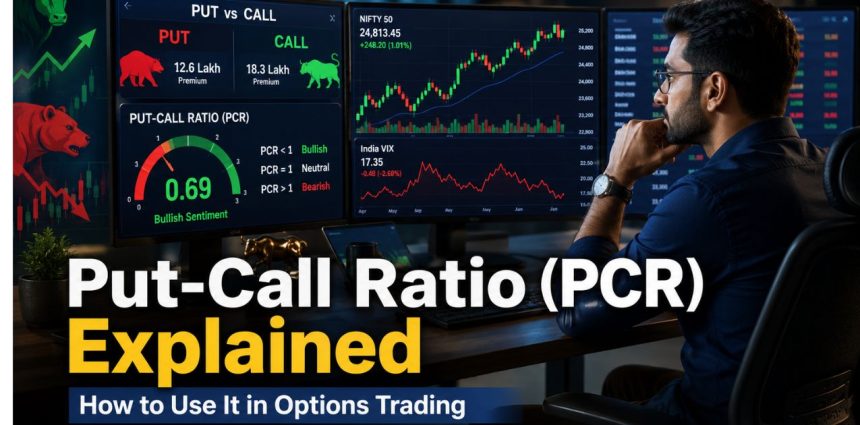
What Is the Put-Call Ratio? The Market’s Hidden Mood Meter
Every day, millions of options contracts are traded on NSE, BSE, and exchanges worldwide. Traders buy calls when they expect prices to rise. They buy puts when they expect prices to fall. But what if you could add up all those bets, and use the total to understand where the crowd is positioned right now?
That is exactly what the Put-Call Ratio (PCR) does.
The Put-Call Ratio is one of the most widely tracked sentiment indicators in options trading.
It converts an entire option chain into a single number, telling you whether the market is building more bearish protection or more bullish exposure.
For Indian traders using Nifty, Bank Nifty, Sensex, FinNifty, or stock options, PCR is especially useful because option chain activity shifts quickly during the trading day.
NSE’s option chain displays open interest, change in open interest, volume, implied volatility, and strike-wise call/put activity with volume and open interest shown in contracts (NSE India, nseindia.com/option-chain).
But PCR is not a magic buy-or-sell signal. A high PCR does not automatically mean “buy,” and a low PCR does not automatically mean “sell.” The real edge comes from reading PCR with price action, open interest buildup, India VIX, max pain, and expiry context.
This guide explains everything, from the formula to practical trading frameworks, so you can use PCR correctly.
What Is Put-Call Ratio: The Core Concept
The Put-Call Ratio compares the number of put options with the number of call options.
A put option generally gains value when the underlying falls, or when traders seek downside protection. A call option generally gains value when the underlying rises, or when traders expect upside. PCR gives a quick sentiment snapshot of whether the options market is more active on the put side or the call side.
PCR is calculated in three ways, each serving a different purpose:
| PCR Type | Formula | What It Measures |
|---|---|---|
| Volume PCR | Put Volume ÷ Call Volume | Intraday trading activity |
| Open Interest PCR | Put OI ÷ Call OI | Outstanding positions |
| Change in OI PCR | Change in Put OI ÷ Change in Call OI | Fresh buildup during a period |
Example: If total put open interest is 60 lakh contracts and total call open interest is 50 lakh contracts, then PCR = 60 ÷ 50 = 1.20. That means put open interest is 20% higher than call open interest.
Most traders default to just two types. The Change in OI PCR is the one they miss, and it is critical for detecting whether fresh positions are being built on the put side or the call side within a session.
Check Live: Nifty PCR Today Live Chart—Put Call Ratio (OI & Change OI)| NIFTYTRADER
Volume PCR vs OI PCR: Which Should You Use?
Both are useful, but they answer different questions.
Volume PCR is based on contracts traded during the day. It is more sensitive and changes quickly.
| Use Case | Why Volume PCR Helps |
|---|---|
| Intraday trading | Captures live market activity |
| Breakout confirmation | Shows sudden put or call demand |
| Reversal alerts | Detects panic or FOMO in real time |
| Expiry day | Useful when volume spikes rapidly |
However, volume PCR can be noisy. A sudden spike in put volume may reflect hedging, panic buying, fresh speculation, or a large institutional adjustment. Volume alone does not tell you which.
Open Interest PCR is based on outstanding positions. NSE defines open interest as the total number of outstanding contracts held by market participants at the end of the day (NSE India, nseindia.com/market-data/oi-spurts). OI PCR is more stable and more reliable for structure.
| Use Case | Why OI PCR Helps |
|---|---|
| Support and resistance reading | Shows where option writers are most active |
| Positional bias | More stable than volume PCR |
| Expiry analysis | Helps locate pressure zones by strike |
| Trend confirmation | Works with price and OI buildup together |
The simple rule: OI PCR is better for market structure and positional trades. Volume PCR is better for speed and intraday moves.
PCR Interpretation: What Do Different Levels Mean?
There is no universal PCR level that works in every market condition. A PCR of 1.20 can be bullish in one setup, neutral in another, and a warning signal in a third. Context always matters.
That said, traders commonly use these broad zones as a starting framework:
| PCR Range | General Interpretation | Trader’s Read |
|---|---|---|
| Below 0.70 | More call activity than put activity | Bullish sentiment, but possible overconfidence |
| 0.70 – 1.00 | Balanced market | Neutral to mildly bullish |
| 1.00 – 1.30 | More put activity | Support building or cautious sentiment |
| 1.30 – 1.60 | Heavy put activity | Can be bullish if put writing dominates |
| Above 1.60 | Extreme put-side activity | Possible over-hedging or contrarian zone, confirm with price |
These are illustrative zones, not mechanical rules. The same PCR reading can mean opposite things depending on whether it is a trending market or a range-bound one, whether it is expiry week or the start of a new series, and whether puts are being bought or written.
The Biggest PCR Mistake: Reading It Backwards
This is where most beginners go wrong.
Many traders assume: High PCR = bearish. Low PCR = bullish. That is only partially true — and in index options, it is often wrong.
A high PCR means put activity is higher than call activity. But in Nifty and Bank Nifty options, puts are frequently sold by option writers near strong support zones. When a large institution sells a put, it shows up in OI just like when a retail trader buys a put. The PCR rises in both cases, but the market implication is completely opposite.
Put buyer: Bearish bet. Expecting the market to fall.
Put writer/seller: Bullish bet. Collecting premium, expecting the market to hold above the strike.
So, rising PCR near a strong support level often signals that smart money is writing puts — which is actually a bullish signal. This is why PCR must always be read with price location and OI buildup, not in isolation.
Similarly, low PCR means call activity is higher. That can look bullish, but if call writers are aggressively adding OI at higher strikes, that actually shows strong resistance, not a buying opportunity.
Always ask three questions before acting on PCR: Are puts being bought or sold? Are calls being bought or sold? Is price confirming the signal?
How to Use PCR in Trading: 4 Practical Methods
Method 1: PCR With Price Trend
PCR should confirm price action, not replace it.
| Price Movement | PCR Movement | Interpretation |
|---|---|---|
| Price rising | PCR rising | Strong trend if put writing supports the move |
| Price rising | PCR falling sharply | Rally may be call-buying driven, watch for exhaustion |
| Price falling | PCR falling | Weak market if call writing increases |
| Price falling | PCR rising sharply | Could be panic hedging or genuine support building |
Example: If Nifty is rising and PCR is also rising from 0.90 to 1.20, it may mean put writers are becoming confident. But if Nifty is rising while PCR collapses from 1.20 to 0.70, the move may be driven by aggressive call buying, which can become unstable near resistance.
Method 2: PCR With Open Interest Buildup
PCR becomes significantly more useful when read alongside OI buildup patterns.
| OI + Price Setup | Market Meaning |
|---|---|
| Put OI rising + price rising | Bullish support buildup |
| Call OI rising + price falling | Bearish resistance buildup |
| Put OI unwinding + price falling | Support breaking down |
| Call OI unwinding + price rising | Resistance breaking up |
This is why PCR should always be read with strike-wise option chain data, not just the aggregate number.
Method 3: PCR for Support and Resistance
In index options, heavy put OI often acts as support, while heavy call OI often acts as resistance. PCR helps understand which side is stronger.
| Option Chain Signal | Market Meaning |
|---|---|
| Highest put OI below spot price | Support zone |
| Highest call OI above spot price | Resistance zone |
| PCR rising near support | Support likely strengthening |
| PCR falling near resistance | Resistance likely strengthening |
| Put OI unwinding at support | Breakdown risk rising |
| Call OI unwinding at resistance | Breakout risk rising |
For example, if Nifty spot is at 23,500 and the highest put OI is at 23,400 while the highest call OI is at 23,700, traders treat 23,400 as support and 23,700 as resistance. If PCR rises while Nifty holds above 23,400, the support is likely holding. If PCR drops and put OI unwinds, the support may break.
Strike-wise Max Pain Table (Illustrative):
| Strike Price (Nifty) | Call OI (Lakh) | Put OI (Lakh) | Strike PCR |
|---|---|---|---|
| 23,200 | 12.5 | 3.2 | 0.26 |
| 23,400 | 18.3 | 6.7 | 0.37 |
| 23,500 | 22.4 | 19.8 | 0.88 |
| 23,700 | 14.6 | 21.3 | 1.46 |
| 23,900 | 8.1 | 25.7 | 3.17 |
In this setup, the ATM zone around 23,500 shows balanced activity (PCR 0.88), strong put support below at 23,400, and strong call resistance above at 23,700. The Max Pain level tends to sit where combined OI is heaviest, and market makers have an incentive to keep expiry near that zone.
Method 4: PCR on Expiry Day
Expiry-day PCR behaves differently from regular sessions. Option writers adjust quickly, premiums decay fast, and a single large move can reshape the entire option chain within minutes.
Important note for 2026: NSE index derivatives, including Nifty 50, Bank Nifty, FinNifty, Midcap Select, and Nifty Next 50, now follow a Tuesday expiry structure.
BSE Sensex options follow Thursday expiry. Always check the current exchange expiry calendar before using PCR for expiry-day trades, as expiry schedules are subject to SEBI-approved regulatory changes (NSE India contract specifications; Reuters, June 2025).
| PCR Signal on Expiry | Interpretation |
|---|---|
| PCR above 1.30 | Put writers may be active — but watch for sudden unwinding |
| PCR below 0.80 | Call writers may be active — but a breakout can trigger short covering |
| PCR changing rapidly | Avoid blind trades — wait for 15 to 30 minute confirmation |
| PCR stable near max pain | Range-bound expiry likely |
| PCR breaking sharply with price | Directional expiry possible |
For expiry trading, track PCR over 15-minute, 30-minute and 60-minute windows — not single-minute ticks. A single-minute PCR spike on any expiry day is almost always noise until confirmed by sustained price and OI movement.
PCR and India VIX: Using Both Together
PCR alone is powerful. Combined with India VIX, it becomes significantly more precise.
| PCR Signal | India VIX Signal | Combined Interpretation |
|---|---|---|
| PCR above 1.30 | VIX above 20 | Fear elevated — watch for reversal only if price holds support |
| PCR above 1.30 | VIX below 14 | Likely hedging activity only — weaker signal |
| PCR below 0.70 | VIX below 13 | Complacency risk rising — confirm with resistance and price weakness |
| PCR below 0.70 | VIX spiking | Calls bought despite rising fear — market confusion, avoid |
| PCR neutral 0.90–1.10 | VIX normal | No clear signal—wait for directional breakout |
When PCR and VIX agree, signal strength increases. When they diverge, extra caution is needed before acting.
Check Live: India VIX Live – Today’s Level, Chart &History | NIFTYTRADER
PCR as a Contrarian Indicator: How to Use It Responsibly
PCR is also used as a contrarian sentiment gauge. When too many traders become bearish and put activity surges to extremes, the market may be approaching a bottom. When too many become bullish and call activity dominates, the market may be approaching a top.
Cboe publishes daily put/call ratios across total, index, equity, and other option categories globally, showing how universally this contrarian reading is applied by professional traders worldwide (Cboe Global Markets, cboe.com/markets/us/options/market-statistics/daily).
However, contrarian trading using PCR carries serious risk. A high PCR can remain elevated for days while the market continues falling. A low PCR can persist while the market continues rising. Acting too early on extreme PCR readings is one of the most common and costly mistakes in options trading.
The safer contrarian approach:
| Contrarian Setup | Safer Confirmation Before Acting |
|---|---|
| Very high PCR | Price stops falling + put OI unwinding slows |
| Very low PCR | Price stops rising + call buildup increases |
| Panic put buying spike | VIX cools + key support holds on price chart |
| Excess call buying | Resistance holds + price momentum weakens visibly |
5-Step PCR Trading Framework
Before taking any PCR-based trade, run through these five checks in order:
Step 1 — Check Market Trend: Is the index trending up, trending down, or range-bound? PCR works differently in each environment. In a strong uptrend, rising PCR can support the rally. In a downtrend, the same high PCR may simply confirm fear.
Step 2 — Check PCR Direction: Do not only look at the current PCR value. Check whether it is rising, falling, or flat.
| PCR Direction | Meaning |
|---|---|
| Rising PCR | Put side becoming stronger |
| Falling PCR | Call side becoming stronger |
| Flat PCR | Market balanced or waiting for a catalyst |
Step 3—Check Strike-Wise OI: Look at strikes near the spot price. Far out-of-the-money strikes can distort the aggregate PCR picture. Focus on ATM and near-ATM strikes for intraday decisions.
Step 4—Check Price Confirmation: PCR is useful only when price confirms the signal. If PCR suggests bullish sentiment but price is making lower lows, wait for price alignment before entering any position.
Step 5 — Assess Your Risk Honestly: This step is non-negotiable. SEBI’s study on India’s equity F&O segment found that 93% of individual traders incurred losses between FY22 and FY24, with aggregate losses exceeding ₹1.8 lakh crore over three years (SEBI Press Release, September 2024). PCR is a decision-support tool. It is not a shortcut to profitable trading, and it is not a reason to overtrade.
Best PCR Settings by Trader Type
| Trader Type | Best PCR View |
|---|---|
| Scalper | 5-minute and 15-minute change in PCR |
| Intraday Trader | 15-minute, 30-minute and full-day PCR |
| Expiry Trader | PCR + max pain + strike-wise OI shift |
| Positional Trader | Daily OI PCR trend across multiple sessions |
| Beginner | OI PCR with support and resistance only |
Common PCR Mistakes to Avoid
| Mistake | Why It Hurts Traders |
|---|---|
| Using PCR alone without price context | PCR gives no entry point, stop loss or target |
| Ignoring expiry calendar changes | NSE and BSE now follow different expiry days |
| Treating high PCR as always bullish | May reflect fear or hedging, not put writing |
| Treating low PCR as always bearish | May reflect strong call buying instead |
| Ignoring strike-level OI data | Aggregate PCR hides important shifts near key strikes |
| Not checking India VIX | Volatility significantly changes option behaviour |
| Acting on single-minute PCR spikes | Small, fast changes are usually noise |
| Ignoring post-expiry OI reset | OI base resets after each expiry—fresh series PCR needs fresh reading |
Where to Find PCR Data Free
| Source | What You Get |
|---|---|
| NSE India (nseindia.com) | OI-based PCR, option chain, OI spurts, contract specs |
| NSE Bhavcopy | Daily OI and volume data by strike |
| Sensibull (sensibull.com) | Visual PCR charts, OI analysis tools |
| Opstra by Definedge (opstra.definedge.com) | Strike-wise OI, PCR heat maps |
| Cboe (cboe.com) | Global put/call ratio data for reference |
| NiftyTrader (niftytrader.in) | Real-time PCR, Nifty market roundups, F&O analysis |
Key Takeaways
PCR = Total Put OI ÷ Total Call OI. Above 1.0 means more put activity; below 1.0 means more call activity.
Three PCR types exist, Volume PCR, OI PCR, and Change in OI PCR. Each serves a different purpose, and a complete analysis uses all three.
PCR is not a standalone signal. It must always be read with price action, OI buildup, India VIX, and expiry context.
The most important distinction: putting in writing is bullish; putting in buying is bearish. Both raise PCR. Always determine which is happening before acting.
Extreme PCR readings can signal contrarian opportunities, but only when price holds the relevant level and VIX confirms the setup.
NSE index derivatives now expire on Tuesday; BSE Sensex options expire on Thursday. Always check the current exchange expiry calendar before expiry-day trades.
SEBI data shows 93% of F&O traders lose money. Use PCR as one disciplined input, never as a reason to overtrade.
FAQs
What is a good PCR level?
There is no fixed good PCR level. Generally, PCR below 0.70 shows call-heavy activity; 0.70–1.00 is neutral; 1.00–1.30 shows rising put activity; and above 1.30 shows strong put-side activity. Interpretation depends on market trend, expiry context, and whether puts are being bought or written.
Is high PCR bullish or bearish?
High PCR can be bullish if it reflects put writing near support. It can be bearish if it reflects panic put buying during a falling market. Always confirm with price and OI buildup before acting.
Is low PCR bullish or bearish?
Low PCR can reflect bullish call buying, but it can also reflect aggressive call writing near resistance. That is why PCR must always be used alongside strike-wise option chain data.
Which PCR is better—volume PCR or OI PCR?
Volume PCR is better for intraday activity and speed. OI PCR is better for support, resistance, and broader market structure.
When does NSE expiry happen now?
NSE index derivatives, including Nifty 50 and Bank Nifty, now generally expire on Tuesday. BSE Sensex options expire on Thursday. Always verify the current expiry schedule on the exchange website before expiry-day trades.
Can PCR predict market direction?
PCR can help gauge sentiment, but it cannot predict direction alone. It works best when used together with price action, open interest, India VIX, max pain, and trend analysis.
Disclaimer: This article is for educational purposes only and does not constitute investment advice. Options trading involves significant financial risk. Readers should consult a SEBI-registered investment advisor before taking any position in derivatives markets.
Sources: NSE India (nseindia.com) — Option Chain and Contract Specifications; Cboe Global Markets (cboe.com) — Daily Put/Call Ratio Statistics; SEBI Press Release, September 2024 (sebi.gov.in); Reuters, June 2025 — NSE/BSE Expiry Day Changes; Investopedia (investopedia.com)—Put-Call Ratio Meaning; NiftyTrader Research Desk (niftytrader.in)