Introduction
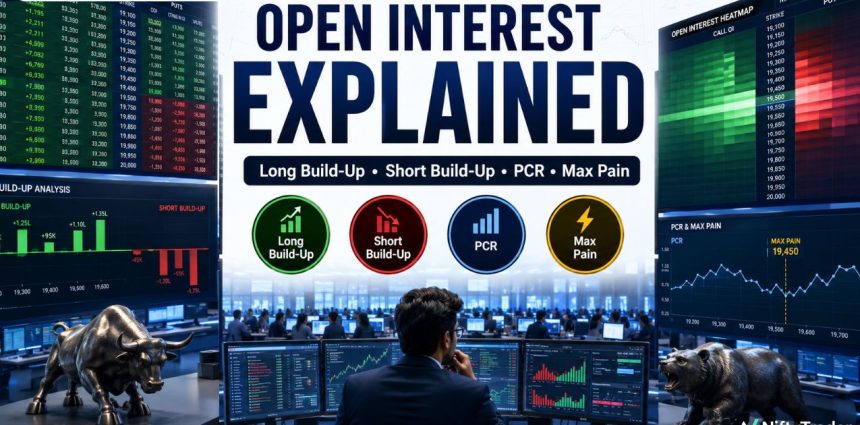
India’s derivatives market now processes more contracts than any other exchange in the world, yet most retail traders still rely almost entirely on price charts. Open Interest, the one data point that reveals where large traders are actually committing real money, is routinely ignored or misread. That gap is where losing trades are made. This guide explains exactly what Open Interest is, how to read every OI build-up signal correctly, and how to apply the NiftyTrader three-step filter to cut through the noise.
Key Takeaways
- Open Interest is the total number of outstanding F&O contracts that have not been settled. It shows real money commitment, not just trading activity.
- Rising OI with a rising price signals a long build-up — fresh bullish conviction entering the market.
- Rising OI with a falling price signals a short build-up — fresh bearish conviction entering the market.
- Falling OI with a rising price signals short covering — a rally that may lack durability without fresh long participation.
- Falling OI with a falling price signals long unwinding — bulls exiting, not bears attacking.
- The NiftyTrader OI Rule: Always cross-check OI direction with price direction and volume before acting on any single signal.
What Is Open Interest — and Why Should You Care?
Most traders look at price. Some look at volume. But the traders who consistently read the market correctly look at Open Interest, the number that tells you how much real money is committed to a position right now.
Open Interest is the total count of all active, unsettled F&O contracts in the market at any given moment. When a buyer and a seller enter a fresh contract together, OI rises by one.
When an existing contract is squared off or expires, OI drops. It is not a running trade count; it is a snapshot of live, uncommitted bets still on the table.
Here is why it matters: Volume tells you how busy the market was today. Open Interest tells you how many players are still in the game tonight.
Why Open Interest Has Become More Important in India’s Markets
India’s derivatives market has become the world’s largest by contract volume, with index options activity on the NSE regularly exceeding cash market turnover. As participation from retail traders, proprietary desks, and institutional investors grows, OI data has become one of the fastest ways to gauge where real money is positioned.
With weekly expiry volumes surging, rising retail participation in options strategies, and FII hedging activity intensifying around macro events, distinguishing genuine directional trends from temporary positioning shifts has never been more critical.
Whether traders are tracking RBI policy decisions, Union Budget announcements, earnings seasons, or global risk events, OI often reveals where market participants are placing their bets before price trends become obvious to everyone else.
OI vs Volume: The Difference Traders Miss
These two numbers are routinely confused, especially by newer F&O participants.
Volume counts every transaction. A trade opened and closed within the same session counts twice toward volume but nets to zero for OI. Open Interest only rises when a new contract is created, one new buyer plus one new seller, and only falls when an existing contract is closed.
Think of it this way: a packed stadium with 50,000 people who arrive and leave throughout the day has high footfall (volume). But only the people still in their seats at the end of the day are counted in Open Interest.
For the Indian F&O trader, this distinction matters most around expiry. Near expiry, volume spikes as positions are rolled or closed, but OI often falls sharply as contracts get settled.
A volume spike near expiry should be interpreted cautiously, it may reflect rollovers and position adjustments rather than fresh directional conviction. An OI spike near expiry carries considerably more signal weight. Participant wise Open Interest data is updated daily.
How OI Build-Up Works: The Four Core Combinations
Every OI reading must be interpreted alongside price movement to mean anything. Here are the four combinations every F&O trader should know.
Price Rising + OI Rising = Long Build-Up (Bullish Confirmation)
New money is entering the market and backing the upside. Both buyers and sellers are committing fresh capital, but buyers are clearly in control because price is rising. This is the strongest bullish confirmation signal — fresh capital is actively supporting the move.
What to watch for: stocks or indices where OI increases consistently across two to three sessions while price makes higher highs. This is a trend initiation or trend confirmation signal, not a noise trade.
Price Falling + OI Rising = Short Build-Up (Bearish Confirmation)
New money is entering, but sellers are in charge. Fresh short positions are being built aggressively. This is a bearish confirmation, it signals that the downside move has real institutional or large trader participation behind it.
What to watch for: When Nifty or a large-cap stock falls with rising OI for two or more consecutive sessions, it indicates sustained selling pressure, not a panic dip. Dip-buying in this environment carries significantly higher risk than it may appear.
Price Rising + OI Falling = Short Covering (Use Caution)
Price is rising, but Open Interest is declining. This means existing shorts are closing their positions, not that new bulls are entering. The price rise is mechanical, driven by position exits, not conviction.
Key NiftyTrader rule: a rally on short covering alone is not a structural bullish signal. Unless a new long build-up replaces the covered shorts, the rally can fade quickly.
Short covering is fuel, not foundation. That said, strong short-covering rallies can sustain upside momentum for several sessions, particularly when FII positioning shifts simultaneously, so the signal warrants watching rather than immediate fading.
Price Falling + OI Falling = Long Unwinding (Warning Sign)
Existing longs are exiting. Price falls not because bears are attacking but because bulls are giving up. This is often seen at the end of extended uptrends when smart money begins distributing.
Long unwinding is a warning sign, especially when it begins in frontline stocks like Reliance, HDFC Bank, or TCS. If these names show long unwinding while the index still looks stable, the broader market is more vulnerable than it appears.
The Institutional Angle: When FII Alignment Changes Everything
The four OI combinations above become significantly more powerful when institutional positioning confirms the signal.
When FII index futures and options data, released daily by NSE and tracked on NiftyTrader’s FII-DII page, aligns with OI build-up signals from the broader market, conviction levels tend to be materially higher than when OI changes are driven primarily by retail positioning. Institutional money moves in large blocks and with longer time horizons.
When FII futures net positioning shifts in the same direction as OI build-up, the probability of sustained follow-through increases.
Conversely, when retail-driven OI signals contradict FII positioning, extra caution is warranted. FIIs building net short index futures positions even while domestic indices hold steady has historically preceded corrective moves of one to three percent in several market cycles.
Real-World Example: Short Covering vs. Long Build-Up
During several major RBI policy sessions, Nifty witnessed rising prices accompanied by falling OI, a textbook short-covering signal rather than fresh bullish conviction. Traders who interpreted those initial rallies as structural breakouts found that momentum faded within one to two sessions once covered shorts were exhausted and no fresh long buildup emerged to replace them.
In contrast, during genuine trend initiations, such as the post-Union Budget rallies that followed fiscal consolidation signals, rising OI consistently accompanied the price move across multiple sessions, confirming that fresh capital was entering rather than old positions exiting.
The practical lesson: two Nifty rallies of identical magnitude can mean very different things depending on what OI is doing simultaneously.
Why OI Changes Rapidly Near Weekly Expiry
Nifty and Bank Nifty weekly expiries often create unusual OI behaviour that traps unprepared traders.
As expiry approaches, participants aggressively close, roll over, or hedge positions. This causes sharp changes in Open Interest that often have little to do with directional conviction.
A large drop in OI on expiry day typically reflects contract settlement rather than a meaningful shift in market sentiment. Traders should place greater emphasis on fresh OI build-up in the next expiry series rather than interpreting expiry-day data in isolation.
The same logic applies at monthly expiry. The first two sessions of a new monthly series are often noisy, OI levels rebuild from scratch, and early readings can be misleading until sufficient positions accumulate.
The NiftyTrader OI Rule: A Three-Step Filter
NiftyTrader’s approach to OI analysis does not rely on any single data point. The NiftyTrader OI Rule is a three-step filter that significantly reduces false signals.
Step 1 — Identify OI Direction: Is OI rising or falling? Pull this data from NSE’s daily F&O bhavcopy or NiftyTrader’s live Option Chain tool, which updates in near-real-time throughout the trading session.
Step 2—Cross-Check with Price Direction: Is price rising or falling? Map the combination against the four frameworks above. Rising OI with a rising price is the strongest bullish confirmation, but also check whether short covering or long unwinding better explains the observed move.
Step 3 — Validate with Volume: Is F&O volume above the five-session average? High OI build-up on below-average volume is a weak signal. The strongest signals occur when OI builds significantly alongside above-average volume participation.
If all three steps align, the signal is high confidence. If only two align, treat it as a watch, not a trade trigger. If only one aligns, treat it as noise.
How to Read OI in the NiftyTrader Option Chain
NiftyTrader’s Option Chain displays OI data for every strike price across Nifty, Bank Nifty, and individual stock options. Here is how to use the key data points.
PCR (Put-Call Ratio) from OI: Divide total Put OI by total Call OI. A PCR above 1.2 is broadly considered bullish, more put writing signals that market makers expect the index to hold. A PCR below 0.8 is broadly considered bearish. PCR readings should always be interpreted relative to historical ranges and prevailing market volatility rather than fixed thresholds alone.
Max Pain Strike: The strike at which the maximum number of F&O contracts will expire worthless. Historically, indices show a bias toward settling near this level on expiry day.
OI Concentration at Strikes: The Call and Put strikes holding the highest OI become natural resistance and support zones respectively. If Nifty is at 24,200 and the 24,500 CE holds the highest Call OI, that strike functions as a near-term ceiling, until OI shifts.
Change in OI Day-on-Day: The single most actionable data point in the Option Chain. Knowing total OI is not enough — what matters is whether OI at a specific strike is building or shrinking session by session. Fresh Call writing at a strike signals resistance being constructed. Fresh Put writing signals support being built.
OI Quick-Reference Cheat Sheet
Price Direction — OI Direction — Signal — Interpretation
Rising — Rising — Long Build-Up — Bullish; fresh capital supporting the move
Falling — Rising — Short Build-Up — Bearish: fresh shorts entering with conviction
Rising — Falling — Short Covering — Bullish but potentially less durable; watch for fresh long build-up
Falling—Falling—Long Unwinding—Weakness; bulls exiting, not bears attacking
Common OI Reading Mistakes Indian Traders Make
Mistake 1 — Treating OI in isolation. The most frequent error. OI without price context is meaningless. Always use the four-combination framework alongside current price action.
Mistake 2 — Ignoring rollover OI. At monthly expiry, OI rolls over to the next series. A sudden OI jump on the first day of a new series is normal, it does not signal a new directional move.
Mistake 3 — Confusing stock OI with index OI. Index OI reflects macro positioning. Stock OI reflects company-specific views. The signals can diverge significantly, especially before results or corporate events. Treat them separately.
Mistake 4 — Ignoring FII OI data. FII index futures and options data, released daily by NSE and tracked on NiftyTrader’s FII-DII page, reveals institutional positioning. Ignoring it means trading with half the picture.
NiftyTrader Proprietary Data Snapshot
Data reflects most recent NSE provisional close. For live updates, visit NiftyTrader’s Option Chain and FII-DII tracker.
Nifty PCR (OI-based) — tracked via NiftyTrader Option Chain — above 1.2 broadly signals bullish bias
Bank Nifty PCR—tracked via NiftyTrader Option Chain—below 0.8 broadly signals bearish bias
India VIX—tracked via NiftyTrader Markets Page—above 18 indicates elevated volatility; PCR signals less reliable above this level
FII Index Futures Net—tracked via NiftyTrader FII-DII Page—net short indicates hedged or bearish institutional positioning
Source: NSE provisional data / NiftyTrader Option Chain. Data refreshes intraday.
Practical Application: Spotting OI Signals on Nifty
Consider two scenarios that look identical on a price chart.
Scenario A: Nifty closes up 180 points. Total OI on Nifty futures rises 8% in a single session. Volume is 40% above the five-session average. By the NiftyTrader OI Rule, Rising OI, Rising Price, volume confirmation present, this is a high-confidence long build-up signal. The market has broken its range on fresh money, not simply short covering.
Scenario B: Nifty rises 180 points, but OI falls 6%. Volume is in line with the average. This is short covering, sellers giving up. It may push Nifty higher for another session or two, but without fresh long build-up replacing the covered shorts, the move lacks structural durability.
Two identical-looking 180-point moves. Completely different risk profiles. The trader who understands OI will approach them very differently.
What Open Interest Cannot Tell You
Open Interest reveals positioning, not certainty.
A rise in OI shows that traders are creating new positions.
It does not reveal whether those positions will ultimately be profitable. Markets can continue rising despite heavy short build-up, and they can fall despite aggressive long build-up.
Professional traders use OI as a confirmation tool rather than a prediction tool.
Price action remains the final arbiter of market direction. OI tells you the shape of the battlefield, not who will win.
Bottom Line
Open Interest is not a magic indicator. It is a confirmation tool that tells you whether price moves are backed by fresh conviction or are simply mechanical position exits.
Used correctly, with the NiftyTrader three-step filter combining OI direction, price direction, and volume, it dramatically reduces false signals and keeps you aligned with institutional money flows rather than chasing retail noise.
In India’s now-dominant global derivatives market, ignoring OI is no longer an option any serious F&O trader can afford.
Use Live NiftyTrader’s Option Chain and FII-DII tracker, updated throughout the trading session:
FAQs
Q1. Is high Open Interest always bullish?
No. High OI simply means more contracts are outstanding. Whether that is bullish or bearish depends entirely on the direction in which that OI was built — long build-up versus short build-up. High OI with a falling price is a bearish signal.
Q2. Where can I find OI data for Indian stocks and indices?
NSE publishes daily F&O bhavcopy files on its website. NiftyTrader’s Option Chain aggregates this data with live intraday updates, along with PCR, Max Pain, and Change in OI by strike.
Q3. What is a “significant” OI change?
There is no universal threshold. As a practical rule, a single-session OI change exceeding 5% for index futures or 10% for individual stock futures — when accompanied by above-average volume — is worth close attention.
Q4. Can OI data be manipulated?
OI is exchange-reported data from NSE, reflecting actual contracts outstanding rather than sentiment surveys. However, large players can build and unwind positions rapidly around high-impact events such as earnings or RBI policy decisions, which can make OI signals temporarily misleading. Treat expiry week OI data with extra caution.
Q5. How does OI relate to India VIX?
India VIX measures expected near-term volatility derived from Nifty option premiums. High VIX typically coincides with heavy put buying, rising Put OI, which can distort PCR readings. When VIX is above 18 to 20, PCR-based signals are less reliable, and price action alongside FII positioning becomes the more important filter.
Related Reads
How to Read Option Chain Data — NiftyTrader
What Is Put-Call Ratio (PCR) and How to Use It — NiftyTrader
FII-DII Data Explained for Traders — NiftyTrader
Sources
NSE Futures and Options Data — nseindia.com
NSE Option Chain — nseindia.com/option-chain
NSE F&O Bhavcopy Files — nseindia.com
NSE Participant-wise Open Interest Data — nseindia.com
NiftyTrader Option Chain Dashboard — niftytrader.in
Disclaimer: This article is for educational purposes only and does not constitute investment advice. Trading in F&O instruments carries significant risk. Please consult a SEBI-registered financial advisor before making investment decisions. NiftyTrader does not recommend buying or selling any specific securities.