
Nikkei Falls 3.6% as Chip Stocks Advantest, Tokyo Electron Tumble on Wall Street Selloff
Japan’s stock market came under heavy selling pressure on Tuesday as the Nikkei fell over 3%, extending a global rout in semiconductor stocks after weakness on Wall Street spilled over into Asian markets. The sharp decline followed steep losses in U.S. chipmakers and a broad selloff in South Korea, adding to investor concerns over the global semiconductor industry.
The decline in Nikkei was largely driven by heavyweight chip equipment makers, while investors also turned cautious ahead of quarterly earnings from major technology companies in both Japan and the United States. The weakness highlighted how closely Asian equity markets remain tied to developments in the global semiconductor sector.
Track Live : GIFT Nifty Live – Today Price, Chart, Timings and Nifty Opening Signal
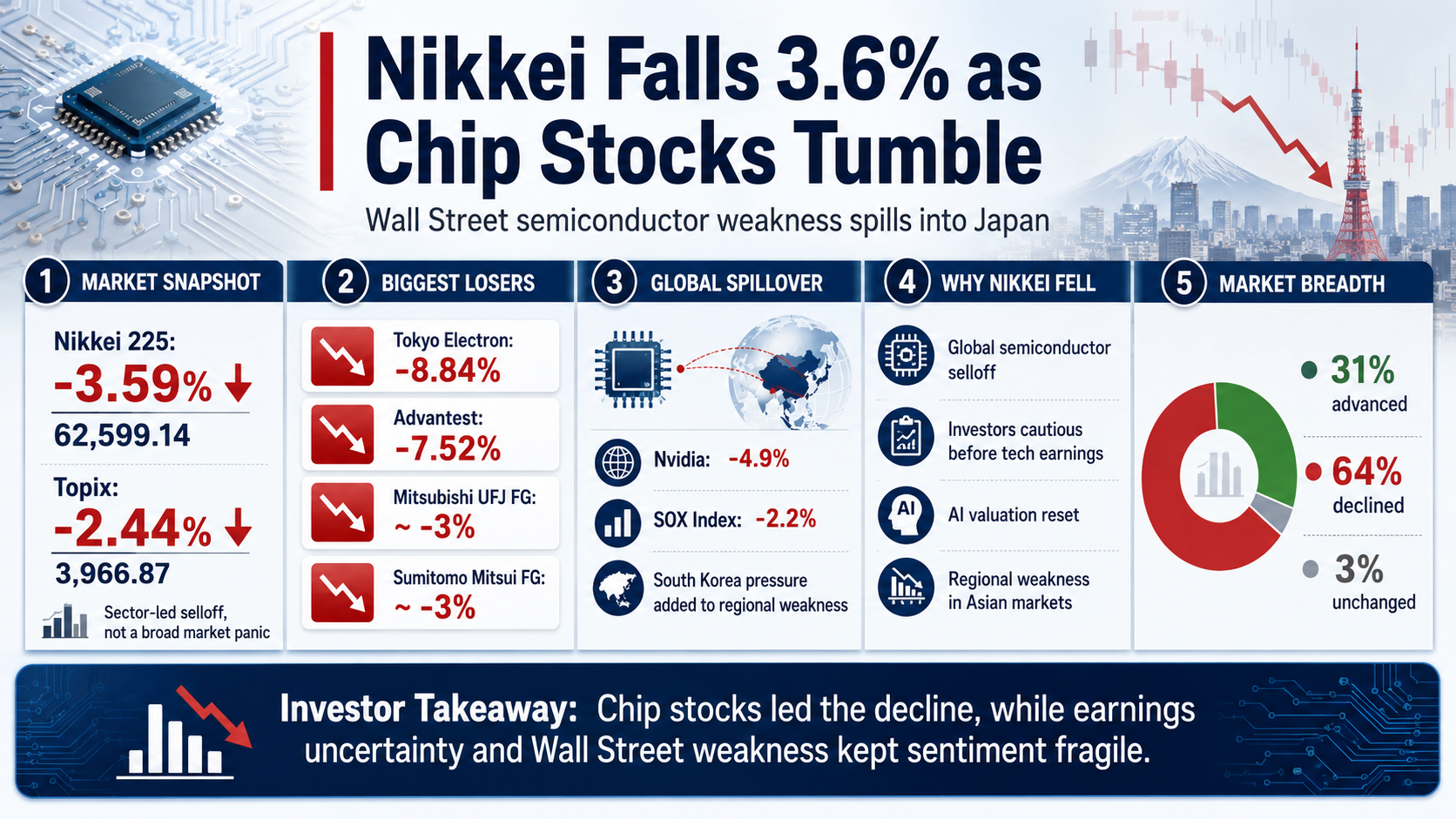
Nikkei Falls Over 3% as Chip Stocks Drag the Market Lower
Japan’s benchmark Nikkei 225 dropped 3.59% to 62,599.14, while the broader Topix index declined 2.44% to 3,966.87 during Tuesday’s session.
The fall followed another weak session for semiconductor stocks in the United States, where technology shares continued to face selling pressure.
Despite the sharp decline, market strategists said the move reflected sector-specific weakness rather than a broad risk-off shift across financial markets.
“This is not a broad selloff, or the market is not in a risk-off sentiment,” said Daisuke Hashizume, Senior Strategist at Daiwa Securities.
“Investors are cautious about buying stocks before earnings of big tech firms in the U.S. and Japan. There are uncertainties in the market,” he added.
Read More : KOSPI Plunges 10.8%, Worst Fall in 5 Months, as SK Hynix, Samsung Slide on Memory Chip Rivalry Fears
Biggest Losers: Japan’s Nikkei Selloff
The sharp decline in Japan’s equity market was led by semiconductor stocks, while banking shares also came under pressure as investors reduced exposure ahead of major earnings announcements.
| Stock | Move |
|---|---|
| Tokyo Electron | ▼ 8.84% |
| Advantest | ▼ 7.52% |
| Mitsubishi UFJ Financial Group | ▼ Nearly 3% |
| Sumitomo Mitsui Financial Group | ▼ Nearly 3% |
Wall Street Chip Selloff Spreads Across Asia
Investor sentiment weakened after Nvidia fell 4.9% overnight, extending losses across the global semiconductor industry.
The Philadelphia Semiconductor Index (SOX) also declined 2.2%, taking its correction to 21% below its record closing high reached on June 22.
Although the semiconductor index remains 63% higher in 2026, the recent correction has raised concerns about profit booking in technology stocks following a strong rally earlier this year.
The weakness in U.S. semiconductor shares quickly spread across Asian markets, putting pressure on technology-heavy indices.
Track Live : Nifty Levels Today
Key Market Data
The global semiconductor selloff weighed heavily on Japanese technology stocks, with chip equipment makers suffering much steeper losses than the broader market after weakness on Wall Street spilled into Asia.
| Indicator | Value |
|---|---|
| Nikkei 225 | -3.59% |
| Topix | -2.44% |
| Nvidia (Previous U.S. Session) | -4.90% |
| Philadelphia Semiconductor Index (SOX) | -2.20% |
| Advantest | -7.52% |
| Tokyo Electron | -8.84% |
South Korea’s KOSPI Adds to Regional Market Pressure
Market sentiment was further hurt by another sharp decline in South Korea.
The KOSPI was down around 7% in early trading, following an even steeper selloff driven by heavy losses in Samsung Electronics and SK Hynix.
Analysts noted that the Nikkei’s recent movements have closely tracked both the KOSPI and the Philadelphia Semiconductor Index, reflecting investors’ growing concerns over the outlook for global chipmakers.
The broader weakness across Asia reinforced fears that slowing sentiment in the semiconductor sector could continue weighing on regional equity markets.
Advantest and Tokyo Electron Lead Losses
Japan’s semiconductor-related companies were among the biggest losers during the session.
Advantest, a major supplier of semiconductor testing equipment, fell 7.52%.
Tokyo Electron, one of the world’s largest semiconductor equipment manufacturers, declined 8.84%, making it one of the worst-performing stocks on the Nikkei.
The sharp declines in these heavyweight technology companies accounted for a significant portion of the benchmark index’s losses.
Chip stocks led the decline
Semiconductor-related companies were among the biggest losers:
- Advantest: -7.52%
- Tokyo Electron: -8.84%
The weakness followed another sharp decline in U.S. semiconductor shares overnight.
- Nvidia fell 4.9%
- The Philadelphia Semiconductor Index (SOX) dropped 2.2%, extending its correction to around 21% below its June record high, although it remains significantly higher for the year.
Why did Japan’s Nikkei fall?
Several factors combined to pressure Japanese equities:
- Global semiconductor selloff: Weakness in U.S. chipmakers spilled into Asian markets.
- South Korea’s KOSPI slump: A nearly 11% decline in South Korea’s benchmark index reinforced concerns across the regional technology sector.
- AI valuation concerns: Investors continue to reassess whether AI-related semiconductor stocks have become overvalued after a prolonged rally.
- Earnings uncertainty: Markets are waiting for quarterly results from major U.S. and Japanese technology companies before taking fresh directional bets.
Banking shares also came under pressure
Selling was not limited to technology stocks.
Major financial stocks also declined as investors reduced exposure:
- Mitsubishi UFJ Financial Group: nearly -3%
- Sumitomo Mitsui Financial Group: nearly -3%
These stocks had previously benefited from expectations that the Bank of Japan could raise interest rates sooner than expected.
Market breadth remained weak
Trading on the Tokyo Stock Exchange reflected broad weakness:
- 31% of listed stocks advanced.
- 64% declined.
- 3% were unchanged.
Banking Stocks Also Witness Profit Booking
Selling was not limited to technology shares.
Japanese banking stocks, which had recently gained on expectations that the Bank of Japan could raise interest rates sooner than expected, also came under pressure.
Mitsubishi UFJ Financial Group and Sumitomo Mitsui Financial Group each declined nearly 3%, as investors booked profits following recent gains.
Market breadth also reflected the cautious sentiment.
Among more than 1,500 companies listed on the Tokyo Stock Exchange Prime Market:
- Around 31% of stocks advanced
- Nearly 64% declined
- About 3% remained unchanged
Companies Most Exposed to the Global Chip Selloff
The current semiconductor correction is affecting companies across the global chip value chain—from AI chip designers and memory manufacturers to semiconductor equipment suppliers and electronics manufacturers. While the reasons differ by region, investors are closely watching companies with high exposure to AI spending, memory chips, semiconductor capital expenditure, and global supply chains.
| Region | Companies | Why They’re in Focus |
|---|---|---|
| United States | Nvidia, AMD, Micron, Intel | AI infrastructure spending, data-center demand, memory pricing, and semiconductor investment cycles remain the biggest drivers. |
| Japan | Tokyo Electron, Advantest, Screen Holdings | Leading suppliers of semiconductor manufacturing and testing equipment, making them highly sensitive to foundry capital spending. |
| South Korea | Samsung Electronics, SK Hynix | Global memory-chip leaders exposed to AI memory demand, DRAM pricing, and rising competition from China’s semiconductor industry. |
| Taiwan | TSMC, MediaTek | TSMC is the world’s leading advanced chip foundry, while MediaTek is closely tied to smartphone and consumer electronics demand. |
| India (Sentiment Impact) | Dixon Technologies, Kaynes Technology, CG Power, Syrma SGS Technology | These companies could see sentiment-driven moves as investors monitor India’s expanding semiconductor manufacturing, OSAT, EMS, and electronics ecosystem. |
Here’s What Happened Today and Why Traders Reacted
Global investors continued reducing exposure to semiconductor stocks after fresh weakness in U.S. technology shares.
The decline in Nvidia, coupled with further losses in the Philadelphia Semiconductor Index, triggered selling across Asian chipmakers.
At the same time, South Korea’s steep market decline intensified concerns about the semiconductor industry’s near-term outlook, prompting traders to book profits in Japan’s leading technology stocks.
Investors also remained cautious ahead of earnings announcements from major technology companies in both Japan and the United States, choosing to reduce risk before receiving fresh business updates.
What Does This Mean for Investors?
The latest decline suggests investors are becoming more selective after this year’s strong rally in semiconductor stocks.
The key factors investors will monitor include:
- Earnings from major U.S. technology companies.
- Quarterly results from Japanese chipmakers.
- Outlook from Nvidia and other global semiconductor leaders.
- Demand for AI-related semiconductor products.
- Recovery in the Philadelphia Semiconductor Index.
Long-term demand for artificial intelligence, high-performance computing, and advanced memory chips remains supportive for the sector, but near-term volatility is expected to persist until earnings provide greater clarity.