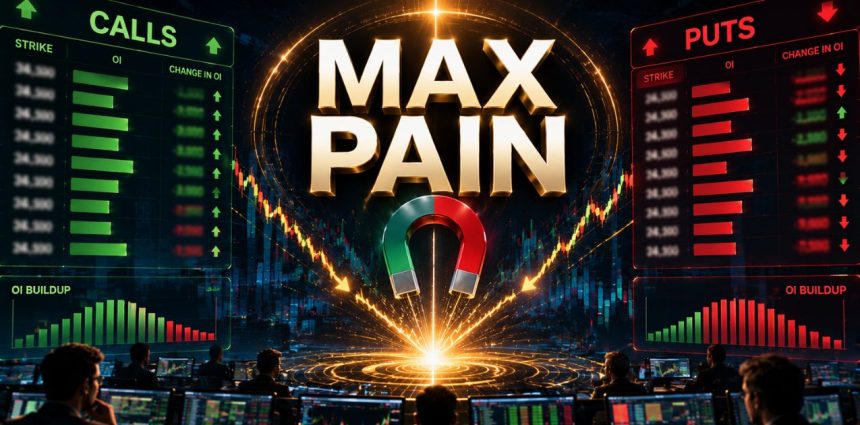
Every expiry day, traders watch the Nifty option chain for one number many believe pulls the market: the max pain level. Here is how it works, what it predicts, and where its limits are.
Key Takeaways
- Max pain is the strike where option buyers collectively lose the most at expiry, equivalently, the level where option writers pay out the least.
- It is calculated by finding the strike that minimises the total in-the-money value across all open call and put contracts.
- Large writers and market makers are theoretically incentivised to see the index settle near this level.
- It matters most in the final 30–60 minutes before NSE weekly and monthly expiry, when gamma exposure peaks.
- It is a reference zone, not a guarantee; read it alongside open-interest analysis, PCR, India VIX, and price action.
Track live Nifty and Bank Nifty max pain on NiftyTrader’s Option Chain tool
What Is Max Pain in Options Trading?
Max pain, also called maximum pain or the max pain point, is the strike price at which the total intrinsic value of all outstanding options is at its lowest. Because every rupee an option buyer gains is a rupee an option writer loses, the max pain price is simultaneously the level of maximum financial pain for buyers and minimum payout for sellers.
The term was popularised in US markets and has since become a closely tracked data point on NSE, particularly around weekly and monthly expiry for Nifty 50 and Bank Nifty.
The theory rests on one logical premise: large participants who have written substantial quantities of options, banks, brokerages, and funds, have a financial incentive to see expiry occur near the level where the most premium is retained.
Proponents argue these well-capitalised writers have enough hedging capability to influence where the index settles, at least in the final hour.
Keep one thing straight from the start: max pain is a derived, descriptive number. It reflects how the market is currently positioned. On its own it does not cause anything, it maps where the most money is parked.
How Is Max Pain Calculated?
For every potential expiry settlement price, you work out how much money option writers would have to pay out:
- A call at a strike below the settlement price is in-the-money and costs writers
(Settlement − Strike) × Call Open Interest. - A put at a strike above the settlement price is in-the-money and costs writers
(Strike − Settlement) × Put Open Interest.
Add up that total payout at every candidate level. The price with the lowest total payout is the max pain price. (Minimising what writers pay out is the same as maximising the number of contracts that expire worthless.)
Illustrative example. Suppose a few sessions before a Nifty weekly expiry, open interest looks like this:
| Strike | Call OI (lots) | Put OI (lots) |
|---|---|---|
| 24,800 | 10,000 | 50,000 |
| 24,900 | 20,000 | 35,000 |
| 25,000 | 30,000 | 30,000 |
| 25,100 | 45,000 | 18,000 |
| 25,200 | 70,000 | 8,000 |
Test each level by summing the payout writers owe if the index settles there. At 25,000, the in-the-money calls (24,800 and 24,900) plus the in-the-money puts (25,100 and 25,200) leave writers owing the equivalent of about 7.4 million point-lots.
Run the same exercise at the wings and the bill balloons, roughly 18 million at 24,800 and over 20 million at 25,200. Because the total payout bottoms out at 25,000, that strike is the max pain for this chain.
The intuition is simple: max pain sits where the big call wall above and the big put wall below roughly balance. In live markets this runs across dozens of strikes at once, which is why platforms like NiftyTrader compute and display it in real time.
Why Does the Market Sometimes Move Toward Max Pain?
This is the central and most debated question around the concept. There are two schools of thought.
The institutional gravity theory holds that large writers with significant short positions across multiple strikes use delta hedging and spot activity near expiry to nudge the index toward max pain. As expiry approaches and gamma exposure peaks, market makers who are short near-the-money options must hedge dynamically, selling into rallies and buying into dips around heavily-traded strikes. Even moderate directional flow can then pin the index near a big strike.
The statistical convergence theory is more measured. It argues that max pain is not deliberate manipulation but a natural reflection of where the heaviest open interest sits. Large OI on both sides of a strike creates resistance and support simultaneously, making it mechanically difficult for the index to break decisively either way near expiry. The market drifts toward equilibrium, and max pain happens to sit at that equilibrium.
The reality likely blends both forces, which is why the concept has practical value even for traders who stay agnostic about manipulation.
Max Pain vs Put-Call Ratio (PCR): How They Differ
Both are derived from option chain data, but they measure different things and should not be confused.
| Parameter | Max Pain | Put-Call Ratio (PCR) |
|---|---|---|
| What it measures | Strike where buyers lose the most. | Ratio of put OI to call OI |
| Primary use | Expiry-level reference | Sentiment gauge |
| Data source | All strikes combined | All strikes or specific strikes |
| Best timeframe | Expiry day, final hour | Any day, intraday or swing |
| Interpretation | The index may drift here near the close. | As a rough rule of thumb, PCR above ~1.2 leans bullish; below ~0.8 bearish (readings are debated and context-dependent) |
Used together, they give a fuller picture. If the PCR is firmly bullish (heavy put writing) and max pain sits above the current index level, sentiment and expiry gravity are pointing the same way.
Track Live: Nifty PCR Today Live Chart – Put Call Ratio (OI & Change OI)
When Is Max Pain Most Relevant?
Max pain is not a tool for every session. Its relevance is highest under specific conditions.
On weekly expiry day. Nifty 50 weekly options now expire every Tuesday (the NSE moved the weekly expiry from Thursday to Tuesday with effect from 1 September 2025, after SEBI directed exchanges to spread expiries across the week). The closer the session gets to 3:20–3:30 PM IST, the more the max pain level acts as a magnetic reference, as institutional hedging compresses volatility into the close.
As the session matures. Time value collapses rapidly through expiry day, so the delta and gamma of near-the-money options shift sharply after midday, and the tug-of-war between call and put writers becomes most visible in the index.
When India VIX is low. In high-volatility regimes, external events override the gravitational pull. When VIX is subdued, typically below ~14, the index is more likely to respect max pain because fewer macro shocks disrupt the OI equilibrium.
When max pain is close to the spot. If Nifty is at 24,350 and max pain is 24,400, a drift toward that level is far more plausible than if max pain is 500 points away.
Practical Ways Traders Use Max Pain on NSE
Option sellers (premium writers). Traders who short straddles or strangles use max pain to validate a position, if it aligns with their short strike, conviction on holding through expiry rises.
Expiry-day positional traders. Some take directional trades in the final hour targeting the max pain strike, with tight stops, betting on the magnetic pull. Distance matters: the nearer the spot already is, the better the odds; when max pain is far away, do not assume the index will snap back.
Portfolio hedgers. Fund managers running index-put hedges use max pain to assess whether a hedge is likely to expire in- or out-of-the-money.
Weekly vs. monthly. Bank Nifty no longer has weekly options, NSE discontinued them in November 2024, leaving only monthly Bank Nifty contracts that expire on the last Tuesday of the month.
The monthly Nifty contract also settles on the last Tuesday. Because monthly OI build-up is larger and institutional interest higher, monthly max pain typically carries more weight than weekly. Also track how the level moves: a max pain that climbs across sessions hints writers are repositioning higher.
The Limitations of Max Pain Theory
Max pain is not infallible, and several situations routinely cause the index to ignore it entirely.
Global triggers override local OI. A sharp move in US futures, a surprise Fed statement, or a domestic event such as RBI policy or the Union Budget can push Nifty decisively away from max pain regardless of positioning.
Max pain shifts intraday. Because OI changes as traders close or roll positions, the max pain strike itself moves — a level valid at 9:30 AM can shift 50–100 points by noon. Tracking it in real time is essential.
Correlation is not causation. Academic evidence for “pinning” is mixed and strongest for individual stocks with concentrated OI, weaker for liquid indices. Sometimes the index simply finishes near max pain because OI had clustered around where it was already trading.
Low-liquidity distortions. In thin far-month contracts, a few large trades can skew the calculation, making the level less reliable.
It is a zone, not a stop. Treating max pain as an exact target is a common retail error. Read it as a band, typically ±50 to ±100 points around the calculated level for Nifty, not a precise strike.
How to Track Max Pain on NiftyTrader
NiftyTrader’s live Option Chain displays the max pain level in real time for Nifty 50, Bank Nifty, and major sectoral indices. You can see the pain distribution across all strikes visually, watch how the level shifts through the day, and compare it against the current spot and PCR to build an expiry-day view.
Check today’s Nifty max pain on NiftyTrader’s Option Chain
Bottom Line: Should You Trade Max Pain?
Max pain is one of the more intellectually grounded ideas in derivatives analysis because it is rooted in the actual monetary incentives of market participants.
It requires no belief in conspiracy, only the observation that large option sellers have a stake in where expiry settles, and that stake is visible in public OI data.
Used alone, it is incomplete. Used inside a structured expiry-day framework, alongside OI analysis, PCR, India VIX, and price action, it is a consistently useful reference that every F&O trader should understand and track.
Frequently Asked Questions
Does Nifty always close at max pain on expiry?
No. It often closes near the max pain zone on calm expirations, but trends, events, and large directional flows regularly push the close well away from it.
Is max pain the same as the highest open-interest strike?
Not exactly. The highest-OI call and put strikes are inputs, but max pain is the single level that minimises total writer payout across all strikes, usually between the big call wall and the big put wall.
When is max pain most useful?
In the last day or two before expiry, when gamma is high and positioning is largely set, and especially when spot is already near the level.
Can retail traders rely on max pain alone?
No. It is one input among several, pair it with OI change, PCR, India VIX, and price action.
This article is for educational purposes only and does not constitute investment advice. Options trading involves significant risk. Please consult a SEBI-registered adviser before trading in F&O instruments.