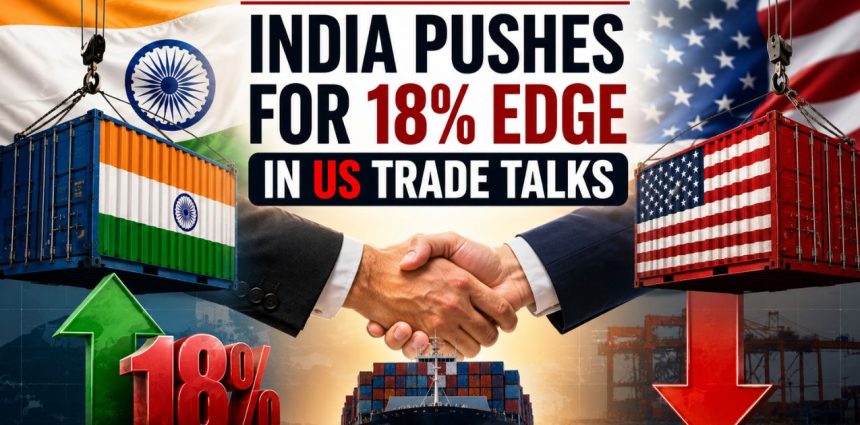
With $140 billion in bilateral trade at stake and a hard July 24 deadline, India and the US are in the final stretch of a trade agreement that will determine the price competitiveness of Indian exports for years ahead.
KEY TAKEAWAYS
- USTR Jamieson Greer is in New Delhi this week for two-day BTA talks with Commerce Minister Piyush Goyal
- India is pushing to lock in an 18% tariff rate on goods exported to the US, lower than Vietnam’s 20%+ and Bangladesh’s 20%+
- July 24 is the hard deadline: the US temporary 10% tariff expires that day and Section 301 rates could replace it
- India’s US imports surged 15.95% to $52.9 billion in FY26, narrowing the trade surplus to $34.41 billion, a negotiating card New Delhi is using
- Section 301 forced labour probe proposes an additional 12.5% tariff on India; hearing submissions closed June 22
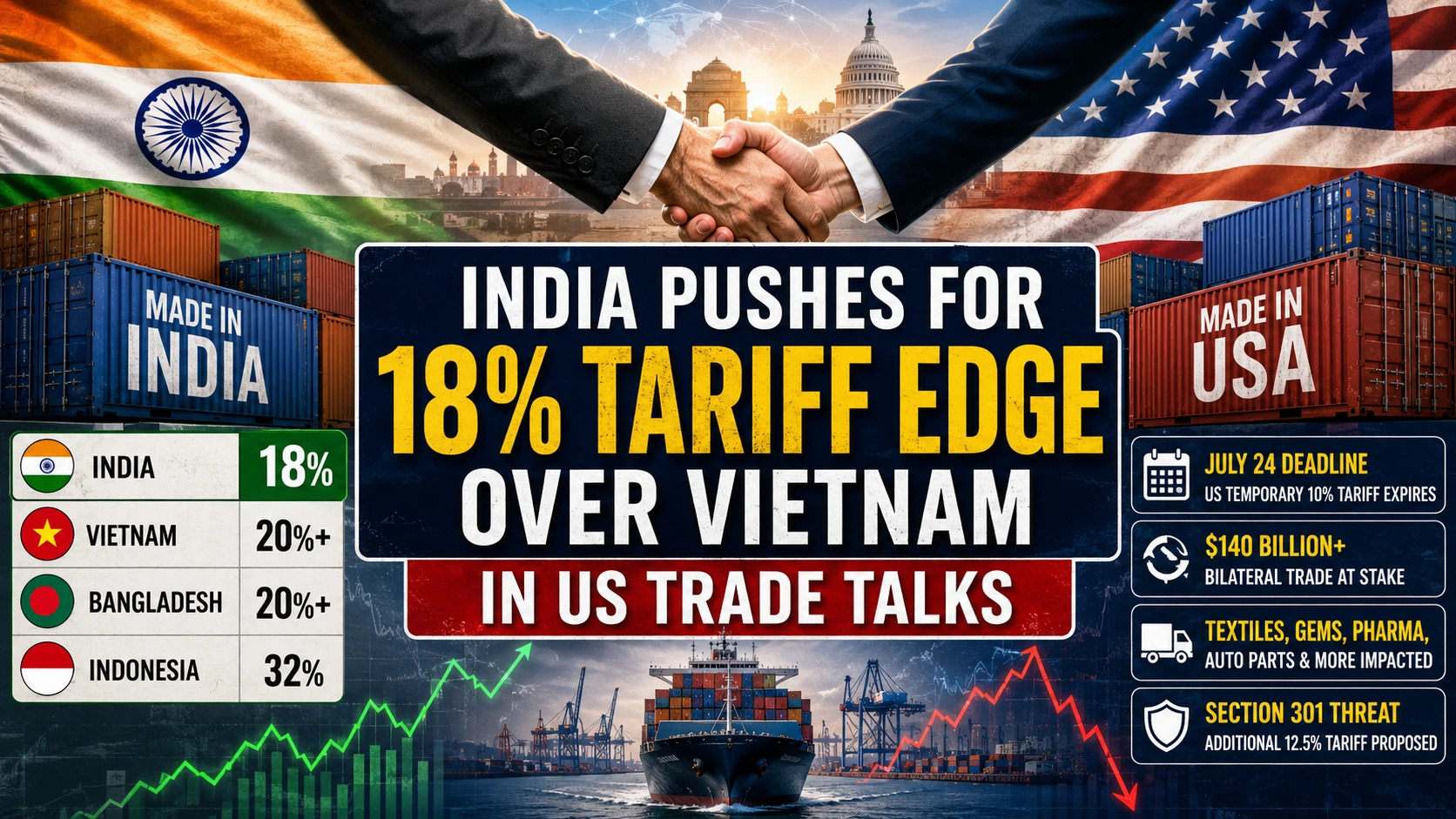
US Trade Representative Jamieson Greer arrived in New Delhi on Monday for two days of ministerial-level trade talks, with India pushing to finalise a Bilateral Trade Agreement (BTA) that locks in an 18% tariff on Indian goods, lower than rates applied to Vietnam and Bangladesh, before the US temporary tariff regime expires on July 24.
Greer is meeting Commerce and Industry Minister Piyush Goyal to discuss the interim trade deal agreed to by Prime Minister Narendra Modi and President Donald Trump in February, according to a statement from the Office of the US Trade Representative issued on Sunday.
The talks follow chief negotiator discussions held in New Delhi from June 2–4 and come with bilateral trade between the two countries now exceeding $140 billion.
Why the 18% Number Matters So Much
When the BTA framework was first agreed upon, India held a tariff advantage over ASEAN nations including Vietnam, Indonesia, Thailand, Malaysia, Sri Lanka, Pakistan, and Bangladesh, with the US announcing an 18% tariff on Indian goods. That edge is precisely what New Delhi is trying to preserve and legally protect in the final text.
The trade arithmetic is concrete. If an Indian shirt and a Vietnamese shirt are both priced at $100 before duties, the Indian product costs $118 in the US market after the 18% tariff, versus $120 for the Vietnamese equivalent.
That two-dollar gap can meaningfully shift purchasing decisions for American importers buying millions of units at scale.
Commerce Minister Piyush Goyal said Monday that India is working with Washington to ensure exporters retain that edge. “The faster, the better,” he said on whether a deal could be done by July 24.
Tariff Comparison: India vs. Competing Exporters
| Country | US Tariff Under BTA Framework | Key Competing Sectors |
|---|---|---|
| India | 18% (target) | Textiles, pharma, gems, leather, auto parts |
| Vietnam | 20%+ | Textiles, apparel, electronics |
| Bangladesh | 20%+ | Garments, readymade apparel |
| Indonesia | 32% | Textiles, palm oil, rubber |
| China | 145%+ | Electronics, machinery, chemicals |
Source: USTR, White House Joint Statement February 2026, Daily Excelsior
What Collapsed the February Deal — And What’s Being Rebuilt
In February, both sides agreed to bring US tariffs on Indian goods down to 18% from 50%, with India committing to lower trade barriers and purchase American energy, aircraft, and technology. But the deal was derailed when the US Supreme Court struck down Trump’s sweeping global tariff architecture on February 20.
Following that ruling, Trump reimposed a flat 10% reciprocal tariff on all trading partners for 150 days, the regime now set to expire on July 24. That is the window both sides are working within.
India has proposed eliminating or reducing tariffs on all US industrial goods and a wide range of agricultural products, including dried distillers’ grains, red sorghum, tree nuts, fresh and processed fruit, soybean oil, wine, and spirits. India has also committed to purchasing $500 billion worth of US energy products, aircraft, precious metals, technology goods, and coking coal over the next five years.
Sectors With the Most at Stake
Over 30% of India’s exports in textiles and apparel, pharmaceuticals, smartphones, gems and jewellery, and marine products are directed to the US, which amplifies the impact of how the final tariff rate is structured.
| Sector | India’s US Export Value (FY26) | Tariff Status | Risk Level |
|---|---|---|---|
| Pharmaceuticals | ~$12.7 billion | Largely exempt | Low–Medium |
| Textiles & Apparel | ~$15.5 billion | 18% (if BTA signed) | High |
| Gems & Jewellery | ~$10 billion | 18% (exemptions if BTA signed) | Medium |
| Electronics/Smartphones | Part of $87.3bn total | Exempt (for now) | Medium |
| Auto Components | ~$2.5 billion | Subject to Section 232 | High |
Source: KPMG India Tariff Impact Report, PineBridge Investments, White House Joint Statement
Textiles, leather, and gems & jewellery have seen some exporters report up to 50% declines in turnover during the period of tariff uncertainty, with many redirecting shipments to European and Gulf markets or offering deep discounts to retain US buyers. A signed deal at 18% directly reverses that pressure.
The Trade Surplus Story No One Is Telling Properly
Here is the number that gives India negotiating leverage, and explains why Washington is willing to deal.
India’s exports to the US in FY26 stood at $87.31 billion, a marginal rise from $86.51 billion the previous year. But imports from the US jumped sharply to $52.90 billion from $45.63 billion — a 15.95% surge. As a result, India’s trade surplus with the US declined to $34.41 billion in FY26, down from $40.88 billion in FY25.
Commerce Secretary Rajesh Agrawal attributed part of the export slowdown to the Middle East crisis, noting that India’s exports to the region fell 57.95% in March 2026 alone, a drop of $3.5 billion in a single month.
The surplus narrowing is not a sign of weakness. It is a signal to Washington that India is already absorbing more American goods, a fact that strengthens New Delhi’s case for a lower tariff rate in return. That context is absent from most coverage of these talks.
The Section 301 Problem: A Live Threat on the Same Day
In March, the USTR launched two separate Section 301 investigations against India and several other countries, one targeting excess industrial capacity, the other addressing failures to eliminate forced labour from global supply chains.
On June 2, the USTR proposed imposing an additional 12.5% tariff on 54 countries, including India, under the forced labour probe. June 22, today, was the deadline for parties to submit hearing appearance requests.
The proposal is not yet finalised. But if Section 301 rates are imposed on top of whatever emerges after July 24, India’s effective tariff burden could exceed the 18% framework entirely.
Commerce Secretary Agrawal confirmed that a finalised BTA would address broader trade concerns including the 301 investigations, providing clarity that the current bilateral uncertainty cannot.
India has also sought written assurances from Washington that no new tariffs will be layered onto the agreed rate after the deal is signed. That clause is reportedly still being negotiated.
What Happens on July 24 — Two Scenarios
| Scenario | Outcome for Indian Exporters |
|---|---|
| BTA Phase 1 signed before July 24 | 18% tariff locked in; Section 301 addressed within deal framework; textiles, gems, leather gain price edge over Vietnam and Bangladesh |
| Talks stall past July 24 | 10% temporary tariff expires; Section 301 rates of 12.5% could apply; effective tariff burden may exceed 20%, eliminating India’s competitive edge |
Source: USTR filings, White House Joint Statement, Ministry of Commerce data
Section 301 is currently the only legal mechanism through which the US can impose new tariffs of any magnitude after the temporary regime expires, making the outcome of these investigations directly tied to the July 24 deadline.
Trump said at the G7 in France last week that India and the US are “very close” to finalising the deal, calling Modi a “tough negotiator.” Goyal has echoed that both sides are working to close remaining gaps, with mid-July as the target.
The next trigger to watch: whether Greer’s two-day visit produces a joint statement on June 24 or whether talks are extended into a third round, which would compress the timeline to under three weeks before July 24.
Track FII/DII activity and sector-level flows live on NiftyTrader’s FII-DII Tracker. For options positioning ahead of macro events, use the Option Chain tool.
Disclaimer: This article is for informational purposes only and does not constitute investment advice. Securities markets are subject to risks. Please consult a SEBI-registered investment advisor before making financial decisions. NiftyTrader is not responsible for trading losses incurred based on this content.