
Domestic Flows Push India Cash Market to Rs.1.35L Cr Despite FPI Exit
Indian equities witnessed a sharp correction in early 2026, but domestic flows helped the cash market remain resilient despite significant foreign investor selling.
Data showed that average daily turnover (ADT) in the cash market increased from ₹1.02 lakh crore in December 2025 to ₹1.35 lakh crore in March 2026, even as benchmark indices corrected nearly 15%.
The trend highlights the growing role of domestic flows in supporting India’s equity market during periods of volatility.
Domestic Flows Offset Heavy FPI Selling
Foreign Portfolio Investors (FPIs) withdrew nearly ₹1.3 lakh crore from Indian equities during the first three months of 2026.
However, domestic mutual funds absorbed much of the selling pressure by investing approximately ₹1.5 lakh crore during the same period.
Strong domestic flows were supported by steady Systematic Investment Plan (SIP) contributions, providing mutual funds with consistent liquidity even during the market correction.
This helped prevent a sharp decline in cash market activity despite persistent foreign outflows.
Read More : Sensex Falls 607 Points, Nifty Drops 155 on Friday as IT Selloff Wipes Weekly Gains
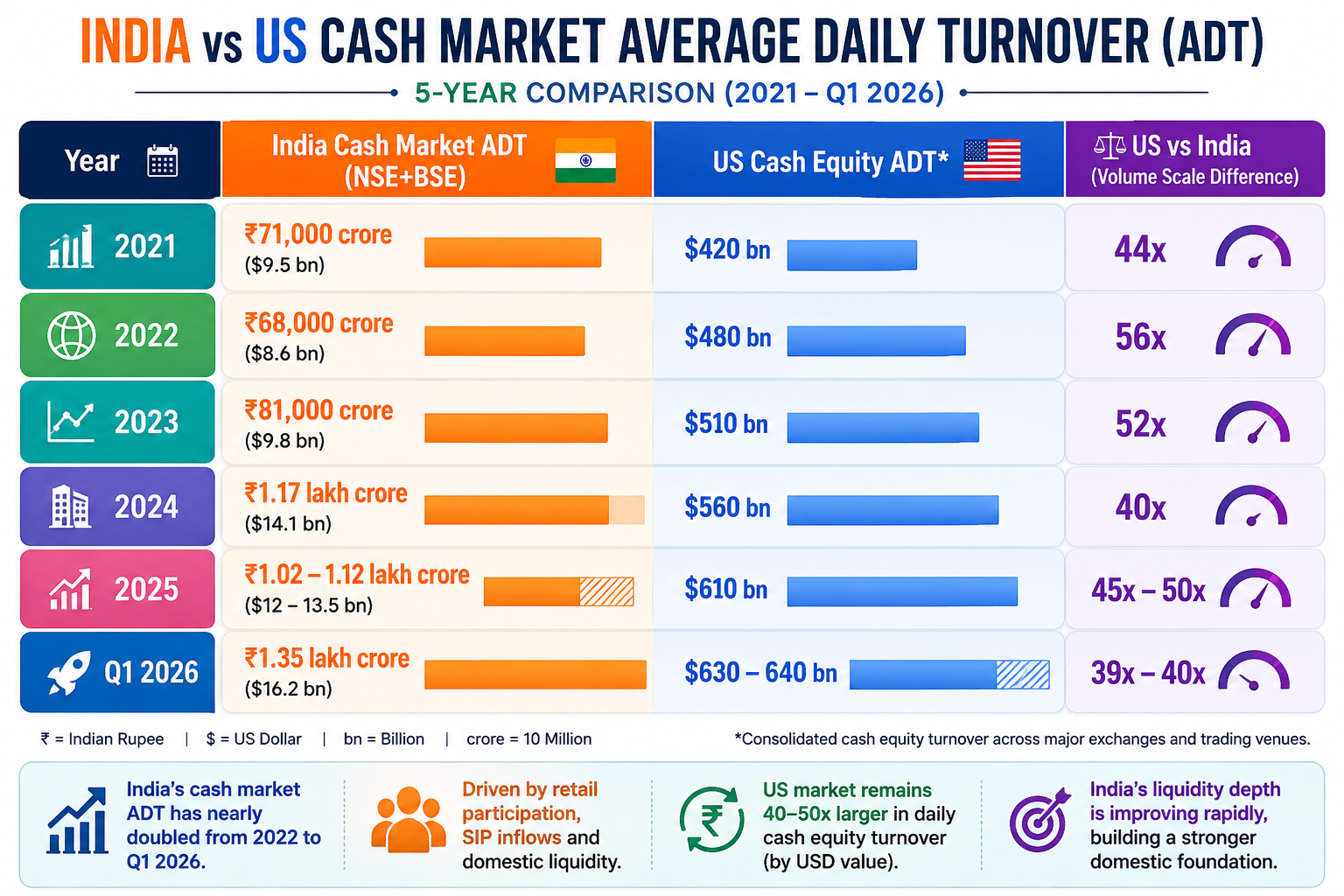
India vs US: 5-Year Average Daily Turnover (Cash Equity Market)
For investors, the key takeaway is not that India is close to matching the US in absolute trading value—it is not. The real story is that India’s cash market turnover has expanded much faster than most major markets, driven by retail participation, SIP flows, and growing domestic institutional activity.
| Year | India Cash Market ADT (NSE+BSE) | US Cash Equity ADT* | US vs India |
|---|---|---|---|
| 2021 | ₹71,000 crore ($9.5 bn) | $420 bn | 44x |
| 2022 | ₹68,000 crore ($8.6 bn) | $480 bn | 56x |
| 2023 | ₹81,000 crore ($9.8 bn) | $510 bn | 52x |
| 2024 | ₹1.17 lakh crore ($14.1 bn) | $560 bn | 40x |
| 2025 | ₹1.02–1.12 lakh crore ($12–13.5 bn) | $610 bn | 45x–50x |
| Q1 2026 | ₹1.35 lakh crore ($16.2 bn) | $630–640 bn | 39x–40x |
Cash Market Turnover Increased During Market Weakness
The rise in cash market turnover stood out because trading activity typically declines during major market corrections.
Instead, the average daily turnover climbed steadily as domestic investors remained active buyers.
Market participants noted that similar resilience in trading activity was last observed during the Covid-led market crash.
The latest data suggests that domestic flows are increasingly influencing market liquidity and trading volumes.
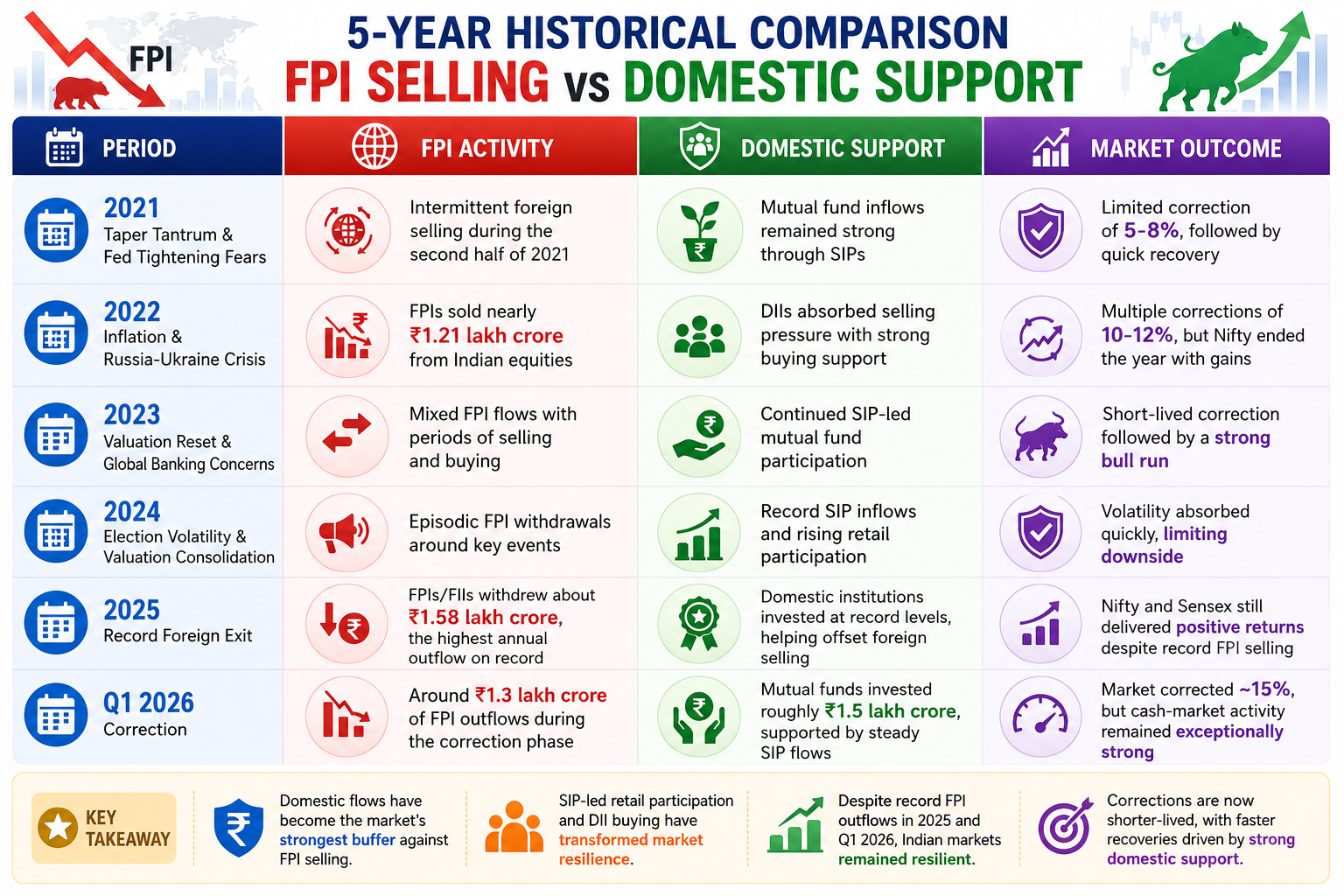
5-Year Historical Comparison: FPI Selling vs Domestic Support
| Period | FPI Activity | Domestic Support | Market Outcome |
|---|---|---|---|
| 2021 Taper Tantrum & Fed Tightening Fears | Intermittent foreign selling during the second half of 2021 | Mutual fund inflows remained strong through SIPs | Limited correction of 5-8%, followed by quick recovery |
| 2022 Inflation & Russia-Ukraine Crisis | FPIs sold nearly ₹1.21 lakh crore from Indian equities | DIIs absorbed selling pressure with strong buying support | Multiple corrections of 10-12%, but Nifty ended the year with gains |
| 2023 Valuation Reset & Global Banking Concerns | Mixed FPI flows with periods of selling and buying | Continued SIP-led mutual fund participation | Short-lived correction followed by a strong bull run |
| 2024 Election Volatility & Valuation Consolidation | Episodic FPI withdrawals around key events | Record SIP inflows and rising retail participation | Volatility absorbed quickly, limiting downside |
| 2025 Record Foreign Exit | FPIs/FIIs withdrew about ₹1.58 lakh crore, the highest annual outflow on record | Domestic institutions invested at record levels, helping offset foreign selling | Nifty and Sensex still delivered positive returns despite record FPI selling |
| Q1 2026 Correction | Around ₹1.3 lakh crore of FPI outflows during the correction phase | Mutual funds invested roughly ₹1.5 lakh crore, supported by steady SIP flows | Market corrected 15%, but cash-market activity remained exceptionally strong |
Mutual Fund Inflows Strengthened Market Stability
Mutual fund inflows emerged as a key support for the stock market during the correction.
Regular SIP investments enabled fund managers to continue deploying capital even as market sentiment weakened.
A market participant said:
“Domestic flows have become an important pillar of market stability. Consistent mutual fund investments are helping absorb periods of foreign selling.”
The growing participation of domestic investors has reduced the market’s dependence on foreign capital compared with previous correction cycles.
What the Numbers Reveal
1. India’s Liquidity Is Growing Faster
India’s average daily cash-market turnover nearly doubled between 2022 and early 2026, rising from roughly ₹68,000 crore to ₹1.35 lakh crore. This growth has been fueled by rising retail participation and persistent mutual fund inflows.
2. The US Remains the Global Liquidity Hub
Even after India’s surge, the US cash equity market processes approximately 40–50 times more dollar value each day. A single high-volume session in mega-cap stocks such as Apple, Nvidia, Microsoft, or Amazon can rival the entire daily turnover of India’s cash market.
3. India’s Derivatives Market Tells a Different Story
The cash-market comparison understates India’s overall trading activity. India’s derivatives segment has expanded dramatically, with notional turnover running into hundreds of lakh crores daily, far exceeding cash-market volumes.
Historical Perspective for Investors
| Market Phase | India ADT Trend | Key Driver |
|---|---|---|
| 2021 Post-Covid Boom | Strong rise | Retail investing surge |
| 2022 Global Inflation Shock | Moderation | FPI selling pressure |
| 2023 Recovery Rally | Gradual increase | Return of domestic buying |
| 2024 Election Year | Record turnover | Retail and SIP participation |
| 2025 Consolidation | Slight slowdown | Valuation concerns, F&O regulations |
| Q1 2026 Correction | Sharp rebound in volumes | MFs absorbed FPI exits |
What Impacted the Market Today?
Several factors influenced market sentiment:
- Strong domestic flows into equities
- Mutual fund investments of around ₹1.5 lakh crore
- Steady SIP contributions
- Elevated cash market turnover
- Continued participation from retail investors
These factors helped offset the impact of heavy FPI selling during the quarter.
What Is the Impact on Investors?
For investors, the data highlights the growing importance of domestic flows in India’s equity market.
The ability of mutual funds to absorb foreign selling may help reduce volatility during future market corrections.
For traders, higher cash market turnover generally supports liquidity and efficient price discovery.
The trend also indicates that domestic institutional investors are playing a larger role in determining market direction.
Domestic Flows May Continue To Support Indian Equities
The first quarter of 2026 demonstrated how domestic flows can support market activity even during a sharp correction.
While FPIs sold nearly ₹1.3 lakh crore worth of equities, mutual funds invested around ₹1.5 lakh crore, helping maintain liquidity and trading activity.
If SIP inflows remain strong, domestic flows could continue to provide stability to the Indian stock market in the coming months.
The latest market data underscores a structural shift in Indian equities, where domestic investors are increasingly shaping market performance and supporting cash market resilience.