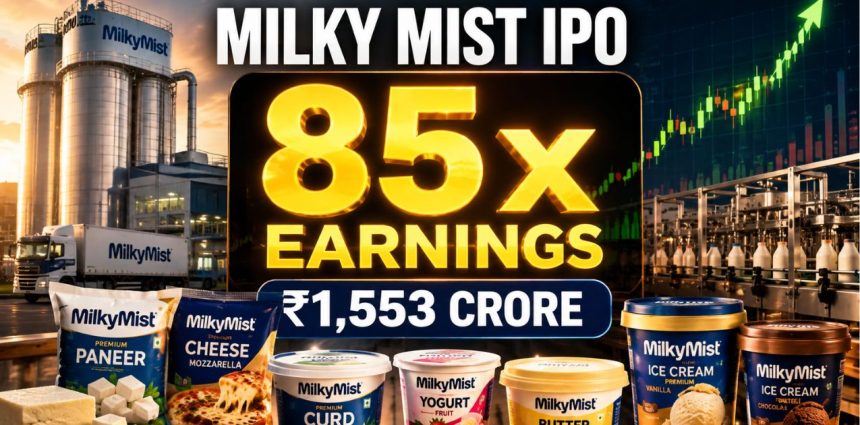
Milky Mist Dairy Food Ltd. has opened its ₹1,553-crore IPO for subscription on August 11, giving investors until August 13 to bid. The price band is fixed at ₹133–₹140 per share, with the issue comprising a ₹1,428-crore fresh issue and a ₹125-crore offer for sale. The shares are scheduled to list on the NSE and BSE on August 18.
But the bigger question is not whether Milky Mist is growing. It clearly is. Revenue rose 33.6% to ₹3,138.36 crore in FY26, while EBITDA increased 40.2% to ₹435.22 crore and profit after tax jumped 175.7% to ₹127.01 crore.
The catch is the price investors are being asked to pay for that growth. At the ₹140 upper band, Milky Mist is valued at about ₹10,778 crore, translating into roughly 84.8 times FY26 post-issue earnings.
That creates the central IPO debate: Can Milky Mist sustain its unusually fast earnings growth long enough to justify a valuation far above most listed dairy peers?
Milky Mist IPO: Key Details
| Particular | Details |
|---|---|
| IPO size | ₹1,553 crore |
| Fresh issue | ₹1,428 crore |
| Offer for sale | ₹125 crore |
| Price band | ₹133–₹140 |
| IPO dates | August 11–13, 2026 |
| Minimum lot | 107 shares |
| Minimum investment | ₹14,980 |
| QIB quota | 50% |
| NII quota | 15% |
| Retail quota | 35% |
| Expected listing | August 18, 2026 |
| Implied market cap at ₹140 | ~₹10,778 crore |
The company has also already raised ₹465.30 crore from anchor investors, including domestic mutual funds and other institutional investors, ahead of the public issue.
Check Live: Milky Mist Dairy Food IPO
The Real Milky Mist Story Is Not “Milk”
One important distinction separates Milky Mist from a conventional dairy company.
Milky Mist does not operate in the liquid-milk segment. Its business is focused on value-added dairy and packaged foods, including paneer, cheese, curd, yogurt, butter, ghee and ice cream.
That positioning matters because value-added dairy generally offers a different growth and margin opportunity from commodity liquid milk.
The company has built particularly strong positions in packaged paneer, cheese and yogurt. An IPO research note citing the RHP puts Milky Mist’s organised packaged-paneer market share at about 19%, South India’s organised cheese share at around 12%, and organised yogurt share at roughly 13%.
Its premium positioning is also reflected in pricing: paneer and curd are typically priced above average Indian brands, according to the same RHP-based analysis.
Why that matters
Milky Mist is therefore being presented to the market less as a traditional dairy commodity play and more as a branded value-added food company.
That is potentially attractive.
But it also helps explain why the IPO valuation is demanding.
FY26 Financials: The Numbers Look Impressive
Milky Mist’s consolidated financial performance has accelerated sharply.
| Financial metric | FY24 | FY25 | FY26 |
|---|---|---|---|
| Revenue | ₹1,821.61 cr | ₹2,349.50 cr | ₹3,138.36 cr |
| EBITDA | ₹222.33 cr | ₹310.35 cr | ₹435.22 cr |
| EBITDA margin | 12.21% | 13.21% | 13.87% |
| PAT | ₹19.44 cr | ₹46.07 cr | ₹127.01 cr |
| PAT margin | 1.07% | 1.96% | 4.05% |
| Total borrowings | ₹1,036.72 cr | ₹1,376.38 cr | ₹1,671.85 cr |
The RHP-based IPO analysis puts FY24–FY26 revenue CAGR at 31.26%, while EBITDA margin improved from 12.21% to 13.87%.
The standout number is PAT
Revenue increased 33.6% in FY26.
EBITDA increased about 40%.
But PAT jumped almost 176%.
That is a major improvement in profitability and is one of the strongest arguments in favour of the IPO.
However, investors should not automatically extrapolate that 176% growth rate. The comparison starts from a relatively low FY25 profit base, and the IPO valuation already reflects a substantial amount of future growth.
Check Live: IPO Calendar Watch 2026 – Check Mainboard & SME IPO Updates
The Valuation Problem: 85 Times Earnings
At ₹140, the implied post-issue market capitalisation is around ₹10,778 crore.
Based on FY26 post-issue EPS of about ₹1.65, the IPO is priced at approximately 84.84 times earnings.
That is where the expectation gap becomes significant.
Milky Mist’s business is growing faster than several established listed dairy companies. But investors are also paying a much higher multiple for that growth.
A current Value Research comparison puts Milky Mist at roughly 84.9x FY26 earnings, versus about 23.6x for Dodla Dairy, 56.9x for Hatsun Agro and 21.5x for Parag Milk Foods.
In simple terms:
The business is growing fast.
The market is already pricing in more growth.
Therefore, merely delivering another strong year may not be enough. Milky Mist may need to deliver strong growth plus margin expansion plus better capital efficiency to make the current valuation look reasonable over time.
Debt Is the Other Side of the Growth Story
This is where the IPO becomes more complicated.
Milky Mist’s total borrowings rose from about ₹1,036.7 crore in FY24 to ₹1,671.9 crore in FY26. Its FY26 debt-to-equity ratio stood at about 3.61x.
That does not automatically make the IPO unattractive.
In fact, part of the fresh issue proceeds will be used to repay or prepay outstanding borrowings. Other proceeds will fund expansion and modernisation of the Perundurai manufacturing facility and the deployment of refrigeration equipment.
So the IPO has a dual role:
fund expansion + strengthen the balance sheet.
That is positive.
But it also means investors should monitor whether future growth becomes less dependent on debt-funded capital expenditure.
Cash Flow Is a Key Test After Listing
The earnings numbers look considerably better than the cash-generation picture.
Operating cash flow remained positive, but the company has been investing heavily in plant and equipment. Value Research notes that capital expenditure exceeded operating cash flow in each of the last three years, resulting in negative free cash flow over that period.
This creates an important forward-looking test.
Investors should watch three things after listing:
- Does operating cash flow catch up with reported profit?
- Can the company fund expansion without repeatedly increasing leverage?
- Does ROCE rise meaningfully as the new capacity starts contributing?
If the answer is yes, today’s premium valuation could become easier to defend.
If not, the market may eventually question whether revenue growth is translating efficiently into shareholder returns.
South India Still Drives the Business — But the Mix Is Improving
Milky Mist generated about 69.23% of FY26 revenue from South India, down from 73.68% in FY24.
At first glance, that concentration is a risk.
But the underlying trend is more encouraging.
Revenue from the rest of India grew at a 40.88% CAGR between FY24 and FY26, compared with a 27.23% CAGR for South India. Exports also grew at a 49.02% CAGR, although from a much smaller base.
So the better interpretation is:
Milky Mist remains heavily exposed to South India, but its geographic diversification is moving in the right direction.
That is precisely the execution story investors need to watch after the IPO.
What the IPO Money Will Fund
The ₹1,428-crore fresh issue will be used primarily for:
- repayment/prepayment of certain borrowings;
- expansion and modernisation of the Perundurai manufacturing facility;
- deployment of visi coolers, ice cream freezers and chocolate coolers;
- general corporate purposes.
The company plans to expand its value-added dairy manufacturing capabilities, including areas such as whey protein concentrate, yogurt and cream cheese.
This creates a potential second leg of growth, but it also increases execution requirements.
New capacity only creates shareholder value if utilisation rises fast enough to cover the capital invested.
Milky Mist IPO GMP: Positive, But Don’t Confuse It With Valuation
As of 10:00 AM on August 11, Milky Mist’s reported GMP was ₹20.50. Against the ₹140 upper price band, that implied a notional grey-market price of ₹160.50, or around a 14.6% premium.
But GMP is unofficial and can change quickly.
More importantly, a positive GMP does not solve the valuation question.
It tells us about current grey-market sentiment.
It does not tell us whether an 84.8x earnings multiple will be sustainable over the next three to five years.
Also Check: IPO – Latest & Upcoming IPOs List 2026 | Check Live BSE NSE IPOs
Milky Mist IPO Subscription: Early Day-1 Signal
At 10:19 AM on August 11, the IPO was around 7% subscribed, according to the live subscription data available at that time.
The category-wise subscription was:
- QIB: 0.00x
- NII: 0.08x
- Retail: 0.10x
- Employee: 0.08x
This is an early Day-1 snapshot, not the final subscription outcome. Institutional bidding can also accelerate later in the issue window.
The anchor book of ₹465.30 crore provides an initial institutional participation signal, but the public issue still needs to demonstrate broader demand before the closing date.
Milky Mist IPO: Bull Case vs Bear Case
| Bull case | Bear case |
|---|---|
| 31%+ revenue CAGR | ~85x FY26 P/E |
| FY26 PAT jumped 176% | High leverage |
| Improving EBITDA margins | Negative free cash flow |
| Strong value-added dairy positioning | ~69% revenue from South India |
| Strong paneer/cheese/yogurt positions | Heavy dependence on Perundurai facility |
| Geographic diversification improving | Expansion requires execution |
| IPO proceeds reduce debt | High expectations already priced in |
What Investors Should Watch After Listing
The most important indicators will not be the GMP.
They will be:
1. Revenue growth
Can Milky Mist maintain something close to its historical 30% growth trajectory?
2. EBITDA margin
The margin has already improved from 12.21% to 13.87%. Further expansion would strengthen the valuation case.
3. Debt reduction
The IPO should provide balance-sheet relief. Investors should track whether borrowings actually decline.
4. Cash conversion
The biggest quality test is whether accounting profit increasingly converts into operating and free cash flow.
5. Non-South India growth
The company has already shown faster growth outside its home market. Maintaining that trajectory will be critical to the national-brand thesis.
6. Capacity utilisation
Expansion makes sense only if new capacity gets absorbed without dragging down returns.
Should You Apply for the Milky Mist IPO?
The answer depends on what you are paying for.
For investors looking for a high-growth value-added dairy and packaged-food business, Milky Mist has several compelling characteristics: rapid revenue growth, improving margins, strong category positions and a broadening distribution footprint.
But at the ₹140 upper band, investors are not buying an undiscovered growth story.
They are paying upfront for continued high growth, further margin improvement, debt reduction and successful national expansion.
That makes the IPO a growth-at-a-price proposition rather than a conventional value IPO.
Our view
Business quality: Positive
Growth visibility: Positive
Balance-sheet comfort: Needs improvement
Cash-flow quality: Key monitor
Valuation: Expensive
Execution risk: Moderate to high
The most important expectation gap is simple:
Milky Mist has already demonstrated that it can grow rapidly. The market now needs it to prove that it can convert that growth into sustainable cash returns at a valuation of nearly 85 times earnings.
That is the real IPO test.
Final Take
Milky Mist’s IPO has a genuine growth story behind it, but the ₹1,553-crore issue is not cheap.
FY26 revenue rose 33.6%, EBITDA climbed about 40% and PAT surged 175.7%. Yet borrowings reached ₹1,671.85 crore and the IPO values the company at roughly ₹10,778 crore at the upper band.
The expectation is therefore unusually high.
If revenue growth remains strong, margins continue expanding, debt falls and cash conversion improves, the premium valuation could gradually become easier to justify. If those improvements disappoint, the same valuation could become the stock’s biggest post-listing risk.
For investors, the Milky Mist story is less about whether the company can grow, and more about whether it can grow fast enough to catch up with the price already being demanded.
Read Next: Nvidia’s $500 Billion AI Plan: Why Wall Street Is Betting on Compute
FAQ
Is Milky Mist IPO open today?
Yes. The IPO opened on August 11 and closes on August 13, 2026.
What is the Milky Mist IPO price band?
The price band is ₹133–₹140 per share.
What is the Milky Mist IPO size?
The total issue size is ₹1,553 crore, comprising a ₹1,428-crore fresh issue and ₹125 crore OFS.
What is Milky Mist’s FY26 profit?
FY26 consolidated PAT was ₹127.01 crore.
Is Milky Mist a liquid-milk company?
No. It focuses on value-added dairy products such as paneer, cheese, curd, yogurt, butter, ghee and ice cream rather than liquid milk.
What is the Milky Mist IPO valuation?
At ₹140, the implied post-issue market capitalisation is around ₹10,778 crore and the issue is priced at about 84.8x FY26 post-issue earnings.
What is the key risk?
The biggest risks are the high valuation, leverage, cash-flow conversion, South India concentration and execution of the company’s expansion plans.
Disclaimer: This article is for informational purposes only and does not constitute investment advice or a recommendation to apply for the Milky Mist IPO. GMP and market estimates are unofficial and may change; investors should assess valuation, risks and financials independently before investing.