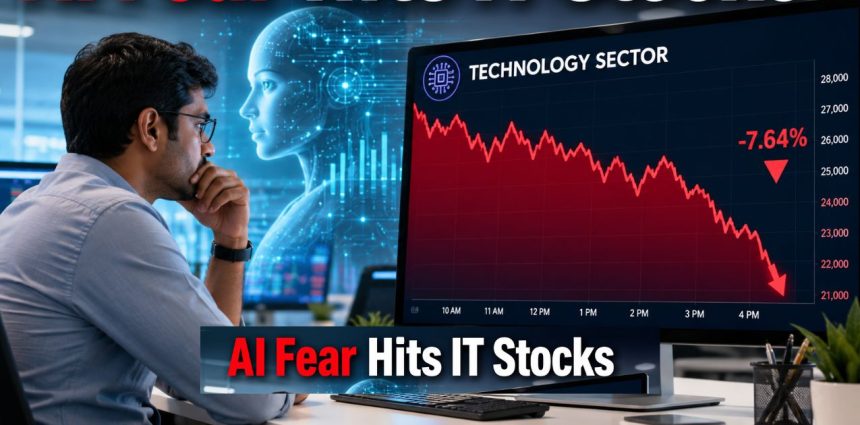
The selloff in Indian IT stocks is no longer just a one-day reaction. The Nifty IT index fell more than 2% on Tuesday to a fresh 52-week low of 26,425.85, with Infosys, TCS, Wipro, and LTIMindtree among the major losers. What makes the fall important today is not only the price damage but also the timing: investors are entering Q1 earnings season with doubts over US client spending, Federal Reserve policy, AI disruption, and weak global tech sentiment all hitting the sector together.
Key Takeaways
| Point | Why It Matters |
|---|---|
| Nifty IT hit a fresh 52-week low | Shows sector-wide pressure, not just stock-specific weakness |
| TCS, Infosys, Wipro fell over 2% | Large-cap IT is leading the decline |
| Fed uncertainty remains a risk | Higher rates can hurt US discretionary tech spending |
| Accenture’s outlook is a warning | Global IT demand is still selective and uneven |
| Q1 commentary matters most | Guidance may decide whether the sector stabilises or falls further |
Check Live: Nifty IT Sector — Live Performance, Stocks & Weightage
What Happened Today?
The Nifty IT index slipped more than 2% and touched 26,425.85, its fresh 52-week low. LTIMindtree fell around 3%, while Wipro, Infosys, and Tata Consultancy Services declined over 2% each. HCL Technologies also slipped around 2%, while Mphasis, Tech Mahindra, Coforge, and Persistent Systems traded with smaller losses.
This is not an isolated fall. Business Standard reported last week that the Nifty IT index had already dropped 13% in three weeks, even as the Nifty 50 gained around 2% during the same period. That gap tells investors something important: money is not simply leaving equities; it is rotating away from IT.
Why Are IT Stocks Falling?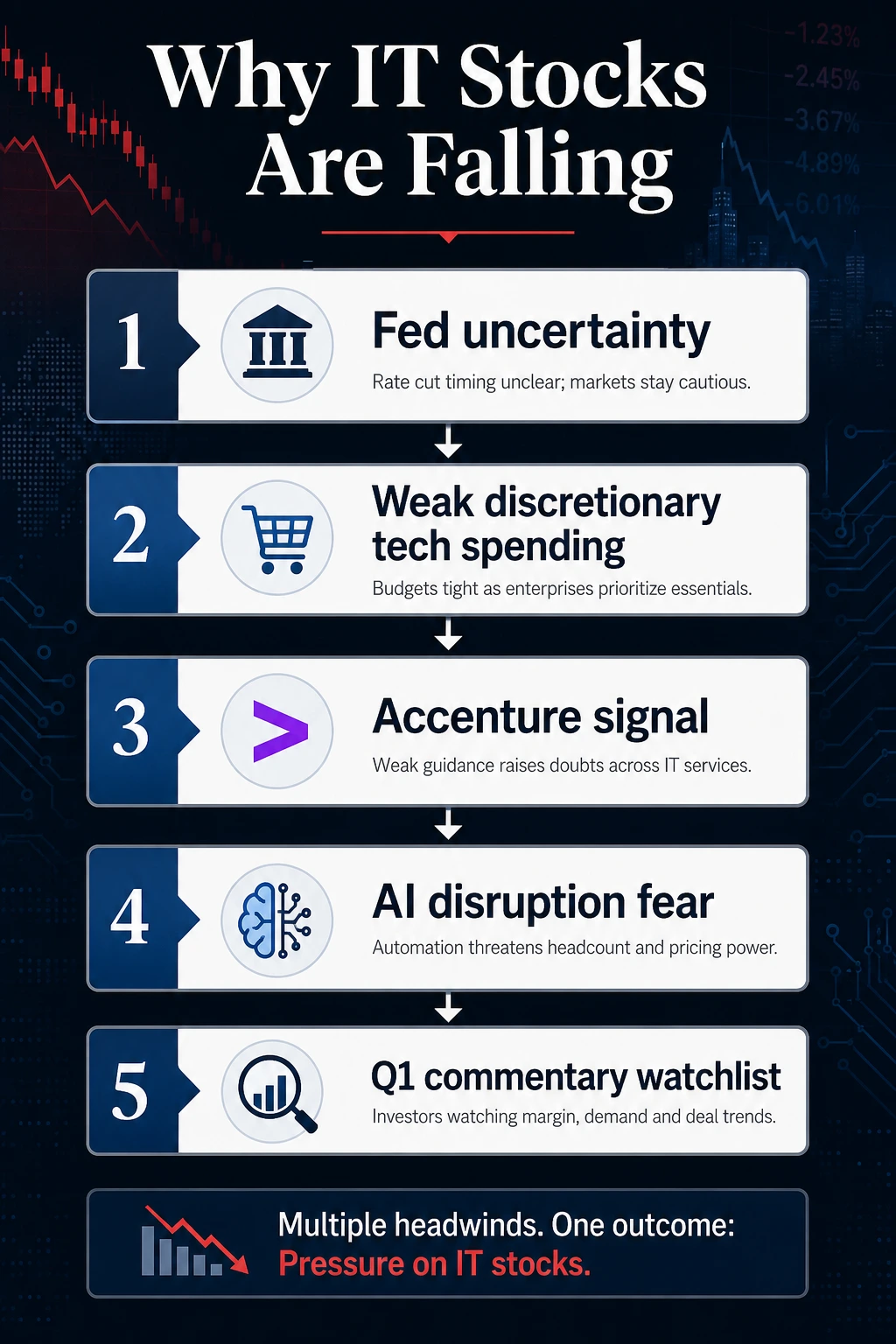
| Pressure Point | Impact On IT Stocks |
|---|---|
| US rate uncertainty | May reduce discretionary technology budgets |
| Inflation concerns | Keeps “higher-for-longer” rate risk alive |
| Weak client spending | Hurts consulting and digital transformation deals |
| AI disruption fear | Raises questions over long-term billing models |
| Q1 results ahead | Investors are cutting risk before management commentary |
The biggest issue is the US economy. Indian IT companies earn a large share of revenue from North America. When rates stay high, companies in banking, retail, telecom, and technology often delay non-essential digital projects. That hits discretionary IT services first.
The Federal Reserve kept rates unchanged in June, but it also said inflation remains elevated relative to its 2% goal. Reuters reported that Fed projections showed the policy rate could rise slightly by the end of 2026, while inflation expectations for the year were marked up to 3.6% from 2.7%.
For IT investors, that means one thing: the rate-cut comfort trade is not clean yet.
Accenture Has Made Investors More Nervous
Accenture’s recent numbers added to the pressure. The company reported Q3 FY26 revenue of $18.72 billion, up 3% in local currency, but new bookings fell 3% in local currency. Its Americas revenue grew only 1% in local currency, while the company now expects full-year FY26 revenue growth of 3% to 4% in local currency.
That does not mean Indian IT companies will report poor numbers. But Accenture is a key global signal for enterprise tech demand. If clients are still cautious on consulting, cloud migration, and transformation work, investors worry that Indian IT guidance may stay soft.
Why Q1 Results Matter More Than Usual
TCS will announce its April-June quarter results on July 9, effectively starting the Q1 earnings season for the IT pack. The market will watch revenue growth, margins, deal wins, and attrition, but the bigger trigger will be management commentary.
Investors want answers to three questions:
| Investor Question | Why It Matters |
|---|---|
| Are US clients spending again? | Determines revenue growth visibility |
| Are AI projects scaling or replacing work? | Impacts long-term business model |
| Are margins holding up? | Shows pricing power and cost control |
The last point is important. TCS had earlier said its annualised AI revenue crossed $2.3 billion in Q4, up from $1.8 billion in the previous quarter, and its order book stood at $12 billion. But Reuters also noted that some analysts still viewed AI revenue as small compared with TCS’s overall scale.
That is the sector’s real debate: AI may create new work, but it may also reduce traditional manpower-heavy billing.
Bull Case Vs. Bear Case
| Bull Case | Bear Case |
|---|---|
| Valuations may become attractive after sharp correction | Earnings downgrades may continue |
| Weak rupee can support reported revenue | US spending recovery may be delayed |
| AI, cybersecurity and cloud remain long-term growth areas | AI may compress traditional service pricing |
| Large deal wins may support revenue visibility | Q1 commentary may disappoint |
Stocks And Sectors Affected
The immediate impact is on large-cap IT stocks such as TCS, Infosys, Wipro, HCLTech, LTIMindtree, and Tech Mahindra. Mid-tier names including Persistent Systems, Coforge, and Mphasis may also remain volatile because they usually trade at richer valuations and are more sensitive to growth expectations.
Sectors linked to IT demand, BFSI, telecom, retail, manufacturing, healthcare, technology, and US federal spending will matter closely for company-specific commentary during the Q1 earnings season.
Check Live: TCS Option Chain (TCS) — Live OI, IV, Greeks & PCR
Risks
The key risk is that the current selloff shifts from sentiment-led to earnings-led. If Q1 results show weak deal conversion, slower project ramp-ups, margin pressure, or cautious FY27 guidance, the market may reset growth expectations again.
Other risks include elevated US inflation, a higher-for-longer Fed rate path, possible US rate hikes, geopolitical shocks, pressure on discretionary technology budgets, and faster-than-expected AI-led disruption in traditional IT services.
Opportunities
The opportunity is selective, not sector-wide. Large IT companies still have strong balance sheets, high cash generation, long client relationships, and dividend payout potential, which can make them attractive during deep corrections.
However, investors may prefer companies that show stronger deal wins, better cost control, clear AI execution, resilient margins, and higher exposure to non-discretionary technology spending.
What To Watch Next
Investors should watch TCS results on July 9, followed by Infosys, Wipro, HCLTech, and LTIMindtree management commentary. The key monitorables will be deal wins, client spending trends, AI-related revenue, margin outlook, and FY27 demand visibility.
Also track Accenture’s next demand signals, Fed rate expectations, rupee movement, large outsourcing deal announcements, and whether the Nifty IT index can reclaim key short-term resistance levels after holding its support zone.
Also Check: Wipro Option Chain (WIPRO) — Live OI, IV, Greeks & PCR
Bottom Line
The Nifty IT fall is not just about one weak trading session. It reflects a deeper reset in expectations around US spending, Fed policy, AI disruption, and earnings visibility. The sector may recover if Q1 commentary improves, but until then, investors should avoid treating every dip as automatically cheap.