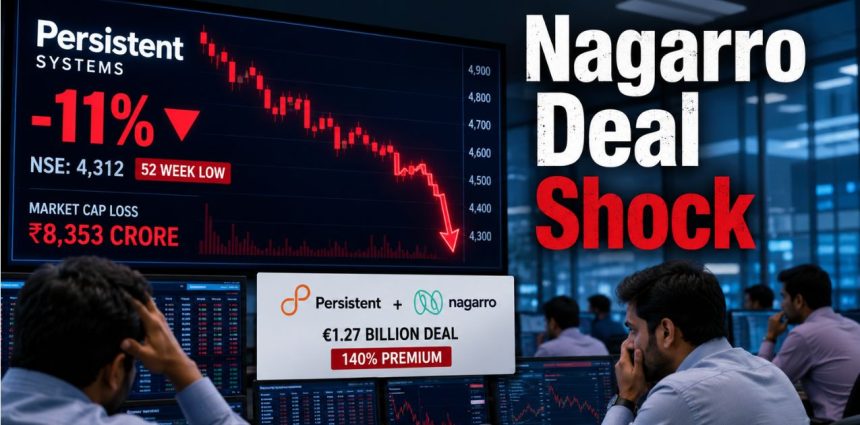
Persistent Systems shares suffered one of their sharpest falls in years on Monday after investors reacted nervously to the company’s plan to acquire Germany-based Nagarro SE in a large all-cash deal.
The stock fell nearly 11 percent, touched a fresh 52-week low of ₹4,312 on the NSE, and wiped out about ₹8,353 crore in market capitalisation, according to market reports.
The reason was not that the deal lacked strategic logic. In fact, on paper, the acquisition gives Persistent exactly what Indian IT companies have been chasing for years, scale in Europe, stronger digital engineering capabilities, a broader client base, and a larger global revenue platform.
The concern is different: investors are asking whether Persistent is paying too much, taking on too much execution risk, and risking near-term earnings dilution at a time when IT demand is already under pressure.
Persistent has announced a voluntary public takeover offer for all outstanding shares of Nagarro at €81 per share.
The offer is all-cash and values Nagarro at an enterprise value of about €1.27 billion, or roughly ₹13,667 crore.
The company has already secured about a 21 percent stake in Nagarro through a binding share purchase agreement with Lantano Beteiligungen GmbH, Nagarro’s largest shareholder.
The offer requires a minimum acceptance threshold of 50 percent plus one share and is expected to close in Q4 CY26 or Q1 CY27, subject to regulatory approvals.
Check Live: PERSISTENT SYSTEMS Share Price Chart: Live
Why the Market Reacted So Sharply
The biggest trigger was valuation. Persistent’s offer represents around a 140 percent premium to Nagarro’s undisturbed closing price on June 25, 2026, and around a 94 percent premium to its three-month volume-weighted average price.
Such a large premium immediately raised questions over return on investment, especially because global IT services companies are facing slower discretionary spending, AI-led pricing pressure, and margin uncertainty.
For shareholders, the worry is simple: Persistent is buying a large company, in cash, at a big premium, in a difficult demand cycle. That combination usually makes investors cautious, even when the long-term strategy is attractive.
| Key Deal Detail | What It Means |
|---|---|
| Offer price | €81 per Nagarro share |
| Deal value | Around €1.27 billion enterprise value |
| Premium | ~140% to June 25 closing price |
| Stake already secured | ~21% via binding agreement |
| Minimum acceptance | 50% plus one share |
| Expected closing | Q4 CY26 / Q1 CY27 |
| Combined scale | ~$2.9 billion annualised revenue |
| Combined workforce | 46,000+ employees |
Strategic Logic: Why Persistent Wants Nagarro
The acquisition could transform Persistent from a fast-growing mid-tier IT company into a much larger global digital engineering player. Nagarro brings a strong European presence, around 18,500 employees, operations across 40+ countries, and about €1 billion in revenue in CY25.
Persistent says the combined entity would have an annualised revenue run rate of nearly $2.9 billion, more than 46,000 employees, and a better balance across North America, Europe, and the rest of the world.
This matters because Persistent has historically had stronger exposure to North America. Nagarro helps it diversify geographically and adds depth in industrial, consumer, TMT, and BFSI verticals.
It also brings capabilities in ERP, customer experience, AI, cloud, and digital engineering, areas where large enterprises are still spending despite the broader slowdown.
Brokerage View: Good Strategy, Tough Execution
Brokerages were not dismissing the deal outright. Most agreed that the acquisition improves Persistent’s long-term scale and European footprint. But they also highlighted near-term risks.
Nomura said the transaction aligns with Persistent’s ambition to reach $5 billion in revenue by FY31 but warned that the transaction is large relative to Persistent’s current size, making execution critical. Equirus Capital was more cautious, saying the premium paid leaves little room for error.
Emkay noted that the deal strengthens Persistent’s European footprint but may create near-term EPS dilution and balance-sheet leverage concerns.
ICICI Securities said the strategic rationale is sound, but turning around Nagarro’s growth profile in a challenging demand environment will be a key monitorable.
Motilal Oswal took a more constructive view, saying the acquisition appears priced at around 9.1x EV/EBITDA, which it considered reasonable for a business of Nagarro’s size. However, even if it said execution, cost synergies, and margin convergence will need close tracking over the next few quarters.
What Investors Should Watch Next
The next big trigger will be clarity on financing, integration structure, and management commentary. Persistent has indicated that Nagarro will continue as a separate entity for two years after the transaction closes, with existing management continuing to run the business.
That may reduce immediate integration disruption, but it also means investors may have to wait longer to see full synergy benefits.
For the stock, the debate now becomes a classic “near-term pain versus long-term gain” story.
If Persistent manages integration well, protects margins, and improves Nagarro’s growth trajectory, the deal could become a major global scale-up moment. But if revenue growth slows, debt pressure rises or margins disappoint, the stock may continue to face valuation pressure.
Read Next: PFC-REC Merger Approved: What 88:100 Share Swap Means for Investors
Bottom Line
Persistent’s Nagarro deal is bold, strategic, and potentially transformational. It gives the company scale, Europe exposure, and a broader AI-led digital engineering platform.
But the market is not rewarding ambition alone. Investors want proof that the high acquisition premium can translate into earnings growth, margin stability, and stronger return ratios.
For now, Persistent Systems has moved from being a clean growth story to a high-stakes execution story. The deal may strengthen the company over the long term, but the sharp 11 percent fall shows that investors are not ready to ignore the price paid.