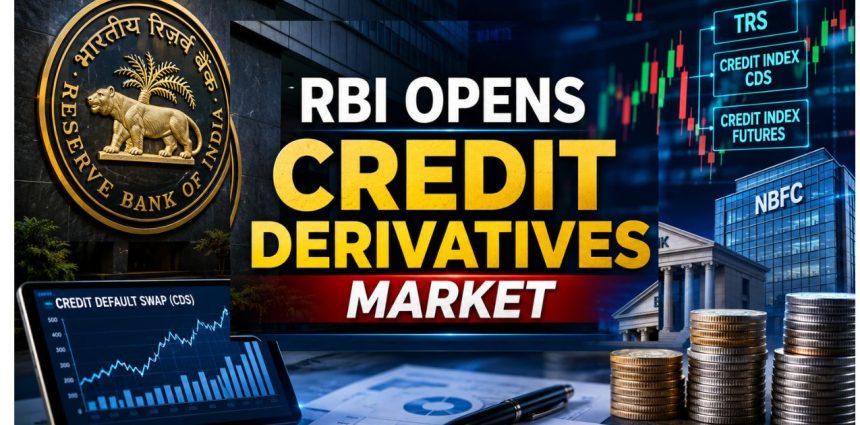
India’s credit markets just got a major structural upgrade. The Reserve Bank of India, on June 25, 2026, issued the Master Direction, RBI (Credit Derivatives) Directions, 2026, with immediate effect, superseding the earlier 2021-22 Credit Derivatives Directions issued in February 2022 that were restricted to single-name Credit Default Swaps on corporate bonds.
The new directions introduce Total Return Swaps, CDS on credit indices, and exchange-traded futures on credit indices, the most substantive overhaul of India’s credit derivatives architecture since the market’s inception.
For banks, NBFCs, mutual funds, insurers, and foreign portfolio investors, the rules change who can play, what instruments they can use, and how freely they can manage credit risk. Here is what every investor in financial sector stocks needs to understand right now.
What Changed on June 25, 2026?
The revised framework removes restrictions linking participation to underlying credit exposures, allowing eligible entities significantly greater flexibility in managing credit risk. Previously, CDS usage was tightly tied to whether a participant actually held the underlying bond, a constraint that severely limited hedging activity and market depth.
The new rules enable resident Indian non-retail users to deploy instruments such as CDS and Total Return Swaps without restrictions on purpose, while limiting the use of these instruments by non-resident users for hedging purposes only.
This is the key shift: institutional players in India no longer need a specific underlying exposure to trade credit protection. They can use these instruments for portfolio management, yield enhancement, or synthetic credit positioning, not just hedging.
New Instruments: TRS and Credit Index Products Explained
The 2022 framework only permitted single-name CDS on corporate bonds. The 2026 Directions introduce a materially expanded product suite: CDS on credit indices, Total Return Swaps on corporate bonds, and futures on credit indices traded on recognised stock exchanges.
A Total Return Swap allows one party to receive the total economic return of a bond, interest plus price appreciation or depreciation, in exchange for paying a fixed or floating rate. It gives institutions synthetic exposure to corporate debt without actually holding the bond.
CDS on credit indices let participants hedge or take views on a basket of corporate credits simultaneously, reducing single-issuer concentration risk. Exchange-traded credit index futures add transparency and guaranteed settlement to what has historically been an opaque OTC market.
Who Can Now Participate? Eligible NBFCs and HFCs Get Expanded Role
This is where the policy has direct implications for listed financial sector stocks. Scheduled commercial banks, standalone primary dealers, non-banking financial companies, and housing finance companies meeting prescribed conditions may now act as market-makers.
Eligible market-makers now explicitly include NBFCs in the Upper and Middle Layers, including Housing Finance Companies, in addition to Scheduled Commercial Banks, excluding Small Finance Banks, Payment Banks, Local Area Banks, and Regional Rural Banks. Development Finance Institutions including EXIM Bank, NABARD, NHB, SIDBI, and NaBFID are also included.
It is important to note that this expanded role applies only to NBFCs and HFCs meeting prescribed RBI conditions, not the broader universe of all registered NBFCs. Being designated a market-maker in credit derivatives is not just a technical classification; it means fee income, balance-sheet efficiency, and deeper relationships with institutional clients.
Insurance companies, pension funds, mutual funds, alternative investment funds, and foreign portfolio investors shall also be eligible to act as protection sellers, opening a new revenue stream for entities that previously sat on the sidelines of India’s credit risk transfer market.
FPI Access: New Channel for Foreign Capital Into Corporate Bonds
FPIs may transact in exchange-traded CDS as both protection buyers and sellers. However, their gross short positions in credit index futures may not exceed their consolidated long position in corporate bonds and credit index futures, a safeguard against purely speculative positioning.
This matters because FPIs now have a regulated synthetic route to gain exposure to Indian corporate credit without necessarily buying bonds outright. For banks and NBFCs that issue bonds in the market, this could meaningfully broaden the demand base for their paper, potentially compressing credit spreads and lowering borrowing costs over time.
Check Live: Participant-Wise OI—FII, DII, Client, Pro Positions Today
What This Means for NBFC and Banking Stocks
The policy has multi-layered implications for financial sector investors:
Better credit risk management: Banks and eligible large NBFCs can now hedge their corporate loan and bond portfolios more precisely using CDS and TRS, reducing unexpected credit losses, a direct positive for asset quality metrics.
New fee income streams: Market-maker status for eligible NBFCs and HFCs means access to derivative structuring fees and bid-ask spreads on credit instruments, diversifying non-interest income.
Corporate bond market deepening: The revised directions seek to broaden the credit derivatives market, facilitate efficient transfer and management of credit risk, and support the development of the corporate bond market, a structural positive for banks and NBFCs that rely on bond markets for fundraising.
Lower cost of funds (medium-term): As more participants can hedge credit risk, demand for highly rated corporate bonds from banks and NBFCs is likely to rise, gradually narrowing credit spreads.
Market participants had sought greater flexibility in the draft framework. The RBI said it had accepted several suggestions, including permitting resident non-retail users to buy and sell protection without restrictions related to the underlying exposure and introducing TRS as an eligible instrument. The regulator’s responsiveness to industry feedback signals continued constructive engagement with the financial sector.
The Risk Investors Should Not Ignore
The expansion of credit derivatives deepens markets only when pricing, reporting, counterparty risk management, and settlement systems are sufficiently robust.
If volumes remain thin in the initial phase, as they did after the 2022 CDS launch, or if participants use the new instruments primarily for synthetic leverage rather than genuine risk transfer, the real-world market impact may be significantly more limited than the policy intent suggests.
Adoption pace and regulatory monitoring of participant behaviour will be the critical variables to track.
Key Framework Parameters at a Glance
The RBI has retained approval authority over CDS product design on exchanges; before launching any CDS product, exchanges must obtain RBI approval for product design, changes in product design, eligible participants, and other details, meaning exchange-traded volumes will ramp gradually as product approvals come through.
The next trigger: SEBI’s operational guidelines for exchange-traded credit derivatives, which will determine actual trading timelines on NSE and BSE. Stocks such as Bajaj Finance, Shriram Finance, L&T Finance and large HFCs may remain on investor watchlists if treasury-led participation in credit derivatives gains traction among qualifying institutions.
Read Next: Persistent Systems Crashes 11%: Is Nagarro Deal Too Costly?