
Biscuits, Soaps and Juices May Avoid Fresh Price Hikes as FMCG Firms Wait
FMCG Price Hikes Put on Hold as West Asia Tensions Keep Companies on Edge
Just when consumers were preparing for another round of price hikes, India’s leading FMCG companies have hit the pause button. Rising crude oil prices and renewed uncertainty in West Asia have forced companies to rethink pricing strategies, leaving investors wondering whether margins or volumes will take priority in the coming quarters.
Here’s why companies are choosing caution instead of immediate price increases.
FMCG Companies Delay Fresh Price Hikes Despite Cost Pressures
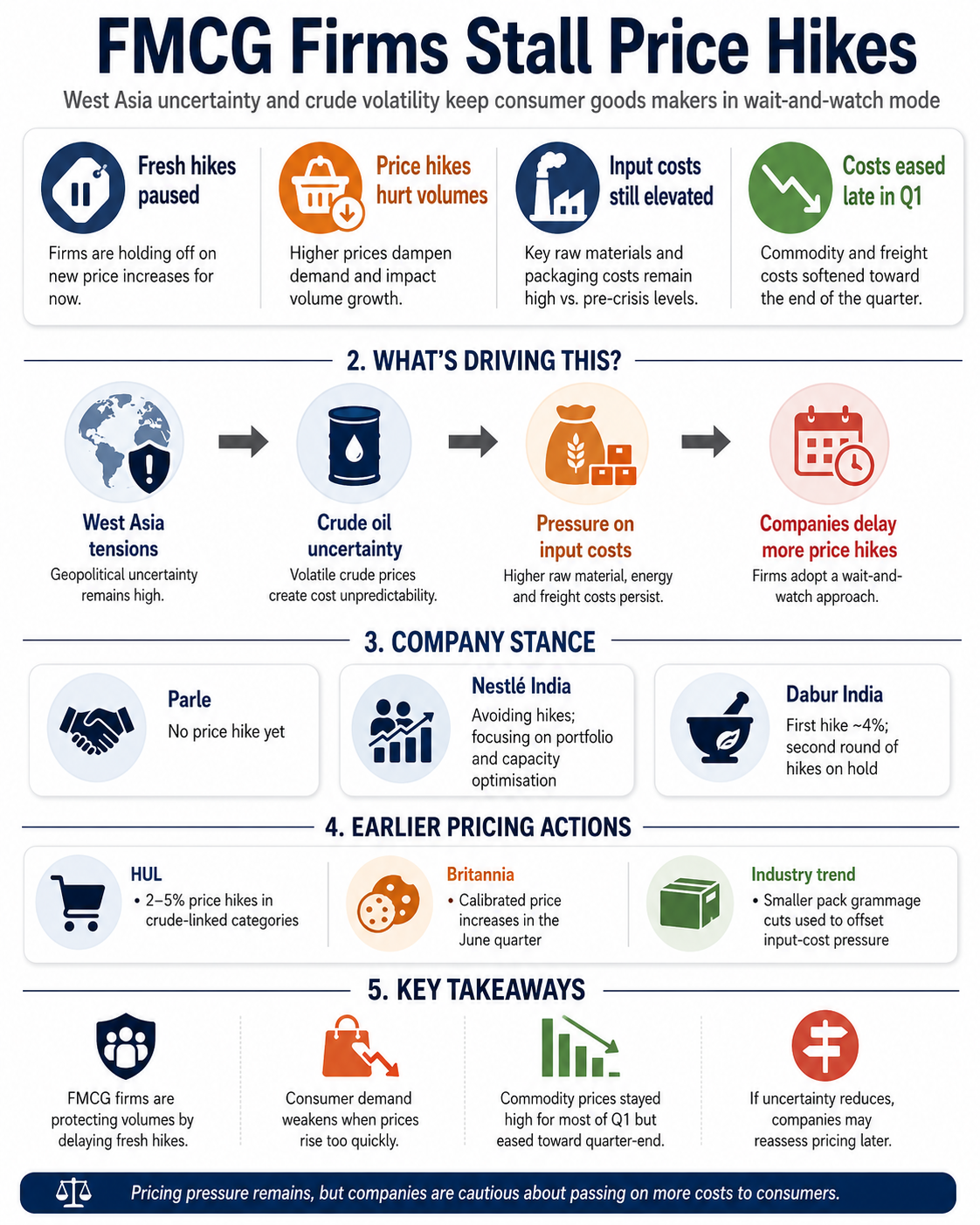
Leading FMCG companies are adopting a wait-and-watch approach on further price hikes as geopolitical tensions in West Asia continue to create uncertainty around crude oil prices.
Although raw material costs remain elevated, companies are avoiding aggressive pricing decisions because higher prices could hurt consumer demand and sales volumes.
Industry executives say the recent easing in crude prices provided temporary relief, but renewed tensions have made companies cautious about taking another round of price increases.
Parle, Nestle India and Dabur Hold Back Pricing Decisions
Several major consumer goods companies have delayed planned price revisions.
Parle, the maker of Parle-G biscuits, has not increased prices despite higher input costs.
An industry executive said:
“Crude oil prices have come down from unsustainable levels, easing some pressures. But tensions are escalating again. Amid this uncertainty we are holding any pricing action for the time being.”
Nestle India has also stayed away from fresh price hikes, choosing instead to improve operational efficiency through portfolio and capacity optimisation.
Meanwhile, distributors of Dabur India said the company has not implemented the second round of price increases that it had earlier planned.
Read More : Mutual Fund Flows Split in June: Equity Investors Return as Debt Funds Bleed ₹1.09 Lakh Crore
Companies Fear Higher Prices Could Hurt Demand
The biggest concern for FMCG companies is protecting sales volumes.
A sector expert said:
“Increased prices have a direct impact on volume growth as consumers start to assess purchases. Pricing action is usually the last resort for companies.”
With uncertainty around West Asia continuing, companies may prefer absorbing some cost pressure rather than risking weaker consumer demand.
This is especially important as rural and value-conscious consumers remain sensitive to price increases.
Input Costs Begin to Ease After a Tough Quarter
While most companies experienced elevated commodity costs throughout the June quarter, recent trends have shown some improvement.
Godrej Consumer Products (GCPL) noted in its latest business update:
“Input costs remained elevated through most of Q1… Encouragingly, costs have begun to ease in the closing weeks of the quarter.”
This improvement has strengthened expectations that companies may avoid another immediate round of price hikes if commodity prices remain stable.
Earlier Price Hikes Had Already Returned MRPs to Pre-GST Levels
Most packaged goods manufacturers had already increased prices or reduced pack sizes after their March quarter earnings.
Among the major actions:
- Hindustan Unilever (HUL) increased prices by 2–5% across several categories and reduced pack sizes for selected products.
- Britannia Industries introduced calibrated price hikes during the June quarter.
- Dabur India had earlier raised prices by nearly 4%.
According to analysts at JM Financial, maximum retail prices (MRPs) across several FMCG categories have now largely returned to pre-GST levels after successive rounds of price increases.
Listed FMCG Stocks to Watch (As of July 10, 2026)
Track Live : All Listed Stocks In NSE
| Company | Closing Price (₹)* | What Investors Should Watch |
|---|---|---|
| Hindustan Unilever | 2,150.60 | Margins vs. volume growth after recent price hikes |
| Nestlé India | 1,455.20 | Pricing strategy, premium product demand and margin resilience |
| Dabur India | 443.50 | Whether the company proceeds with a second round of price hikes |
| Britannia Industries | 5,353.00 | Gross margin recovery amid wheat, sugar and dairy cost movements |
| Godrej Consumer Products (GCPL) | 1,088.40 | Palm oil and crude-linked raw material cost trends |
| Marico | 852.50 | Edible oil, copra and safflower price movements |
| Tata Consumer Products | 1,111.90 | Tea procurement and packaging cost inflation |
| ITC | 281.75 | FMCG business margin outlook and non-cigarette segment growth |
*Closing prices are based on the latest available market data for July 10, 2026. Intraday prices may differ slightly depending on the data provider.
Why FMCG companies are pausing price hikes
- Consumer demand remains the priority. Higher prices can hurt volumes as consumers reduce discretionary purchases or switch to cheaper alternatives.
- Crude-linked raw material costs have eased from recent highs, reducing immediate pressure on margins, although the situation remains uncertain due to renewed tensions in West Asia.
- Companies expect further clarity before implementing another round of price increases.
Companies adopting a wait-and-watch approach
- Parle Products has not increased prices despite elevated input costs and is monitoring crude oil trends before taking any pricing action.
- Nestlé India is focusing on portfolio optimization and capacity expansion instead of immediate price hikes.
- Dabur India has postponed its planned second round of price hikes after an initial increase of around 4%, although it continues to monitor raw material costs.
- Godrej Consumer Products (GCPL) said input costs remained elevated through most of the June quarter but started easing toward the end of the quarter.
Earlier pricing actions
Following March-quarter earnings, most major FMCG companies announced calibrated price hikes or grammage reductions to offset higher packaging, freight and crude-linked input costs.
- Hindustan Unilever (HUL) implemented 2–5% price increases across selected categories and reduced pack sizes in value segments.
- Britannia Industries also introduced calibrated price increases during the June quarter.
- According to analysts, MRPs in several FMCG categories have largely returned to pre-GST rationalisation levels after successive price hikes.
What Impact Could This Have on FMCG Stocks?
For listed FMCG stocks, the near-term outlook remains mixed.
Companies that delay price hikes could benefit from stronger consumer demand and better sales volumes. However, if crude oil and packaging costs rise again, profitability could come under pressure.
Large diversified companies such as Hindustan Unilever, Nestle India, Britannia Industries, Dabur India, and Godrej Consumer Products are expected to rely more on cost optimisation and operational efficiencies rather than frequent price increases.
Key Commodities That Matter
| Commodity | Why It Matters | Stocks to Watch |
|---|---|---|
| Crude Oil & Packaging | Higher crude raises plastic packaging and freight costs. | HUL, Dabur, GCPL, Marico |
| Palm Oil | Key input for soaps, personal care and snacks. | GCPL, HUL, Britannia |
| Wheat, Sugar & Milk | Major ingredients for biscuits, dairy and packaged foods. | Britannia, Nestlé India |
| Cocoa & Coffee | Affects chocolates, confectionery and coffee products. | Nestlé India, Tata Consumer |
| Paper Packaging | Impacts cartons and shipping costs. | ITC, Tata Consumer |
What Should Investors Watch Next?
Investors should closely monitor three key factors over the coming weeks:
- Crude oil price movements and geopolitical developments in West Asia.
- June-quarter earnings commentary from major FMCG companies on margins and demand.
- Any fresh pricing actions or grammage reductions announced by leading consumer goods manufacturers.
If commodity prices continue to soften, FMCG companies could witness margin improvement without imposing additional price hikes—a combination that would be positive for both consumers and investors.