Sensex crashes over 1,300 points, Nifty slips below 24,000 as Iran tensions, crude oil surge shake Dalal Street
The Indian stock market came under heavy selling pressure on Wednesday as escalating geopolitical tensions in the Middle East rattled investor sentiment. The Sensex crashed more than 1,300 points during the session, while the Nifty slipped below the 24,000 mark, as rising crude oil prices, a weakening rupee and weak global cues triggered broad-based profit booking.
The sharp decline followed fresh comments by US President Donald Trump on Iran, adding to concerns over global stability and the outlook for energy prices. With Brent crude climbing above USD 76 per barrel, investors turned cautious, leading to selling across most sectors.
Sensex crashes, Nifty remain under pressure throughout the session
Selling was visible across frontline stocks, while the broader market also remained weak. The Nifty Smallcap 100 declined 0.24%, and the Nifty Midcap 100 fell 0.12%, indicating cautious sentiment beyond large-cap stocks.
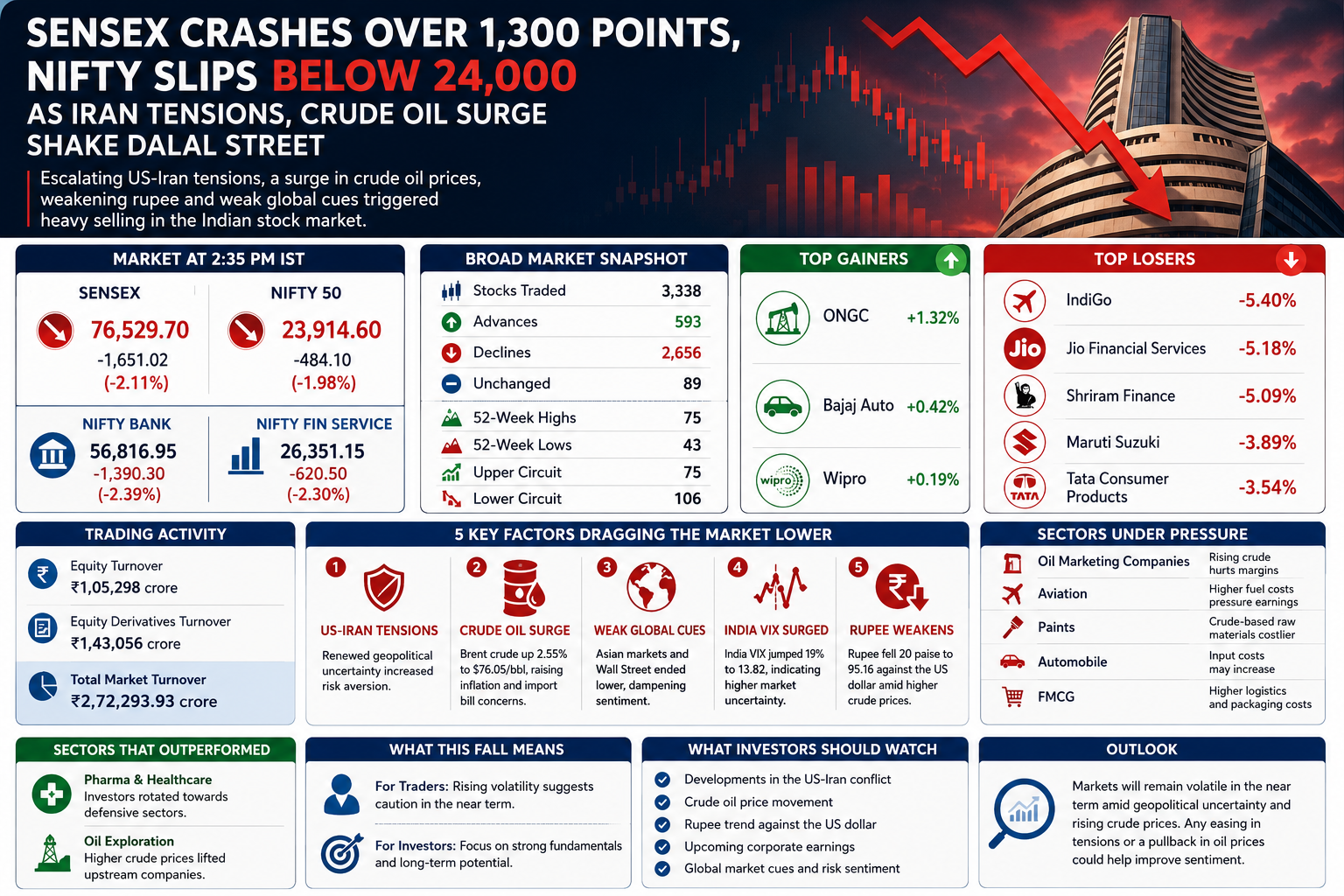
As of 2:35 PM IST, the BSE Sensex was down 1,651.02 points (2.11%) at 76,529.70, while the Nifty 50 dropped 484.10 points (1.98%) to 23,914.60, slipping below the crucial 24,000 mark.
The banking segment remained under heavy pressure, with Nifty Bank falling 1,390.30 points (2.39%) to 56,816.95, while the Nifty Financial Services Index declined 620.50 points (2.30%) to 26,351.15.
Here’s what happened today and why traders reacted
Markets reacted to a combination of global and domestic developments that increased uncertainty.
The biggest trigger was the renewed geopolitical tension between the United States and Iran. Investor confidence weakened after Donald Trump signalled that talks with Iran were effectively over.
“To me, I think it’s over. I don’t want to deal with them… They’re vicious, violent people. It’s just a waste of time dealing with them. They’re liars.”
The comments came after fresh US strikes on Iran, reports of attacks on three ships in the Strait of Hormuz and the revocation of a licence that had allowed Iran to sell oil. These developments fuelled concerns about global oil supply disruptions and increased risk aversion across financial markets.
Broad-based selloff dominates market breadth
Market breadth remained decisively negative, highlighting widespread selling across sectors.
- Stocks traded: 3,338
- Advances: 593
- Declines: 2,656
- Unchanged: 89
- 52-week highs: 75
- 52-week lows: 43
- Upper circuit: 75 stocks
- Lower circuit: 106 stocks
The advance-decline ratio reflected strong bearish sentiment, with declining stocks outnumbering advancing shares by more than four to one.
Track Live : All Listed Stocks In NSE
Top gainers
Despite the broad market weakness, a handful of stocks managed to stay in positive territory.
| Stock | Change |
|---|---|
| ONGC | +1.34% |
| Bajaj Auto | +0.42% |
| Wipro | +0.09% |
Oil producer ONGC benefited from higher crude oil prices, while select defensive names attracted buying interest.
Top losers
Selling pressure remained intense across financials, aviation, automobiles and consumer stocks.
| Stock | Change |
|---|---|
| IndiGo | -5.30% |
| Jio Financial Services | -5.10% |
| Shriram Finance | -5.24% |
| Maruti Suzuki | -4.20% |
| Tata Consumer Products | -3.34% |
Financial stocks continued to witness sharp profit booking, while aviation counters remained under pressure due to rising crude oil prices.
Read More : India’s Auto Parts Industry Hits Rs.7.60 Lakh Crore As Global Sourcing Shift Boosts Growth
Five factors that dragged the market lower
1. US-Iran tensions hit global risk sentiment
Renewed geopolitical uncertainty prompted investors to reduce exposure to equities and shift towards safer assets.
2. Crude oil prices moved higher
Brent crude rose 2.55% to USD 76.05 per barrel, raising concerns over India’s import bill, inflation and corporate margins. Since India imports a majority of its crude oil requirement, sustained higher prices can weigh on economic growth.
A market expert said:
“With the renewed US-Iran tensions and the consequent spike in Brent crude to USD 76, the market is again back to uncertain territory. How long this lasts and what its consequences will be remain uncertain.”
3. Weak global cues
Asian markets, including Japan’s Nikkei 225 and South Korea’s Kospi, traded lower after Wall Street ended the previous session in the red, adding to the cautious mood.
4. India VIX surged
The India VIX, which measures expected market volatility, jumped 19% to 13.82, reflecting higher uncertainty among traders.
5. Rupee weakened against the dollar
The Indian rupee fell 20 paise to 95.16 against the US dollar, pressured by higher crude oil prices and weakness in domestic equities.
Trading activity remains robust
Investor participation remained strong despite the sharp decline.
- Equity turnover: ₹1,05,298 crore
- Equity derivatives turnover: ₹1,43,056 crore
- Total market turnover: ₹2,72,293.93 crore
The high trading volumes indicate aggressive institutional activity as investors reposition portfolios amid elevated volatility.
Crude-sensitive sectors bore the brunt of selling
Rising crude prices triggered sharp selling in sectors where fuel costs have a direct impact on profitability.
The Nifty Oil & Gas Index declined around 1.5%, while the Auto and FMCG indices also ended lower.
Among the major losers were BPCL, HPCL, Indian Oil, Asian Paints, IndiGo and ITC, as investors factored in the possibility of margin pressure if crude prices remain elevated.
Major company updates kept select stocks in focus
Despite the broader weakness, a few stocks bucked the trend.
Kalyan Jewellers jumped 5.4% after reporting a strong business update for the June quarter, indicating healthy demand.
Info Edge gained 3.1% on renewed buying interest.
Higher crude prices also supported upstream energy companies. ONGC and Oil India gained around 0.5% each as stronger oil prices are generally positive for their earnings.
Pharmaceutical and healthcare stocks also outperformed the broader market, with investors rotating towards defensive sectors.
What today’s fall means for traders and investors
Wednesday’s sell-off highlighted how quickly global geopolitical developments can influence domestic markets.
For traders, the rise in India VIX suggests volatility could remain elevated in the near term, especially if crude oil prices continue to climb.
For long-term investors, the correction underscores the importance of focusing on company fundamentals rather than reacting to short-term geopolitical headlines. Companies with strong earnings visibility and healthy balance sheets are likely to remain resilient despite periods of market volatility.
What should investors watch now?
The market’s next move will depend on several key factors, including developments in the US-Iran conflict, the direction of crude oil prices, the rupee’s movement and upcoming corporate earnings.
Any easing in geopolitical tensions could improve market sentiment. However, if crude oil prices remain elevated or global uncertainty intensifies, volatility in the Sensex, Nifty and the broader Indian stock market may continue in the coming sessions.