
Could the NSE IPO Finally Become Reality After Nearly a Decade?
The wait for the NSE IPO may finally be nearing its end. After years of regulatory hurdles and multiple delays, India’s largest stock exchange is reportedly close to receiving SEBI’s approval. If everything goes according to plan, the NSE IPO could hit the primary market as early as September, making it one of the biggest and most anticipated public offerings in India’s capital market history.
NSE IPO Likely to Receive SEBI Approval by Next Month
The NSE IPO is expected to move a major step forward, with merchant banking sources indicating that the Securities and Exchange Board of India (SEBI) could issue its observation letter by next month.
According to merchant banking sources, the regulator’s review is progressing smoothly, with the exchange responding promptly to queries.
“At the current pace, the issue is expected to get the green signal by next month. As all queries are promptly replied to from their side,” a merchant banking source said.
The source added that most of SEBI’s questions relate to disclosure language and regulatory requirements rather than fundamental concerns.
Track Live : IPO – Latest & Upcoming IPOs List 2026 | Check Live BSE NSE IPOs
Offer Structure & Financial Health
- 100% Offer for Sale (OFS): The public issue consists entirely of up to 14.89 crore equity shares offloaded by existing institutional shareholders. No fresh capital will flow back into NSE.
- Primary Selling Shareholders: State Bank of India (SBI) is offloading 2.475 crore shares. Other institutional sellers include General Insurance Corporation of India (GIC Re) and Canada Pension Plan Investment Board (CPPIB). LIC will fully retain its 10.72% stake.
- Listing Constraints: Because a stock exchange cannot list on itself, NSE shares will list and trade exclusively on the Bombay Stock Exchange (BSE) mainboard.
- Financial Margins: For the financial year FY26, NSE maintained high global profitability standards with world-class operating profit margins hovering around 55%.
Here’s What Happened Today and Why Traders Reacted
Investor sentiment improved after reports suggested that the NSE IPO could receive regulatory approval as early as August.
- June 17, 2026: NSE officially filed its DRHP with SEBI, resolving a decade-long regulatory standstill.
- July 17, 2026: Global investor roadshows are scheduled to kick off across vital financial hubs including the US, UK, Hong Kong, and Singapore.
- August 2026 (Expected): SEBI is anticipated to issue its final observation letter, which serves as the formal regulatory green light.
- September 2026 (Targeted): The public issue is expected to open for bidding, subject to favorable broader market conditions.
Read More : Swiggy Shares Jump 6% as Domestic Ownership Crosses 50%; Instamart Nears Inventory-Led Model
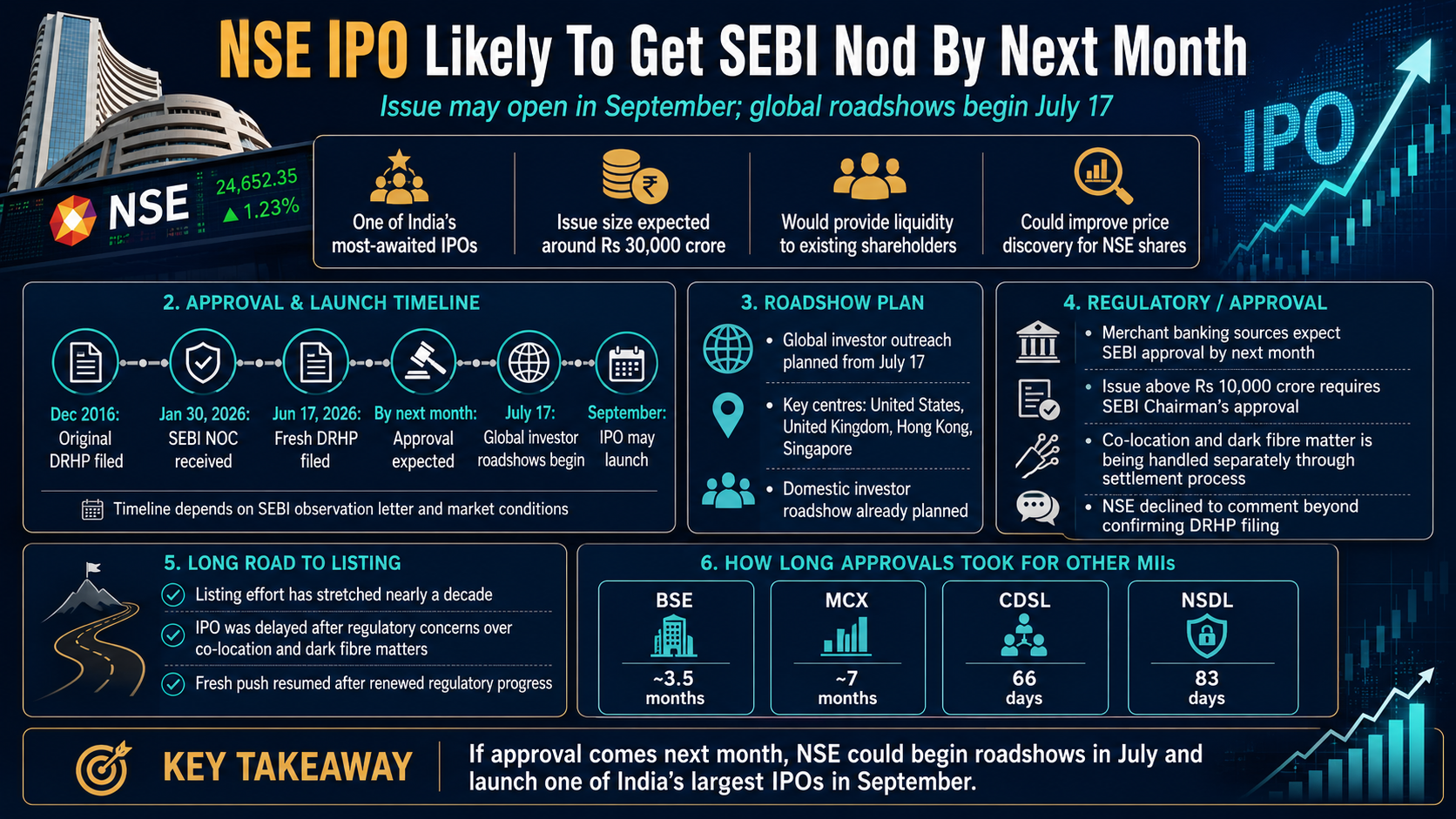
Global Roadshows to Begin Ahead of the NSE IPO
Merchant bankers have already planned an international investor outreach programme for the NSE IPO.
The global roadshows are scheduled to begin on July 17 across major financial centres, including:
- United States
- United Kingdom
- Hong Kong
- Singapore
Domestic investor meetings have also been planned ahead of the proposed public issue.
If SEBI issues its observation letter on schedule, the exchange could launch the IPO in September, depending on market conditions.
However, an NSE spokesperson declined to comment on the timeline, saying:
“The Company has filed a DRHP with SEBI. We are unable to provide further comments at this stage.”
Why the Listing Delayed (and How It Unlocked)
Why the Co-location Issue Is No Longer the Biggest Obstacle
One of the biggest reasons behind optimism over the NSE IPO is that the long-pending co-location and dark fibre matters have largely been separated from the listing process.
According to another merchant banking source:
“As the key issue of co-location and dark fibre is already delinked from the IPO and is in the settlement process, the major issue is out.”
This means SEBI’s review can now focus on routine regulatory scrutiny and disclosure requirements.
The NSE IPO Has Taken Nearly 10 Years to Reach This Stage
The journey of the NSE IPO has been one of the longest in India’s capital markets.
NSE first filed its Draft Red Herring Prospectus (DRHP) in December 2016. However, the IPO process stalled after SEBI raised concerns over the exchange’s co-location and dark fibre cases.
The exchange revived its listing plans after filing a settlement application in June last year. It received SEBI’s no-objection certificate earlier this year before filing a fresh DRHP on June 17.
If approved next month, it would mark a significant regulatory milestone after nearly a decade of delays.
Why This Could Become One of India’s Biggest IPOs
The NSE IPO is expected to be worth around ₹30,000 crore, making it one of the largest public offerings in India’s history.
Because the issue size exceeds ₹10,000 crore, the IPO will require approval from the SEBI Chairman under the regulator’s delegation of powers.
The listing would also provide long-awaited liquidity to thousands of existing shareholders while improving price discovery for unlisted NSE shares.
Why Investors Are Closely Watching the NSE IPO
The NSE IPO has attracted strong interest from both institutional and retail investors.
NSE dominates India’s equity derivatives market and remains among the world’s largest derivatives exchanges by trading volume.
The exchange has also delivered strong financial performance in recent years, supported by rising retail participation, increasing trading activity and continued growth in India’s capital markets.
These factors are expected to make the IPO one of the most closely watched offerings of 2026.
NSE IPO
The proposed IPO is expected to be one of India’s largest public offerings, with reports indicating an issue size of around ₹30,000 crore. It is expected to be a 100% Offer for Sale (OFS), meaning the proceeds will go to existing shareholders rather than NSE itself. Merchant banking sources expect SEBI’s observation letter in August, with the IPO targeted for September, subject to regulatory approval and market conditions.
| Metric | Latest |
|---|---|
| Expected IPO Size | ₹30,000 crore |
| Business | Stock Exchange & Market Infrastructure Institution |
| IPO Type | 100% Offer for Sale (OFS) |
| Expected SEBI Approval | August 2026 (anticipated) |
| Expected IPO Launch | September 2026 (subject to approval) |
| Proposed Listing Venue | BSE (an exchange cannot list on itself) |
Audited FY26 Financial Highlights
NSE enters the IPO process with one of the strongest financial profiles among global exchange operators. Despite regulatory provisions during FY26, the company remained highly profitable and debt-free.
| Financial Metric | FY26 |
|---|---|
| Total Income | ₹18,713.37 crore |
| Revenue from Operations | ₹16,601.31 crore |
| Profit After Tax (PAT) | ₹10,302.06 crore |
| Operating EBITDA Margin | 66.85% |
| PAT Margin | 50.98% |
| Debt Position | Debt-free (Zero borrowings) |
| Dividend (FY26) | ₹35 per equity share |
| Total Dividend Payout | ₹8,663 crore |
| Dividend (FY25) | ₹35 per equity share |
What These Numbers Mean for Investors
Revenue Base
Revenue from operations of ₹16,601 crore highlights NSE’s dominant position in India’s capital markets, with transaction charges remaining its largest revenue source.
Profitability
A PAT of over ₹10,300 crore and an EBITDA margin of nearly 67% place NSE among the most profitable exchange businesses globally. Exchange operators benefit from significant operating leverage because incremental trading volumes require relatively little additional cost.
Strong Balance Sheet
NSE is debt-free, giving it considerable financial flexibility while reducing interest costs and balance-sheet risk.
Dividend Track Record
The exchange maintained a ₹35 per share dividend for both FY25 and FY26, with a total FY26 payout of ₹8,663 crore, reflecting its strong cash generation and shareholder-friendly capital allocation.
Key Investor Takeaways
- 100% OFS: Since the IPO is expected to be entirely an Offer for Sale, NSE will not receive fresh capital from the issue. The proceeds will go to existing shareholders selling their stakes.
- High-margin business: EBITDA margins of nearly 67% demonstrate the scalability of the exchange business model.
- Consistent cash generation: Strong profitability and a stable dividend history indicate robust free cash flow generation.
- Regulatory milestone: The IPO still depends on SEBI issuing its observation letter, which merchant banking sources expect in August before a potential September launch.