Will SEBI’s big short selling reform change how investors trade stocks?
India’s stock market could be heading for one of its biggest structural changes in years. SEBI Short Selling Rules may soon become more investor-friendly as the market regulator is reportedly planning to expand stock lending and borrowing while reducing collateral requirements.
If implemented, the proposal could significantly improve liquidity in the cash market, make short selling easier, and encourage investors to shift some activity away from the country’s booming derivatives segment.
The proposed reforms are still under discussion, but they could reshape how traders and institutional investors participate in India’s equity markets.
Track Live : Results Calendar — NSE & BSE
SEBI plans to expand the list of stocks available for short selling
According to people familiar with the discussions, SEBI is considering nearly doubling the number of stocks eligible for the Securities Lending and Borrowing (SLB) mechanism.
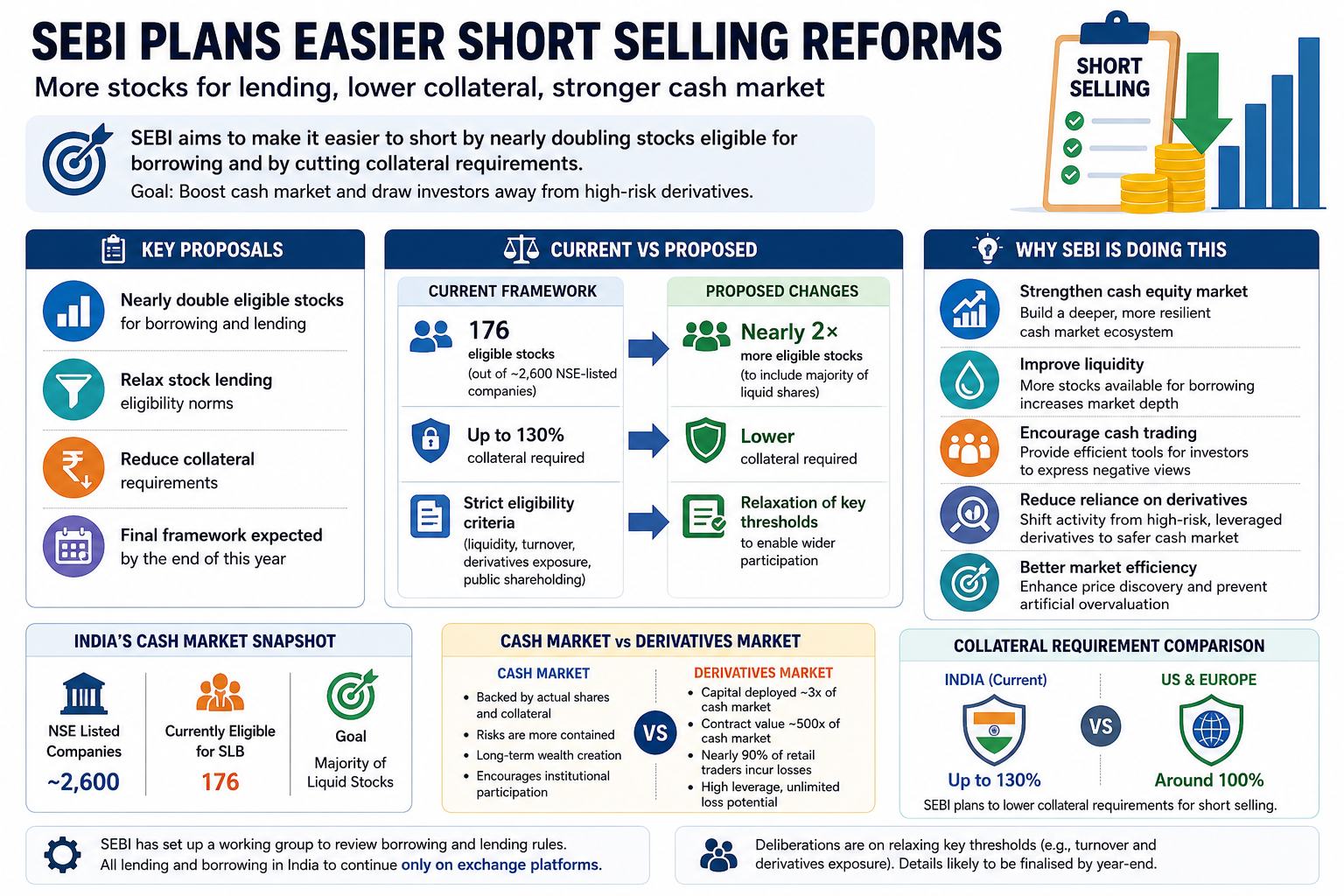
At present, only 176 companies out of nearly 2,600 stocks listed on the National Stock Exchange (NSE) qualify for stock lending and borrowing.
The regulator wants to include a much larger pool of liquid stocks, making it easier for investors to take short positions in the cash market.
The move is aimed at improving price discovery and increasing participation in India’s cash equity market.
Drive Cash Market Engagement
- Expand Pool: Increase eligible SLB stocks from 176 up to nearly 350 out of 2,600 NSE-listed companies.
- Lower Barriers: Cut steep collateral requirements to reduce entry costs for short sellers.
- Shift Volume: Divert capital from retail-dominated futures and options (F&O) back to the cash market.
Collateral requirements may also be reduced
Another major proposal under the new SEBI Short Selling Rules is a reduction in collateral requirements.
Currently, investors may have to provide collateral of up to 130% while borrowing shares for short selling.
In comparison, collateral requirements in markets such as the United States and Europe are generally close to 100%.
Lower collateral requirements would reduce the cost of short selling, improve capital efficiency and make the lending and borrowing mechanism more attractive for institutional and sophisticated investors.
Read More : Why Vedanta Group Stocks Fall Up to 9% Even as Iron & Steel Output Rose 4%
Update Strict Historical Rules
- Historical Context: Scandals in the early 2000s and 2017–2020 triggered hyper-strict SLB criteria.
- Current Limitation: Only 7% of listed NSE companies can currently be legally borrowed for shorting.
- Target Outcome: Relax thresholds to cover the vast majority of liquid shares by the end of 2026.
Why is SEBI considering these changes now?
One of the biggest reasons is the rapid expansion of India’s derivatives market.
While India’s cash equity market has grown sharply over the past decade, derivatives trading has expanded even faster.
According to market data:
- The NSE’s market capitalisation has increased from around $1 trillion a decade ago to more than $5 trillion.
- Capital deployed in derivatives is now roughly three times larger than the cash market.
- The gross contract value of derivatives is almost 500 times larger than the cash equity market.
SEBI has repeatedly highlighted that nearly 90% of retail investors lose money in derivatives trading, raising concerns over excessive speculative activity.
By making short selling easier in the cash market, the regulator hopes to encourage more balanced participation in equity investing.
Which stocks could become eligible?
The proposed changes are expected to relax some of the existing eligibility norms.
Currently, a stock generally needs:
- Average monthly trading turnover of at least ₹100 crore over the previous six months.
- Sufficient derivatives exposure of at least ₹100 crore.
- Adequate public shareholding and liquidity.
Sources indicated that SEBI is considering easing some of these thresholds, although the final framework has not yet been decided.
The reforms are expected to include a much larger number of liquid companies.
Review Eligibility Thresholds
- Liquidity Rule: Stocks currently require a minimum average monthly trading turnover of ₹100 crore ($10.5 million) over 6 months.
- Market Size: Stocks must support market-wide derivative exposure of at least ₹100 crore.
- Public Float: Strict minimum thresholds govern how much stock must be held by public shareholders.
SEBI is unlikely to change exchange-based lending
Despite requests from foreign institutional investors, SEBI is unlikely to allow off-exchange stock lending.
India’s stock lending and borrowing system currently operates exclusively through stock exchanges.
The regulator believes that routing all transactions through exchanges improves transparency, strengthens price discovery and concentrates market liquidity.
That policy is expected to remain unchanged even if other reforms are approved.
Direct Market Impact
- Retail Safety: Mitigates heavy retail losses by encouraging safer cash positioning over leveraged F&O.
- Price Discovery: Enhances dual-directional trading, correcting overvalued stocks efficiently.
- Global Alignment: Modernises India’s short-selling infrastructure to align with global market standards.
Why is SEBI considering this move?
SEBI’s proposed reforms are aimed at strengthening India’s cash equity market, which has lagged behind the rapidly expanding derivatives market. By making stock borrowing and lending easier, the regulator hopes to improve liquidity, enable more efficient price discovery, and encourage investors to trade in the cash market instead of relying heavily on leveraged derivatives. The move is also intended to reduce the risks faced by retail investors, as SEBI has repeatedly highlighted that nearly 90% of retail derivatives traders incur losses.
Summary of SEBI’s Core Motives
- Strengthen India’s cash equity market.
- Reduce excessive dependence on the derivatives market.
- Improve liquidity by expanding the stock lending and borrowing (SLB) universe.
- Enhance price discovery through efficient short selling.
- Lower trading costs by reducing collateral requirements.
- Attract greater participation from institutional and foreign investors.
- Build a deeper, more balanced capital market ecosystem.
Detailed Breakdown
1. Curbing speculative growth in derivatives
India’s derivatives market has expanded far faster than the cash market over the past decade. Since derivatives involve leverage, they expose retail investors to significantly higher risks. By making short selling easier in the cash market, SEBI wants investors to express bearish views using actual shares rather than highly leveraged futures and options contracts.
2. Boosting cash market liquidity
Currently, only 176 of nearly 2,600 NSE-listed companies are eligible under the Securities Lending and Borrowing (SLB) mechanism. Expanding this universe would:
- Increase the availability of borrowable shares.
- Improve trading activity in liquid stocks.
- Encourage participation from domestic and global institutional investors.
- Reduce capital lock-up by lowering collateral requirements.
3. Improving price discovery
Efficient short selling helps markets reflect both positive and negative views on a stock.
Benefits include:
- Preventing stocks from becoming artificially overvalued.
- Allowing investors to express negative views without relying solely on derivatives.
- Making stock prices more reflective of underlying fundamentals.
- Supporting healthier two-way trading and market efficiency.
4. Reducing systemic risk
SEBI has been tightening rules around derivatives over the past 18 months because of growing retail participation and associated risks. Strengthening the cash market is part of a broader strategy to create a more balanced market structure, where investors have greater incentives to trade in fully collateralized cash equities rather than highly leveraged products.
What is short selling?
Step-by-Step Example of a Short Trade
- Borrow and Sell: You borrow 100 shares of Company X from a broker and immediately sell them in the market at the current price of ₹1,000 per share. You now have ₹1,00,000 cash, but you owe the broker 100 shares.
- The Price Drops: As you predicted, negative news hits Company X, and the stock price drops to ₹700 per share.
- Buy Back (Covering): You go back into the market and buy 100 shares at the new lower price of ₹700, costing you ₹70,000.
- Return and Profit: You return the 100 shares to your broker to settle your debt. Your total profit is the difference: ₹1,00,000 (initial sale) minus ₹70,000 (buyback cost) = ₹30,000 profit (minus minor borrowing fees).
The Core Risks of Short Selling
- Infinite Loss Potential: When you buy a stock normally, your maximum loss is 100% (if the stock goes to zero). When you short a stock, there is theoretically no limit to how high the price can rise, meaning your potential losses are infinite.
- Borrowing Costs: You do not own the shares, so you must pay a fee or interest to the lender for as long as you keep the short position open.
- Short Squeezes: If a heavily shorted stock suddenly spikes in price, short sellers will rush to buy back shares to cut their losses. This sudden wave of buying pushes the price even higher, trapping remaining short sellers in a compounding loss loop.