
India’s Next Bull Run: Rupee Stability, Falling Crude Oil And Rising SIPs Align
Is India Quietly Entering Its Next Bull Run? Here’s Why Investors Are Watching Closely
What if the next big rally has already begun—but few investors have noticed?
While markets continue to witness short-term volatility, the bigger picture is quietly changing. Several macroeconomic indicators that held back Indian equities over the past two years are now turning favourable at the same time.
That combination could become the foundation of India’s next bull run, making this a period investors may look back on as the beginning of a long-term wealth creation cycle.
Track Live : Stock Market Today
India’s Next Bull Run May Be Built on Rupee Stability, Not Easy Money
Every major rally has had a different trigger.
The 2003-08 bull market rode on global growth and the commodity boom. The post-pandemic rally was fuelled by abundant global liquidity. The 2014-17 cycle reflected optimism around structural reforms.
This time, India’s next bull run looks different.
Instead of speculative excess, the market may be driven by improving corporate earnings, stronger macroeconomic stability, rising domestic participation and India’s growing strategic role in the global economy.
“The next bull market is unlikely to be built on speculative excess or abundant liquidity. It is more likely to be driven by improving earnings visibility, stronger macroeconomic stability, rising domestic participation and India’s growing strategic importance in the global economy.”
Read More : Vadilal Family Succession Rejig Gets SEBI Relief, Promoter Holding Remains Unchanged
Four Macro Signals Are Supporting India’s Next Bull Run
Four major economic developments are beginning to move in India’s favour simultaneously.
This alignment is improving confidence across both domestic and foreign investors.
Rupee Stability Is Strengthening Market Confidence
The Indian rupee is showing signs of stability after a prolonged period of volatility.
A stable currency reduces inflation risks, lowers import costs and improves business planning. It also makes India a more attractive destination for global investors searching for predictable growth.
For foreign institutions, currency stability is often the first step before increasing equity exposure.
Geopolitical Risks Are Slowly Easing
Global markets remained under pressure due to prolonged geopolitical tensions in West Asia.
As tensions begin to moderate, investors are shifting their focus back to economic growth and corporate earnings instead of geopolitical uncertainty.
Improving global risk appetite generally benefits emerging markets like India.
Lower Crude Oil Prices Are Turning Into a Major Advantage
Lower crude oil prices could become one of the biggest positives for the Indian economy.
Since India imports nearly 85% of its crude oil requirement, softer oil prices help reduce inflation, improve the current account deficit and strengthen government finances.
Lower energy costs also improve profitability for manufacturing, logistics, aviation, automobiles, chemicals and consumer companies.
Read Here : PM Modi Says India Averted Fuel Crisis by Sourcing Energy From Over 40 Countries During West Asia Conflict
Domestic Liquidity Has Changed the Indian Stock Market Forever
Perhaps the biggest structural change is happening within India itself.
Regular SIP investments, growing mutual fund participation and increasing financialisation of household savings have created a powerful domestic liquidity engine.
Unlike previous market cycles, Indian equities are no longer entirely dependent on Foreign Portfolio Investors (FPIs).
Strong domestic inflows are now capable of absorbing large phases of foreign selling.
That structural change significantly strengthens the outlook for India’s next bull run.
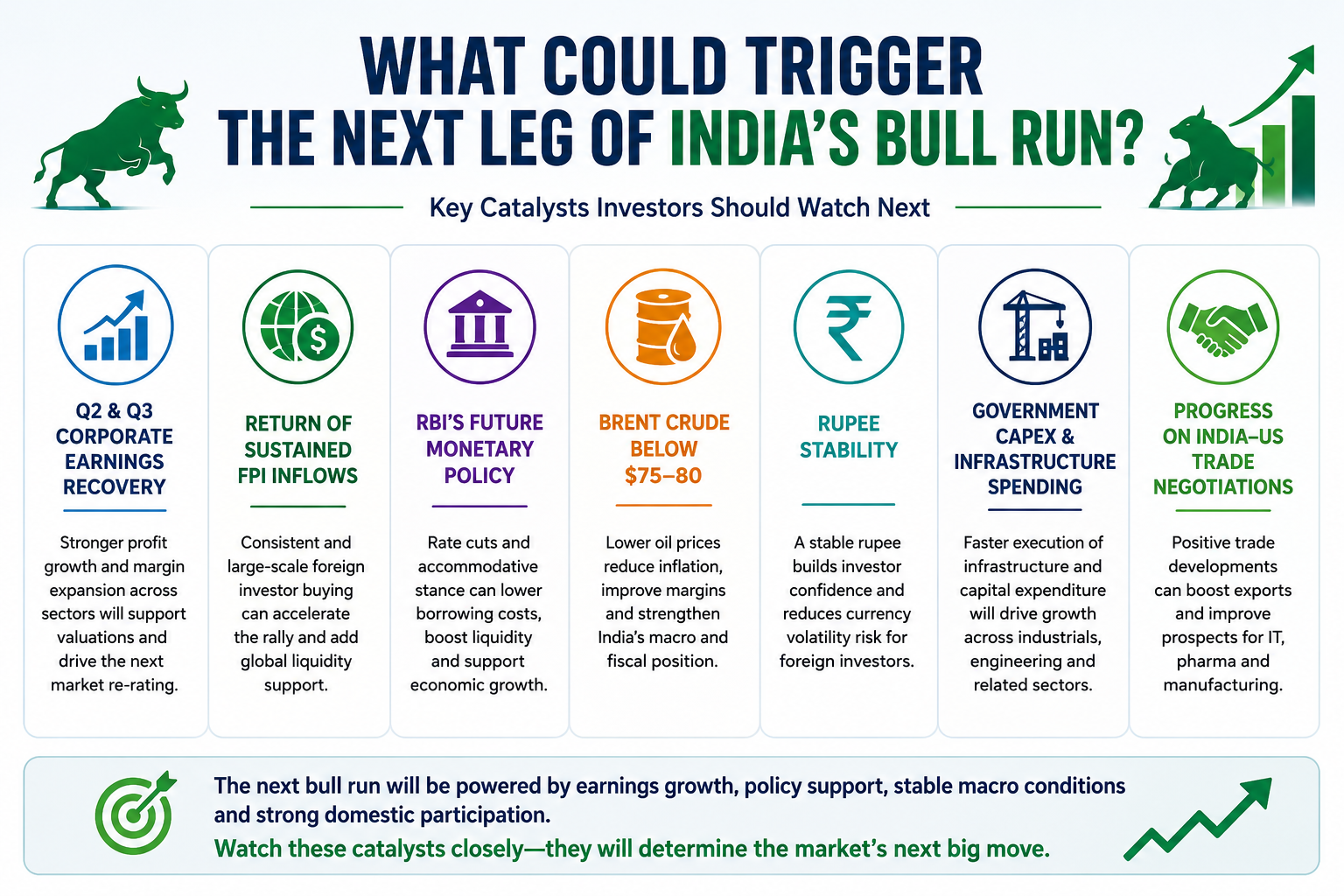
What Could Trigger the Next Leg of India’s Bull Run?
Investors should watch these key catalysts:
- Q2 & Q3 Corporate Earnings: Stronger profit growth will be crucial to support current valuations and drive the next market re-rating.
- Sustained FPI Inflows: A return of consistent foreign buying could significantly accelerate the rally as global investors turn more positive on India.
- RBI Monetary Policy: Any supportive policy stance or rate cuts could boost liquidity, borrowing, and economic growth.
- Brent Crude Below $75–80: Lower oil prices reduce inflation, improve corporate margins, and strengthen India’s macro outlook.
- Rupee Stability: A stable rupee enhances foreign investor confidence and reduces currency risk.
- Government Capex: Faster infrastructure and capital expenditure execution can boost growth across industrial and manufacturing sectors.
- India–US Trade Progress: Positive developments in trade negotiations could improve prospects for exports, IT, pharma, and manufacturing sectors.
Recent market commentary suggests easing crude prices and improved rupee stability have made foreign investors more constructive on India. However, analysts say the next sustained bull run will ultimately require stronger corporate earnings alongside these supportive macro factors.
Here’s What Happened Today and Why Traders Reacted
Today’s market sentiment remained supported by improving macroeconomic expectations.
Investors closely tracked rupee stability, softer crude oil prices, easing geopolitical tensions and continued domestic fund inflows.
Together, these developments strengthened expectations that India’s earnings cycle could improve over the coming quarters.
Many market participants also believe that even modest FPI buying could accelerate market re-rating because domestic liquidity remains exceptionally strong.
Major Corporate Earnings Could Decide the Next Market Move
Macroeconomic improvements alone are not enough.
The next phase of India’s next bull run will largely depend on strong corporate earnings.
Companies reporting healthy revenue growth, margin expansion and better guidance are likely to outperform.
Strong quarterly results from banking, capital goods, infrastructure, manufacturing, auto and financial companies could further strengthen investor confidence.
What Impact Could India’s Next Bull Run Have on Investors?
If the current macro trends continue, the broader market could remain well supported despite short-term volatility.
Long-term investors may benefit from improving earnings visibility and stronger economic growth.
Traders could witness sector-specific momentum as companies benefiting from lower input costs deliver better financial performance.
Quality businesses with consistent earnings growth are likely to attract the largest institutional inflows.
Why India’s Next Bull Run Could Last Longer Than Previous Cycles
The biggest difference this time is the simultaneous alignment of multiple positive factors.
Lower crude supports a stronger rupee. A stable rupee attracts foreign capital. Domestic SIP inflows cushion FPI selling, while easing geopolitical tensions improve global risk appetite.
These forces reinforce one another instead of working independently.
Although market volatility will remain and valuations are still expensive in certain pockets, the long-term backdrop is becoming increasingly favourable.
History shows that the strongest bull markets often begin quietly—long before investors fully recognise them.
If the current macroeconomic alignment continues over the coming quarters, this period may eventually be remembered as the starting point of India’s next bull run.