Adani’s $11.5 Billion Odisha Aluminium Bet Could Reshape India’s Metals Industry
India’s metals sector has just witnessed one of its biggest investment announcements.
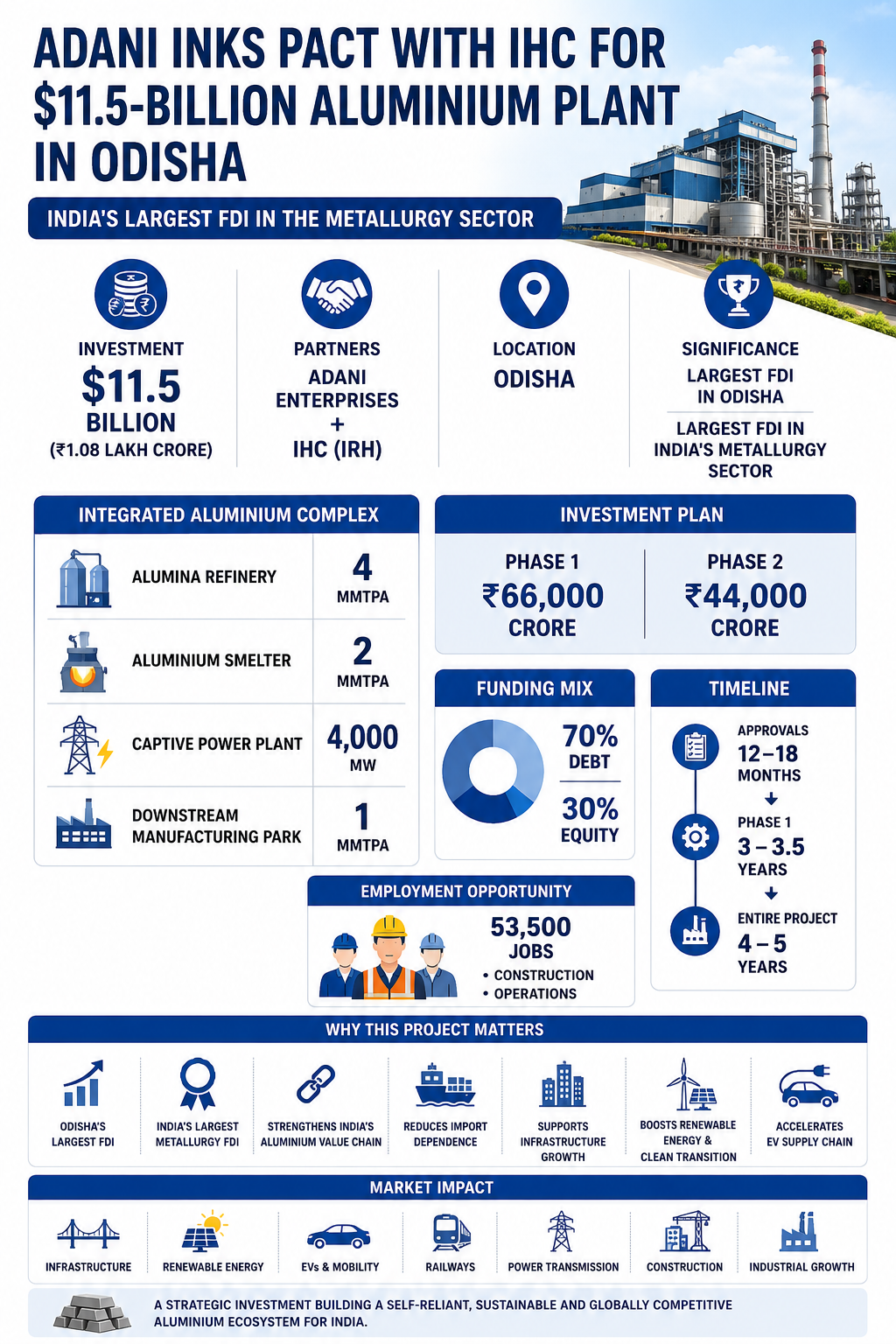
Adani Enterprises Ltd (AEL) has partnered with Abu Dhabi-based International Resources Holding (IRH), a subsidiary of International Holding Company (IHC), to build a $11.5 billion (₹1.08 lakh crore) integrated aluminium plant in Odisha. The project is not only the largest foreign direct investment (FDI) in Odisha’s history but also the biggest investment ever announced in India’s metallurgy sector.
For investors, the announcement signals Adani Group’s long-term expansion into a sector expected to benefit from rising manufacturing, infrastructure spending, electric vehicles and digitalisation.
Adani and IHC sign landmark agreement with Odisha government
The two companies signed a Memorandum of Understanding (MoU) with the Odisha government through 2PointZero, a subsidiary of IHC, to develop the integrated aluminium project.
The investment will be executed in two phases. Around ₹66,000 crore will be invested in Phase 1, while ₹44,000 crore will be deployed in Phase 2, taking the total project cost to approximately ₹1.08 lakh crore ($11.5 billion).
According to the company, nearly 70% of the project will be financed through debt, while the remaining amount will come through equity.
Funding Breakdown
- Total Investment: ₹1.08 lakh crore ($11.5 billion)
- Debt Funding: 70% of the total investment (approximately ₹75,600 crore)
- Equity Funding: 30% of the total investment (approximately ₹32,400 crore) [1]
Phase-Wise Investment
- Phase 1: ₹66,000 crore
- Phase 2: ₹44,000 crore
Read More : Nifty IT Index Jumps 4.6% After 5-Year Low; Guggenheim Says AI Fears Overblown
What will the mega aluminium project include?
The integrated manufacturing complex will be one of the largest aluminium facilities in India.
The project will include:
| Facility | Capacity |
|---|---|
| Alumina refinery | 4 MMTPA |
| Aluminium smelter | 2 MMTPA |
| Captive power plant | 4,000 MW |
| Downstream manufacturing park | 1 MMTPA |
The project aims to create one of India’s largest aluminium value chains, from refining bauxite to producing value-added aluminium products.
Timeline
According to Adani Enterprises:
- Regulatory approvals are expected within 12–18 months.
- Phase 1 is expected to become operational in 3–3.5 years after approvals.
- The full project is targeted for commissioning within 4–5 years.
Employment Impact
The project is expected to generate approximately 53,500 jobs, including:
- Around 35,000 during construction.
- Around 18,500 during operations.
Raw Material Strategy
Adani has secured long-term raw material arrangements with the Odisha Mining Corporation and is also seeking long-term bauxite linkages from the Odisha government. The company indicated it may participate in future captive mining auctions to secure additional supplies.
Karan Adani sees long-term opportunity in aluminium demand
Speaking after the announcement, Karan Adani, Managing Director of Adani Ports and Special Economic Zone, highlighted the long-term demand outlook.
“As digitisation and manufacturing in the country increase, the demand for aluminium is going to go up and we see that as a big opportunity, a long-term opportunity for the country.”
He added that all regulatory approvals are expected within the next 12 to 18 months.
Once approvals are received, Phase 1 is expected to become operational in around three to three-and-a-half years, while the entire project is targeted for completion within four to five years.
Raw material supply already being secured
To ensure uninterrupted production, the Adani Group has signed long-term raw material arrangements with the Odisha Mining Corporation (OMC).
The company is also working with the Odisha government to secure long-term bauxite linkages and may participate in future mining auctions to strengthen captive raw material availability.
This strategy could help reduce supply risks and improve long-term profitability.
Why This Adani-IRH Project Matters
The Adani Enterprises–International Resources Holding (IRH) joint venture is more than just another industrial investment. It is a strategic project that could reshape India’s aluminium industry, strengthen domestic manufacturing, and accelerate Odisha’s emergence as a global metals hub.
1. Odisha’s Largest-Ever Foreign Direct Investment (FDI)
With a proposed investment of $11.5 billion (₹1.08 lakh crore), the project is the largest FDI proposal in Odisha’s history, underscoring growing international investor confidence in the state’s industrial ecosystem.
2. India’s Biggest FDI in the Metallurgy Sector
The investment is also the largest foreign direct investment in India’s metallurgy and metals sector, marking a milestone for the country’s heavy manufacturing ambitions and reinforcing India as a preferred destination for global industrial capital.
3. Strengthens India’s Aluminium Value Chain
The integrated project combines a 4 MMTPA alumina refinery, 2 MMTPA aluminium smelter, captive power generation and a downstream manufacturing park. This creates an end-to-end aluminium ecosystem—from refining bauxite to producing value-added aluminium products—within a single industrial complex.
4. Expands Domestic Aluminium Production Capacity
Industry estimates indicate the new complex could increase India’s aluminium production capacity by nearly 50% once fully operational, significantly enhancing the country’s ability to meet rising domestic demand while strengthening its position in global aluminium markets.
5. Reduces Dependence on Imported Value-Added Aluminium
By establishing a large downstream manufacturing park, the project is expected to produce high-value aluminium products domestically. This can reduce India’s reliance on imported finished aluminium components, improve supply-chain resilience, and support the government’s manufacturing and self-reliance objectives.
6. Supports India’s Infrastructure and Energy Transition
Aluminium is a critical input for several high-growth sectors. The project is expected to supply materials required for:
- Renewable energy infrastructure, including solar equipment
- Electric vehicles (EVs) and lightweight mobility solutions
- Power transmission and distribution networks
- Railways, construction and urban infrastructure
- Aerospace and advanced engineering
- Packaging and industrial manufacturing
A larger domestic supply base can help meet long-term demand as India continues to expand infrastructure and manufacturing.
7. Positions Odisha as a Global Aluminium Manufacturing Hub
Odisha already accounts for more than half of India’s aluminium production due to its abundant bauxite reserves. The integrated project is expected to deepen the state’s role in the global aluminium supply chain while attracting downstream industries, ancillary businesses and MSMEs.
8. Creates Employment and Industrial Development
The project is expected to generate approximately 53,500 jobs across construction and operations, while driving investments in logistics, utilities, engineering services and supporting industries throughout the region.
Track Live : Live Stock Screener for Indian Markets
Adani Group Stocks: Complete List of 11 Listed Companies With Latest Share Prices
| Company | NSE Symbol | Sector | Current Stock Price* |
|---|---|---|---|
| Adani Enterprises | ADANIENT | Incubator, Infrastructure & Commodities | ₹3,177.50 |
| Adani Ports and Special Economic Zone | ADANIPORTS | Ports & Logistics | ₹1,883.20 |
| Adani Green Energy | ADANIGREEN | Renewable Energy | ₹1,555.20 |
| Adani Energy Solutions | ADANIENSOL | Power Transmission & Distribution | ₹1,556.90 |
| Adani Total Gas | ATGL | City Gas Distribution | ₹733.45 |
| Ambuja Cements | AMBUJACEM | Cement | ₹428.95 |
| Adani Power | ADANIPOWER | Thermal Power | ₹224.55 |
| AWL Agri Business | AWL | FMCG & Food | ₹183.96 |
| Orient Cement | ORIENTCEM | Cement | ₹136.42 |
| ACC | ACC | Cement | ₹1,350.70 |
| New Delhi Television | NDTV | Media & Broadcasting | ₹81.52 |
What is the impact on the market and investors?
For long-term investors, the project underlines Adani Enterprises’ strategy of creating large-scale infrastructure assets that can generate cash flows over several decades.
The investment could also benefit companies involved in mining, engineering, capital goods, logistics, power equipment and industrial construction during the execution phase.
The project is expected to create around 53,500 jobs across construction and operations, supporting economic growth in Odisha while boosting the state’s position as a major metals manufacturing hub.
Although the project will take several years to become operational, investors will closely monitor regulatory approvals, project execution, financing milestones and raw material linkages.
As India’s demand for aluminium continues to rise across electric vehicles, renewable energy, defence, infrastructure and manufacturing, the Adani aluminium plant in Odisha could emerge as one of the country’s most significant industrial projects over the next decade.