Top 100 Cities Drive 35% Of India’s Income, But Surat And Tiruppur Stand Out In Spending
India’s next consumption boom may not come from Mumbai or Bengaluru—it could be driven by cities like Tiruppur and Surat.
The latest PRICE report reveals a major shift in India’s economic landscape, showing that several fast-growing cities are now spending more per household than many established metro cities. The trend highlights where India’s next wave of consumer demand could emerge, making it an important development for investors tracking the country’s long-term growth story.
India’s Income Report Shows Consumption Is Moving Beyond India’s Biggest Metros
The latest report, The Many Urban Indias, prepared by the People Research in India’s Consumer Economy (PRICE) and Tata Sons Pvt Ltd, suggests India’s consumption story is entering a new phase.
While Bengaluru and Chandigarh continue to record the country’s highest average household income of around ₹28 lakh annually, spending patterns are shifting towards emerging cities.
The report identifies Tiruppur, Chandigarh, Thiruvananthapuram and Vadodara among India’s highest household spenders. Notably, none of these cities belong to the country’s six largest metropolitan regions.
Changing Income & Consumption Geography
- Income Leaders: Bengaluru and Chandigarh lead the country with the highest average household income at approximately ₹28 lakh per year.
- Spending Powerhouses: Tiruppur, Chandigarh, Thiruvananthapuram, and Vadodara are the country’s biggest spenders on a per-household basis.
- Metro Shift: None of the top 5 cities for per-household consumption belong to India’s six largest metropolitan centres.
- The Surat Phenomenon: Outside the “Big Six” metros, Surat has the largest consumption market in India, with average household consumption exceeding Bengaluru’s. This is driven by its textile industry, diamond trade, and migrant entrepreneurship.
- Emerging $30B Markets: Surat, Ahmedabad, and Pune have each emerged as consumer markets worth around $30 billion.
Read More : India’s LPG Use Falls 8% As West Asia Supply Shock Hits Cooking Gas Flows
Surat Emerges as India’s Biggest Consumption Hub Outside the Big Six
Among all emerging cities, Surat stands out.
The city has become the largest consumption market outside India’s six biggest metros, with average household consumption now exceeding Bengaluru’s.
According to the report, Surat’s expanding textile industry, diamond trade and strong migrant-led entrepreneurship have accelerated income growth and created a rapidly expanding middle- and high-income population.
Meanwhile, Ahmedabad and Pune have also evolved into consumer markets worth nearly $30 billion each.
The Rise of the Urban Middle Class
- Income Shifts: Over the past decade, middle-income households (earning ₹6 lakh to ₹36 lakh annually) nearly doubled from 29% to 53%, and are projected to reach 60% by 2030-31.
- High-Income Surge: High-income households (earning over ₹36 lakh) now account for 12% of urban households, up from 3% a decade ago.
- Poverty Eradication: Low-income households (earning less than ₹1.5 lakh) are projected to virtually vanish from the top 100 cities by 2031, leaving just a 0.3% share.
- Macro Projections: Finance Minister Nirmala Sitharaman noted the middle class will account for 93% of total consumer spending by 2036, with nearly 500 cities becoming economic hubs.
India’s Urban Middle Class Is Growing Faster Than Ever
The PRICE report highlights another structural trend that could support India’s consumption story for years.
Middle-income households earning between ₹6 lakh and ₹36 lakh annually now account for 53% of urban households, compared with 29% a decade ago.
This figure is expected to rise to 60% by 2030-31.
High-income households earning above ₹36 lakh have increased to 12%, up sharply from 3% ten years ago.
At the same time, households earning below ₹1.5 lakh annually are projected to almost disappear from India’s top 100 cities by 2031.
Formal Jobs and Rising Incomes Are Fueling Consumer Spending
India’s urban workforce is also becoming more formal.
The share of salaried households with formal employment contracts has increased from 32% to nearly 38% over the past decade.
Dual-income families are becoming increasingly common, boosting disposable income and household purchasing power.
While refrigerators, televisions and smartphones are now widespread, ownership of cars, air conditioners and washing machines remains relatively low across many emerging cities.
The report says this leaves significant room for future demand growth.
Labour Market & Spending Trends
- Formalisation: Salaried households with formal job contracts rose to 38% (up from 32% a decade ago), alongside a rise in dual-income households.
- Universal Goods: Electronics like refrigerators, televisions, and mobile phones are now nearly universal across the top 100 cities.
- Future Demand Rooms: Car ownership (18%), washing machines (25%), and air conditioners (25%) remain low in “breakout” cities.
- Next Growth Wave: Mid-sized cities like Raipur and Asansol are on the cusp of a sharp increase in big-ticket item purchases as they hit critical income thresholds.
Consumer Durable Companies Could Be the Biggest Winners
Several mid-sized cities are approaching income levels that typically trigger purchases of higher-value products.
Cities such as Raipur and Asansol are expected to witness faster demand for cars, air conditioners and washing machines as household incomes continue to rise.
For consumer durable manufacturers, automobile companies, retailers and housing finance firms, this represents a sizeable long-term opportunity.
Here’s What Happened Today and Why Traders Reacted
The PRICE report strengthened the long-term investment theme around India’s domestic consumption story.
Although the report is not expected to trigger immediate market moves, it reinforces investor confidence in sectors linked to rising household spending.
Consumer goods companies, automobile manufacturers, organised retailers, private banks, NBFCs and home appliance makers could all benefit if consumption growth continues shifting towards emerging cities.
Finance Minister Nirmala Sitharaman also recently said that the middle class is expected to account for 93% of India’s consumer spending by 2036, while nearly 500 cities are likely to emerge as the country’s next economic hubs.
“The middle class is expected to account for 93 percent of total consumer spending by 2036,” the Finance Minister said.
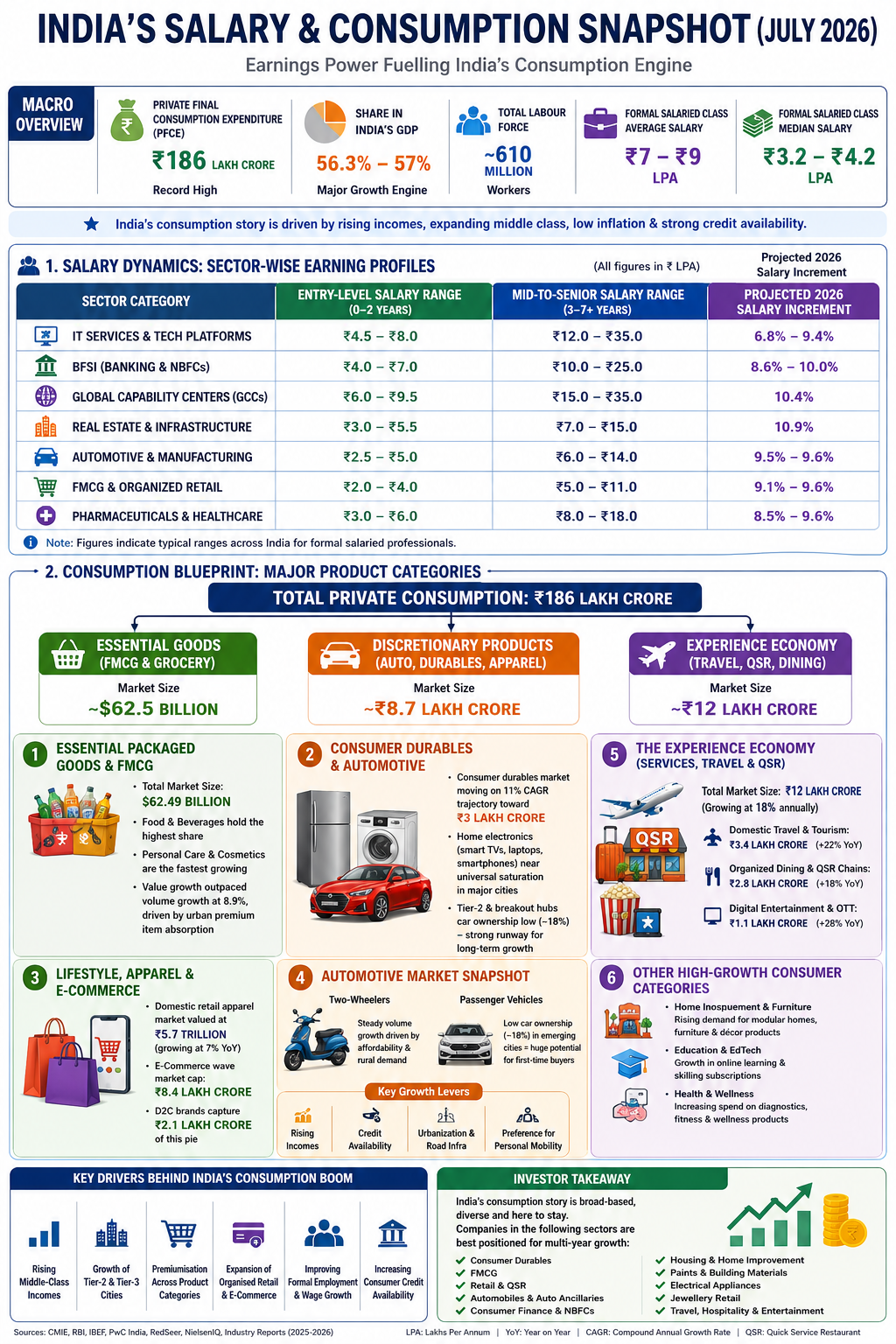
India’s Salary & Consumption Snapshot (July 2026)
Sector-wise Salary Trends (Approx.)
| Sector | Entry-Level | Mid/Senior |
|---|---|---|
| IT & Technology | ₹4.5–8 LPA | ₹12–35 LPA |
| BFSI | ₹4–7 LPA | ₹10–25 LPA |
| Global Capability Centres (GCCs) | ₹6–9.5 LPA | ₹15–35 LPA |
| Real Estate & Infrastructure | ₹3–5.5 LPA | ₹7–15 LPA |
| Auto & Manufacturing | ₹2.5–5 LPA | ₹6–14 LPA |
| FMCG & Retail | ₹2–4 LPA | ₹5–11 LPA |
| Pharma & Healthcare | ₹3–6 LPA | ₹8–18 LPA |
🛒 Major Consumption Categories
- FMCG & Grocery: India’s FMCG sector continues to grow steadily, supported by premiumisation, urban recovery and rural demand. Food & beverages, personal care and home care remain the largest categories.
- Consumer Durables: Demand for air conditioners, refrigerators, washing machines and smart appliances is expected to rise as incomes increase, particularly in Tier-2 and Tier-3 cities.
- Automobiles: Low vehicle ownership in emerging cities leaves significant room for first-time purchases, supporting long-term growth for passenger vehicles and two-wheelers.
- Apparel & Retail: Organised retail, fashion brands and e-commerce continue to benefit from rising disposable incomes and premium consumption trends.
- Travel, QSR & Entertainment: Spending on travel, dining, quick-service restaurants and digital entertainment is rising as consumers allocate more income to experiences rather than essentials.
Track Live : Live Stock Screener for Indian Markets
Stocks & Sectors That Could Benefit
The PRICE–Tata Sons “The Many Urban Indias” report suggests that rising incomes and stronger consumer spending in Tier-2 and Tier-3 cities could support a multi-year consumption cycle across several sectors.
- Consumer Durables & Electricals: Air conditioners, refrigerators, washing machines and home appliances could see higher demand as household incomes rise.
- Retail & QSR: Organised retailers, apparel chains, supermarkets and quick-service restaurants may benefit from increasing discretionary spending.
- FMCG: Packaged foods, personal care and household products are expected to gain from wider consumption across emerging cities.
- Automobiles & Auto Ancillaries: Low vehicle ownership in many breakout cities leaves significant room for first-time car and two-wheeler purchases.
- Consumer Finance & NBFCs: Retail lenders, vehicle financiers and consumer durable financing companies could benefit from rising credit demand.
- Housing & Home Improvement: Growth in home ownership may boost demand for housing finance, sanitaryware, tiles and home improvement products.
- Paints & Building Materials: Decorative paints, cement, pipes, plywood and construction materials could gain as residential construction accelerates.
- Jewellery Retail: Organised gold and diamond retailers may benefit from rising disposable incomes and higher spending during weddings and festivals.