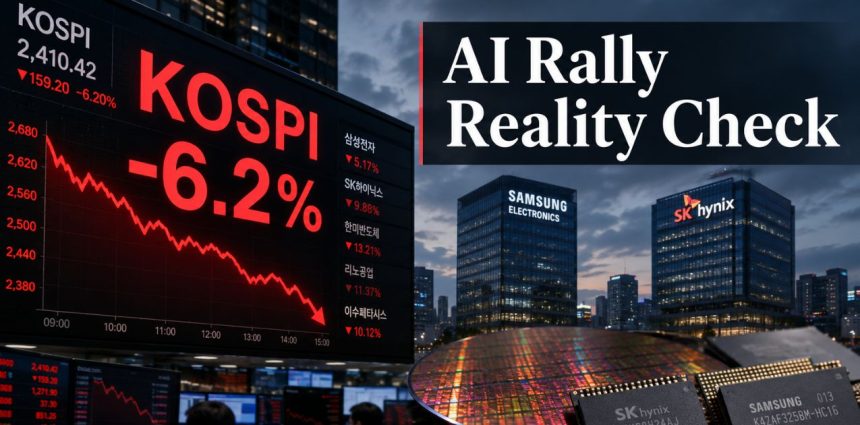
South Korea’s Kospi suffered a sharp selloff on Tuesday as investors dumped AI-linked chip stocks despite strong earnings expectations from Samsung Electronics. The selloff has raised a bigger question for global markets: is the AI trade finally showing signs of overheating?
Samsung, SK Hynix Lead the Slide
The benchmark Kospi was down 505 points, or 6.2%, at 7,546.10 during Tuesday’s session, with heavyweight semiconductor stocks driving the decline.
Samsung Electronics fell 7.47% even after projecting a 19-fold year-on-year jump in second-quarter operating profit, a forecast that alone exceeds the company’s combined profit over the previous three years, powered by record memory chip prices.
SK Hynix dropped 6.70%. Together, the two chipmakers account for more than half of the Kospi’s total index weight, meaning their slide did outsized damage to the broader market.
Adding to the sector’s turbulence, SK Hynix is reportedly moving ahead with a roughly $28 billion US share sale, planning to list American Depositary Receipts on Nasdaq under the ticker SKHY, a move that could become one of the largest foreign listings in the US market if it goes through.
Also Read: Samsung Hits $1 Trillion as KOSPI Breaks 7000 Record
Sidecar Curb Triggered as Selling Intensifies
The speed of Tuesday’s decline was sharp enough to trip South Korea’s automatic “sidecar” mechanism, which temporarily suspends programme trading to slow algorithm-driven selling. Of the 910 stocks traded during the session, 357 advanced while 511 declined, showing the weakness went well beyond just the chip counters.
Battery, Shipbuilding and Auto Stocks Also Hit
The damage wasn’t confined to semiconductors. LG Energy Solution fell 6.77% after flagging a 77% drop in April-June operating profit on soft EV demand.
Hanwha Ocean was the day’s biggest loser, plunging 22.91% after Canada picked German submarines over South Korean bids in a closely watched defence contract.
Hyundai Motor lost 6.57% and affiliate Kia Corp fell 5.66%, while steelmaker POSCO Holdings slipped 3.27%. Samsung BioLogics was comparatively resilient, down just 0.57%.
Foreign Investors Keep Selling
Foreign institutional investors extended their selling streak, offloading shares worth 1.3 trillion won (about $851.45 million) during the session, a sign overseas funds are trimming exposure just as domestic sentiment sours.
Check Live: FII DII DATA | NIFTYTRADER
Kospi’s Concentration Problem
Tuesday’s crash exposes a structural weakness that goes beyond one bad session. The Kospi’s 2026 rally has been driven almost entirely by two stocks, Samsung Electronics and SK Hynix, which together make up more than half the index.
That concentration works brilliantly on the way up, but it means the entire benchmark is now hostage to sentiment around a single theme: AI memory demand. When doubt creeps into that narrative, there’s no diversification cushion to soften the fall, which is exactly what played out this week.
Is the Global AI Rally Overdone?
The bigger question extends beyond Seoul. South Korean chipmakers sit at the center of the global AI hardware supply chain, supplying the memory that powers AI infrastructure worldwide.
A sharp reversal in Samsung and SK Hynix is worth watching for Nasdaq-listed semiconductor names, memory chip suppliers, and broader Asian tech markets riding the same AI wave.
Adding to the pressure, reports suggest Apple is exploring sourcing chips from two Chinese semiconductor manufacturers, a development that could intensify competitive threats to both Korean giants.
If global investors start applying the same scrutiny elsewhere, Tuesday’s selloff may prove an early tremor rather than an isolated event.
Why Indian Investors Should Watch This
Samsung and SK Hynix are central to the global AI memory supply chain, so weakness here can ripple into sentiment across Asian technology counters, Nasdaq futures, and global risk appetite. If the correction spreads, Indian IT stocks, semiconductor ancillary players, and auto component makers tied to global chip supply chains could see more cautious sentiment in the sessions ahead, even without any direct fundamental read-through.
Kospi Still World’s Best Performer in 2026
Despite the rout, the Kospi remains the best-performing major index globally this year, up 76% year-to-date, largely on the AI-linked chip rally. That same concentration is now working against the market: with Samsung and SK Hynix commanding such heavy index weight, any wobble in AI sentiment quickly translates into outsized swings for the entire benchmark.
Bottom Line
Tuesday’s 6% drop wasn’t triggered by weak earnings; it was triggered by doubts over whether stellar earnings can keep repeating. With foreign investors selling, a heavily concentrated index structure, and competitive threats from Chinese chipmakers entering the conversation, the Kospi’s AI-fuelled rally is facing its first real stress test of 2026, one that global and Indian markets alike would do well to watch closely.