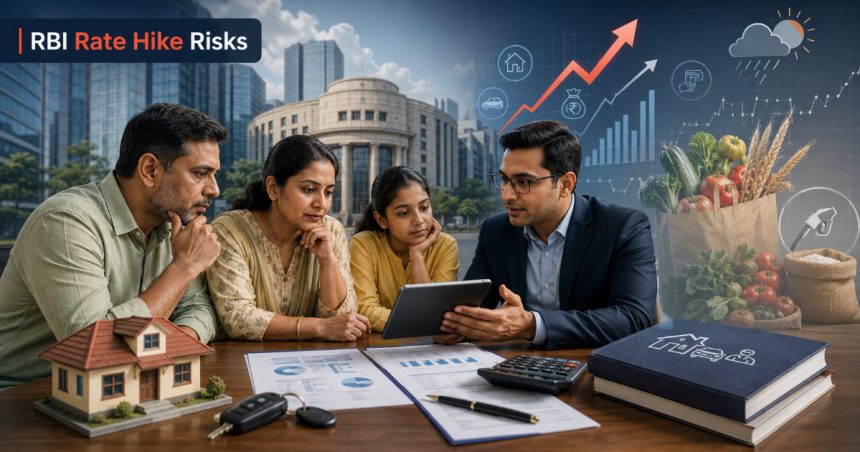
RBI Rate Hike Risk Returns as Inflation May Push Interest Rates Higher
Could your home loan or car loan become more expensive by the end of this year? While the Reserve Bank of India (RBI) is expected to leave interest rates unchanged in the coming months, a new report from BofA Securities suggests inflation risks could force the central bank to raise rates later in 2026. The outlook has important implications for borrowers, banks, NBFCs and stock market investors.
BofA Securities Sees RBI Holding Rates Before Tightening Later This Year
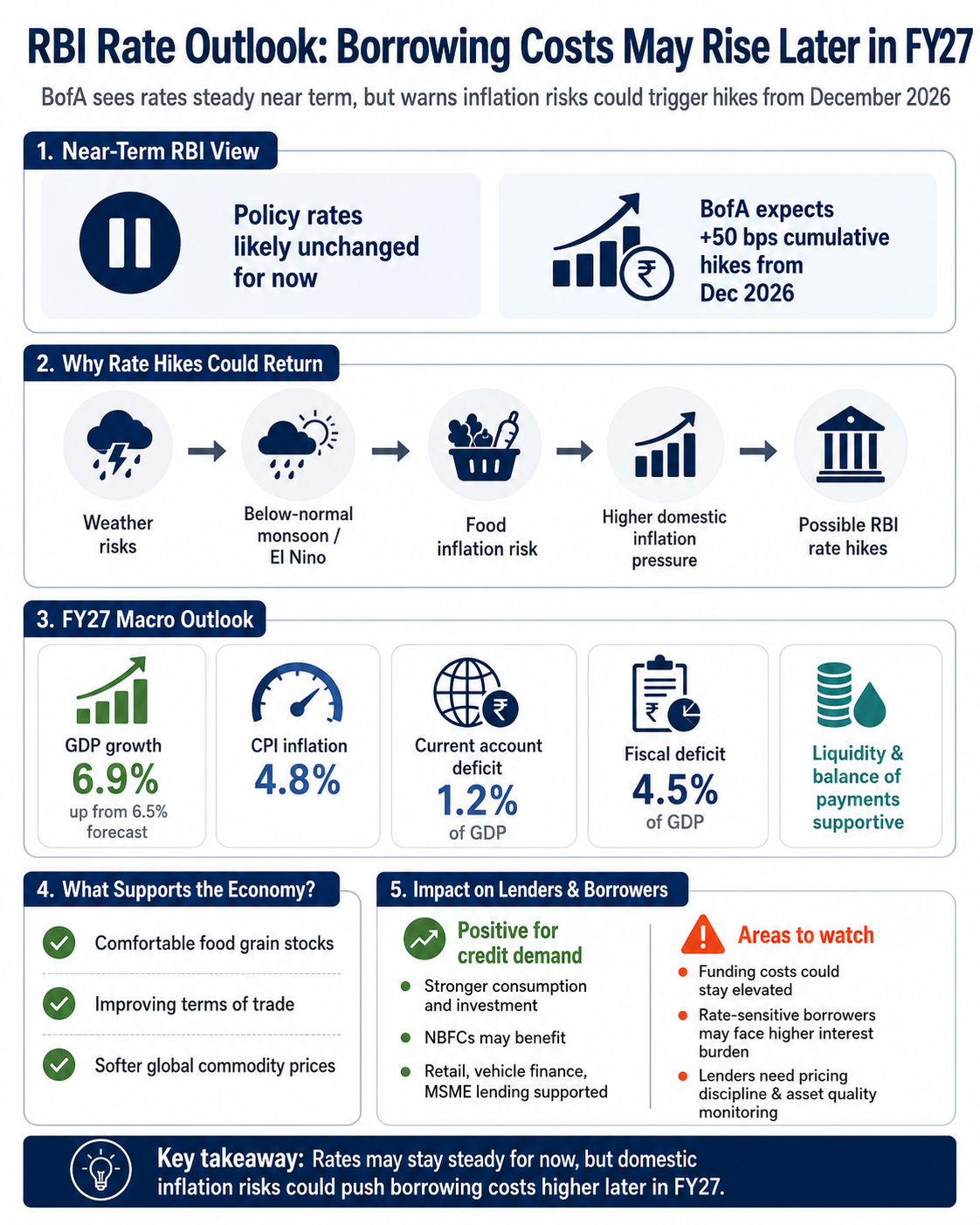
The RBI is likely to maintain the current policy rate in the near term as inflation remains broadly under control.
However, BofA Securities expects the central bank to deliver a cumulative 50 basis points (bps) of RBI rate hikes beginning in December 2026, as inflation risks become increasingly driven by domestic factors rather than global events.
The report says macroeconomic risks have shifted from geopolitical tensions to local weather conditions, making the upcoming monsoon and food prices critical for future monetary policy.
Stronger Economic Growth Gives RBI More Room to Fight Inflation
The report has raised India’s FY27 GDP growth forecast to 6.9%, up from 6.5%, reflecting stronger consumer spending and improving investment activity.
A healthier economy generally supports credit demand but also increases the possibility of inflationary pressures if demand outpaces supply.
BofA expects FY27 CPI inflation to average 4.8%, but warns that the second half of the financial year could become more challenging.
Read More : Biscuits, Soaps and Juices May Avoid Fresh Price Hikes as FMCG Firms Wait
RBI Repo Rate History (Last 5 Years: July 2021 – July 2026)
The RBI’s monetary policy over the past five years can be divided into three phases: pandemic-era accommodation (2021–April 2022), aggressive inflation-fighting rate hikes (May 2022–February 2023), and easing with subsequent policy pause (2025–July 2026). As of July 2026, the repo rate stands at 5.25% after cumulative rate cuts in 2025 and an unchanged stance through 2026.
| Effective Date | Repo Rate | Action | Key Reason |
|---|---|---|---|
| Jul 2021 – Apr 2022 | 4.00% | Hold | Pandemic-era support for economic recovery |
| 04 May 2022 | 4.40% | +40 bps | Off-cycle hike as inflation surged |
| 08 Jun 2022 | 4.90% | +50 bps | Inflation breached RBI’s tolerance band |
| 05 Aug 2022 | 5.40% | +50 bps | Continued tightening |
| 30 Sep 2022 | 5.90% | +50 bps | Persistent food and fuel inflation |
| 07 Dec 2022 | 6.25% | +35 bps | Moderating but elevated inflation |
| 08 Feb 2023 | 6.50% | +25 bps | Final hike of the tightening cycle |
| Feb 2023 – Jan 2025 | 6.50% | Hold | Inflation control and policy stability |
| 07 Feb 2025 | 6.25% | −25 bps | First rate cut after two-year pause |
| 09 Apr 2025 | 6.00% | −25 bps | Inflation eased further |
| 06 Jun 2025 | 5.50% | −50 bps | Larger cut to support growth |
| 05 Dec 2025 | 5.25% | −25 bps | Continued easing cycle |
| Feb 2026 – Jul 2026 | 5.25% | Hold | Neutral stance amid inflation and monsoon risks |
Critical Analysis of the Rate Action
- Total Tightening Velocity: During the high-inflation shock window of 2022–2023, the Monetary Policy Committee (MPC) deployed a cumulative hike of 250 basis points over just 10 months to prevent hyper-inflation.
- The 2025 Retraction Loop: After leaving rates at a peak of 6.50% for two full years, the RBI slashed rates by a cumulative 125 basis points throughout 2025 to stimulate expansion as localized consumer price indices stabilized.
- Current Status (July 2026): The policy corridor is currently on a strict hold at 5.25%. Institutional analysts predict that if local weather disruptions or El Niño anomalies trigger secondary consumer basket shocks later this year, the RBI is positioned to pause further relief or reverse into structural hikes.
How Much Have Home Loan EMIs Changed in the Last 5 Years?
The RBI’s 250 basis point (2.5%) repo rate hike cycle during 2022–2023 significantly increased borrowing costs before the central bank cut rates by 125 bps in 2025. As a result, EMIs today remain above the pandemic-era lows, although they are lower than the peak seen in 2023–24.
EMI Impact on a ₹50 Lakh Home Loan (20-Year Tenure)
| Period | Typical Home Loan Rate | Monthly EMI | Change vs 2021 |
|---|---|---|---|
| Mid-2021 (Pandemic Low) | 6.75% | ₹38,018 | — |
| 2023–2024 (Peak Rate Cycle) | 9.25% | ₹45,793 | ▲ ₹7,775/month |
| July 2026 (Current) | 8.00% | ₹41,822 | ▲ ₹3,804/month |
Key Takeaways
- Peak impact (2023–24): A ₹50 lakh home loan EMI increased by about ₹7,775 per month, adding nearly ₹93,300 a year to household repayments.
- Current position (July 2026): After RBI’s 125 bps rate cuts in 2025, the EMI has reduced by around ₹3,971 from the peak, but it is still about ₹3,804 per month higher than during the low-rate period of 2021.
Why Many Borrowers Didn’t See Higher EMIs
Instead of immediately increasing EMIs, several lenders chose to extend the loan tenure for floating-rate borrowers. This kept monthly repayments relatively stable but increased the total interest paid over the life of the loan, with some 20-year loans extending to 24–27 years depending on the lender and borrower profile.
Current Stock Prices (Closing – 10 July 2026)
Track Live : All Listed Stocks In NSE
| Company | Current Price (₹) |
|---|---|
| HDFC Bank | 824.95 |
| ICICI Bank | 1,401.20 |
| State Bank of India (SBI) | 1,036.00 |
| Hindustan Unilever (HUL) | 2,150.60 |
| Nestlé India | 1,455.20 |
| Dabur India | 443.50 |
| Britannia Industries | 5,353.00 |
| Godrej Consumer Products (GCPL) | 1,088.40 |
| Marico | 852.50 |
| Tata Consumer Products | 1,111.90 |
| ITC | 281.75 |
These are the latest available closing prices for 10 July 2026 from current market data.
Monsoon and El Nino Could Become the Biggest Inflation Drivers
According to the report, the biggest risk to inflation is no longer global commodity prices but domestic weather conditions.
Below-normal monsoon rainfall and rising El Nino risks could push up food prices during the second half of FY27 and slow rural economic activity.
At the same time, comfortable food grain stocks, softer global commodity prices and improving terms of trade are expected to cushion some of the inflationary impact.
Fiscal and External Balance
- CAD Improvement: The current account deficit is expected to narrow to 1.2 per cent of GDP in FY27, helped by lower crude oil prices.
- Fiscal Deficit: India’s fiscal deficit is projected to hold steady at 4.5 per cent of GDP.
- Credit Growth: Supportive liquidity and a strong balance of payments will keep credit lines healthy.
India’s External Position Continues to Improve
The report remains optimistic about India’s macroeconomic fundamentals.
BofA Securities expects the current account deficit to narrow to 1.2% of GDP in FY27, supported by lower crude oil prices.
The fiscal deficit is projected to remain at 4.5% of GDP, while comfortable liquidity and a stronger balance of payments position are expected to support overall credit growth.
NBFCs Could Benefit Despite Higher Interest Rate Risks
The improving economic outlook is expected to support NBFCs, particularly those focused on:
- Retail lending
- Vehicle finance
- MSME financing
Higher consumption and investment demand are likely to boost loan growth across these segments.
However, the report cautioned that any future RBI rate hike could increase borrowing costs for lenders, making liability management and pricing discipline increasingly important.
Here’s What Happened Today and Why Traders Reacted
The report reassured investors that the RBI is unlikely to change interest rates immediately.
However, expectations of a possible 50 bps RBI rate hike from December have shifted market attention toward inflation risks, particularly food inflation linked to weather conditions.
Investors are now closely tracking monsoon progress, inflation data and future RBI policy commentary for clues on the interest-rate cycle.
What Could Be the Market Impact?
The possibility of future RBI rate hikes could create mixed reactions across sectors.
Banking stocks may benefit from improved lending margins if loan growth remains healthy. However, higher interest rates could also slow borrowing demand over time.
Rate-sensitive sectors such as real estate, automobiles and consumer durables may face pressure if borrowing costs rise, while defensive sectors could remain relatively resilient.
NBFCs with strong balance sheets, diversified funding sources and disciplined lending practices are expected to be better positioned if funding costs increase.
What Does It Mean for Borrowers and Investors?
For borrowers, the report signals that loan EMIs may remain stable in the near term, but the risk of higher borrowing costs later this year cannot be ignored if inflation accelerates.
For investors, the focus should remain on monthly inflation data, monsoon performance and upcoming RBI monetary policy meetings. If food inflation stays under control, the central bank may continue to hold rates. But if inflation rises sharply, a rate hike from December 2026 could become increasingly likely, influencing banks, NBFCs and other interest rate-sensitive sectors.