Key Takeaways
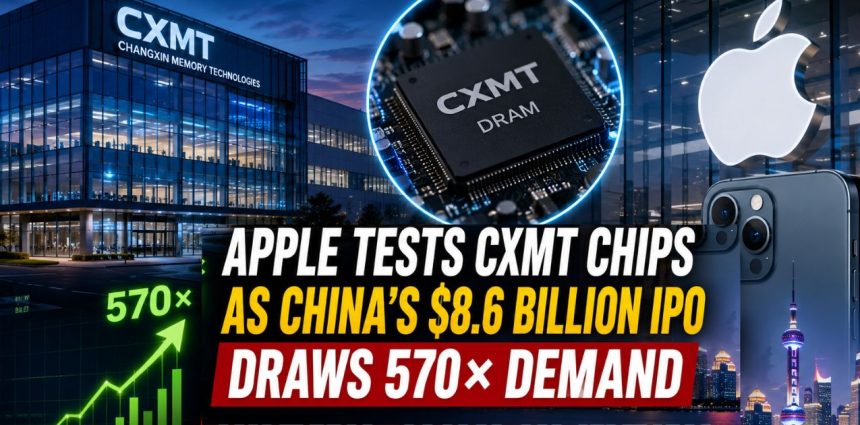
- China’s largest DRAM maker CXMT drew institutional bids worth 1.24 trillion shares against 2.17 billion shares on offer, an oversubscription of roughly 570 times
- The $8.6 billion Shanghai STAR Market IPO is the second-largest on the exchange since 2019, but demand trailed recent STAR Market debuts that crossed 5,000x
- Retail investors subscribed 243.93 times, also softer than earlier blockbuster Chinese tech IPOs
- The STAR Market has slumped roughly 25% since its July 1 peak, erasing over 4 trillion yuan (about $590 billion) in value
- CXMT swung from a ¥19.23 billion loss in 2023 to its first annual profit in 2025, with Q1 2026 revenue up 719% YoY
- Shares are set to list on July 27, becoming a key test of appetite before more Chinese tech IPOs
- The listing is a useful sentiment gauge for India’s own semiconductor push at Dholera and Sanand
Institutional Books Close 570 Times Covered
Chinese memory chipmaker CXMT Corp locked in institutional bids worth 1.24 trillion shares against just 2.17 billion shares reserved for funds, insurers and pension managers in its IPO, translating into an oversubscription ratio of roughly 570 times, according to a Sunday filing.
For an $8.6 billion raise, the second-largest on Shanghai’s STAR Market since its 2019 launch, after chip foundry SMIC’s 2020 listing, that’s a strong show of institutional confidence in China’s memory-chip ambitions.
Yet the number tells only half the story. Three other STAR Market IPOs this year, Zhuhai Trinomab Pharmaceutical, Chongqing Genori Technology and Wuhan Changjin Photonics, each drew institutional demand exceeding 5,000 times their offered shares.
Against that yardstick, the CXMT IPO’s 570x looks comparatively restrained, a signal that even China’s most closely watched chip listing isn’t immune to the caution sweeping global semiconductor markets.
CXMT IPO Snapshot
| Metric | Detail |
|---|---|
| IPO Size | $8.6 billion (~RMB 57.9 billion) |
| Issue Price | RMB 8.66 per share |
| Shares Offered (Institutional) | 2.17 billion shares |
| Institutional Shares Subscribed | 1.24 trillion shares |
| Institutional Oversubscription | ~570× |
| Retail Oversubscription | 243.93× |
| Exchange | Shanghai STAR Market |
| Expected Listing Date | July 27, 2026 (Unofficial) |
| Market Rank | 2nd-largest STAR Market IPO since 2019 |
Retail Investors Show Similar Restraint
The retail tranche of the CXMT IPO mirrored this pattern. CXMT disclosed earlier in the week that individual investors oversubscribed their portion by 243.93 times, solid by any normal IPO standard, but noticeably cooler than the retail frenzy that has driven several recent Chinese tech listings.
Together, the institutional and retail books point to a market still willing to back CXMT’s growth story, just not at any price.
A Global Chip Stock Rout Is the Real Backdrop
The CXMT IPO isn’t landing in a vacuum. Semiconductor stocks worldwide have been under sustained pressure as investors reassess whether valuations built on the AI infrastructure boom ran too far, too fast.
South Korea’s Kospi has been hit by three separate chip-led selloffs since early June, with Samsung Electronics and SK Hynix both falling by double digits even after Samsung posted a blockbuster quarterly profit.
Broadcom’s cautious AI chip guidance in June added to the unease, dragging chipmakers from Seoul to Silicon Valley lower as funds rotate out of the sector’s biggest winners.
Also Read: South Korea’s Kospi Plunges 6.6% as AI Stocks Slide
STAR Market Has Erased Nearly $590 Billion in Three Weeks
Nowhere is that repricing sharper than on Shanghai’s STAR Market, home to many of China’s leading chip companies and the exchange where the CXMT IPO will list.
The index has fallen roughly 25% from its July 1 peak, wiping out more than 4 trillion yuan, close to $590 billion, in market value in under three weeks.
That backdrop makes CXMT’s ability to still draw hundreds-of-times oversubscription notable, even if the multiple undershoots the standards set by earlier STAR Market debuts this year.
Check Live to explore: NIFTY 50, BANK NIFTY, GIFT NIFTY
CXMT’s Place in the Global DRAM Order
CXMT is China’s largest DRAM producer and the world’s fourth-biggest, trailing only Samsung Electronics, SK Hynix and Micron Technology.
Founded in 2016, the company counts Alibaba Cloud, ByteDance, Tencent, Lenovo and Xiaomi among its major clients, and its chips go into smartphones, PCs, servers and increasingly AI data-centre hardware, a segment where surging demand has tightened global memory supply and pushed up chip prices through 2026.
The turnaround shows up in CXMT’s own numbers too: the company swung from a loss of roughly 19.23 billion yuan in 2023 to its first full-year profit in 2025, and followed that with Q1 2026 revenue of about 50.8 billion yuan, a 719% jump from a year earlier, alongside net profit of roughly 24.76 billion yuan.
Regulators cleared the CXMT IPO for listing in just 148 days from application to approval, a record pace on the STAR Market that analysts read as Beijing prioritising the company’s capitalisation as industrial policy, part of a broader push to cut reliance on foreign chip technology.
CXMT Financial Turnaround
| Period | Figure |
|---|---|
| FY2023 | Net Loss: ~¥19.23 billion |
| FY2025 | First Full-Year Net Profit |
| Q1 2026 | Revenue: ~¥50.8 billion (+719% YoY) |
| Q1 2026 | Net Profit: ~¥24.76 billion |
Global DRAM Market Leaders
| Rank | Company | Country |
|---|---|---|
| 1 | Samsung Electronics | South Korea |
| 2 | SK Hynix | South Korea |
| 3 | Micron Technology | United States |
| 4 | CXMT (ChangXin Memory) | China |
Why This Matters for Indian Markets Too
The CXMT IPO is also a useful read on global chip-sector sentiment at a time when India is racing to build its own semiconductor base.
With Tata Electronics’ Dholera fab moving through high-volume trial runs and Micron shipping India-made memory modules from its Sanand facility, swings in global DRAM pricing and investor appetite for chip equity feed directly into the capital flowing toward India’s semiconductor and electronics manufacturing story.
A sustained cooling in global chip valuations could also influence how FIIs position India-linked technology and manufacturing plays in the sessions ahead.
What Traders Should Watch Next
CXMT’s shares are expected to begin trading on the STAR Market on July 27, though the company hasn’t made an official announcement confirming the date. That debut will be closely tracked as a barometer for a pipeline of other high-profile Chinese tech listings waiting in the wings.
A strong opening pop would suggest investors are separating CXMT’s fundamentals from the sector-wide selloff; a muted debut would reinforce concerns that the AI-driven chip rally has further to unwind before it stabilises.
NiftyTrader Desk View
| Parameter | View |
|---|---|
| Sentiment | Cautiously Positive |
| Key Trigger | July 27, 2026 STAR Market Listing Debut |
| Key Risk | Extended Global Semiconductor Stock Selloff |
| India Read-Through Watch | FII Flows Into India’s Semiconductor and Electronics Manufacturing Stocks |
| Investor Takeaway | Demand Remains Strong, but Investor Selectivity Is Increasing |
Track how global chip-sector volatility is shaping FII positioning in Indian markets on NiftyTrader’s live FII-DII Dashboard.
Bottom Line
The CXMT IPO ultimately confirms that capital is still available for China’s flagship semiconductor bets, even as the broader chip trade cools. The gap between this year’s frothiest STAR Market debuts and CXMT’s comparatively measured 570x institutional demand is itself the story, a sign that investors are turning more selective rather than walking away.
The July 27 listing, and how CXMT shares trade in the sessions that follow, will offer the clearest signal yet of whether global chip-stock nerves are easing or deepening.
Read Next: India’s 7-Billion-Litre Ethanol Surplus Could Finally Find a New Home
FAQs
Q1. How big is the CXMT IPO?
CXMT’s Shanghai STAR Market IPO is worth $8.6 billion (about RMB 57.9 billion), making it the second-largest STAR Market listing since 2019.
Q2. How oversubscribed was the CXMT IPO?
Institutional investors subscribed 1.24 trillion shares against 2.17 billion shares on offer, an oversubscription of roughly 570 times. The retail portion was oversubscribed 243.93 times.
Q3. When will CXMT shares start trading?
CXMT is expected to list on the Shanghai STAR Market on July 27, 2026, though the company hasn’t officially confirmed the date.
Q4. Why did the CXMT IPO see weaker demand than other STAR Market listings?
A global selloff in semiconductor stocks, triggered by valuation concerns around the AI infrastructure boom, has made investors more selective even toward strong listings like CXMT.
Q5. Where does CXMT rank among global DRAM makers?
CXMT is China’s largest DRAM producer and the world’s fourth-largest, behind Samsung Electronics, SK Hynix and Micron Technology.
Q6. Is the CXMT IPO relevant for Indian investors?
Indirectly, yes. Global DRAM pricing and chip-sector sentiment influence capital flows into India’s own semiconductor push, including Tata Electronics’ Dholera fab and Micron’s Sanand facility.
Q7. How much has the STAR Market fallen amid the chip selloff?
The STAR Market has dropped about 25% from its July 1, 2026 peak, erasing more than 4 trillion yuan (~$590 billion) in market value.
Disclaimer: This article is for informational purposes only and does not constitute investment advice. CXMT is listed on a foreign exchange; NiftyTrader.in does not recommend buying, selling or trading any security mentioned. Please consult a SEBI-registered financial advisor before making investment decisions. Data verified against company filings and wire reports as of July 19–20, 2026.