
South Korea’s stock market witnessed one of its sharpest declines in years on Tuesday as the KOSPI Plunges 11%, dragged down by a steep selloff in heavyweight chipmakers Samsung Electronics and SK Hynix. The decline came as investors grew increasingly concerned about China’s rapidly expanding semiconductor capabilities following the blockbuster market debut of ChangXin Memory Technologies (CXMT).
The sharp correction triggered market-wide trading curbs and wiped out billions in market value, highlighting how sensitive South Korea’s equity market has become to developments in the global semiconductor industry. With Samsung and SK Hynix accounting for more than half of the KOSPI’s weight, the weakness quickly spread across the broader market.
Track Live : GIFT Nifty Live – Today Price, Chart, Timings and Nifty Opening Signal
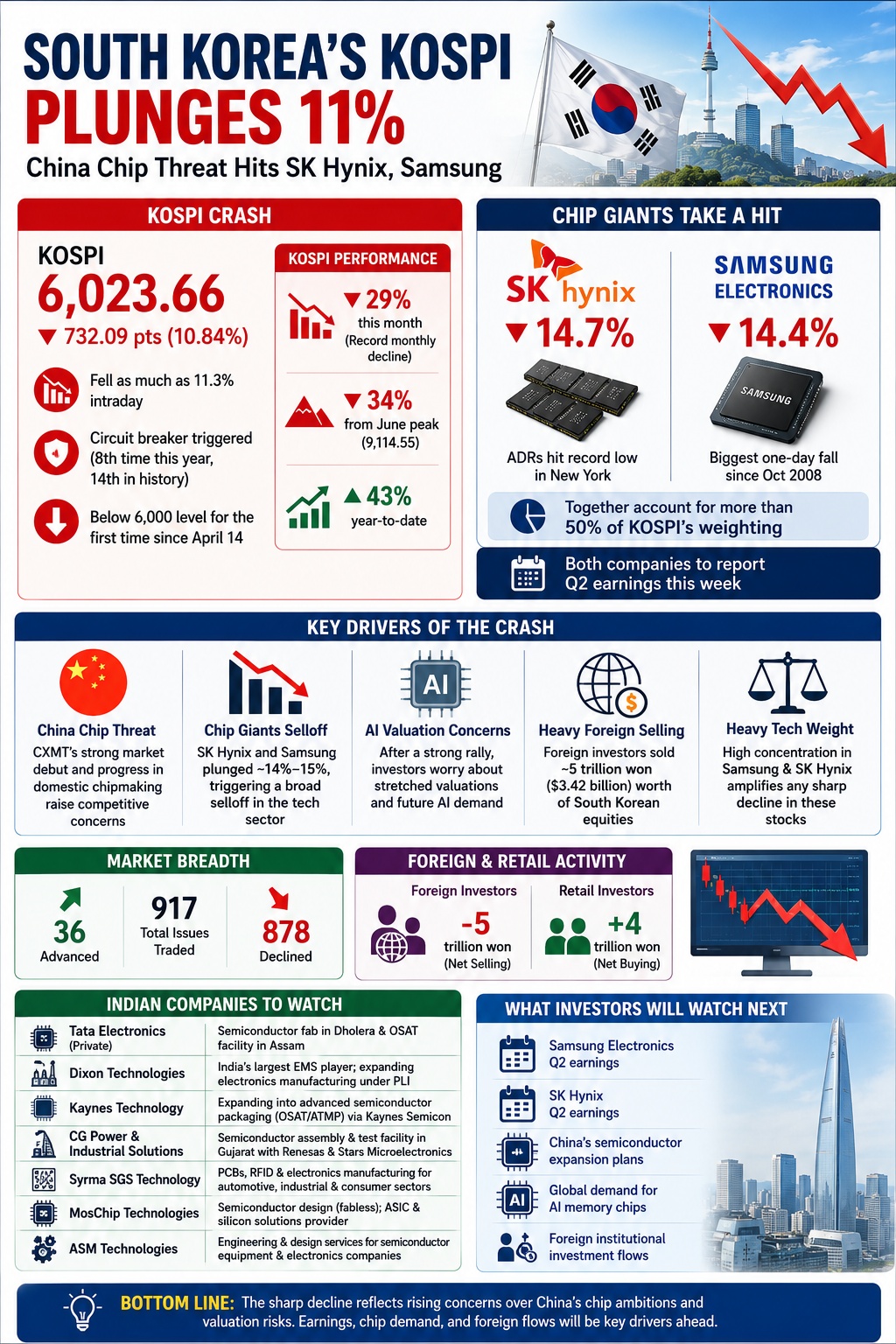
KOSPI Plunges 11% as Chip Stocks Lead the Market Lower
The benchmark KOSPI ended the session at 6,023.66, down 732.09 points, or 10.84%, marking its worst single-day performance in nearly five months.
During intraday trade, the index dropped as much as 11.3%, forcing authorities to activate a market-wide circuit breaker for the eighth time this year and the 14th time in the exchange’s history.
The selloff also pushed the KOSPI below the psychologically important 6,000 mark for the first time since April 14.
The benchmark has now declined 29% this month, exceeding its previous record monthly fall of 27% recorded during the Asian Financial Crisis in October 1997. Despite the recent correction, the index remains 43% higher on a year-to-date basis, although it has fallen 34% from its June peak of 9,114.55.
The selloff has been severe throughout July:
- Down 29% this month, surpassing the previous record monthly decline of 27% in October 1997.
- Down 34% from its June peak of 9,114.55.
- Still up 43% year-to-date despite the recent correction.
Samsung and SK Hynix Bear the Brunt of the Selloff
The biggest pressure came from South Korea’s two semiconductor giants.
SK Hynix plunged 14.7% after its American Depositary Receipts (ADRs) fell to a record low in New York and slipped below their original U.S. listing price.
Samsung Electronics dropped 14.4%, recording its biggest one-day decline since October 2008.
The sharp losses were magnified because the two companies together account for more than half of the KOSPI’s total weighting, making their movements highly influential on the overall index.
Investors are now awaiting the companies’ second-quarter earnings, scheduled later this week, for clarity on demand trends and profitability.
Read More : Bharat Electronics Q1: Revenue Up 25%, Profit Up 8%, But Margins Miss — Stock Falls 4%
The pressure was concentrated in South Korea’s largest chipmakers.
- SK Hynix plunged 14.7%
- Samsung Electronics tumbled 14.4%
Together, the two companies account for more than half of the KOSPI’s weighting, magnifying the impact on the broader market.
Both companies are also scheduled to report quarterly earnings later this week, adding to investor caution.
Track Live : Nifty Levels Today
Key Drivers of the Crash
- China’s semiconductor threat intensified: Investors grew increasingly concerned that China’s chip industry is advancing faster than expected following ChangXin Memory Technologies’ (CXMT) blockbuster market debut and reports of progress in domestic chipmaking equipment.
- Sharp selloff in Samsung and SK Hynix: South Korea’s two largest memory-chip makers plunged around 14%–15%, triggering widespread selling across the technology sector ahead of their quarterly earnings.
- AI chip valuation concerns: After a prolonged rally in AI-related semiconductor stocks, investors reassessed whether valuations had become too stretched amid rising competition and uncertainty over future AI infrastructure spending.
- Heavy foreign institutional selling: Overseas investors sold approximately 5 trillion won (about $3.42 billion) worth of South Korean equities, accelerating the market decline despite buying from domestic retail investors.
- KOSPI’s heavy tech concentration amplified losses: Samsung Electronics and SK Hynix together account for more than half of the KOSPI’s weighting, meaning their steep declines dragged the entire index sharply lower.
China’s Semiconductor Progress Raises Competitive Concerns
The market reaction was driven not only by the global technology selloff but also by growing concerns over China’s progress in semiconductor manufacturing.
Investor sentiment weakened after ChangXin Memory Technologies (CXMT) made a strong stock market debut, reinforcing expectations that China could accelerate its expansion in the memory chip industry.
Reports that a Chinese state-backed company has started producing immersion DUV lithography equipment further heightened concerns about China’s efforts to reduce reliance on foreign semiconductor technology.
Kim Seok-hwan, a market analyst at Mirae Asset Securities, said the market’s concern extends beyond CXMT’s current financial performance.
“The market’s concern lies less in CXMT’s current earnings and more in its potential for accelerated capacity expansion to rival Korean companies and technology development following its IPO,” he said.
Analysts believe investors are increasingly questioning whether South Korea can maintain its long-standing leadership in the global memory semiconductor market as Chinese competitors expand production capacity.
Foreign Investors Accelerate Selling
Foreign institutional investors remained aggressive sellers throughout the session.
They sold approximately 5 trillion won ($3.42 billion) worth of South Korean equities, adding further pressure on the market.
Retail investors attempted to absorb some of the selling by purchasing around 4 trillion won worth of shares, but their buying was insufficient to offset the heavy foreign outflows.
Market breadth also reflected the severity of the selloff.
Out of 917 actively traded stocks, only 36 advanced, while 878 declined, highlighting widespread weakness across sectors.
Indian Companies That Could Be in Focus After the KOSPI Selloff
The sharp correction in South Korean semiconductor stocks could put the spotlight on India’s fast-growing electronics and semiconductor ecosystem. While the global chip selloff may create short-term volatility, companies building domestic chip manufacturing, packaging, and electronics capabilities could remain in focus as investors reassess global supply chains and India’s long-term opportunity.
| Company | Segment | Why It Could Be in Focus |
|---|---|---|
| Tata Electronics (Private) | Semiconductor Fab & OSAT | Building India’s semiconductor fabrication plant in Dholera and semiconductor assembly & test facility in Assam, making it central to India’s chip manufacturing ambitions. |
| Dixon Technologies | Electronics Manufacturing Services (EMS) | India’s largest listed EMS company, expanding mobile phones, laptops and electronic component manufacturing under the PLI scheme. |
| Kaynes Technology | EMS & Semiconductor Packaging | Expanding into advanced semiconductor assembly and testing (OSAT/ATMP) through Kaynes Semicon, strengthening India’s domestic chip ecosystem. |
| CG Power & Industrial Solutions | Semiconductor Assembly (OSAT) | Developing a semiconductor assembly and test facility in Gujarat with Renesas Electronics and Stars Microelectronics, positioning itself as a key semiconductor manufacturing player. |
| Syrma SGS Technology | Electronics Manufacturing | Manufactures PCBs, RFID products and electronic systems for automotive, industrial and consumer electronics, benefiting from electronics localization. |
| MosChip Technologies | Chip Design (Fabless) | A leading Indian semiconductor design company providing ASIC, silicon engineering and embedded solutions for global semiconductor firms. |
| ASM Technologies | Semiconductor Engineering Services | Provides engineering, product development and design services to semiconductor equipment manufacturers and electronics companies, making it a niche beneficiary of semiconductor investments. |
Here’s What Happened Today and Why Traders Reacted
The market reacted sharply as investors reassessed the competitive landscape of the global semiconductor industry.
China’s rapid progress in memory chip manufacturing, coupled with the successful listing of CXMT and reports of domestic lithography equipment production, raised concerns that South Korean chipmakers could face stronger competition in the coming years.
At the same time, global weakness in semiconductor stocks and heavy foreign institutional selling amplified the decline.
Since Samsung Electronics and SK Hynix represent the largest weights in the KOSPI, their sharp losses triggered broader market selling and forced automatic trading curbs through circuit breakers and sidecar mechanisms.
What Does This Mean for Global Investors?
The sharp decline highlights how closely South Korea’s equity market is tied to the global semiconductor cycle.
Investors will now closely monitor:
- Samsung Electronics’ second-quarter earnings.
- SK Hynix’s earnings and guidance.
- China’s semiconductor expansion plans.
- Global demand for AI memory chips.
- Foreign institutional investment flows.
Any signs of improving demand or stronger-than-expected earnings could help stabilize sentiment, while continued concerns over China’s technological progress may keep volatility elevated.