Sensex Closing Auction Fuels Volatility, Index Swings 2,100 Points Before Closing 417 Points Lower
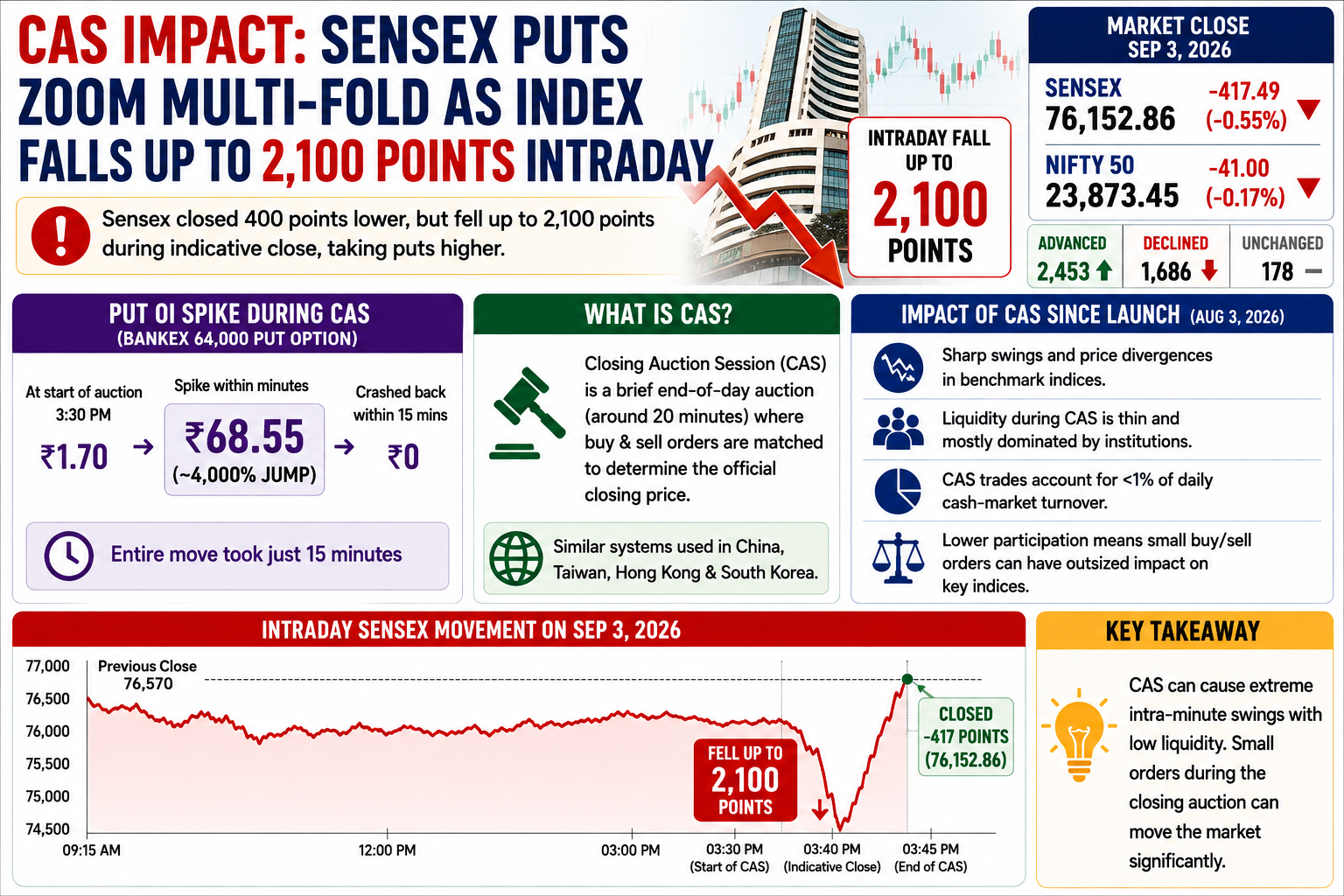
The Sensex fell as much as 2,100 points during the indicative close on September 3, creating a dramatic surge in put option prices before the benchmark index settled at a much smaller loss.
The sharp move once again put the spotlight on the Closing Auction Session (CAS) and its impact on derivatives trading. While the Sensex eventually closed just 417 points lower, the temporary plunge during the auction caused some Sensex puts to jump multi-fold.
For options traders, the episode highlights a growing concern: thin liquidity during the CAS can amplify relatively small orders and create extreme short-term price movements.
Track Live : Opening Price Clues – What Pre-Market Data Says Today
Sensex Closing Auction Fuels Volatility, ends 417 points lower after a much sharper indicative fall
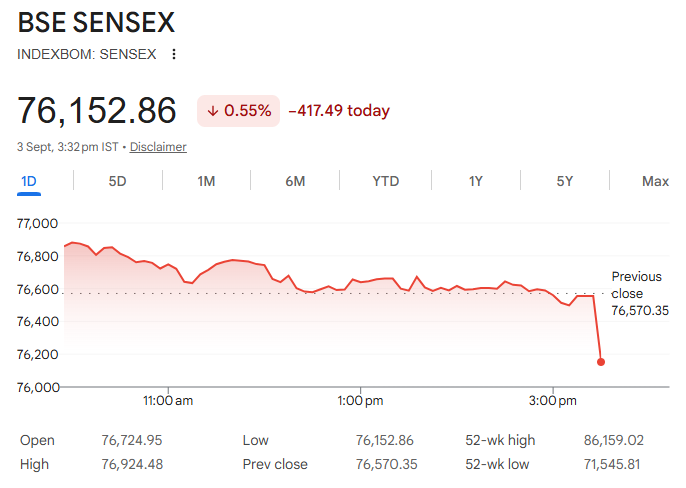
The Sensex closed 417.49 points, or 0.55%, lower at 76,152.86 on September 3.
The Nifty also ended in the red, falling 41 points, or 0.17%, to 23,873.45.
Market breadth was relatively mixed, with 2,453 shares advancing, 1,686 declining and 178 remaining unchanged.
But the closing numbers did not capture the full volatility seen during the post-CAS indicative close.
The Sensex briefly fell as much as 2,100 points, creating a sharp repricing in put options linked to the benchmark.
Bankex put option had earlier surged nearly 4,000%
The September 3 episode comes shortly after another extreme example during the first monthly expiry at BSE under the new system.
A Rs 64,000 put option linked to Bankex was trading at just Rs 1.70 when the auction started.
Within minutes, its price jumped to Rs 68.55, representing an increase of nearly 4,000%.
The option then crashed back to zero.
The entire move unfolded within approximately 15 minutes, highlighting the extraordinary price swings that can occur when liquidity is limited.
For options traders, such movements can produce significant gains or losses within a very short period.
What is the Closing Auction Session and why is it causing volatility?
The CAS was introduced on August 3 as a brief end-of-day auction in which buy and sell orders are matched to determine the official closing price of stocks.
The mechanism replaced the earlier method of calculating closing prices using the average price of trades executed during the final 30 minutes of continuous trading.
Regulators introduced the CAS to bring India’s market structure closer to global practices. Similar closing auction mechanisms are used in markets including China, Taiwan, Hong Kong and South Korea.
However, the Indian implementation has faced concerns over liquidity and price stability.
Thin CAS liquidity can amplify small orders
The biggest issue for traders is the relatively low participation during the auction.
Exchange data showed CAS trades accounted for less than 1% of daily cash-market turnover and less than one-third of the volumes recorded under the previous closing methodology.
With fewer participants and thinner liquidity, even relatively small buy or sell orders can have a disproportionately large effect on prices.
That becomes particularly important when the underlying index is linked to actively traded derivatives.
A sudden change in the indicative index level can therefore trigger a dramatic repricing of options, especially contracts that are close to expiry or have very low premiums.
Why options traders need to be particularly careful
The latest Sensex move is a warning for traders who hold short-dated options around the CAS window.
A put option that appears almost worthless before the auction can suddenly become highly valuable if the indicative index price moves sharply. But the reverse can happen just as quickly once liquidity returns or the indicative price changes.
The Bankex example demonstrates this risk clearly: an option moved from Rs 1.70 to Rs 68.55 before returning to zero within minutes.
Such volatility can make option pricing extremely difficult and increase the risk of unexpected mark-to-market losses.
Track Live : NSE Option Chain — Live
Here’s what happened today and why traders reacted
The sharp move in the Sensex during the indicative close directly affected the value of put options.
Put options generally gain value when the underlying index falls. Therefore, the sudden 2,100-point decline during the indicative closing process caused some Sensex puts to surge in value.
The unusual movement quickly attracted attention on social media, with users posting screenshots and questioning how the Sensex could show such a large intraday fall before eventually closing only around 400 points lower.
The episode has renewed concerns about how the CAS is functioning, particularly around derivatives expiry.
Read More : RBI Faces Liquidity Glut as India Gets $127 Billion From Its Diaspora, Giving RBI a New Headache
What the CAS impact means for investors and traders
For long-term equity investors, the CAS-related swings may have limited fundamental significance because they do not necessarily represent a genuine change in the underlying value of companies.
For F&O traders, however, the impact can be substantial.
Investors should closely monitor indicative prices, liquidity and option premiums during the closing auction, particularly around expiry sessions.
The latest Sensex episode also puts pressure on exchanges and regulators to assess whether the current CAS structure is producing unintended volatility.
Until liquidity improves, traders may continue to see unusual price movements near the market close.
The key takeaway is simple: the Sensex’s 2,100-point indicative fall was far larger than its final 417-point decline, but the temporary move was enough to send some put options soaring. For derivatives traders, that difference could have a very real impact on trading positions and portfolios.