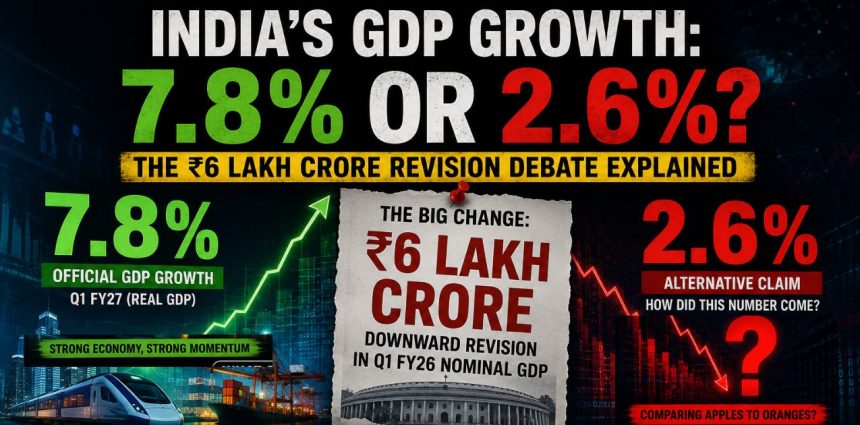
India’s 7.8% GDP growth number is no longer fighting just one battle.
The first challenge was the controversial 2.6% calculation, which emerged after an old GDP estimate was compared with the new 2022-23-base series.
That comparison has been rejected by the Ministry of Statistics and Programme Implementation (MoSPI) as methodologically inappropriate.
But the debate has now moved somewhere more difficult to dismiss.
Can the new GDP series earn enough confidence among economists, investors and analysts to become the new benchmark for measuring India’s growth?
That is the question gaining importance after fresh criticism of the methodology, concerns about large historical revisions and doubts over whether official GDP fully captures the economic experience on the ground.
The latest debate therefore isn’t simply about 7.8% versus 2.6%.
It is about whether India’s revised growth measurement can stand up to repeated scrutiny.
The 7.8% Number Is Still the Official GDP Print
Let’s start with what has not changed.
MoSPI’s Q1 FY27 estimate shows India’s real GDP grew 7.8% year-on-year during April-June 2026.
Nominal GDP growth was 10.3%, while real GVA increased 8.2%.
The new estimates were released under the updated GDP series using 2022-23 as the base year, replacing the previous 2011-12 base.
The 7.8% growth rate also exceeded the RBI’s 7% forecast, making the print stronger than the central bank and much of the market had expected.
So the official number itself has not changed.
The argument has shifted to how that number should be interpreted.
Also Read: India’s 7.8% GDP Has a Bigger Story Hiding Behind the Number
The 2.6% Fight Was Only the Beginning
The initial controversy centred on the sharp revision to the previous year’s GDP estimate.
Critics used an earlier GDP number from the old series and compared it with the latest number generated under the new series.
That produced the much lower 2.6% growth calculation.
MoSPI’s response was straightforward: the two figures were generated under different GDP series and methodologies and therefore should not be mixed to calculate a growth rate.
The ministry has repeatedly defended the 7.8% figure on that basis.
That means investors should not treat 2.6% as a second official GDP estimate.
But there is a more important question left behind:
Why did the historical numbers change so substantially in the first place?
That is where the current debate becomes more interesting.
The New GDP Series Is Facing Its Real Credibility Test
The government has made a major statistical reset.
The new framework uses a 2022-23 base year, updated administrative datasets, a new Output Producer Price Index and a Banking Services Price Index.
It also introduces broader use of double deflation in manufacturing, while the number of price deflators has increased substantially.
Statistics Secretary Saurabh Garg has said the revisions reflect better data and methodology rather than a systematic attempt to reduce the previous year’s base and mechanically boost current growth. He also said revisions over recent years have moved in both directions.
On paper, those changes are intended to make India’s national accounts more representative of the modern economy.
But better methodology does not automatically eliminate the need for scrutiny.
And that is exactly what is happening now.
Why Economists Are Still Asking Questions
Fresh commentary on September 4 has widened the debate.
Former Chief Statistician of India Pronab Sen has questioned whether the latest 7.8% number can comfortably pass scrutiny given the size of recent downward revisions.
Separately, economists writing in the Indian Express have argued that even if the government’s methodological explanation is correct, India’s record on economic data has created a higher burden of proof around the latest numbers.
That distinction is crucial.
There is a difference between saying:
“The GDP data has been manipulated.”
and saying:
“The methodology may be defensible, but investors need greater transparency to understand the revisions.”
The second is a much more reasonable question.
And it is likely to remain part of the GDP debate for some time.
The Strongest Defence of 7.8% Is Outside the GDP Table
There is also a reason the latest GDP print cannot simply be dismissed.
Several independent economic indicators are showing strong activity.
Industrial production rose 6.3% during the quarter, gross capital formation increased 11.9%, private consumption grew 7.1%, and exports expanded around 12%.
Corporate sales growth and GST collections also point toward reasonably strong economic activity.
Investment is particularly important.
Gross capital formation increased to roughly 34.3% of GDP, up from 31.4% a year earlier, according to Reuters reporting on the latest data.
These indicators do not independently prove that every decimal point of the GDP calculation is correct.
But they provide an important counterargument to the idea that the 7.8% number has no connection with underlying economic activity.
But GDP and the Ground Reality Can Still Diverge
This is where the latest criticism becomes relevant for investors.
A high GDP number does not automatically mean every household, worker or business is experiencing an equally strong economy.
Recent analysis has pointed to concerns around employment, wages, consumer sentiment and inflation.
Indian Express highlighted several indicators that critics believe help explain why public confidence in the GDP number remains weaker than the headline growth rate might suggest.
This does not mean those indicators invalidate GDP.
Instead, they raise another important analytical point:
GDP measures aggregate economic output. It does not measure how evenly that growth is distributed.
For equity investors, that distinction matters.
A 7.8% economy can still produce very different outcomes for banks, consumer companies, IT services, capital-goods businesses and smaller companies.
The ₹6 Lakh Crore Revision Still Matters
The historical revision remains one of the biggest reasons this debate has not disappeared.
When previous GDP estimates are materially revised, investors have to revisit historical comparisons.
That can affect how analysts interpret:
- GDP growth trends
- fiscal deficit ratios
- debt-to-GDP
- tax buoyancy
- corporate profit-to-GDP
- consumption intensity
- investment cycles
- valuation assumptions
The issue isn’t that revisions are inherently suspicious.
GDP estimates are routinely revised as better information becomes available.
The question is how transparent and reproducible those revisions are.
That is why the government’s detailed methodology explanations will matter almost as much as the headline growth rate itself.
What the New GDP Series Changes for Investors
For markets, the 2022-23 base-year series creates both an opportunity and a complication.
The opportunity
The new framework is designed to better reflect today’s economy, including newer data sources, updated price measures and changes in the structure of production.
That could eventually provide investors with a more useful picture of India’s growth engine.
The complication
Historical data must now be interpreted carefully.
Investors cannot casually take an old-series number from one year and compare it with a new-series number from another year.
That is precisely how the 2.6% controversy gained traction.
The safer approach is to use the revised time series consistently when analysing trends.
The Next GDP Revision Could Be More Important Than Today’s Headline
The most revealing test may not come from another economist’s comment.
It could come from the data itself.
MoSPI has said future quarterly revisions are expected to become smaller because more timely information is now available, although revisions cannot disappear completely.
That creates a simple test for the new system:
Does the 7.8% estimate remain broadly stable as more data arrives?
If it does, confidence in the revised series should strengthen.
If large revisions repeatedly emerge, the debate over transparency and methodology is likely to continue.
In other words, the credibility of the new GDP series will be built over several quarters, not one release.
What Traders Should Watch Now
For investors, the GDP argument should not become a distraction from the next market signals.
1. Q2 FY27 GDP
The next quarterly release will show whether the strong Q1 momentum is continuing.
2. Consumption
The 7.1% private-consumption growth rate needs to translate into sustained demand for consumer-facing sectors.
3. Private investment
The sharp increase in capital formation could become one of the most important signals if it persists.
4. Manufacturing
Investors should watch whether manufacturing growth feeds into capacity utilisation, capex and corporate earnings.
5. Employment and wages
These indicators can help explain whether headline growth is broad-based.
6. Future GDP revisions
This could become the most important statistical signal of all.
7.8% Is the Number. Trust Is the Next Story.
India’s Q1 FY27 economy grew at an official 7.8% real GDP rate.
The 2.6% figure that triggered the initial controversy should not be presented as a competing official GDP estimate because it results from comparing figures from different statistical series, something MoSPI has rejected.
But the debate has evolved.
The more important question now is whether the new 2022-23-base GDP series can establish a durable record of credibility.
There are arguments on both sides.
The government points to improved data sources, updated methodology and stronger independent economic indicators.
Critics point to historical revisions, methodological complexity and a gap between headline GDP and some measures of household economic wellbeing.
Neither side can settle that question with one quarterly release.
The real test will come through future revisions, future GDP releases and whether the broader economy continues to confirm the direction shown by the national accounts.
For investors, therefore, the story is no longer simply
7.8% or 2.6%?
It is:
Can India’s new GDP framework make 7.8% a number the market can confidently build its next growth forecast around?
Read Next: SEBI Steps Up Bid To Recover Kingdon’s $22.25 Mn Adani Gains