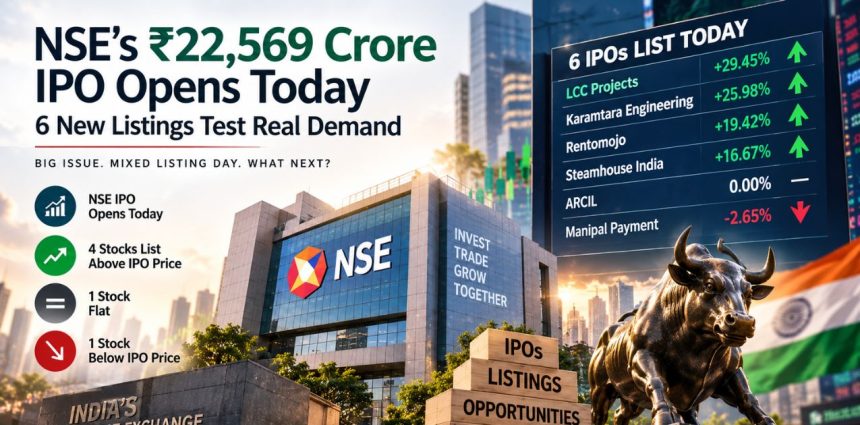
India’s primary market is facing an unusually revealing session on September 17 as the NSE’s mega IPO opens while six recently issued stocks begin exchange trading, exposing a sharp gap between subscription demand and actual price discovery.
The National Stock Exchange of India’s ₹22,568.94 crore IPO, rounded to ₹22,569 crore, opened for subscription on Thursday, September 17.
But the bigger story is what is happening alongside it.
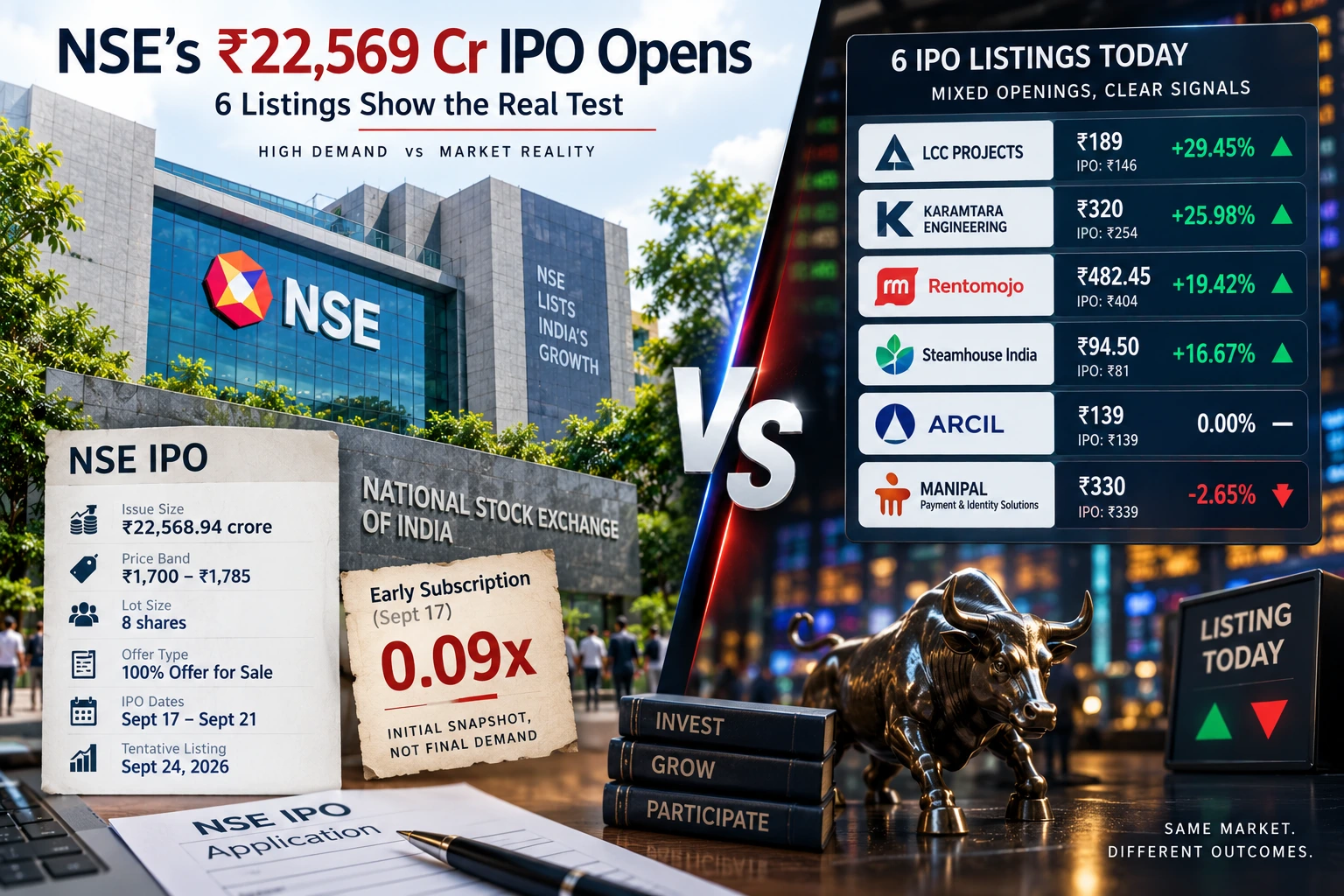
Six mainboard IPO stocks are making their exchange debut on the same day, creating a live comparison between money entering new issues and prices emerging after shares actually begin trading. LCC Projects, Karamtara Engineering, Rentomojo and Steamhouse India opened above their IPO prices, ARCIL opened at the issue price, while Manipal Payment & Identity Solutions opened below it.
That creates the central market tension for September 17:
IPO demand remains strong in parts of the market, but the opening-day tape is already showing that investors are not valuing every new issue alike.
And the NSE itself has not yet produced a final demand verdict. Reuters reported that the issue was subscribed 0.09 times early on September 17, an initial snapshot rather than a closing figure.
Check Live: IPO – Latest & Upcoming IPOs List 2026 | Check Live BSE NSE IPOs
Need to Know
| NSE IPO Detail | Key Figure |
|---|---|
| Issue size at cap price | ₹22,568.94 crore |
| Shares offered | 12,64,36,651 |
| Price band | ₹1,700–₹1,785 |
| Lot size | 8 shares |
| Minimum retail application | ₹14,280 |
| Fresh issue | Nil |
| Offer structure | 100% Offer for Sale |
| Post-offer market capitalisation at cap | ₹4,41,787.50 crore |
| IPO opens | September 17, 2026 |
| IPO closes | September 21, 2026 |
| Tentative listing | September 24, 2026 |
The final offer is an Offer for Sale, meaning existing shareholders are selling shares and NSE itself receives no IPO proceeds. The offer represents about 5.11% of post-offer equity.
Six Listings Put IPO Demand to the Test
The six mainboard stocks that debuted on September 17 produced a wide range of opening outcomes:
| Company | IPO Price | NSE Opening Price | Opening Move |
|---|---|---|---|
| LCC Projects | ₹146 | ₹189 | +29.45% |
| Karamtara Engineering | ₹254 | ₹320 | +25.98% |
| Rentomojo | ₹404 | ₹482.45 | +19.42% |
| Steamhouse India | ₹81 | ₹94.50 | +16.67% |
| ARCIL | ₹139 | ₹139 | Flat |
| Manipal Payment & Identity Solutions | ₹339 | ₹330 | −2.65% |
The spread from LCC Projects to Manipal Payment is more than 32 percentage points, highlighting how differently the market can price businesses once trading begins.
LCC Projects: Strongest Opening
LCC Projects opened at ₹189 on NSE, against an IPO price of ₹146, a 29.45% premium. Its ₹427.14 crore IPO was heavily subscribed. HDFC Sky reported a 49.57x subscription at 5:14 p.m. on September 11, while exchange-linked final data reported by Moneycontrol showed 48.51x. The difference should be treated as a timing/data-snapshot variance rather than silently presented as one uncontested number.
The company is an EPC player focused on irrigation and water-supply infrastructure. Its post-listing risks include project execution, working-capital needs and dependence on order flows.
Karamtara: 26% Premium
Karamtara Engineering opened at ₹320, up 25.98% from its ₹254 issue price. Its IPO closed with 62.63x overall subscription, including 159.59x from QIBs. The company makes components linked to renewable energy and power transmission and also has manufacturing exposure outside India, making exports, trade conditions and currency moves relevant variables.
Rentomojo: 72.88x Demand, 19.42% Opening Gain
Rentomojo opened at ₹482.45 on NSE, compared with its ₹404 issue price, a 19.42% premium. Its IPO closed with 72.88x overall subscription, including 177.29x QIB demand. The company reported FY26 revenue of ₹387 crore versus ₹266 crore a year earlier and profit of ₹104.2 crore versus ₹43.1 crore.
The market will now judge those growth numbers against factors such as asset utilisation, subscriber defaults, capital intensity and inventory economics.
Steamhouse: 16.67% Premium
Steamhouse India opened at ₹94.50, against an ₹81 issue price, a 16.67% gain. Its IPO was subscribed 30.49x, with QIB participation at 43.91x. The company supplies industrial steam and nitrogen through pipeline systems. At the upper IPO band, reported valuation metrics included roughly 57.9x FY26 P/E and 30x FY26 EV/EBITDA, making the earnings-growth expectation an important forward-looking risk.
ARCIL: Subscription Did Not Become a Premium
Asset Reconstruction Company (India), or ARCIL, opened at exactly ₹139, its issue price. Its IPO recorded 20.10x overall subscription. More importantly, ARCIL’s AUM had increased to ₹20,149.99 crore as of March 31, 2026, compared with ₹16,852.57 crore a year earlier.
That creates one of the clearest lessons from the session: heavy subscription does not automatically translate into a premium opening.
Manipal Payment: The Weakest Opening
Manipal Payment & Identity Solutions opened at ₹330 on NSE, down 2.65% from its ₹339 issue price. Its IPO closed at 1.42x subscription, with QIBs at 1.26x, NIIs at 1.22x and retail investors at 2.19x.
The opening does not establish a long-term winner or loser. It simply provides the first formal market price after the subscription period.
NSE IPO: The Main Event
At the upper end of the price band, the NSE offer is worth ₹22,568.94 crore. The final share count and cap price produce that figure directly, while the post-offer market capitalisation is about ₹4.42 lakh crore.
The issue is entirely an OFS, so the money flows to selling shareholders rather than into NSE’s balance sheet.
The offer also has a large institutional component. Before the public issue opened, NSE allocated roughly ₹6,746 crore worth of shares to anchor investors at ₹1,785 apiece. LIC was the largest anchor investor at about ₹400 crore, while other major global institutions included Norway’s Government Pension Fund and Abu Dhabi Investment Authority.
Yet anchor demand is not the same thing as public subscription demand. Reuters’ latest early-day reading showed the issue at just 0.09x, which can change materially before the September 21 close.
Check Live: NSE IPO
NSE’s Profit Number Needed a Closer Look
NSE’s FY26 financials are central to the valuation debate.
Official NSE results show FY26 revenue from operations of ₹16,601 crore versus ₹17,141 crore in FY25, while profit after tax fell to ₹10,302 crore from ₹12,188 crore. That represents a decline of roughly 15.5%.
That is the figure investors should use instead of the previously cited ₹9,228 crore.
The uncertainty is not whether NSE has scale. It clearly does. The question is how much future earnings growth the market should assign to an exchange whose trading activity has become more sensitive to derivatives regulation and changes in market volumes.
Reuters reported that NSE derivatives volumes had fallen 27% from their 2024 peaks, while FY26 revenue declined 3.1% and profit fell 15.5%.
That leaves investors balancing two different forces: the structural growth of Indian capital-market participation and the possibility that derivatives-led earnings growth remains less predictable.
Why Subscription Numbers and Listing Prices Can Diverge
September 17 offers a useful real-world example.
Rentomojo closed its IPO at 72.88x subscription and still opened about 19% above issue price. LCC Projects opened nearly 30% higher, while ARCIL opened flat despite 20.10x subscription. Manipal Payment, with only 1.42x subscription, opened below issue price.
Subscription measures the demand during the IPO process.
The opening price measures formal secondary-market price discovery.
Those are connected, but they are not identical.
That distinction matters particularly when grey-market premiums dominate the conversation. GMP is unofficial, can move quickly and does not guarantee the listing price. Today’s actual openings demonstrate why exchange-traded prices deserve greater weight than unofficial pre-listing indications.
Also Read: NSE IPO’s ₹9,998 Crore Options Bet Faces a New Test
The ₹22,569 Crore vs ₹22,561.57 Crore Question
Some pre-opening coverage cited the NSE issue at ₹22,561.57 crore, while the final share count and the ₹1,785 cap price produce ₹22,568.94 crore. The latter is the cleaner figure for this article because it follows the final offer calculation reflected in current IPO data.
For headline purposes, that figure rounds to ₹22,569 crore.
The difference is small relative to the size of the transaction, but precision matters in a marquee IPO where multiple published figures can circulate.
What Investors Should Watch Next
For NSE, the next meaningful signals are the quality and composition of subscription demand through September 21, not the first intraday snapshot.
Institutional participation, retail response and the eventual valuation investors are willing to accept will matter more than a single early number.
For the six debutants, the question has already changed.
It is no longer only whether they can list at a premium. It is whether the opening valuation can hold when the first wave of two-sided trading, profit-taking and fresh buying meets the market.
That is where the expectation gap becomes visible.
Strong IPO subscription can create high expectations. The listed market then has to validate those expectations with actual prices and future earnings.
Today’s Primary-Market Map
| Event | Company | Segment | Key Figure | Status |
|---|---|---|---|---|
| Mega IPO opens | NSE | Mainboard | ₹22,568.94 Cr | Open |
| IPO opens | Sonaselection India | Mainboard | ₹141.57 Cr | Open |
| IPO opens | Kheria Autocomp | SME | ₹46.44 Cr | Open |
| IPO opens | SpectraA Technology Solutions | SME | ₹42.52 Cr | Open |
| Listing | LCC Projects | Mainboard | ₹189 open | Debuted |
| Listing | Karamtara Engineering | Mainboard | ₹320 open | Debuted |
| Listing | Rentomojo | Mainboard | ₹482.45 open | Debuted |
| Listing | Steamhouse India | Mainboard | ₹94.50 open | Debuted |
| Listing | ARCIL | Mainboard | ₹139 open | Debuted |
| Listing | Manipal Payment | Mainboard | ₹330 open | Debuted |
Kheria Autocomp and SpectraA Technology Solutions also opened their SME issues on September 17, while Sonaselection India opened a separate mainboard issue.
What Today’s Session Really Shows
September 17 is not simply a record-sized IPO day.
It is a simultaneous test of capital raising, institutional demand and secondary-market price discovery.
The NSE IPO brings a transaction worth ₹22,568.94 crore, while six recent listings are already showing a wide range of market reactions. The result is a more nuanced picture than a single subscription headline can provide.
The biggest uncertainty now sits around NSE’s eventual subscription mix and valuation acceptance.
The forward-looking risk is equally clear: if derivatives activity remains under pressure or regulation changes the economics of trading, investors may place a different value on future earnings than the market had assigned during the pre-IPO process. Reuters has specifically highlighted this investor caution.
The final verdict on the NSE IPO will therefore come later than the opening bell.
It will emerge from the interaction between subscription demand, valuation, earnings expectations and post-listing price discovery.
Read Next: Saudi Barrels Get Disrupted: Indian Refiners Face Costlier Oil
SEBI Disclaimer: This article is for informational and educational purposes only and is not investment advice, a recommendation, or a solicitation to buy or sell any security. Investors should conduct their own research and consult a SEBI-registered investment adviser before making investment decisions.