
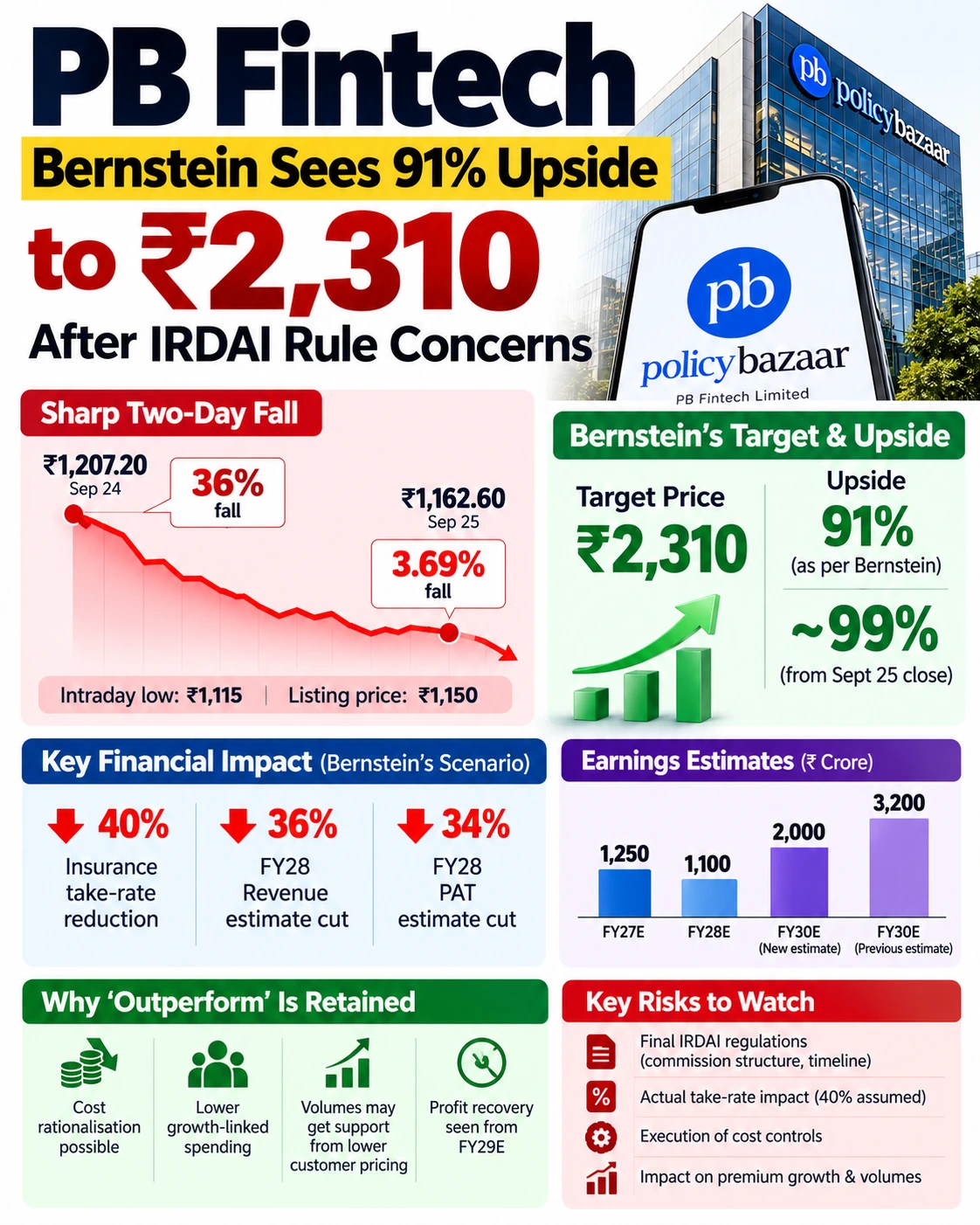
PB Fintech shares have suffered a sharp regulatory-driven reset, but Bernstein has retained its “Outperform” rating and ₹2,310 target price on the Policybazaar parent. Based on the September 25 closing price of ₹1,162.60, the target implies an upside of nearly 99%.
Bernstein’s own note described the target as implying around 91% upside, likely based on the share-price reference used when its analysis was prepared. The brokerage’s positive call comes despite its adverse, or “maximum-pain,” scenario indicating a substantial cut to its FY28 and FY30 earnings forecasts if proposed IRDAI distribution-norm changes are implemented in a materially unfavourable form.
The price target, financial estimates and scenario assumptions cited in this article reflect Bernstein’s research view. They are not guarantees of PB Fintech’s future financial performance or stock-market returns.
TRACK LIVE: PB FINTECH Option Chain (NSE) — Live OI, PCR & Greeks
PB Fintech’s Sharp Two-Day Fall
PB Fintech shares plunged 36% on September 24 amid investor concerns over proposed IRDAI changes to insurance-distribution economics. The stock closed at ₹1,207.20 that day, its largest single-session fall on record.
The pressure continued on September 25, when shares fell another 3.69% to close at ₹1,162.60. During the session, the stock touched a low of ₹1,115—below its ₹1,150 listing price.
The sell-off reflects concern that changes to commissions and distribution economics could reduce the revenue that online insurance platforms earn from insurers. For PB Fintech, whose insurance business includes Policybazaar, any material reduction in take rates could affect revenue growth, margins and the pace of profit expansion.
Market Data and Bernstein Scenario
| Market data | Detail |
|---|---|
| September 24 close | ₹1,207.20 |
| September 24 decline | 36.00% |
| September 25 close | ₹1,162.60 |
| September 25 decline | 3.69% |
| September 25 intraday low | ₹1,115.00 |
| Listing price | ₹1,150 |
| Bernstein’s adverse scenario | Detail |
|---|---|
| Rating | Outperform |
| Target price | ₹2,310 |
| Upside versus the September 25 close | Nearly 99% |
| Upside stated in Bernstein’s note | Around 91% |
| Assumed insurance take-rate reduction | Around 40% |
| Cut to previous FY28E consolidated-revenue estimate | Around 36% |
| Cut to previous FY28E PAT estimate | Around 34% |
| FY27E PAT estimate | Around ₹1,250 crore |
| FY28E PAT estimate | Around ₹1,100 crore |
| FY30E PAT estimate | Around ₹2,000 crore |
| Previous FY30E PAT estimate | Around ₹3,200 crore |
| FY30E profit impact versus prior estimate | Around 38% |
Also Check: POLICYBZR: PB FINTECH Max Pain Live Chart For NSE Stock/Share Price Live
What Bernstein’s Scenario Means
Bernstein estimates that the proposed framework could reduce PB Fintech’s insurance take rates by about 40%. A take rate is broadly the revenue or commission income an insurance-distribution platform retains for facilitating policy sales and renewals.
Under its scenario, the brokerage estimates that its previous FY28E consolidated-revenue forecast for PB Fintech could be cut by around 36%. This does not mean that PB Fintech’s reported revenue will necessarily fall 36% year-on-year; it refers to a reduction versus Bernstein’s earlier FY28 revenue expectation. Paisabazaar may offer some cushion, though Bernstein expects that offset to be only partial.
The pressure may be most significant in the health and motor insurance businesses. Bernstein also said a potential shift in term plans towards a trail-based commission structure could defer cash flows. In a trial-based model, more distributor income is paid over the life of a policy rather than primarily upfront, which could create an initial working-capital drag.
The brokerage expects PB Fintech’s organic premium-growth assumptions, previously around 35% to 40%—to reset lower in FY28E. It has factored in a potential 4% reduction to its earlier FY28E premium-growth forecast, while noting that lower customer pricing could support policy volumes and partly offset the impact.
Why Bernstein Retains Outperform
The central tension in Bernstein’s view is clear: it sees a meaningful earnings reset under an adverse regulatory scenario, yet it continues to see substantial valuation recovery potential.
Bernstein expects FY28E to become a period of more measured, or “rational”, growth for PB Fintech. The brokerage says management has indicated room to rationalise growth-linked costs, including:
- Call-centre hiring and related servicing costs.
- Variable employee payouts and performance-linked incentives.
- Performance-marketing expenditure.
- Other customer-acquisition and expansion costs.
The brokerage expects direct costs in PB Fintech’s core business to decline meaningfully as the company moderates its growth spending. It also factors in phased indirect-cost rationalisation through FY28 and FY29.
Even with these actions, Bernstein estimates that its FY28E profit forecast could be cut by about 34% versus its previous estimate, to around ₹1,100 crore. That would be below its estimated FY27E PAT of around ₹1,250 crore.
Bernstein expects profit recovery to begin from FY29E as growth spending resumes from a lower base. Its adverse scenario estimates FY30E PAT of about ₹2,000 crore, compared with the brokerage’s earlier estimate of about ₹3,200 crore—a reduction of roughly 38%.
Also Read: PB Fintech Share Price Falls 20%: IRDAI Commission Reset Puts Policybazaar Model Under Pressure
Key Risks to Track
The proposed IRDAI rules remain the biggest uncertainty for PB Fintech investors. The final structure, transition timeline and actual effect on commissions will determine whether Bernstein’s adverse scenario proves too pessimistic, broadly accurate or insufficiently conservative.
Investors should monitor:
- Final IRDAI regulations: Draft provisions may change before notification, including commission structures, expense rules and implementation dates.
- Take-rate outcome: Bernstein models an approximately 40% reduction; the actual impact could be lower or higher.
- Forecast revisions: The 36% FY28E revenue-estimate cut and 34% FY28E PAT-estimate cut are Bernstein’s revisions versus its prior forecasts, not expected year-on-year declines in reported financials.
- Cost-rationalisation delivery: PB Fintech must contain spending without materially affecting customer acquisition, conversion, renewals or service quality.
- Cash-flow profile: Greater reliance on trail income may defer revenue receipts and affect near-term working capital.
- Premium growth and policy volumes: Lower customer pricing could increase volumes but may not fully offset weaker take rates.
- FY30 recovery: Bernstein’s ₹2,000 crore FY30E PAT scenario implies a recovery from FY28E but remains well below the brokerage’s earlier ₹3,200 crore projection.
PB Fintech is covered by 25 analysts, according to the reported consensus: 16 have buy recommendations, five have hold ratings and four have sell calls. Investors should treat the brokerage target and earnings scenarios as estimates, review PB Fintech’s disclosures and track the final IRDAI framework before making investment decisions.
Read Next: Stocks to Watch Sept 28: Adani Power, NMDC, SAIL, CleanMax
Disclaimer: The price target, earnings estimates and regulatory-impact scenarios cited are based on Bernstein’s research and represent the brokerage’s views, not guarantees of future performance.
IRDAI’s proposed distribution norms remain subject to the consultation and final regulatory framework, which could differ from the assumptions discussed.
This article is for informational purposes only and should not be considered investment advice.