Nvidia has authorized another $150 billion for share buybacks, taking its remaining authorization to $235 billion through fiscal 2028. Spread evenly over the remaining period, that would imply roughly $44 billion a quarter—more than twice its latest quarterly buyback—while the stock trades at about 16.5 times forward earnings.
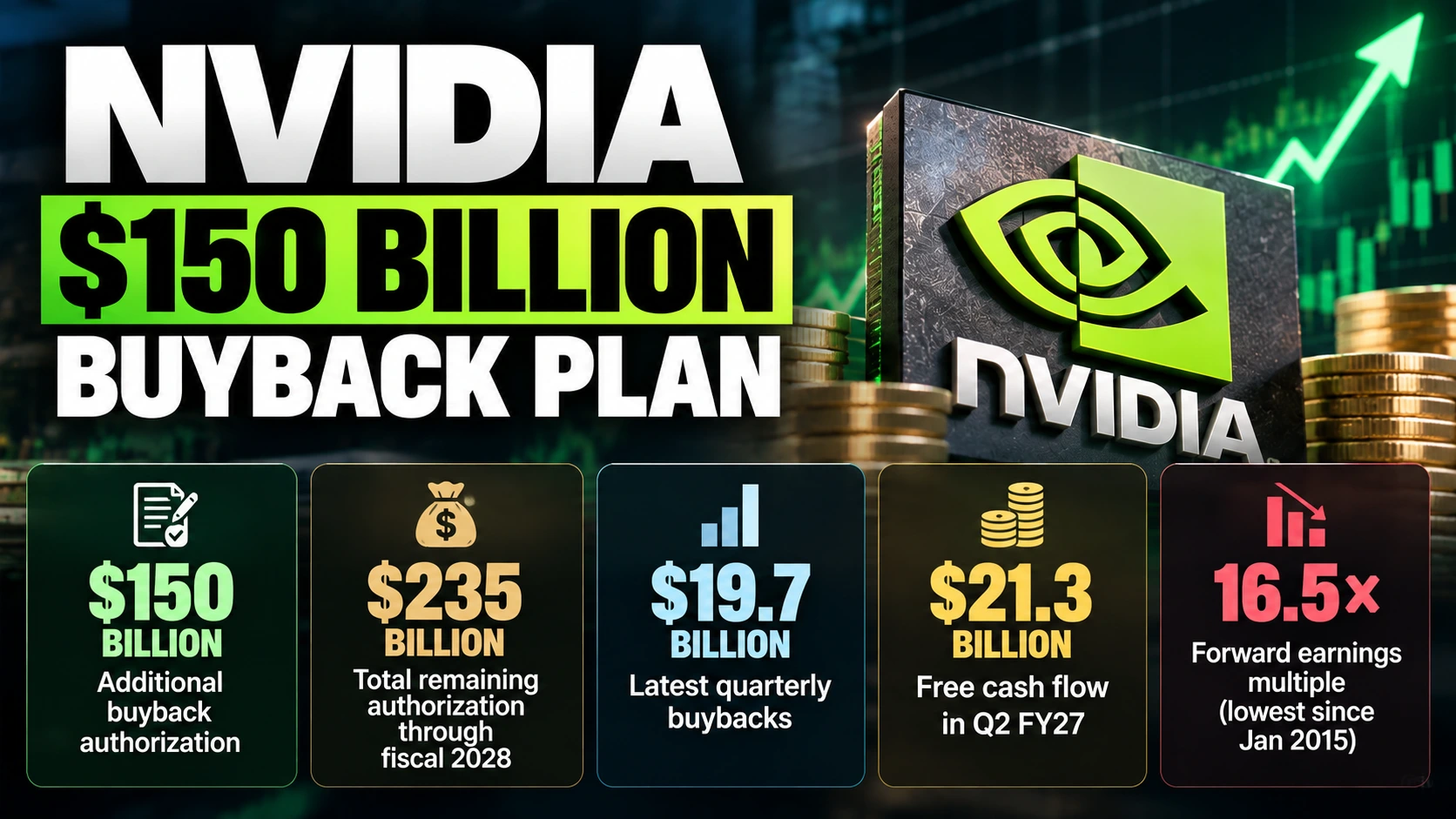
Nvidia (NASDAQ: NVDA) has authorized an additional $150 billion under its existing share repurchase programme, taking the total remaining authorization to $235 billion through fiscal 2028.
Nvidia said the latest increase is the largest increase to a share repurchase authorization in company history. Reuters reported that it also exceeds Apple’s $110 billion buyback authorization approved in 2024.
The timing makes the announcement more notable. Nvidia shares are trading at about 16.5 times 12-month forward earnings, their lowest valuation multiple since January 2015, according to LSEG data cited by Reuters. The stock rose nearly 2% on Monday and has gained more than 20% this year through Friday’s close.
That creates an unusual market tension: Nvidia is committing a record amount of capital to buy back its own shares at a time when its earnings multiple is near an 11-year low.
Also Read: Nvidia’s $500 Billion AI Plan: Why Wall Street Is Betting on Compute
Nvidia’s $150 Billion Buyback: What Changed?
The new $150 billion authorization is an addition to Nvidia’s existing repurchase programme. It does not mean the company will immediately spend that amount.
Following the announcement, Nvidia said approximately $235 billion remains available for repurchases through fiscal 2028, when the company’s financial year ends in late January 2028.
The latest filing also makes clear that Nvidia can execute repurchases depending on market conditions and that the programme may be suspended at any time at the company’s discretion.
That distinction matters: $235 billion is authorization capacity, not a guaranteed cash outflow.
Track Live: GIFT Nifty Live – Today Price, Chart, Timings and Nifty Opening Signal
The $235 Billion Buyback in Numbers
At the end of Nvidia’s latest reported quarter, approximately $99 billion remained under its prior authorization.
After adding another $150 billion, the remaining balance is now about $235 billion.
That means:
| Nvidia Buyback Figure | Amount |
|---|---|
| Additional authorization | $150 billion |
| Total remaining authorization | $235 billion |
| Prior reported balance | ~$99 billion |
| Previous programme capacity implied by latest disclosure | ~$85 billion |
| Latest quarterly buybacks | $19.7 billion |
The difference between the prior reported balance of roughly $99 billion and the implied $85 billion balance before the new authorization suggests about $14 billion of authorization may have been used between the end of July and September 28.
However, Nvidia has not yet reported repurchase activity for that full period, so the ~$14 billion figure should be treated as an inference from disclosed balances rather than confirmed repurchases.
How Large Could Nvidia’s Buybacks Become?
Roughly 16 months remain until the end of fiscal 2028.
Spread evenly across that period, the $235 billion remaining authorization would amount to approximately $44 billion per quarter.
That is more than twice Nvidia’s $19.7 billion quarterly buyback in its latest reported quarter.
This is only a mathematical illustration. Nvidia does not have to maintain an even repurchase schedule, and the actual pace could vary sharply depending on share prices, cash generation, capital needs and market conditions.
The scale nevertheless shows how much larger Nvidia’s potential shareholder-return programme has become.
Can Nvidia’s Cash Flow Support the Buyback?
Nvidia’s operating performance remains exceptionally strong, but its quarterly cash-flow picture is more nuanced than the headline buyback number suggests.
In the latest quarter:
| Q2 Fiscal 2027 | Result |
|---|---|
| Revenue | $96.2 billion |
| Revenue growth | 106% YoY |
| Data Center revenue | $89.0 billion |
| Data Center growth | 117% YoY |
| Free cash flow | $21.3 billion |
| Share buybacks | $19.7 billion |
| Dividends | ~$6.0 billion |
| Total shareholder returns | ~$26.0 billion |
Nvidia generated $21.3 billion of free cash flow during the quarter while returning approximately $26 billion to shareholders.
Across the first half of the fiscal year, however, free cash flow was approximately $69.9 billion, comfortably above total shareholder returns of roughly $45.3 billion over the same period.
That difference is important because a single-quarter comparison can make the capital-return programme look more aggressive than it does on a year-to-date basis.
Nvidia’s Earnings Are Still Growing at Triple-Digit Rates
The enlarged buyback comes despite Nvidia continuing to report extraordinary growth in its AI-related business.
Second-quarter revenue reached $96.2 billion, up 106% year on year, while Data Center revenue rose 117% to $89.0 billion.
For the third quarter, Nvidia guided to revenue of approximately $108 billion, plus or minus 2%.
The guidance also excludes Data Center compute revenue from China, making the China assumption an important variable for investors monitoring future results.
Nvidia’s reported GAAP net income reached $59.7 billion, up 126% year on year.
There is an earnings-quality nuance, however. The GAAP figure included roughly $7.8 billion of gains on equity securities, while non-GAAP net income was approximately $54.0 billion, up 118%.
That distinction does not change the scale of Nvidia’s earnings growth, but it matters when investors assess how much of the latest profit figure came from core operations versus investment gains.
Why Nvidia’s Valuation Multiple Has Fallen Despite Explosive Growth
Nvidia’s valuation is now telling a different story from its current operating growth.
Reuters, citing LSEG data, reported that Nvidia was trading at approximately 16.5 times 12-month forward earnings, the lowest level since January 2015. The stock’s 15-year average forward earnings multiple is close to 30.
A lower multiple can reflect expectations that earnings growth will eventually slow, even when current results remain exceptionally strong.
At the same time, Reuters reported last month that Nvidia was forecasting roughly 70% revenue growth for fiscal 2028.
That leaves investors watching the gap between today’s earnings growth and the growth expectations already embedded in the stock’s valuation.
The market tension is therefore not simply whether Nvidia is growing. It is whether the company can sustain enough earnings and cash-flow growth to justify its investment cycle while also supporting an expanded shareholder-return programme.
What Investors Should Watch Next
The enlarged authorization makes Nvidia’s next quarterly report more important for three reasons.
First, investors can see how quickly the company actually uses the new authorization. A $235 billion capacity figure alone does not show how much cash Nvidia will deploy.
Second, free cash flow versus shareholder returns will show whether the enlarged buyback can increasingly be funded from internally generated cash.
Third, Nvidia’s revenue outlook and China assumptions remain critical to the earnings trajectory that underpins the current valuation.
Nvidia Buyback: Key Numbers to Watch
| Metric | Current Figure | Why It Matters |
|---|---|---|
| New authorization | $150 billion | Record increase |
| Remaining authorization | $235 billion | Potential future repurchases |
| Latest quarterly buybacks | $19.7 billion | Benchmark for repurchase pace |
| Forward P/E | ~16.5x | Lowest since Jan. 2015 |
| Q3 revenue guidance | $108 billion ±2% | Next major operating test |
| Q2 free cash flow | $21.3 billion | Measures cash available for capital returns |
The Expectation Gap Behind Nvidia’s Record Buyback
The $150 billion authorization is therefore only part of the story.
The bigger question is whether Nvidia can continue converting AI demand into sustained revenue, earnings and free cash flow while funding its massive investment cycle and returning increasingly large sums to shareholders.
For investors, the next quarterly report could provide a clearer signal on that balance.
The key variables will be repurchase pace, free cash flow, AI-driven revenue growth, China exposure and the forward earnings multiple.
That leaves an important uncertainty around the record authorization: the size of Nvidia’s buyback capacity is now known, but the pace at which the company ultimately uses it—and the earnings growth supporting that capital return—will be determined quarter by quarter.
Need to Know
- Nvidia added a record $150 billion to its share repurchase authorization.
- Total remaining buyback capacity now stands at approximately $235 billion through fiscal 2028.
- Nvidia’s latest quarterly buybacks were $19.7 billion.
- The stock trades at roughly 16.5x forward earnings, its lowest multiple since January 2015.
- Q2 revenue rose 106% to $96.2 billion, while Data Center revenue jumped 117% to $89.0 billion.
- Nvidia’s Q3 revenue guidance is approximately $108 billion, plus or minus 2%, excluding China Data Center compute revenue.
Read Next: Tax Audit Due Date Sept 30: 4 Form 3CD Disclosures That Could Alter Your Tax Position
FAQ
How much is Nvidia’s new buyback authorization?
Nvidia authorized an additional $150 billion, taking its remaining authorization to approximately $235 billion through fiscal 2028.
Will Nvidia spend the full $235 billion immediately?
No. The authorization represents available capacity, not an immediate cash commitment. Nvidia can adjust or suspend repurchases depending on market conditions.
How much did Nvidia spend on buybacks in its latest quarter?
Nvidia repurchased approximately $19.7 billion of shares during its latest reported quarter.
Why is Nvidia’s valuation receiving attention?
Reuters reported, using LSEG data, that Nvidia was trading at about 16.5 times forward earnings, its lowest multiple since January 2015.
Does a larger buyback guarantee higher Nvidia stock returns?
No. The eventual effect depends on the price paid for shares, earnings growth, free cash flow, the pace of repurchases and the valuation investors assign to future earnings.
Disclaimer
This article is for informational purposes only and does not constitute investment advice. Investors should review company filings and consider their own risk before making investment decisions.