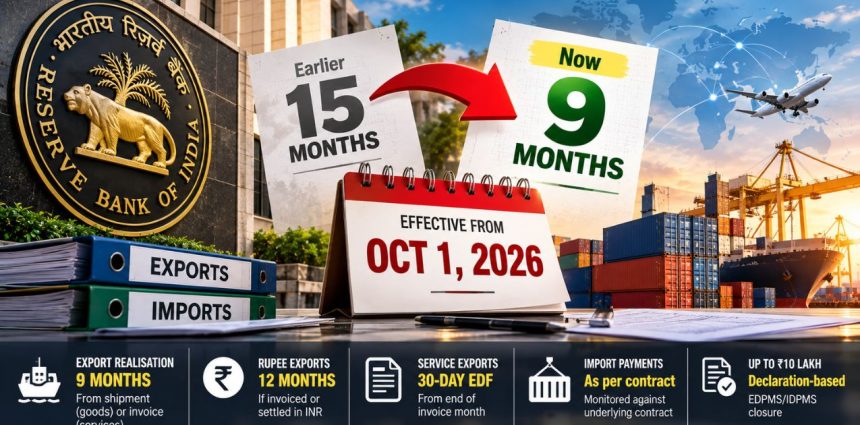
RBI’s September 22 amendment changed the new export-import regulations from 15 months to nine before they take effect. Here is what exporters and importers must check.
If your export receivables plan assumes 15 months from October 1, it is out of date. The Reserve Bank of India’s new FEMA rules for exports and imports, the Foreign Exchange Management (Export and Import of Goods and Services) Regulations, 2026, take effect on October 1, 2026 with a nine-month standard realisation period.
The January 2026 regulations had originally provided for 15 months, or 18 months where exports were invoiced or settled in Indian rupees. RBI’s September 22 amendment changed those periods to nine and 12 months, respectively, before the regulations take effect. It was published in the Gazette on September 24.
The rules also add a 30-day EDF filing window for service exports, tie import-payment monitoring to the underlying contract, and allow declaration-based closure of transactions up to ₹10 lakh.
Track Live: GIFT NIFTY, FII DII DATA, NIFTY OPTION CHAIN, INDIA VIX
Need to Know
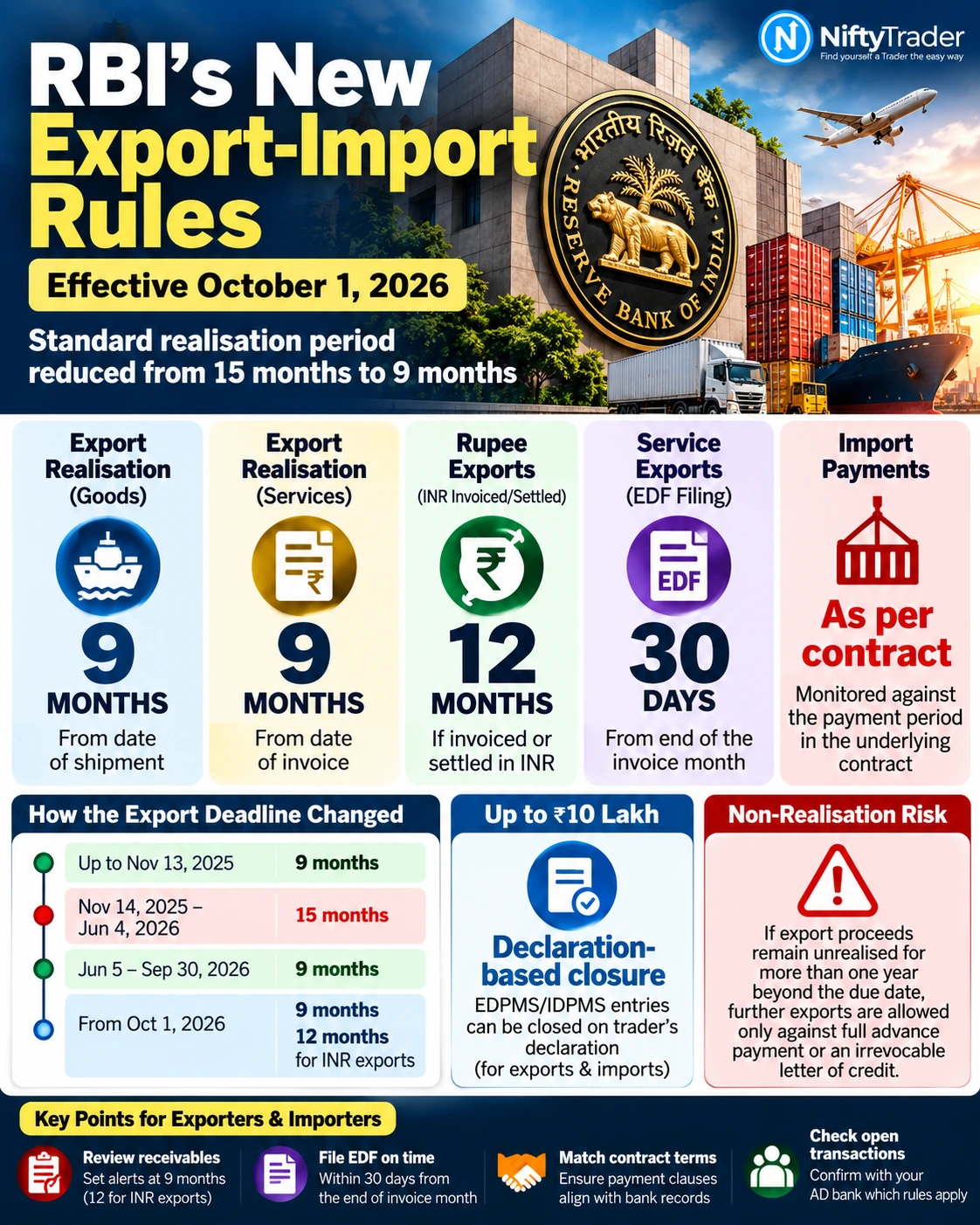
| From October 1, 2026 | What it means |
|---|---|
| Export realisation | 9 months from shipment (goods) or invoice (services) |
| Rupee exports | 12 months if invoiced or settled in INR |
| January text | 15 and 18 months, changed to 9 and 12 by the Sept 22 amendment |
| Service exports | EDF within 30 days from the end of the invoice month |
| Import payments | Monitored against the payment period in the underlying contract |
| Up to ₹10 lakh | EDPMS/IDPMS entries can be closed on the trader’s declaration |
Why the 15-Month Figure Disappeared
The export deadline has changed several times in under a year. A November 2025 amendment to the 2015 rules extended it to 15 months. A June 5, 2026 amendment restored nine months. The September 22 amendment then kept nine months in the new regime.
| Period | Standard export-realisation period |
|---|---|
| Up to Nov 13, 2025 | 9 months |
| Nov 14, 2025 – Jun 4, 2026 | 15 months |
| Jun 5 – Sep 30, 2026 | 9 months |
| From Oct 1, 2026 | 9 months; 12 months for INR exports |
Guides published before September 22 may still show 15 and 18 months for October 1. They no longer reflect the rule.
Exporters: Nine Months, With Extensions on Request
The clock runs from the date of shipment for goods and from the invoice date for services. For goods sent to an overseas warehouse, it runs from the date of sale from the warehouse. Project exports follow the payment terms of the contract.
An authorised dealer (AD) bank can allow more time if the exporter gives reasons that satisfy it.
Service Exporters: A New 30-Day EDF Clock
A service exporter must file an Export Declaration Form (EDF) within 30 days from the end of the month in which the invoice is raised. An invoice raised on October 10 would need its EDF by November 30.
One EDF can cover all of a month’s exports to one or more recipients. For services other than software, the EDF may be filed on or before the date payment is received. The AD bank can extend the deadline for reasonable cause.
Importers: Contract Terms Set the Clock
AD banks will monitor import payments against the period in the underlying contract, replacing the earlier six-month timeline. Importers can request more time, and the bank can allow it if satisfied with the reasons.
₹10 Lakh Threshold: Less Paperwork
For an export shipping bill or service invoice up to ₹10 lakh, the EDPMS entry can be closed on the exporter’s declaration that payment was realised, in full or otherwise. Importers get the same route in IDPMS for bills of entry or invoices up to ₹10 lakh. Quarterly declarations can be used for bulk closure.
The same limit lets an AD bank approve a reduction in export value, including non-realisation, on the exporter’s declaration.
The Risk After October 1: Unrealised Exports Can Restrict Further Shipments
If export proceeds stay unrealised for more than one year beyond the due date, or beyond any extension the AD bank approved, the exporter can make further exports only against full advance payment or an irrevocable letter of credit.
For a standard export subject to the nine-month deadline, this restriction could arise around 21 months after shipment or invoice if no extension is granted. For rupee exports, the corresponding period would be 24 months.
Exporters on RBI’s Caution List as of September 30 remain under the existing orders until they are removed.
Banks must also publish their own policy and SOPs on documents, timelines, extensions, adjustments and advances. They will handle pre-October 1 transactions that previously required RBI approval under the earlier framework.
What to Check Before October 1
- Exporters: List receivables that could run past nine months, and set alerts at nine months (12 for INR exports).
- Service exporters: Build the 30-day EDF date into invoicing.
- Importers: Make sure payment clauses match your bank records.
- Older open transactions: Ask your AD bank which procedure applies, particularly where a pre-October 1 transaction previously required RBI approval.
Read Next: Nifty Rebalancing Today: BSE Nears $600M Inflow as Wipro Exits
FAQ: RBI FEMA Rules From October 1
What is the export payment deadline from October 1, 2026?
Nine months from shipment for goods and from invoice for services, and 12 months for exports invoiced or settled in rupees.
Was the deadline ever 15 months?
Yes. It applied to exports from November 14, 2025 to June 4, 2026, and appeared in the January 2026 text of the new regulations. The September 22 amendment replaced it with nine months before the new rules take effect.
Is there a new EDF requirement for service exports?
Service exporters must file an EDF within 30 days from the end of the invoice month, subject to the stated exceptions.
What is the import payment deadline?
It is the period specified in the underlying contract. The AD bank can allow an extension.
What is the ₹10 lakh rule?
For eligible transactions up to ₹10 lakh, EDPMS and IDPMS entries can be closed on the exporter’s or importer’s declaration.
Disclaimer: This article is for information only and is not legal, tax or financial advice. Consult your authorised dealer bank or a professional adviser.