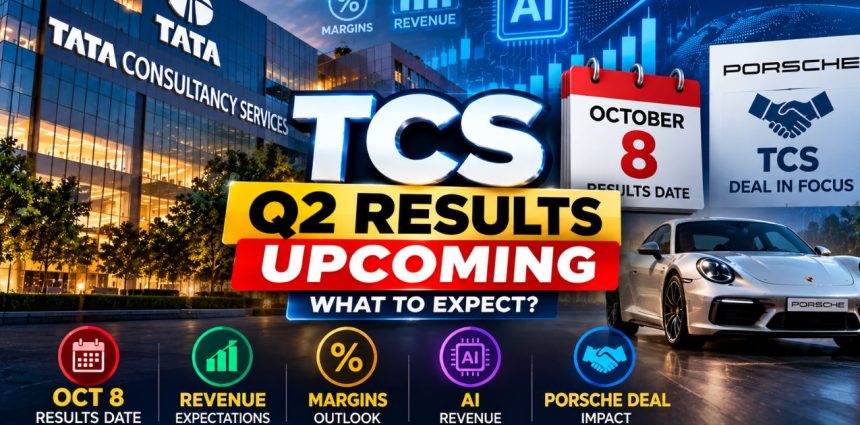
TCS faces an unusually watchful market on October 8. India’s largest IT services company enters its September-quarter results with the stock closing at ₹2,050.60 on September 30, roughly 36% below its end-2025 close of ₹3,205.75. Kotak expects only 0.5% sequential revenue growth, while management continues to target an exit EBIT margin of 25% or more for FY27. The Porsche-MHP transaction is a major deal headline, but it is unlikely to contribute materially to Q2 revenue because the MHP acquisition is expected to close only in the following months.
TCS Q2 Results Date, Dividend and Record Date
TCS’s board is scheduled to meet on Thursday, October 8, 2026, to approve and take on record the audited standalone and consolidated interim financial results for the quarter and half-year ended September 30, 2026. The board will also consider a proposal to declare a second interim dividend. The record date is October 14, 2026, subject to board approval, while the dividend amount has not yet been announced.
TCS paid a ₹12 per-share first interim dividend for Q1 FY27, compared with ₹11 a year earlier. The second interim dividend for Q2 FY26 was ₹11 per share.
Q1 results came after market hours, and Q2 is expected to follow the same pattern, so the first full market reaction would come the next trading day.
Track Live: TCS Option Chain (TCS) — Live OI, IV, Greeks & PCR
What Analysts Expect From TCS in Q2
Kotak Institutional Equities expects TCS revenue to grow 0.5% quarter-on-quarter and 2.8% year-on-year in Q2 FY27. The brokerage expects the sequential increase to be supported by international business.
Kotak expects sequentially stable margins, but around a 100-basis-point decline year-on-year, with wage revisions, acquisitions and pricing pressure among the factors affecting the comparison. The brokerage also expects total contract value, or TCV, of $10 billion-$11 billion, roughly 5% higher year-on-year, helped partly by the Porsche-related deal activity.
That makes the September quarter more of a test of demand stability, deal momentum and margin visibility than a straightforward high-growth quarter.
The Porsche Deal: Big Headline, Later Revenue
Porsche signed a five-year partnership worth €1.25 billion with TCS, while TCS is also acquiring Porsche’s consulting arm MHP for €320 million. The partnership covers AI and digital transformation across Porsche’s operations, while MHP brings automotive and industrial consulting capabilities into the TCS group.
TCS said the MHP acquisition is expected to close within three to four months of the August announcement, subject to regulatory approvals.
The transaction is therefore unlikely to contribute materially to Q2 revenue, even if it supports the deal-win headline and future revenue visibility.
MHP has around 4,500 employees. JM Financial has also highlighted the integration of MHP as one factor that could weigh on TCS’s margin trajectory.
The distinction between deal value and near-term revenue is important. A large contract can strengthen the future pipeline without immediately appearing in the September-quarter top line.
The Margin Puzzle: 24% Now, 25% Target
TCS reported an operating margin of 24.0% in Q1 FY27, compared with 25.3% in the previous quarter.
Management has said it expects margins to improve sequentially through the rest of FY27 now that wage hikes are behind it, targeting an exit EBIT margin of 25% or more. JM Financial says the MHP integration and BSNL ramp-up could weigh on that path, while currency is unlikely to provide much incremental benefit in Q2.
Kotak, however, expects Q2 margins to remain broadly stable sequentially.
That creates an important earnings-season question: if Q2 margins remain around the Q1 level, how quickly can TCS move back toward its 25%-plus exit target during the second half of FY27?
For investors, the answer may matter more than a small difference in quarterly revenue growth.
AI Revenue Versus AI Pricing Pressure
TCS reported annualised AI revenue of $2.6 billion in Q1 FY27, up 13.6% quarter-on-quarter. The company has highlighted AI-led transformation, modernisation and other technology programmes as important parts of its growth strategy.
But AI is also creating a pricing challenge for the IT-services industry.
Reuters, citing five brokerages, reported that cautious client spending and AI-driven pricing pressure are weighing on the September-quarter outlook for India’s major IT companies.
TCS management told JM Financial that newer modernisation deals in the $5 million-$10 million range were not facing pricing pressure, although competitive intensity remains elevated across renewals and negotiations.
The key question for October 8 is therefore not simply whether AI revenue increases.
It is whether AI creates incremental demand and new revenue opportunities faster than it puts pressure on traditional IT-services pricing.
Which TCS Verticals Should Investors Watch?
TCS’s vertical performance could provide an important read-through on client spending.
In Q1 FY27, BFSI revenue grew 1.6% quarter-on-quarter in constant currency, while Consumer Business declined 4.0%.
JM Financial’s management interaction indicated that BFSI and Technology remained healthy, while Consumer Products and Life Sciences & Healthcare were expected to remain soft. Manufacturing was expected to benefit from the ramp-up of the $800 million, five-year SKF deal.
That makes the vertical commentary especially important in Q2.
Strong BFSI spending could support growth, while weakness in discretionary sectors could limit the pace of recovery.
Why the TCS Stock Is Under the Spotlight
TCS closed at ₹2,050.60 on September 30, 2026, close to its 52-week low of around ₹1,976.80, while the 52-week high is around ₹3,350.
Using the September 30 close against the stock’s end-2025 closing level of ₹3,205.75, TCS was down roughly 36% in 2026 at that point.
The weakness is also part of a broader IT-sector decline. Reuters reported that the Nifty IT index was down about 27% in 2026 as of October 1, while the benchmark Nifty 50 was down 13.4%.
TCS also remains eligible for a buyback, according to JM Financial’s assessment.
Against that backdrop, the September-quarter result could be judged not only on reported earnings but also on whether management provides evidence of stabilising demand.
Also Check: TATA CONSULTANCY SERVICES Options Chart
What Q1 FY27 Told Us
TCS’s Q1 performance provides the base against which the September quarter will be measured.
Revenue in US dollars was flat quarter-on-quarter and rose 2.7% year-on-year. On a constant-currency basis, revenue grew 0.4% quarter-on-quarter and 3.2% year-on-year. TCS’s revenue in rupee terms rose 13.9% year-on-year.
TCS also reported $9.5 billion of TCV in Q1, down from $12 billion in Q4 FY26.
The company beat Bloomberg estimates on Q1 revenue, while quarterly profit was narrowly below the Bloomberg estimate.
The Q2 numbers will therefore show whether the modest Q1 growth trend is stabilising or whether demand remains under pressure.
Also Read: TCS Shares Jump 7% as Q1 Earnings, AI Deals and Brokerage Upgrade Fuel Rally
What to Watch on October 8
The September-quarter result will revolve around a few numbers and management signals.
Revenue: Does TCS meet or exceed Kotak’s 0.5% QoQ growth expectation?
Margins: Do operating margins remain around the Q1 level, and does management maintain its 25%-plus FY27 exit target?
TCV: Can total contract value reach the $10-$11 billion range expected by Kotak?
AI revenue: Does the annualised $2.6 billion AI revenue base continue to expand?
Pricing: Are AI and modernisation deals generating additional revenue without creating broader pricing pressure?
Vertical demand: Are BFSI and Technology strong enough to offset softer areas?
Guidance: Does management retain its view that FY27 can improve on FY26 and provide greater visibility for the second half?
Dividend: What second interim dividend, if any, does the board declare?
These factors could be more important to the market reaction than a small earnings beat or miss.
Sector Read-Through
TCS will be the first major IT bellwether to provide a detailed September-quarter update before several peers report.
HCLTech is scheduled to report on October 12, while Infosys is scheduled for October 23.
That means TCS management’s commentary on client spending, AI adoption, pricing, deal conversion and FY27 demand could provide an early signal for the broader Indian IT sector.
Kotak expects Infosys to reduce the upper end of its FY27 growth guidance, highlighting the importance of what TCS says about demand and the second half of the financial year.
TCS Q2 Results: The Numbers to Remember
Ahead of the October 8 result, the key reference points are:
Q1 constant-currency revenue growth: 0.4% QoQ and 3.2% YoY
Q1 operating margin: 24%
FY27 exit margin target: 25% or more
Q1 TCV: $9.5 billion
Kotak Q2 revenue expectation: 0.5% QoQ and 2.8% YoY
Kotak Q2 TCV expectation: $10-$11 billion
Q1 annualised AI revenue: $2.6 billion
September 30 closing price: ₹2,050.60
TCS Q2 results date: October 8, 2026
Second interim dividend record date: October 14, subject to board approval.
The central issue for investors is whether TCS can turn a large pipeline of AI, modernisation and transformation opportunities into sustained revenue growth without sacrificing margins.
The answer will start to emerge with the September-quarter results on October 8.
Read Next: Moneyview IPO: Valuation Tops $1 Billion After Debut; Adjusted Profit Rose 65%
FAQs
When are TCS Q2 FY27 results?
TCS is scheduled to consider and approve its September-quarter and half-year results on October 8, 2026. The board will also consider a second interim dividend.
What is the TCS second interim dividend record date?
The record date is October 14, 2026, subject to the board declaring the dividend. The dividend amount has not been announced.
What does Kotak expect from TCS Q2?
Kotak expects 0.5% QoQ and 2.8% YoY revenue growth, broadly stable sequential margins and TCV of $10-$11 billion.
What is TCS’s AI revenue?
TCS reported $2.6 billion in annualised AI revenue in Q1 FY27, up 13.6% sequentially.
Will the Porsche deal boost TCS Q2 revenue?
The Porsche-MHP transaction is unlikely to contribute materially to Q2 revenue because TCS expects the MHP acquisition to close within three to four months of the August announcement, subject to regulatory approvals. The partnership can, however, support the deal pipeline and future revenue visibility.
What will investors watch most closely in TCS Q2?
Revenue growth, operating margins, TCV, AI revenue, pricing pressure, vertical demand and management’s FY27 outlook will be among the most important signals.
Disclaimer: This article is for informational purposes only and does not constitute investment advice or a recommendation to buy, sell or hold any security. Brokerage estimates are expectations, not actual results. Share-price data cited above are as of September 30, 2026.