
FPIs Are Selling Stocks but Buying IPOs: What Are They Up To in India?
Foreign investors are sending a message to India’s equity market, but it is not as simple as an exit. FPIs have sold a record ₹3 lakh crore in secondary-market equities in 2026 so far, while simultaneously investing more than ₹55,000 crore in Indian IPOs.
The contrasting flows highlight how foreign investors are becoming increasingly selective about where they put money in Indian equities.
Track Live : FII DII Data Today | NSE F&O Lot Size

Why FPIs Are Selling Stocks
FPI selling in the secondary market has accelerated significantly. In 2024, foreign investors bought ₹1.2 lakh crore through the primary market while selling a similar ₹1.2 lakh crore in secondary equities.
In 2025, primary-market investment declined to ₹73,910 crore, while secondary-market selling increased sharply to ₹2.4 lakh crore.
The 2026 figure of ₹3 lakh crore in secondary-market selling therefore represents another major increase in foreign selling pressure.
Key details
FPIs have sold nearly ₹3 lakh crore in secondary markets
In 2026 so far, FPIs have sold approximately ₹2.96 lakh crore through stock exchanges, according to NSDL data cited by Mint. The figure is very close to the ₹3 lakh crore mark highlighted in the latest report.
At the same time, FPIs have invested approximately ₹54,398 crore in India’s primary equity market, largely through IPOs.
So the important contrast is:
| FPI activity in 2026 | Approx. amount |
|---|---|
| Secondary-market equity selling | ₹2.96 lakh crore |
| Primary-market/IPO investment | ₹54,398 crore |
| Broad difference | More than ₹2.4 lakh crore |
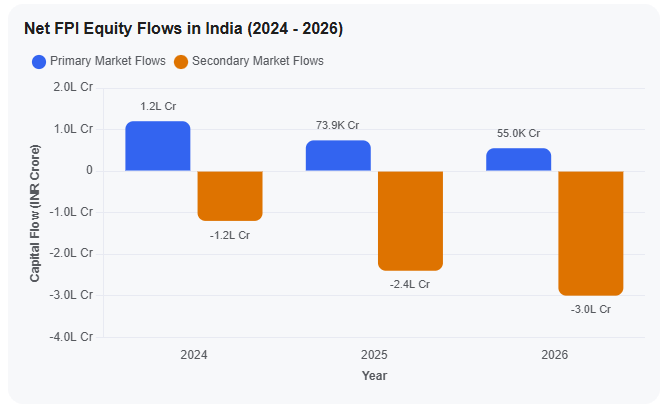
Three-Year Trend: Primary vs. Secondary Equity Flows
The divergence in FPI flows has now persisted for the third consecutive year, with foreign investors selling heavily in the secondary market while continuing to participate in India’s primary equity market. Market participants attribute this behaviour partly to valuation differences and the availability of sizeable IPO opportunities.
- 2024 — Flows broadly balanced: FPIs invested around ₹1.2 lakh crore in primary equity markets, while selling roughly ₹1.2 lakh crore in the secondary market. This resulted in a broadly neutral equity-market footprint.
- 2025 — Secondary selling accelerates: Primary-market investment moderated to ₹73,910 crore, while secondary-market selling increased sharply to around ₹2.4 lakh crore. The gap between IPO buying and listed-equity selling therefore widened significantly.
- 2026 — Divergence widens further: So far in 2026, FPIs have sold around ₹3 lakh crore in secondary equities, while investing more than ₹55,000 crore in Indian IPOs. The latest figures underline that foreign investors have not completely withdrawn from Indian equities; instead, their participation has become increasingly concentrated in the primary market.

Why foreign investors still prefer Indian IPOs
Despite the selling, IPOs remain attractive to foreign investors because new issues can offer negotiated valuations and access to companies that may not have significant representation in benchmark indices.
“IPOs give FPIs access to sizeable allocations, better price discovery and, often, a valuation cushion,” said Pranav Haldea, managing director of Prime Database Group.
He added that the preference has continued because “India’s primary market has consistently offered a pipeline of quality companies even when secondary-market valuations have appeared demanding.”
Tarun Singh, MD and Founder of Highbrow Securities, said IPOs also give FPIs access to sectors such as electronics manufacturing, consumer technology and renewables.
Track Live : Gap Up / Gap Down Stocks – Today’s NSE Opening Gaps
This is not a new trend
The divergence has been visible for several years.
In 2024, FPIs bought about ₹1.2 lakh crore in primary equity markets, while selling roughly the same amount in secondary markets.
In 2025, primary-market investment fell to around ₹73,910 crore, while secondary-market selling increased to approximately ₹2.4 lakh crore. Moneycontrol
This means foreign investors have increasingly been using India’s primary market as a separate channel for deploying capital, even while reducing exposure to listed stocks.
IPO buying does not necessarily mean long-term FPI ownership
The strong IPO investment should not automatically be interpreted as a long-term commitment to newly listed companies.
SEBI data over roughly the last three years shows foreign investors sold about 3% of their anchor holdings at the first unlock and around 60% within a year. Mutual funds, by comparison, sold about 38%.
“For foreign money, the primary market is an entry mechanism, not a home,” Singh explained.
He added that foreign investors tend to buy when valuations are negotiated rather than stretched and may exit when a stock lists at a premium they did not agree to.
Why are FPIs interested in IPOs?
Market participants cited in the report point to several reasons.
1. Better entry-price negotiation
Pranav Haldea, managing director of Prime Database Group, said IPOs can provide FPIs with sizeable allocations and better price discovery, while sometimes offering a valuation cushion compared with already-listed companies.
The key distinction is that an IPO gives institutional investors an opportunity to enter at the issue price, rather than buying an already-listed stock after it has potentially appreciated significantly.
2. Access to newer businesses
Tarun Singh, MD and founder of Highbrow Securities, said IPOs can give foreign investors exposure to sectors such as electronics manufacturing, consumer technology and renewables that may have relatively smaller representation in benchmark indices.
This means the IPO market can offer FPIs access to companies they may not otherwise obtain through traditional large-cap index exposure.
3. Valuation matters
The current FPI behaviour does not necessarily mean foreign investors have abandoned India altogether.
Instead, the flow data suggests that the price and structure of the investment matter.
A foreign investor may sell an expensive listed stock while simultaneously subscribing to a new company where it believes the issue valuation provides a more attractive entry point.
Debt markets offer another route for foreign capital
FPIs have also continued to participate in India’s debt markets. While foreign investors sold nearly ₹24,000 crore in secondary debt markets in 2025, they invested around ₹32,000 crore in primary debt.
Haldea said debt offers FPIs a more predictable risk-return profile.
“The combination of yield visibility and improving market access has made Indian debt relatively more attractive,” he said.
Read More : Bajaj Auto Falls 8%: Terrible Day, So Why Is Hyundai Smiling?
What about the debt market?
The foreign-investor preference is not limited to equities.
According to the latest report, FPIs have also invested in India’s debt markets, including both primary and secondary debt.
The notable exception was 2025, when foreign investors sold almost ₹24,000 crore of secondary debt, but bought approximately ₹32,000 crore of primary debt, leaving their overall debt flows positive.
Market participants have attributed some of this interest to the comparatively predictable return profile of debt, particularly when equity and currency volatility are elevated.
Here’s what happened today and why traders reacted
The latest FPI trend shows a clear divide between India’s secondary and primary markets. While foreign investors have remained heavy sellers of listed stocks, they continue to participate strongly in new share offerings.
This marks the third consecutive year in which FPIs have bought into India’s primary market while selling shares in the secondary market.
For investors, the trend matters because FPI flows can influence liquidity, stock valuations and broader market sentiment.
What this FPI trend means for investors
The contrasting FPI flows suggest that foreign investors are not uniformly turning away from India. Instead, they appear to be differentiating between existing listed stocks, new IPO opportunities and debt instruments.
For traders, continued secondary-market selling could keep volatility elevated, particularly in heavily owned large-cap stocks.
For investors, the IPO numbers underline the importance of looking beyond headline FPI outflows. The bigger question is where foreign capital is moving and at what valuation, rather than simply whether FPIs are buying or selling Indian assets.