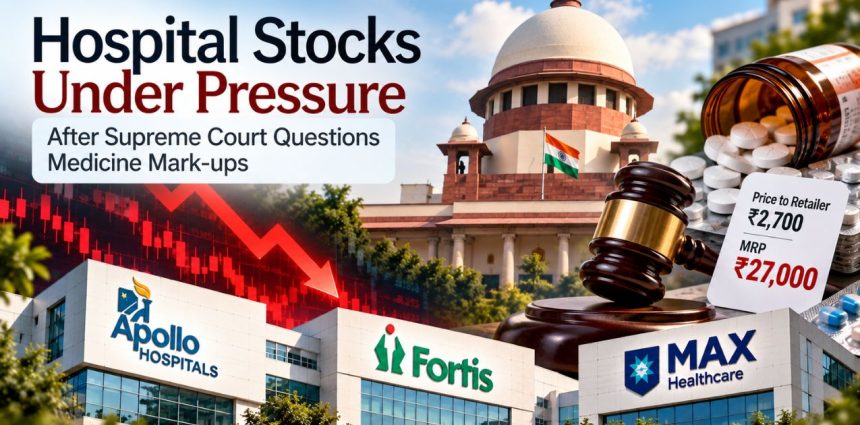
Apollo Hospitals, Fortis Healthcare and Max Healthcare fell sharply after the Supreme Court questioned steep medicine mark-ups. Brokerages see widely different earnings risks, from 2-5% EBITDA impact to high-single-digit or double-digit downside under adverse assumptions.
Hospital stocks remain under pressure after the Supreme Court questioned steep mark-ups on medicines at private hospitals, raising concerns that tighter pricing controls could affect a high-margin part of hospital businesses.
The BSE Hospitals Index fell 5% on September 30, while Apollo Hospitals declined 5.7%, Fortis Healthcare dropped 6.3% and Max Healthcare fell 5.3%, according to an Economic Times report. The selling extended into the October 1 morning trade as investors assessed the potential impact of any future pricing intervention.
But there is still no blanket 16% margin cap. The Supreme Court’s comments were made during the September 29 hearing of petitions concerning medicine-price regulation, and the matter is scheduled for further hearing on October 12, 2026, according to multiple reports.
The market question now is less about whether a 16% figure was mentioned and more about what medicines could eventually be covered, how the rule would work and how much of any pressure hospitals could offset.
Track Live: Nifty Healthcare Sector — Live Performance & Stocks
Why Hospital Stocks Fell
The immediate trigger was the Supreme Court’s concern over the gap between the price at which medicines are supplied to retailers and the maximum retail price paid by patients.
During the September 29 hearing, the bench highlighted a cancer medicine cited as being supplied to retailers for around ₹2,700 while carrying an MRP of ₹27,000. The court also questioned hospitals requiring patients to purchase medicines through their own or designated pharmacies.
The comments prompted broad selling across listed hospital chains on September 30. ET reported a 5% fall in the BSE Hospitals Index, with Apollo, Fortis and Max among the major decliners.
The concern for investors is that pharmacy and medicine-related income can carry higher margins than several other hospital services. Any broad reduction in permitted mark-ups could therefore affect profitability even if medicines represent only part of overall revenue.
What the 16% Figure Actually Means
The 16% figure comes from the existing Drugs (Prices Control) Order, 2013 (DPCO 2013) framework.
Under Paragraph 7 of the DPCO, 16% of the price to retailer (PTR) is allowed as a retailer margin when fixing the ceiling price of scheduled formulations and the retail prices of new drugs. The National Pharmaceutical Pricing Authority also explains that the ceiling price for scheduled medicines is derived by adding a 16% margin to the average PTR.
This framework does not mean that all medicines currently face a uniform 16% cap.
The Supreme Court questioned why the 16% principle used in the existing framework could not be considered more broadly for medicines. The court’s remarks were questions raised during the hearing, not an implemented blanket price-control order.
That distinction is important because the eventual effect on hospital companies will depend on the scope and mechanics of any future measure.
Brokerages See a Wide Range of Earnings Risk
The market’s expectations have diverged sharply, making the earnings impact difficult to pin down at this stage.
Jefferies estimates a potential 2-5% impact on hospital EBITDA, arguing that hospital chains have several levers through which they could absorb or offset some of the pressure.
Axis Capital estimates medicines contribute around 12-15% of total hospital revenue, while KIMS has a higher pharmacy contribution of around 20-22%. It estimates a worst-case impact of roughly 2-3% on revenue and 7-9% on EBITDA.
Macquarie has a wider sensitivity range. It estimates that medicines, consumables and implants together represented around 21% of private hospital revenue in FY26. Its scenario analysis points to an EBITDA impact ranging from high-single digits to double digits, assuming hospitals are able to offset around 60% of the revenue impact through repricing treatment packages and other services.
These estimates are not directly comparable. Jefferies and Axis are expressing the sensitivity mainly in EBITDA terms, while other analyses use different assumptions around revenue exposure, repricing and offsets.
The spread itself is important: it shows that investors do not yet have a single established estimate for the sector-wide earnings impact.
Track Live: GIFT NIFTY, NIFTY50, SENSEX
Elara’s 5-10% Estimate: An Analyst Scenario, Not Consensus
In an interview with CNBC-TV18 published on October 1, Bino Pathiparampil of Elara Securities said the hospital business should be evaluated across its full revenue mix rather than by looking at the margin on an individual medicine or segment.
He estimated that if a 16% margin framework were eventually extended more broadly, the impact on bottom-line earnings and EPS could be around 5-10%.
That estimate should be treated as Pathiparampil’s scenario assessment, rather than a consensus industry forecast. The other brokerage estimates now available show a materially different range of potential outcomes.
Pathiparampil also said hospitals operate with different cost structures and service mixes, which makes applying a single pricing rule across the entire hospital business more complicated.
BofA Points to Bundled Pricing and Existing Regulation
BofA Securities sees some factors that could limit the eventual earnings impact.
According to an October 1 brokerage roundup, drugs and consumables account for around 25-30% of tertiary-care bills, while a substantial portion of pharmacy drugs already has regulated margins in the 16-20% range.
BofA also points to the increasing use of package or bundled pricing, particularly as insurance penetration rises. In such arrangements, patients and insurers often pay for an overall procedure or treatment package rather than a separately visible margin on every individual product or service.
That could create some ability for hospitals to adjust the pricing of procedures and treatment packages if medicine margins are reduced.
However, the amount that can actually be recovered would depend on insurers, patients, competition and the final regulatory framework.
Exposure Will Differ Across Hospital Chains
One reason the earnings impact cannot be reduced to a single sector-wide percentage is that hospital companies have different revenue mixes.
Axis Capital estimates that medicines account for about 12-15% of total hospital revenue, while KIMS has pharmacy revenue exposure of around 20-22%, at the higher end of the industry range.
Meanwhile, Macquarie’s broader 21% figure includes medicines, consumables and implants, rather than pharmacy alone.
This means two hospital chains could face different earnings sensitivity from the same regulatory rule.
The distinction also matters for stock valuations: a company with relatively higher exposure to pharmacy or other products affected by pricing restrictions could face a different earnings scenario from a company whose revenue is more heavily concentrated in clinical services.
The Market Has Priced the Risk Before the Rule Is Known
The sharp September 30 correction highlights a clear expectation gap.
Investors have already reacted to the possibility of wider medicine-price controls, but the final scope of any such regulation is not yet known.
The Supreme Court has raised questions; it has not announced a blanket 16% margin regime for all hospital medicines. The Centre has also been asked to examine the issue before the next hearing.
That leaves several outcomes open.
A narrower framework affecting selected medicines could have a relatively contained impact, while a broader measure covering a much larger portion of hospital pharmacy and consumable pricing could create greater earnings pressure.
The market therefore has to balance the immediate regulatory shock against an uncertain final policy outcome.
October 12 Is the Next Major Trigger
The Supreme Court is scheduled to hear the matter again on October 12, 2026.
Investors will be watching for clarity on whether the discussion remains focused on medicine markups or expands into other aspects of hospital pricing and billing.
The three numbers to keep in focus are therefore not just the 16% figure but also the range of potential earnings sensitivities being discussed:
2-5% EBITDA impact: Jefferies
7-9% EBITDA impact in a worst-case scenario: Axis Capital
High-single-digit to double-digit EBITDA sensitivity: Macquarie under specified assumptions
5-10% bottom-line/EPS sensitivity: Elara’s Bino Pathiparampil scenario
These figures should not be combined into a single range because EBITDA, EPS and revenue impacts measure different things and use different assumptions.
What Investors Should Watch in Hospital Stocks
| Factor | What is known | Why it matters |
|---|---|---|
| Supreme Court issue | The court questioned the broader application of the 16% margin principle | No blanket cap has been implemented |
| Current DPCO framework | A 16% margin is used in calculating ceiling prices for scheduled formulations | Existing framework does not cover all medicines uniformly |
| September 30 reaction | BSE Hospitals Index -5%; Apollo -5.7%; Fortis -6.3%; Max -5.3% | Shows the immediate market response |
| Jefferies | 2-5% potential EBITDA impact | Sees offset mechanisms |
| Axis Capital | 7-9% worst-case EBITDA impact | Highlights differences in exposure |
| Macquarie | High-single-digit to double-digit EBITDA sensitivity | Assumes 60% revenue-impact offset |
| Elara | 5-10% bottom-line/EPS impact in its scenario | Analyst-specific estimate |
| Next hearing | October 12, 2026 | Key regulatory event |
Need to Know
- The Supreme Court has not imposed a blanket 16% margin cap on all medicines.
- The court questioned whether the 16% margin principle used in the DPCO framework could be applied more broadly.
- The court highlighted a cancer-drug example involving roughly ₹2,700 price to retailer versus ₹27,000 MRP.
- The BSE Hospitals Index fell 5% on September 30, while Apollo, Fortis and Max also declined sharply.
- Jefferies estimates a 2-5% potential EBITDA impact under its assumptions.
- Axis Capital estimates a 7-9% worst-case EBITDA impact and says KIMS has relatively high pharmacy exposure at 20-22% of revenue.
- Macquarie’s analysis puts medicines, consumables and implants at around 21% of private hospital revenue in FY26 and sees high-single-digit to double-digit EBITDA sensitivity in its scenario.
- Elara Securities’ Bino Pathiparampil gave a 5-10% bottom-line/EPS scenario estimate in an October 1 CNBC-TV18 interview.
- The next Supreme Court hearing is scheduled for October 12, 2026.
Read Next: Stocks to Watch Oct 1: NCC ₹1,577 Cr Orders, IRFC 2nd GST Notice
FAQs
Has the Supreme Court imposed a 16% margin cap on medicines?
No. The Supreme Court questioned whether the 16% margin principle already used in the DPCO framework could be applied more broadly. No blanket 16% cap covering all medicines has been implemented.
Why did hospital stocks fall?
The court’s comments raised concerns that stricter controls on medicine mark-ups could reduce pharmacy-related profitability at private hospitals. The concern was reinforced by the court’s discussion of a cancer drug with a large gap between its price to retailer and MRP.
How much could hospital earnings be affected?
Estimates vary by methodology and assumptions. Jefferies sees a 2-5% potential EBITDA impact, Axis Capital gives a 7-9% worst-case EBITDA estimate, and Macquarie sees high-single-digit to double-digit EBITDA sensitivity under its specified assumptions. Elara’s Bino Pathiparampil separately estimates a 5-10% impact on bottom-line earnings and EPS in a potential 16% margin-framework scenario.
Why are the estimates so different?
Hospital chains have different pharmacy, consumables and procedure mixes. In addition, some brokerages assume hospitals can recover part of the impact through package repricing and other services. EBITDA, revenue and EPS sensitivities are also different measures and should not be directly equated.
Which hospital stocks have higher pharmacy exposure?
Axis Capital puts KIMS’s pharmacy contribution at around 20-22% of revenue, which it describes as toward the higher end of the industry range.
What is the next important date for hospital stocks?
The Supreme Court matter is scheduled for another hearing on October 12, 2026.
Disclaimer: This article is for informational purposes only and should not be construed as investment advice. Brokerage estimates are scenario-based and may change as regulatory developments become clearer. Investors should assess company-specific revenue mix, valuation and regulatory risks independently.