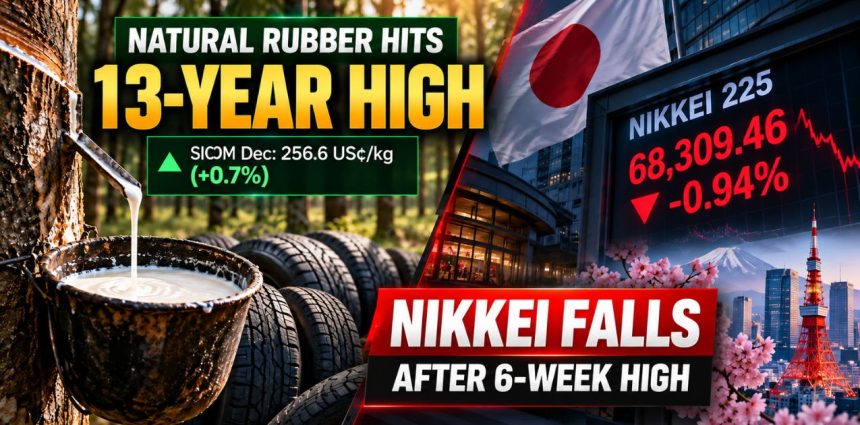
Natural rubber prices climbed to their highest level since 2013 on the SICOM platform as Japan’s Nikkei 225 pulled back from a six-week peak, putting weather disruptions, supply conditions, crude oil and geopolitical risks in focus.
Natural rubber is trading at levels last seen more than 13 years ago, while Japan’s Nikkei 225 retreated on Friday after a sharp run to a six-week high. Investors booked profits in Japanese equities, while rubber futures remained firm, with Osaka futures on course for a second weekly gain.
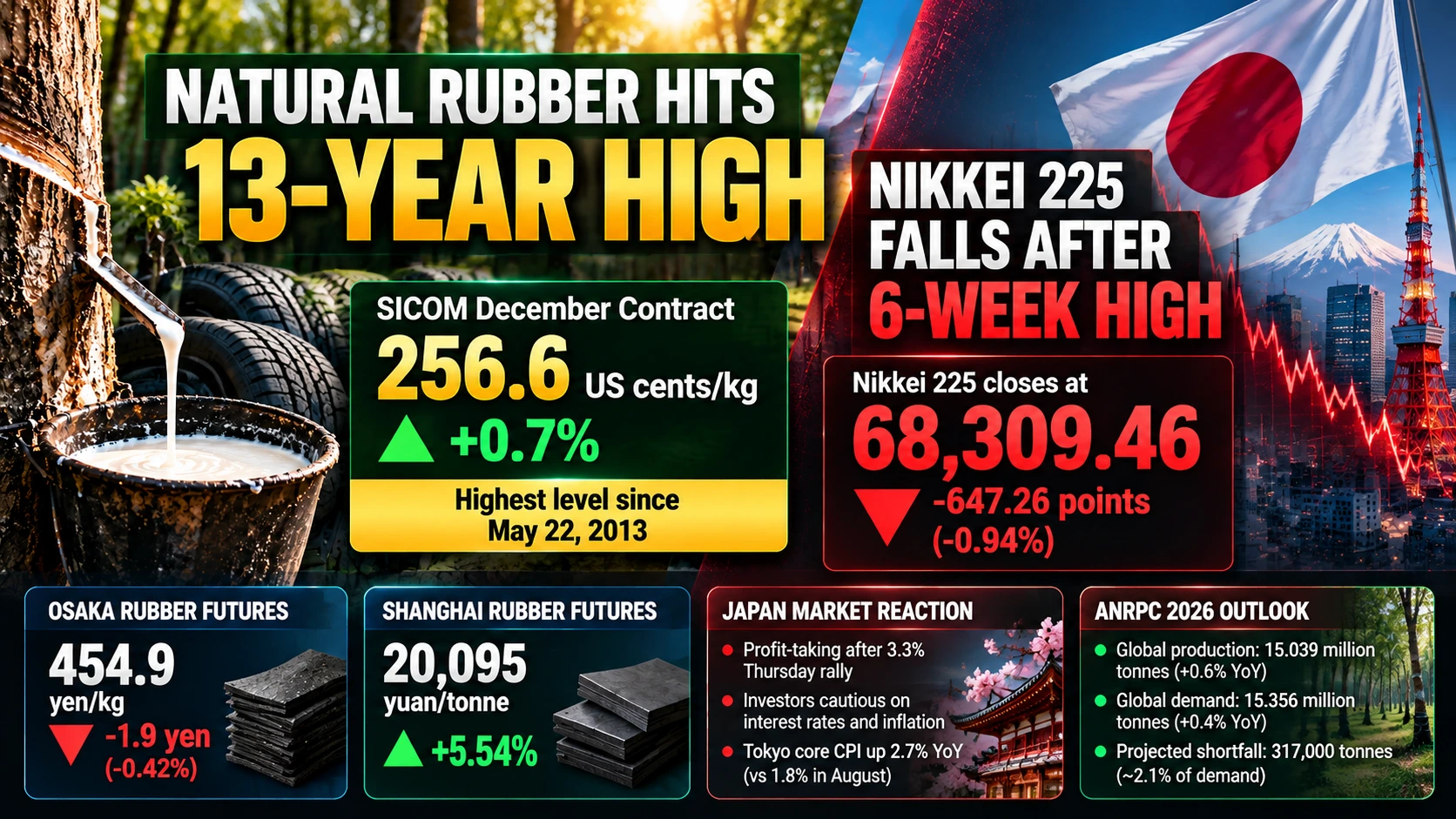
The front-month December rubber contract on the Singapore Exchange’s SICOM platform last traded at 256.6 US cents per kg, up 0.7%, and touched its highest level since May 22, 2013, according to Reuters. The Osaka Exchange’s March rubber contract was down 1.9 yen, or 0.42%, at 454.9 yen per kg as of 0215 GMT on Friday. Reuters said the contract was still on course for a second consecutive weekly gain.
Japan’s Nikkei 225 ultimately closed at 68,309.46, down 0.94%, after Thursday’s 3.3% surge took the index to a six-week high. The Topix ended at 4,091.00, down 0.99%.
Track Live: World News Today – Global Market & Economy Updates
Nikkei Gives Back Part of Thursday’s 3.3% Surge
Japan’s Nikkei 225 fell 647.26 points on Friday after its sharp Thursday rally. The decline reflected profit-taking and caution over interest rates, inflation and geopolitical risks.
Reuters reported that concerns about short-term overheating were likely to encourage profit-taking, citing Yuta Okamoto, an analyst at Tokai Tokyo Intelligence Laboratory. At the same time, the Bank of Japan’s tankan survey showed sentiment among large manufacturers improving for a sixth consecutive quarter, providing a more supportive signal for the domestic economy.
Japanese investors were also assessing fresh inflation data. Tokyo’s core consumer price index rose 2.7% in September from a year earlier, accelerating from 1.8% in August and marking its fastest pace in 10 months. The figure exceeded the 2.4% median market forecast and strengthened the case for further Bank of Japan rate hikes.
Rubber Holds Firm as Weather Disruptions Support Prices
The rubber market is showing a different pattern from Japanese equities.
On Thursday, Japanese rubber futures rose as firm raw-material costs linked to rainfall disruptions in producing regions countered weak demand from tyre manufacturers in China. Reuters reported that rainfall in China’s Hainan and Yunnan provinces had hindered short-term raw-material procurement, while floods in Thailand had disrupted parts deliveries to Toyota’s Thai operations and caused the temporary shutdown of four plants.
Reuters also reported that China’s pre-holiday stockpiling had concluded and pressure on tyre manufacturers’ profits could limit any improvement in demand. Thai benchmark RSS3 prices rose while block rubber prices declined, showing that physical-market conditions were mixed rather than uniformly bullish.
The strongest benchmark signal has come from SICOM. Its December contract reached its highest level since May 22, 2013, according to Reuters. The 13-year comparison applies to the SICOM benchmark and should not be treated as a direct comparison with the yen-denominated Osaka contract.
Shanghai Rubber Adds Another Signal
Shanghai rubber futures also provided a notable signal during the week.
Reuters reported that Shanghai’s January contract jumped 5.54% to 20,095 yuan per tonne on Wednesday and touched its highest level since February 20, 2017, earlier in the day.
The move came as stronger physical prices in Thailand supported the market after floods disrupted tapping activity. Reuters also cited firmer oil prices as another source of support for rubber futures that day.
Natural rubber often takes direction from oil because it competes for market share with synthetic rubber, which is produced from petroleum-based feedstocks.
What ANRPC’s August Report Shows
The Association of Natural Rubber Producing Countries, or ANRPC, released its Monthly Natural Rubber Statistical Report for August 2026 on September 30.
ANRPC projects global natural-rubber production to increase 0.6% to 15.039 million tonnes in 2026, from 14.952 million tonnes in 2025.
Global natural-rubber demand is forecast to rise 0.4% to 15.356 million tonnes, compared with 15.301 million tonnes in 2025. That implies a projected full-year production shortfall of about 317,000 tonnes, or roughly 2.1% of projected demand.
The association said production was affected by weather conditions, particularly erratic rainfall and drier conditions across Southeast Asia. It also revised estimates for Thailand, Malaysia and Indonesia.
ANRPC expects the largest increases in projected consumption to come from China, Malaysia and Cambodia. It also said steady EV-linked demand, led by China and India, was providing modest support to global consumption growth.
The monthly picture was tighter. ANRPC estimated August global production at 1.396 million tonnes, down 4.51% from 1.462 million tonnes a year earlier.
The Eight-Month Gap Does Not Fully Reconcile With the Annual Forecast
Reuters, citing ANRPC data, reported that global natural-rubber production fell 4.2% year on year to 8.68 million tonnes during the first eight months of 2026, while consumption fell 2.7% to 9.89 million tonnes. That left demand ahead of production by roughly 1.21 million tonnes during the period.
The eight-month figures are significantly tighter than ANRPC’s full-year projection. The annual forecast implies a gap of only about 317,000 tonnes.
The arithmetic highlights why the two figures should not be treated as interchangeable. To reach ANRPC’s full-year production forecast, output from September through December would need to total around 6.36 million tonnes. Full-year demand would require approximately 5.47 million tonnes over the same period.
That would mean average monthly production of about 1.59 million tonnes during the final four months of the year, compared with ANRPC’s August estimate of 1.396 million tonnes.
These are NiftyTrader calculations rather than ANRPC statements. The difference may reflect revisions or differences in how monthly and full-year estimates are compiled.
For now, the eight-month data point to tighter conditions, but they do not by themselves establish a permanent or deep structural global deficit.
Oil Is a Wild Card, Not the Main Rubber Driver
Crude oil remains important because natural rubber competes with synthetic rubber, which is produced from petroleum-based feedstocks.
On Friday, Brent crude was around $102.28 a barrel at 0350 GMT, while WTI was near $92.68. Brent was heading for a weekly decline of roughly 2%, even as rubber futures were on course for a second consecutive weekly gain.
That weekly divergence is important. Rubber is heading for a second weekly gain even as Brent is set for a weekly decline, suggesting crude is currently better viewed as a source of volatility than the primary explanation for rubber’s weekly strength.
Reuters reported that oil prices remained elevated after China suspended oil-product exports. The Wall Street Journal separately reported that the United States was sending more troops and another aircraft carrier to the Middle East, adding to concerns over global energy supplies.
ANRPC said Brent crude averaged $91.08 a barrel in August, meaning current prices remain well above the August average.
What It Means for India
Indian equity markets were closed on Friday for Gandhi Jayanti, so Japan’s equity performance, crude oil and Asian rubber futures will become relevant for the next Indian trading session.
For Indian tyre makers, the key question is whether elevated natural-rubber prices persist long enough to increase procurement costs.
The eventual impact will depend on inventory cycles, domestic availability, tyre demand and manufacturers’ ability to pass higher input costs through to customers.
ANRPC’s latest report showed India’s natural-rubber imports fell 10.18% month on month in August. China’s imports increased 3.39%, while Malaysia’s declined 8.24% and Vietnam’s rose 5.08%. The report does not establish a single reason for India’s monthly decline.
In Kottayam, the average RSS-4 price edged up 0.57% to $2.92 per kg in August, according to ANRPC. Physical rubber prices were mixed across grades during the month: SMR-20 rose 4.25%, while RSS-3 declined 4.18%.
Investors tracking Indian tyre companies can also monitor institutional flows through the NiftyTrader FII-DII Tracker.
Track Live: Nifty Auto Sector Analysis explains how rubber and other raw-material costs affect auto-sector margins.
What to Watch Next
The first signal is Brent crude and its response to Middle East developments and China’s fuel-export restrictions.
The second is Asian rubber futures, particularly SICOM and Osaka, which will show whether the recent rally can hold after profit-taking in equities.
The third is the next ANRPC monthly report, which should provide more clarity on the relationship between the reported eight-month supply-demand figures and the full-year forecast.
The fourth is weather across Southeast Asia. Flooding, rainfall patterns and potential El Niño effects can quickly influence tapping activity and physical rubber availability.
For Indian markets, tyre demand, domestic rubber prices and procurement costs will also be important as companies move through the final months of 2026.
Bottom Line
SICOM rubber has reached its highest level since May 2013 while Japan’s Nikkei has pulled back from a six-week peak.
ANRPC’s full-year figures point to a relatively modest 317,000-tonne production shortfall, while the larger eight-month gap reported from ANRPC data does not reconcile neatly with the annual projection.
The current evidence therefore points to weather-related supply risks and firm prices in some rubber markets, but it does not by itself establish a deep structural deficit.
For Indian investors, the key signals are SICOM rubber, Osaka rubber, Brent crude, Southeast Asian weather, ANRPC supply estimates and domestic tyre-sector costs.
Read Next: ₹4,800 Crore FX Shock Hit Indian Banks: Why the Rupee’s Slide Matters Again
Disclaimer: This article is for informational and educational purposes only and does not constitute investment advice or a recommendation to buy, sell or hold any security or commodity. Investments in securities markets are subject to market risks. Readers should consult a SEBI-registered investment adviser before making any investment decision.