
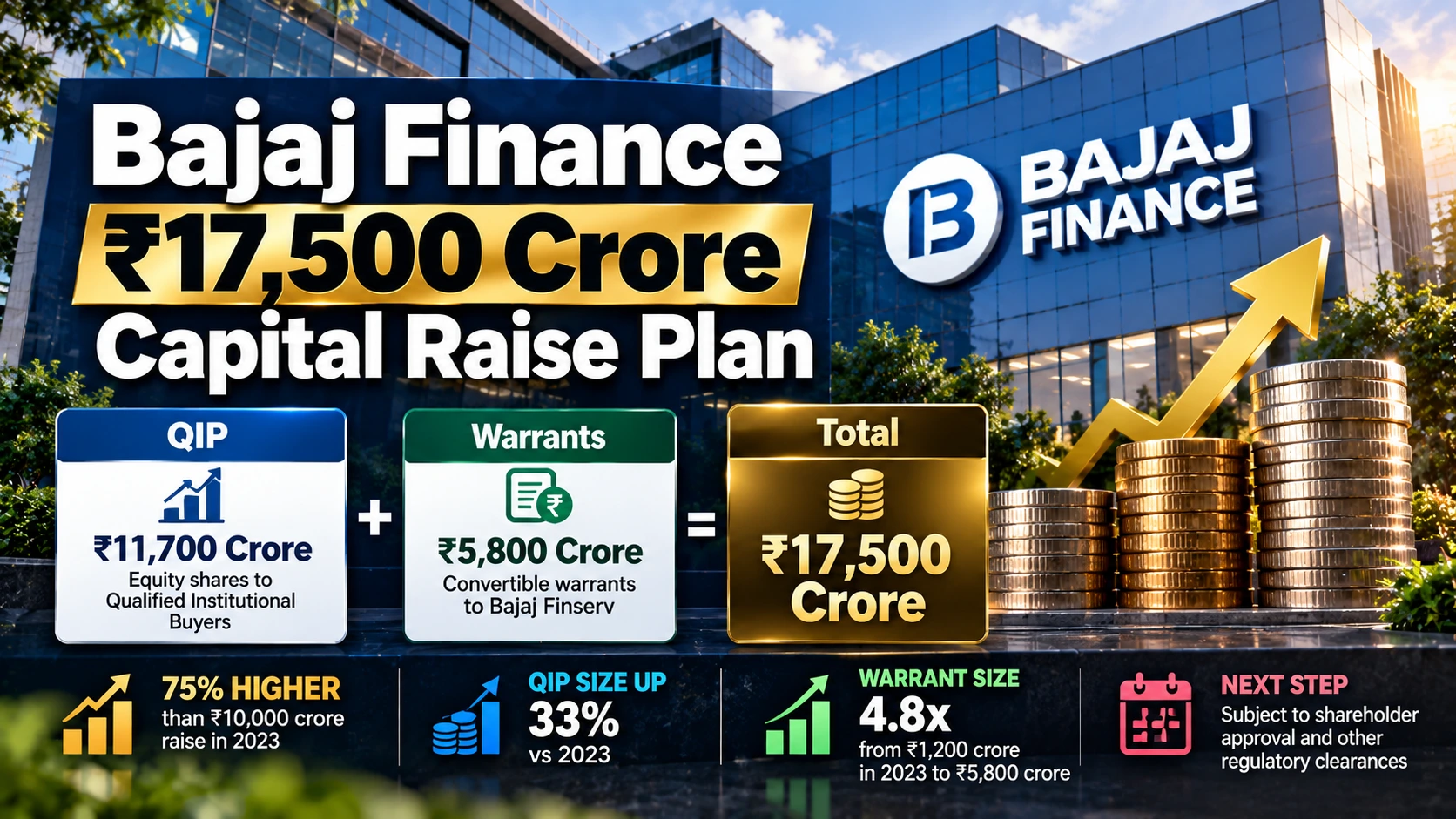
Bajaj Finance QIP: The NBFC has approved a ₹11,700 crore institutional share sale and ₹5,800 crore warrant issue to Bajaj Finserv, taking its proposed capital raise to ₹17,500 crore.
Bajaj Finance has approved a proposed ₹17,500 crore capital raise through two routes: a ₹11,700 crore Qualified Institutions Placement (QIP) and a ₹5,800 crore preferential issue of convertible warrants to Bajaj Finserv, its promoter and holding company. The proposals remain subject to shareholder approval and other applicable statutory and regulatory approvals.
The headline amount is notable, but the bigger change lies in the structure. The proposed ₹17,500 crore raise is 75% above Bajaj Finance’s ₹10,000 crore capital-raising plan approved in 2023. Within that total, the QIP has risen about 33%, while the warrant component has increased nearly 4.8 times, from ₹1,200 crore in 2023 to ₹5,800 crore now.
That creates a key question around the latest Bajaj Finance QIP: why is the company proposing a substantially larger equity raise while reporting strong capital adequacy, rapid AUM growth and improving asset quality?
Track Live: BAJAJ FINANCE Options Chart | Nifty Trader
Bajaj Finance QIP and warrant issue: What the board approved
| Fundraising route | Proposed amount | Structure |
|---|---|---|
| QIP | ₹11,700 crore | Equity shares to Qualified Institutional Buyers |
| Preferential warrants | ₹5,800 crore | Convertible warrants to Bajaj Finserv |
| Total | ₹17,500 crore | QIP + warrants |
The QIP will involve equity shares with a Re 1 face value. The preferential issue will comprise warrants convertible into an equivalent number of equity shares, subject to the applicable terms, pricing rules and approvals.
Bajaj Finance plans to seek shareholder approval through an Extraordinary General Meeting (EGM). The final issue price and the number of shares or warrants to be issued will be determined in line with applicable regulatory requirements.
The ₹17,500 crore headline is not all immediate cash
The warrant component has a different cash-flow profile from the QIP.
Under the disclosed structure, 25% of the warrant consideration is payable at allotment, with the remaining 75% payable when the warrants are exercised and the equity shares are allotted. At the maximum ₹5,800 crore issue size, that means ₹1,450 crore upfront and ₹4,350 crore later, subject to the terms of the issue. The warrants have an exercise period of up to 18 months from allotment.
Therefore, the ₹17,500 crore figure represents the maximum proposed fundraise, not ₹17,500 crore of cash arriving at Bajaj Finance immediately.
Why the 2026 plan is much larger than the 2023 raise
Bajaj Finance undertook a similar capital-raising exercise in 2023.
On October 5, 2023, its board approved up to ₹8,800 crore through a QIP and up to ₹1,200 crore through preferential warrants to Bajaj Finserv. Shareholders approved the proposals later that month. The company subsequently allotted 1.55 million warrants to Bajaj Finserv at ₹7,670 per warrant, aggregating to about ₹1,188.85 crore, with 25% paid initially, and completed a QIP of about ₹8,800 crore in November 2023.
The comparison is:
| 2023 plan | 2026 proposal | Change | |
|---|---|---|---|
| QIP | ₹8,800 crore | ₹11,700 crore | +33% |
| Warrants | ₹1,200 crore | ₹5,800 crore | 4.8x |
| Total | ₹10,000 crore | ₹17,500 crore | +75% |
The increase is therefore not simply a larger version of the old QIP. The promoter-warrant leg has expanded much more sharply than the institutional placement.
Bajaj Finance enters the raise with a ₹5.47 lakh crore AUM base
The proposed capital raise comes as Bajaj Finance continues to expand its lending franchise.
As of June 30, 2026, consolidated AUM stood at ₹5,46,944 crore, up 24% year on year from ₹4,41,450 crore. The company added ₹36,969 crore of AUM during Q1 FY27, while new loans booked rose 20% to 16.13 million.
The customer franchise reached 124.43 million, while management is targeting another 18-20 million customer additions during FY27.
The size of the loan book is important because the proposed equity would provide additional capital to support a much larger operating base than the one backed by the 2023 raise.
Also Check: BAJAJ FINANCE Ltd Futures — Live Price, OI & Basis
Capital adequacy remains above 20%
Bajaj Finance reported 20.90% consolidated capital adequacy as of June 30, 2026, with Tier-I capital at 20.01%.
The company also reported a ₹17,847 crore liquidity buffer and a consolidated deposit book of ₹68,534 crore at the end of Q1 FY27.
The strong capital position makes the timing of the new raise particularly significant. Bajaj Finserv has said its proposed subscription to the ₹5,800 crore warrants is not driven by Bajaj Finance’s immediate capital needs. Instead, it has described the move as demonstrating support and commitment to the subsidiary and providing confidence to prospective investors.
That means the transaction should not automatically be interpreted as a balance-sheet repair exercise.
Bajaj Finserv’s ₹5,800 crore commitment is a major part of the deal
Bajaj Finserv currently owns 51.30% of Bajaj Finance and has approved subscribing to up to ₹5,800 crore of convertible warrants through a preferential allotment on a private-placement basis.
The two parts of the fundraising serve different functions. The QIP is aimed at institutional investors, while the warrant issue brings additional capital from the existing promoter.
The eventual effect on Bajaj Finserv’s ownership and existing shareholders’ percentage ownership cannot yet be calculated precisely, because the final QIP pricing, warrant pricing and resulting number of shares have not been fixed.
That makes final pricing one of the most important next data points for the market.
Why the capital raise matters when AUM is growing 24%
Bajaj Finance is targeting further expansion during FY27.
Its latest investor presentation outlines expectations of 60-62 million new loans, 18-20 million additional customers and 150-175 new locations during the year. The Gold Loan branch network is targeted at 2,700-2,800, while the microfinance network is expected to reach 520-550 branches by FY27-end.
Those targets provide a clear growth backdrop for the proposed capital raise.
However, the October 1 fundraising announcement does not provide a detailed allocation of the maximum ₹17,500 crore across these individual growth initiatives.
That leaves a genuine expectation gap for investors: the company has disclosed the size and structure of the capital raise, but not yet a detailed map showing how the full amount will be deployed.
Profit and asset quality remain strong
Bajaj Finance reported consolidated PBT of ₹8,149 crore and consolidated PAT of ₹6,081 crore in Q1 FY27, both up 28% year on year, according to its investor presentation.
Annualised ROA was 4.7%, while annualised ROE stood at 20.4% during the quarter.
Asset quality also improved. GNPA was 0.96% and NNPA 0.39% at June 30, 2026, compared with 1.03% and 0.50%, respectively, a year earlier.
These numbers indicate that the proposed raise is being announced alongside continued business growth rather than a reported deterioration in the company’s core capital or asset-quality metrics.
CRISIL highlights both capital strength and future risks
CRISIL said Bajaj Finance had strong capitalisation, with consolidated net worth of ₹1,20,398 crore as of June 30, 2026, and consolidated gearing of 3.8 times. It also noted that the group has historically initiated capital raises as gearing moved toward its internal ceiling of around six times.
At the same time, CRISIL identified a forward-looking regulatory monitorable. It said the RBI’s August 6, 2026 draft guidelines on credit facilities for NBFCs, if implemented in their current form, could affect some Bajaj Finance product segments. CRISIL said it would continue monitoring the development.
This creates another layer of uncertainty for the new capital plan: the company is expanding its balance sheet while the regulatory framework for some lending products is still evolving.
The key issue for existing shareholders: pricing and dilution
A QIP involves issuing fresh shares, while warrants can result in further shares if exercised.
The ultimate effect on existing shareholders therefore depends on how much of the proposed ₹11,700 crore QIP is actually raised, the final issue price, the warrant price and how many warrants convert into equity.
At this stage, assigning a precise dilution percentage would go beyond the disclosed information.
The same applies to Bajaj Finserv’s eventual ownership percentage. Its current stake is 51.30%, but the post-transaction percentage will depend on the final securities issued and converted.
What happens next for Bajaj Finance QIP?
The immediate milestones are the EGM and shareholder vote, final QIP terms, issue pricing, warrant pricing and the amount ultimately raised.
Bajaj Finserv has said the proposed warrant allotment is expected to be completed within 15 days of the special resolution passed by Bajaj Finance shareholders, subject to the applicable requirements.
Only after those terms are finalised will investors have greater visibility on the eventual share-count increase, ownership effects and the amount of capital actually deployed.
For now, the clearest signal is that Bajaj Finance has proposed a ₹17,500 crore capital raise—75% above its 2023 plan—while reporting 24% AUM growth, 20.90% capital adequacy and improving asset quality.
The next phase of the story will be determined by pricing, deployment and the returns generated on the additional equity.
Need to Know
₹17,500 crore: Maximum proposed Bajaj Finance fundraise.
₹11,700 crore: Proposed QIP.
₹5,800 crore: Proposed warrants to Bajaj Finserv.
75%: Increase versus the 2023 ₹10,000 crore plan.
4.8x: Increase in the proposed warrant component versus 2023.
20.90%: Consolidated capital adequacy at June 30, 2026.
₹5.47 lakh crore: Consolidated AUM at June 30, 2026.
51.30%: Bajaj Finserv’s current holding in Bajaj Finance.
Read Next: NSE Corporate Bond Index Futures: SEBI NOC In, RBI NOD Awaited
FAQ
What is the Bajaj Finance QIP size?
Bajaj Finance has proposed raising up to ₹11,700 crore through a Qualified Institutions Placement.
What is the total Bajaj Finance fundraising plan?
The company has proposed raising up to ₹17,500 crore through a ₹11,700 crore QIP and a ₹5,800 crore preferential warrant issue.
Who will subscribe to the ₹5,800 crore warrants?
Bajaj Finserv, Bajaj Finance’s promoter and holding company, has approved subscribing to the warrants.
Is the ₹17,500 crore raise final?
No. The board has approved the proposals, but shareholder and applicable statutory and regulatory approvals are still required.
How much of the warrant amount is payable upfront?
At least 25% is payable at allotment. At the maximum ₹5,800 crore size, that is ₹1,450 crore, with the remaining ₹4,350 crore payable on exercise.
Why is the 2026 capital raise notable?
The proposed ₹17,500 crore is 75% above Bajaj Finance’s ₹10,000 crore 2023 plan, while the warrant component has increased from ₹1,200 crore to ₹5,800 crore.
What is Bajaj Finance’s latest AUM?
Consolidated AUM was ₹5,46,944 crore as of June 30, 2026, up 24% year on year.
Will the fundraise dilute existing shareholders?
Fresh QIP shares and any equity issued upon warrant conversion can increase the total share count. The exact dilution cannot yet be calculated because the final pricing and number of securities have not been determined.
What is Bajaj Finserv’s current stake in Bajaj Finance?
Bajaj Finserv currently holds 51.30% of Bajaj Finance’s issued and paid-up equity share capital.
What are the key factors to watch next?
Investors will be watching shareholder approval, QIP and warrant pricing, the final amount raised, the pace of warrant conversion and how the additional capital is deployed.
Disclaimer: This article is for news and information purposes only and is not investment advice. The proposed fundraising remains subject to shareholder, regulatory and statutory approvals, and final terms may change.