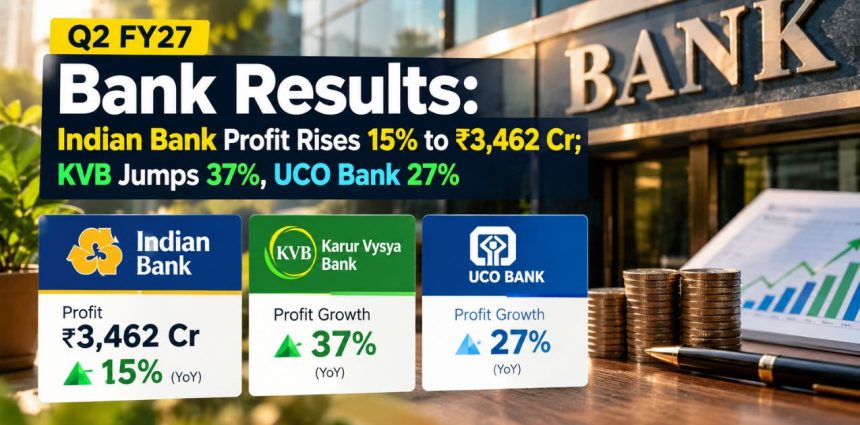
Indian Bank reported ₹3,462 crore in Q2 FY27 profit, including an approximately ₹1,400 crore benefit linked to NSE shares. Its board also approved a ₹7,000 crore bond-fundraising plan. Meanwhile, Karur Vysya Bank led four lenders in percentage profit growth, as treasury earnings came under pressure across the sector.
October 15, 2026
Indian Bank’s net profit rose 14.71% year-on-year to ₹3,462 crore in the September quarter, but its shares closed 1.7% lower at ₹835 on October 15. The contrast stood out on a day when the Sensex climbed 2.11% and the Nifty 50 advanced 1.66%.
The share-price movement does not, by itself, establish why investors sold. But the earnings composition provides an important reason to look beyond the headline profit increase: Indian Bank reported an approximately ₹1,400 crore benefit associated with previously unlisted NSE shares that subsequently became listed, while provisions and contingencies rose sharply.
The bank has also approved plans to raise up to ₹7,000 crore through bonds. Together, these developments put the focus on three questions: how much of the profit growth is repeatable, how the bank is preparing for future credit-loss requirements, and what its fundraising plans mean for the balance sheet.
The wider banking results tell a similarly mixed story. Karur Vysya Bank recorded the fastest percentage profit growth among the four lenders compared here, South Indian Bank reported record quarterly net interest income, and UCO Bank’s treasury income fell sharply even as its profit increased.
Bank Q2 results: How the four lenders performed
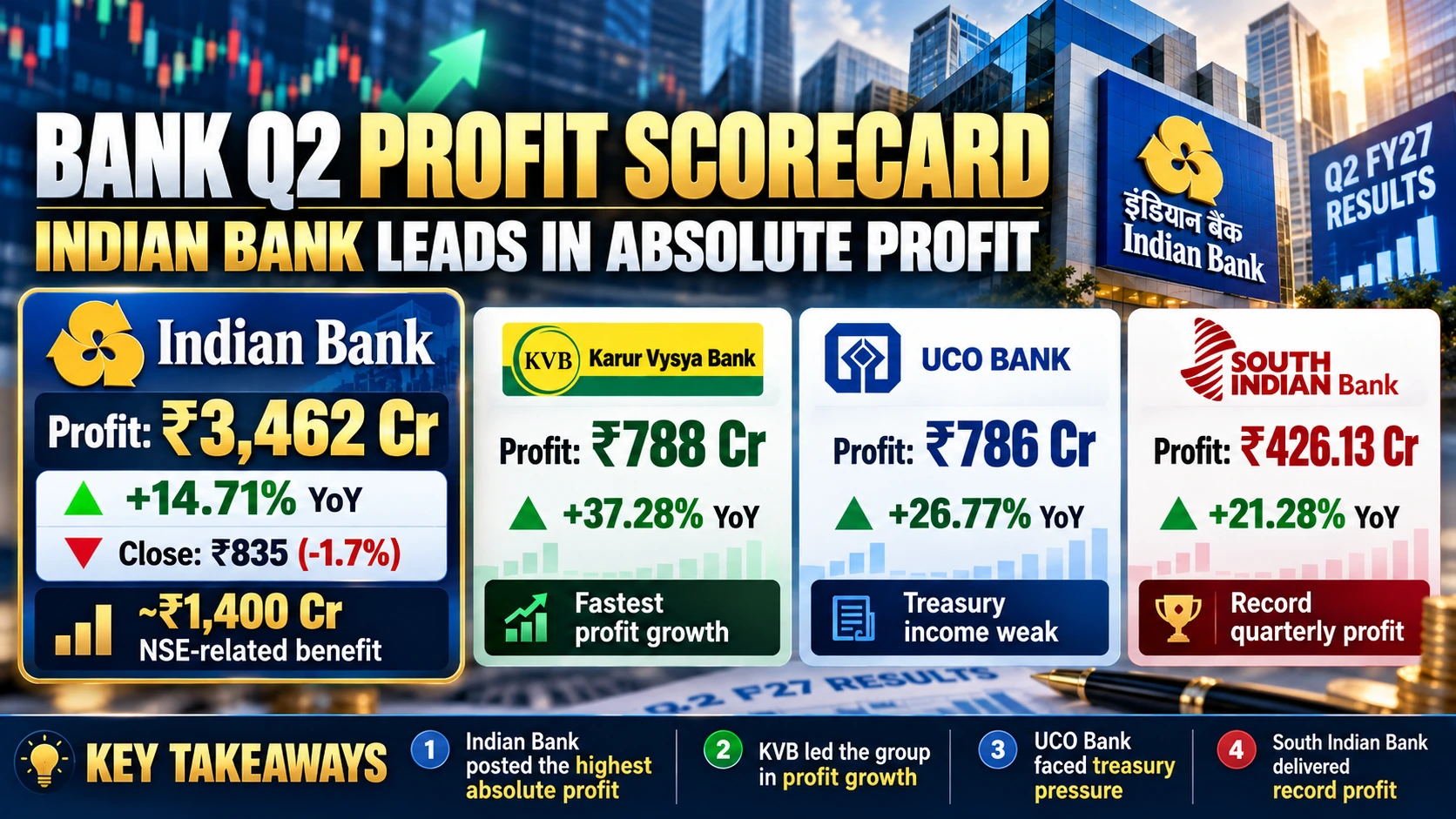
| Bank | Q2 FY27 net profit | YoY growth | Key earnings signal |
|---|---|---|---|
| Indian Bank | ₹3,462 crore | 14.71% | NII rose 17.83%; NSE-share-related benefit of about ₹1,400 crore |
| UCO Bank | ₹786 crore | 26.77% | Treasury income fell about 72% YoY to ₹29 crore |
| South Indian Bank | ₹426.13 crore | 21.28% | NII increased about 38% to ₹1,116 crore |
| Karur Vysya Bank | ₹788 crore | 37.28% | NII rose 18.72%; NIM improved to 4.34% |
Sources: Indian Bank’s Q2 FY27 results, UCO Bank’s financial results, South Indian Bank’s FY27 results and Karur Vysya Bank’s official disclosures. Figures are rounded where appropriate.
The comparison separates absolute profit from percentage growth. Indian Bank generated the highest quarterly profit among these four lenders, while Karur Vysya Bank delivered the strongest percentage increase. The more important distinction is how each bank generated its earnings and whether those drivers can continue.
Indian Bank Q2 results: Strong operating profit, but an NSE gain changes the picture
Indian Bank reported standalone net profit of ₹3,462.24 crore for Q2 FY27, compared with ₹3,018.22 crore a year earlier.
Net interest income (NII) rose 17.83% to ₹7,719 crore, while operating profit increased 46.58% to ₹7,090 crore. Non-interest income climbed to ₹3,953 crore from ₹2,487 crore, supported by foreign-exchange gains, fee income and the reported NSE-share-related benefit.
Managing Director Binod Kumar told Financial Express that the bank received a benefit of around ₹1,400 crore after previously unlisted NSE shares became listed.
This is a significant detail for anyone assessing the results. A gain associated with the listing or revaluation of an investment is not automatically comparable with recurring income from lending, fees and other routine banking activities. The bank’s reported net profit remains valid, but investors evaluating its underlying earnings trajectory need to distinguish the different sources of income.
The bank also reported provisions and contingencies of ₹2,222 crore, compared with ₹739 crore a year earlier. Kumar told The Economic Times that the bank was building a buffer ahead of the expected-credit-loss (ECL) framework, due to take effect on April 1, 2027.
Asset quality improved despite the higher provisions. Gross non-performing assets (GNPA) declined to 1.61% from 2.60% a year earlier, while the net NPA ratio fell to 0.14%.
The combination is important: stronger operating profit and lower bad-loan ratios support the positive earnings story, while the NSE-related benefit and higher provisions complicate comparisons with future quarters.
Indian Bank approves a ₹7,000 crore bond-fundraising plan
Separately, Indian Bank’s board approved fundraising of up to ₹7,000 crore through non-equity instruments.
The plan comprises:
- Up to ₹5,000 crore through long-term infrastructure bonds to finance or refinance infrastructure and affordable-housing lending.
- Up to ₹2,000 crore through Basel III-compliant Additional Tier 1 (AT1) or Tier 2 bonds to meet capital requirements.
The fundraising may take place in one or more tranches during the current or subsequent financial years, depending on the bank’s requirements.
This is an approved fundraising plan, not a completed issue or an equity share sale. It is a separate development from the NSE-share-related earnings benefit and should not be interpreted as evidence that the bank has already raised the money.
What to watch next: whether interest income and operating performance remain strong as the contribution from investment-related gains normalises, and how provisions evolve as the bank prepares for the ECL transition.
Track Live: INDIAN BANK Option Chain (NSE) — Live OI, PCR & Greeks
UCO Bank Q2 results: Profit rises as treasury income falls 72%
UCO Bank reported a net profit of ₹786 crore in Q2 FY27, up 26.77% from ₹620 crore in the year-ago quarter.
NII increased 13.96% to ₹2,886 crore, while its global net interest margin improved by 10 basis points year-on-year to 3%.
Credit growth was another key contributor. Total advances rose 24.70% year-on-year to approximately ₹2.87 lakh crore, while total deposits grew 14.36%. The figures cover the bank’s global business; domestic advances and deposits are reported separately.
The treasury numbers, however, were less encouraging. UCO Bank’s treasury income fell approximately 72% year-on-year to ₹29 crore, according to The Economic Times.
That decline illustrates the difference between core banking income and market-sensitive earnings. Growth in lending and NII can support profitability even when gains from investment portfolios are weak, but future results will depend on whether the core-income improvement continues.
Asset quality also improved. The gross NPA ratio declined to 1.96%, while net NPAs stood at 0.18%.
UCO Bank’s next results will help show whether its lending expansion continues to offset volatile treasury income without putting pressure on funding costs or credit quality.
South Indian Bank Q2 results: Record quarterly NII supports profit growth
South Indian Bank reported a net profit of ₹426.13 crore, up 21.28% from ₹351.37 crore in the corresponding quarter last year.
Its NII rose approximately 38% to a record ₹1,116 crore, while net interest margin improved to 3.33% from 2.80%.
The bank’s asset-quality figures also strengthened. Gross NPA declined to 1.24% from 2.93% a year earlier, and net NPA fell to 0.09%.
However, treasury and foreign-exchange earnings declined to ₹80 crore from ₹129 crore in the year-ago quarter, according to The Economic Times. Provisions and contingencies increased to ₹159 crore from ₹63 crore, as reported by Press Trust of India.
South Indian Bank’s results therefore contain a different mix from Indian Bank’s. Higher NII and an improved margin point to stronger core-income performance, while lower treasury and foreign-exchange earnings show that market-linked income remains a variable.
The key question is whether the improvement in lending income and asset quality can continue to support profitability over subsequent quarters.
Karur Vysya Bank Q2 results: Fastest percentage profit growth
Karur Vysya Bank posted net profit of ₹788 crore in Q2 FY27, an increase of 37.28% from ₹574 crore a year earlier.
NII rose 18.72% to ₹1,497 crore from ₹1,261 crore. Net interest margin increased to 4.34% from 4.24% in the corresponding quarter of FY26.
Asset quality remained comparatively strong. Gross NPA declined to 0.69% from 0.76% a year earlier, while net NPA stood at 0.18%.
The bank’s advances expanded 20.35% year-on-year to approximately ₹1.12 lakh crore.
Among the four lenders in this comparison, Karur Vysya Bank recorded the strongest percentage growth in quarterly net profit. Growth in NII and the improvement in NIM provide additional context for that result, rather than relying on the bottom-line increase alone.
Even so, one quarter does not establish that the same pace of earnings growth will continue. Funding costs, the mix of new lending and future credit quality remain important variables.
Why rising bond yields matter for the next set of bank results
Treasury pressure was a broader theme in the September-quarter earnings season.
The benchmark 10-year Indian government bond yield rose by approximately 44 basis points during the July–September quarter, ending September near 7.19%, compared with around 6.75% three months earlier, according to The Economic Times.
Bond prices generally move inversely to yields. When yields rise, the market value of existing fixed-rate bonds tends to fall. Depending on a bank’s investment classification and accounting treatment, this can reduce trading gains or create valuation pressure.
That helps explain why banks can report healthier NII and stronger loan growth without seeing a comparable improvement in treasury earnings. The effect varies by bank according to its securities portfolio, accounting classification and treasury strategy.
The policy outlook adds another risk for upcoming quarters. The Reserve Bank of India raised the repo rate by 25 basis points to 5.50% on October 7. On October 9, it announced another ₹25,000 crore open-market bond sale and raised the minimum daily cash reserve ratio maintenance requirement from 90% to 99%, effective October 16.
These measures were announced after Q2 ended on September 30. They cannot explain the treasury pressure already reported for the quarter, but they are relevant to future funding and liquidity conditions.
A tighter liquidity environment can affect short-term funding costs and banks’ management of deposits, while further market movements could continue to influence treasury portfolios. The actual impact will differ by lender.
The next set of bank results will help establish whether core lending income can continue to offset weaker treasury earnings and how much of reported profit growth is repeatable.
What investors should monitor after the Q2 results
The four banks illustrate why reported net profit is only one part of the earnings picture.
Indian Bank delivered the highest absolute profit in the group, but its NSE-share-related benefit and increased provisions require closer examination. Karur Vysya Bank led percentage growth, supported by higher NII and an improved NIM. South Indian Bank recorded its strongest quarterly NII, while UCO Bank’s results showed how treasury income can fluctuate despite healthy credit expansion.
The indicators worth watching over the coming quarters are:
- Net interest income and margin: whether core lending income continues to grow and margins remain resilient.
- Deposit growth and funding costs: especially for banks whose advances are expanding faster than deposits.
- Treasury income: whether bond-market conditions continue to constrain gains from investment portfolios.
- Provisions and asset quality: whether improving NPA ratios translate into sustainable credit costs as the ECL framework approaches.
The central issue is not simply which bank reported the fastest profit growth. It is which lenders can sustain that growth through recurring banking income, healthy asset quality and manageable funding costs when investment-related gains become less supportive.
Read Next: IMF Forecasts Asia Growth at 4.4% in 2027: 3 Risks for India
Frequently asked questions
Why did Indian Bank shares fall despite higher Q2 profit?
Indian Bank shares closed 1.7% lower at ₹835 on October 15, even as quarterly profit rose 14.71%. The share-price move does not establish a single cause, but the earnings mix—including the NSE-share-related benefit and higher provisions—provides important context for investors assessing the result.
What was Indian Bank’s NSE-share-related gain?
Managing Director Binod Kumar told Financial Express that the listing of previously unlisted NSE shares provided a benefit of around ₹1,400 crore. This should be distinguished from recurring lending income.
Which bank recorded the highest percentage profit growth?
Karur Vysya Bank recorded the highest percentage increase among the four lenders compared here, with net profit rising 37.28% to ₹788 crore.
Why is UCO Bank’s treasury income important?
UCO Bank’s treasury income fell approximately 72% year-on-year to ₹29 crore. Its profit still increased because lending and NII supported earnings, illustrating why treasury income and core banking income need to be assessed separately.
How could the RBI’s October measures affect banks?
The repo-rate hike and liquidity measures came after Q2 ended. Their effects will depend on future interest rates, short-term funding costs, deposit mobilisation and each bank’s securities portfolio.
Disclaimer: This article is for informational and educational purposes only and is not investment advice. Quarterly results and market conditions can change. Readers should refer to official company disclosures and assess their own financial circumstances before making investment decisions.