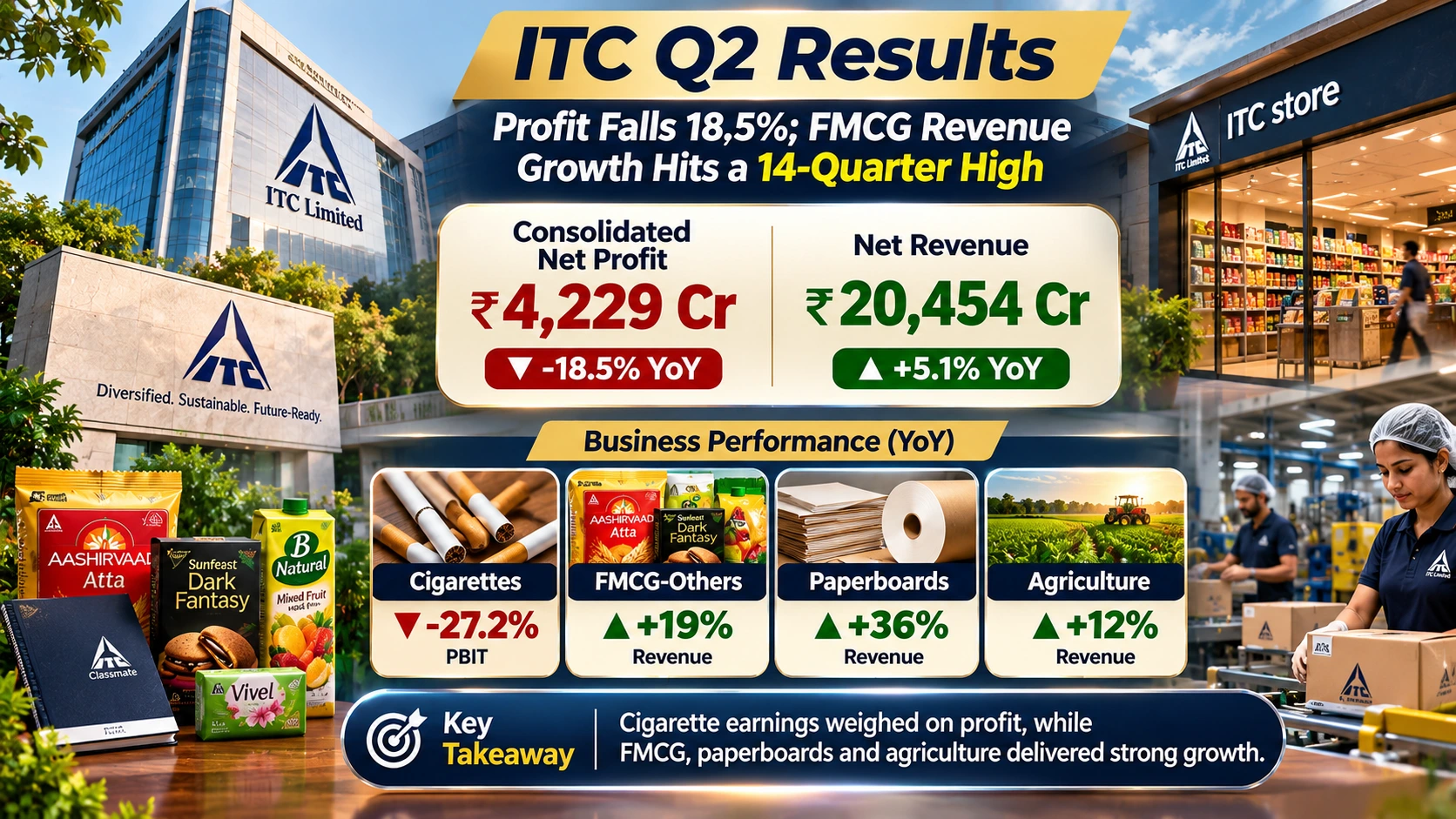
ITC Ltd’s consolidated net profit declined 18.5% year-on-year to ₹4,229 crore in Q2 FY27, even as its non-cigarette FMCG business recorded its strongest revenue growth in 14 quarters. The pressure came from weaker cigarette profitability, with the standalone cigarette segment’s profit before interest and tax (PBIT) falling 27.2%, while consolidated EBITDA declined 15.7%.
The contrast between the two businesses stood out in the September-quarter results. Consolidated FMCG-Others revenue grew 19%, compared with 5.1% growth in the company’s consolidated net revenue. However, improving consumer-business performance has not yet translated into higher overall operating profit.
ITC’s board approved the financial results for the quarter ended September 30, 2026, on November 2.
Track Live: ITC Option Chain (ITC) — Live OI, IV, Greeks & PCR
Need to Know: ITC Q2 FY27 Results
| Financial metric | Consolidated | Standalone |
|---|---|---|
| Gross revenue | ₹30,431 cr (+44.6%) | ₹28,152 cr (+46.6%) |
| Net revenue | ₹20,454 cr (+5.1%) | ₹18,449 cr (+3.1%) |
| EBITDA | ₹5,645 cr (-15.7%) | ₹5,160 cr (-17.4%) |
| Profit before tax | ₹5,695 cr (-18.4%) | ₹5,482 cr (-19.9%) |
| Net profit | ₹4,229 cr (-18.5%) | ₹4,137 cr (-20.1%) |
YoY growth in parentheses. Figures rounded from ITC’s official Q2 FY27 investor presentation.
The two reporting bases tell a similar story: net revenue increased, but profitability declined. The consolidated numbers also include the performance of ITC’s group companies.
Why Did ITC’s Consolidated Profit Fall 18.5%?
ITC reported consolidated net profit of ₹4,229 crore in Q2 FY27, down from ₹5,187 crore in the corresponding quarter last year.
Consolidated EBITDA declined 15.7% to ₹5,645 crore from ₹6,695 crore. Consolidated profit before tax fell 18.4% to ₹5,695 crore.
The deterioration in cigarette profitability was a major pressure point. On a standalone segment basis, cigarette PBIT dropped 27.2% to ₹3,813 crore from ₹5,241 crore.
The year-on-year comparison was also affected by exceptional items. ITC recorded a ₹26 crore exceptional expense in Q2 FY27, linked to its Century Pulp and Paper acquisition. In the corresponding year-ago quarter, it had recognised an exceptional gain of ₹88 crore from the final settlement of an insurance claim relating to damaged leaf tobacco stocks.
This difference added to the pressure on reported profit.
Cigarette Business: Net Revenue Falls 21%, Segment PBIT Drops 27.2%
ITC’s cigarette business continued to face pressure after the unprecedented increase in cigarette taxation.
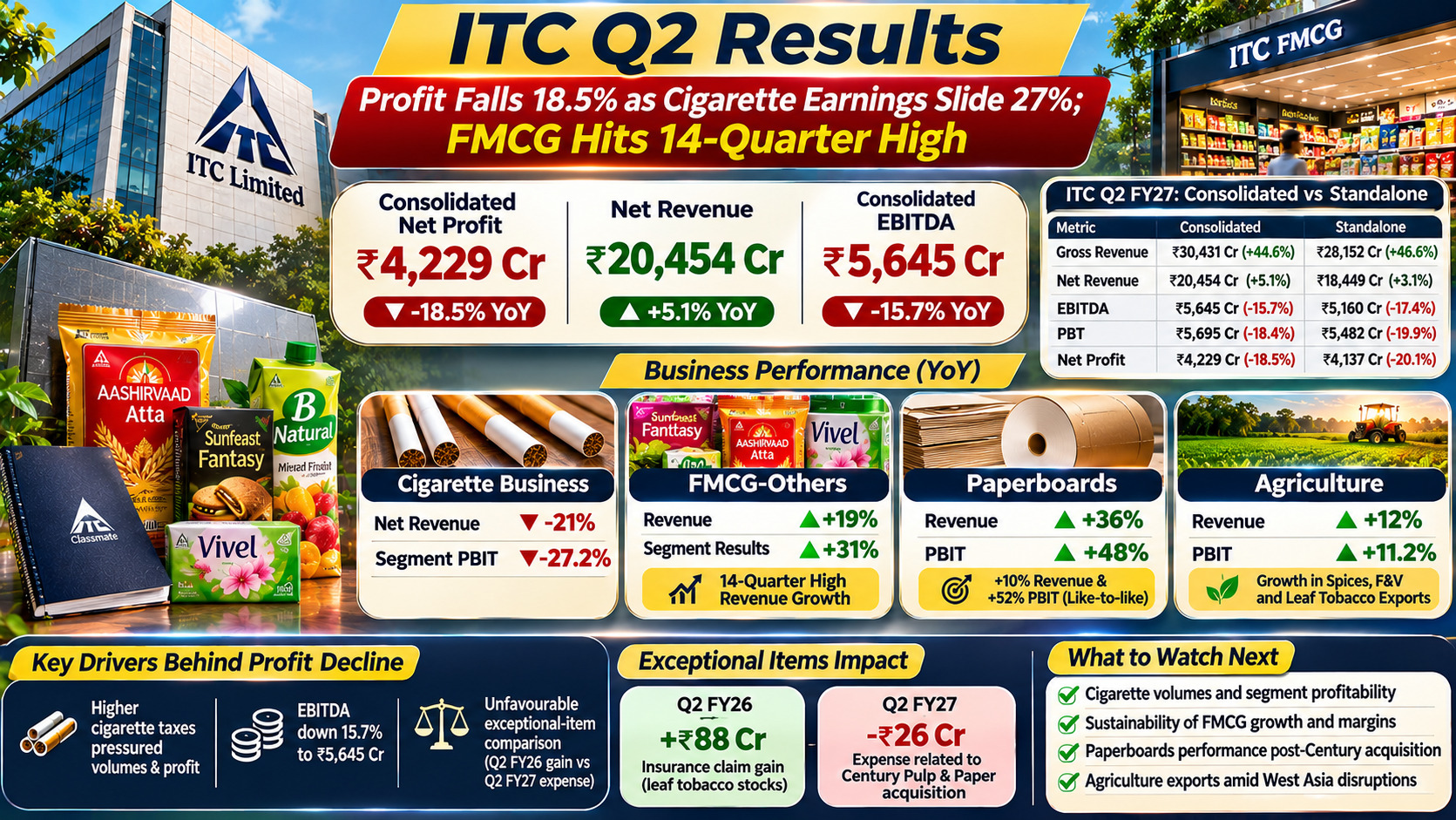
According to the company’s standalone segment figures, cigarette gross revenue increased 78.1% to ₹15,536 crore. However, cigarette net revenue declined 21%, while segment PBIT dropped 27.2% to ₹3,813 crore.
The difference between gross and net revenue is important. Higher cigarette taxation pushed up the gross revenue figure, but this did not translate into stronger net revenue or profitability.
ITC said legal cigarette industry volumes remained under pressure because of the tax increase. The company is responding through calibrated pricing, new product variants and changes to its portfolio to protect its consumer franchise.
It also highlighted a sharp increase in seizures of smuggled cigarette consignments by enforcement agencies, pointing to the widening tax arbitrage opportunity for illicit operators.
For investors, the key concern is whether ITC can protect legal cigarette volumes while adjusting prices to absorb the higher tax burden. A recovery in segment profitability will depend partly on how effectively the company manages this balance.
Also Check: ITC Options Chart | Nifty Trader
FMCG Revenue Growth Hits a 14-Quarter High
ITC’s non-cigarette FMCG business provided the strongest positive in the September-quarter results.
Consolidated FMCG-Others revenue grew 19% year-on-year, while standalone FMCG-Others revenue increased 16%. ITC described FMCG revenue growth as its strongest in 14 quarters. The business also recorded its fourth consecutive quarter of double-digit revenue growth.
On a consolidated like-to-like basis, FMCG-Others revenue increased 17.3%. Growth excluding the atta business stood at 23%.
The company’s category-wise performance was broad-based:
- Biscuits, snacks, noodles, spices, salt, frozen snacks, homecare and notebooks recorded growth of more than 20%.
- Dairy and personal wash products delivered high-teen growth.
- E-commerce, quick commerce and modern trade continued to support the expansion of newer sales channels.
- General trade reported a strong recovery.
Profitability improved alongside revenue. Standalone FMCG-Others segment PBIT rose 27.8% to ₹558 crore from ₹437 crore. At the consolidated level, FMCG-Others segment results increased 31%.
ITC attributed the improvement to better product mix, cost management and calibrated pricing actions, which helped offset higher input costs. The company also reported more than 50 basis points of expansion in FMCG segment EBITDA margin.
The results suggest that ITC’s non-cigarette FMCG business is building growth momentum. The next test is whether it can maintain revenue growth and margin improvement in a competitive consumer market.
Paperboards Business Recovers; Century Pulp and Paper Adds Scale
ITC’s Paperboards, Paper and Packaging segment reported strong growth, although the acquisition of Century Pulp and Paper influenced the year-on-year comparison.
On a standalone basis, segment revenue increased 35.9% to ₹3,016 crore, while segment PBIT rose 47.6% to ₹282 crore.
On a like-to-like basis, excluding the acquired business, segment revenue increased 10% and PBIT rose 52%. The like-to-like PBIT margin expanded by 320 basis points.
ITC completed the acquisition of the Century Pulp and Paper undertaking on August 1, 2026. The acquired business contributed to the reported scale of the paper segment during the quarter.
The company reported improving demand, stronger traction in value-added paperboard products and exports, and pricing actions to mitigate higher input costs.
However, wood prices remained elevated during the quarter because of lower-than-expected harvests and demand from competing industries. Raw-material availability and input costs remain important monitorables for the segment.
Agriculture Business Grows 12% Despite Export Disruptions
ITC’s standalone agriculture segment recorded revenue of ₹4,452 crore, up 12% year-on-year. Segment PBIT increased 11.2% to ₹511 crore.
Growth was led by value-added agricultural products, particularly spices, fruits and vegetables, alongside leaf tobacco exports.
However, agriculture exports continued to face disruptions linked to the West Asia conflict. ITC cited delayed customer orders, constrained shipping availability and a sharp increase in ocean freight costs.
The company has stepped up efforts to develop new geographical markets and diversify its export exposure. Lower domestic demand following the cigarette tax increase also continued to affect its leaf tobacco business.
What Should Investors Watch After ITC Q2 Results?
ITC’s September-quarter performance highlights the growing difference between its cigarette business and its non-cigarette operations. Three factors deserve attention in the coming quarters.
1. Cigarette profitability and legal volumes
The 21% decline in standalone cigarette net revenue and 27.2% fall in segment PBIT underline the pressure created by higher taxation. Stabilisation of legal industry volumes and the company’s ability to manage illicit competition will be important.
2. FMCG growth and margins
Consolidated FMCG-Others revenue growth of 19% is encouraging, but investors will want to see whether the 14-quarter-high growth momentum can continue alongside margin expansion.
3. Paper and agriculture operating conditions
The paper business faces elevated wood costs and raw-material availability constraints, while agriculture exports remain exposed to West Asia-related shipping and trade disruptions.
These factors could influence how quickly ITC’s non-cigarette businesses contribute to a broader improvement in group profitability.
Track Live: ITC Futures — Live Price, OI & Basis Analysis
Bottom Line
ITC’s Q2 FY27 results show a business delivering stronger growth outside cigarettes but still facing a significant earnings challenge in its traditional profit engine.
Consolidated net revenue increased 5.1%, while consolidated net profit declined 18.5% and EBITDA fell 15.7%. The standalone cigarette segment’s 27.2% PBIT decline highlights the scale of the pressure, while consolidated FMCG-Others revenue growth of 19% provides an important counterpoint.
The expectation gap is clear: FMCG revenue growth has reached a 14-quarter high, but the improvement has not yet translated into consolidated profit growth. Whether that gap narrows will depend on cigarette profitability, sustained FMCG margins and the performance of ITC’s paper and agriculture businesses.
Read Next: Stocks to Watch Today, Nov 3: SBI Q2 Results, ITC Profit Falls 20%, Marico Jumps 31%
Disclaimer: This article is for informational and educational purposes only and should not be considered investment advice or a recommendation to buy, sell or hold ITC shares. Investors should independently assess the company’s financial performance, business risks and market conditions before making investment decisions.