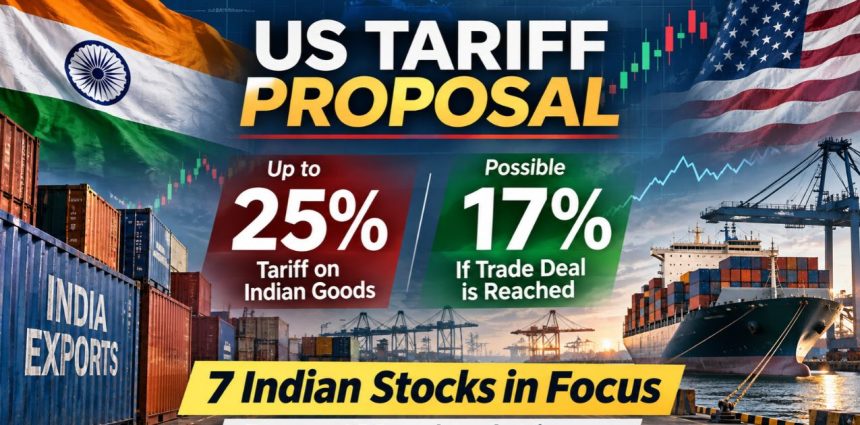
Synopsis: The US has proposed tariffs of up to 25% on Indian goods, with a potential reduction to 17% under a qualifying trade agreement. Jefferies has identified seven Indian stocks across chemicals, textiles and capital goods with varying levels of potential exposure. Company disclosures from Welspun Living, KEI Industries and Cummins India highlight the importance of overseas demand, while a potential $2.69 billion export opportunity against Vietnam adds another dimension to India’s trade negotiations.
Seven Indian export-linked stocks have come into focus after the Donald Trump administration formally proposed tariffs of up to 25% on Indian goods, renewing uncertainty for manufacturers selling to the world’s largest economy.
However, Washington has also offered a potential route to a lower tariff rate of 17% if New Delhi concludes a reciprocal trade agreement that addresses US concerns.
The eight-percentage-point difference could influence international sourcing decisions, export orders and corporate profit margins.
Global brokerage Jefferies has identified Navin Fluorine International, PI Industries, SRF, Welspun Living, Cummins India, Thermax and KEI Industries as companies with varying levels of potential exposure.
Recent corporate disclosures highlight why the development matters. Nearly half of KEI Industries’ ₹991 crore export order book was linked to the US in October, while Welspun Living’s latest investor presentation identifies America as accounting for 59% of its geographical revenue mix.
However, the proposed tariffs are not yet in force, and a negotiated agreement could significantly alter India’s competitive position.
Track Live: NSE Option Chain — Live | BSE Option Chain — Live Sensex & Bankex Options Data Today
US Tariffs on India: What Has Changed?
On November 25, the Office of the United States Trade Representative (USTR) announced findings from its investigation into manufacturing policies under Section 301 of the US Trade Act of 1974.
The investigation, launched on March 11, 2026, initially covered 16 economies. The latest determinations and proposed actions involve 14 economies, including India, China, Japan, Vietnam and the European Union.
Washington maintains that certain industrial policies contribute to persistent excess manufacturing capacity and restrict US commerce. India has rejected that assessment.
| Key development | Details |
|---|---|
| Proposed US tariff on India | Up to 25% |
| Potential negotiated rate | 17% |
| Difference between rates | 8 percentage points |
| Economies facing proposed action | 14 |
| Public comments deadline | January 5, 2027 |
| Public hearings begin | January 25, 2027 |
| Implementation status | Not finalised |
According to the official USTR announcement, the proposed tariff of up to 25% is net of existing Section 301 duties, with exemptions for specified products.
The USTR is also considering adjustments for other applicable duties, including Section 232 measures.
The proposed rate should therefore not be interpreted as a uniform additional 25% levy on every Indian product entering the US.
7 Indian Stocks in Focus as US Tariff Risks Return
According to Jefferies’ November 25 research note, reported by Business Standard and Economic Times, companies across chemicals, textiles and capital goods could face varying levels of exposure.
| Company | Sector | Key factor to monitor |
|---|---|---|
| Navin Fluorine International | Specialty chemicals | Export pricing and margins |
| PI Industries | Agrochemicals | International customer contracts |
| SRF | Diversified chemicals | Product-specific tariffs |
| Welspun Living | Home textiles | US demand and sourcing |
| Cummins India | Capital goods | Export sales and exemptions |
| Thermax | Industrial equipment | Overseas project competitiveness |
| KEI Industries | Wires and cables | US order book and margins |
Source: Jefferies, as reported by financial media. The business risks identified are potential transmission channels, not confirmed earnings losses.
KEI Industries: Nearly Half of ₹991 Crore Export Order Book Linked to the US
KEI Industries’ overseas order pipeline highlights the importance of American demand for Indian engineering goods.
During its October 22 earnings conference call, the company disclosed an export order book of approximately ₹991 crore, with nearly 50% comprising American orders.
Its Q2 FY27 export sales stood at ₹493 crore, compared with ₹472 crore a year earlier. Management also highlighted strong demand from industrial and energy customers in the US.
The latest tariff proposal makes product classifications and contractual pricing particularly important for the cable manufacturer.
However, the order book predates the November 25 announcement and does not represent confirmed tariff-related financial losses.
Source: KEI Industries’ NSE-filed earnings call transcript.
Welspun Living: 59% US Revenue Mix, but Local Manufacturing Offers Some Cushion
Welspun Living has considerable commercial exposure to the American market. Its November 23 investor presentation identifies the US as contributing 59% of its geographical revenue mix.
The home textile manufacturer operates five manufacturing locations, including three in India and two in the US.
Welspun said it retained all its US customers during the earlier tariff disruption by working closely with American retailers. Its Ohio and Nevada operations also recorded pillow sales at 2.4 times the year-earlier level in Q2 FY27.
Meanwhile, the company’s EBITDA margin improved from 9.1% in FY26 to 12.9% in H1 FY27.
These disclosures highlight the importance of customer relationships, local manufacturing and operational efficiency in managing trade disruptions.
Welspun’s US manufacturing presence could provide some protection against tariffs on India-origin shipments. However, it does not eliminate the company’s exposure to American demand or import-related costs.
Its 59% US revenue contribution should not be interpreted as the percentage of revenue directly subject to the proposed tariffs.
Source: Welspun Living’s November 23 NSE-filed investor presentation.
Cummins India: Quarterly Export Sales Reach ₹555 Crore
Cummins India reported export sales of ₹555 crore in Q2 FY27, up 2% year-on-year and 6% sequentially.
Total quarterly sales stood at ₹3,247 crore, including domestic sales of ₹2,692 crore.
During its November 16 earnings call, management highlighted pricing adjustments, cost controls and operational efficiencies as measures to address existing input-cost pressures.
The company’s overseas sales provide useful context for potential trade-related risks. However, the ₹555 crore figure represents exports across all international markets, not exclusively the US.
Source: Cummins India’s official earnings call transcript.
Navin Fluorine, PI Industries, SRF and Thermax
For chemical manufacturers Navin Fluorine, PI Industries and SRF, product differentiation, customer contracts and pricing power could influence their ability to manage additional import costs.
Thermax’s exposure would depend on the tariff classification of exported industrial equipment, overseas manufacturing arrangements and customer contracts.
Comparable US-specific revenue exposure and tariff-related earnings sensitivity have not been established for all four companies. Investors should therefore avoid assuming equal financial vulnerability across the seven stocks.
India vs Asian Exporters: Why the 17% Rate Matters
At the proposed 25% rate, Indian manufacturers could face a competitive disadvantage against several Asian exporters. A negotiated reduction to 17% could change that equation.
| Country or economy | Proposed tariff rate |
|---|---|
| Vietnam | Up to 35% |
| India | Up to 25% |
| Bangladesh | Up to 18% |
| Indonesia | Up to 18% |
| Malaysia | Up to 18% |
| Thailand | Up to 18% |
| Cambodia | Up to 18% |
| India — qualifying trade deal scenario | 17% |
| Japan | Up to 15% |
| South Korea | Up to 15% |
| Taiwan | Up to 15% |
Source: USTR, November 25, 2026. Vietnam could receive a conditional 20% rate. These are proposed rates, not implemented duties. Product exemptions, existing duties, calculation methods and country-specific commitments may differ.
Jefferies estimates that a negotiated 17% rate could give India a tariff advantage of one to three percentage points over selected emerging-market competitors under comparable scenarios.
For industries where international buyers are sensitive to relatively small differences in sourcing costs, that advantage could influence future manufacturing orders.
Could India Tap a $2.69 Billion Export Opportunity Against Vietnam?
The proposed US tariffs could create opportunities for Indian manufacturers alongside the risks.
A Moneycontrol analysis published on November 26 identified $2.69 billion worth of Vietnamese exports to the US in product categories where Indian suppliers were closely competitive, based on 2024 trade data.
The analysis identified several potential opportunities:
| Product category | Vietnam’s US exports in 2024 |
|---|---|
| Prepared and preserved shrimp and prawns | $410.6 million |
| Electrical plugs and sockets | $98 million |
| Semi-precious stones | $44 million |
The extent of India’s competitive advantage could depend on which countries conclude qualifying agreements with Washington.
India vs Vietnam: Four Possible Tariff Scenarios
| Negotiation outcome | India | Vietnam |
|---|---|---|
| Neither secures a qualifying deal | Up to 25% | Up to 35% |
| Both secure qualifying deals | 17% | 20% |
| Only India secures a deal | 17% | Up to 35% |
| Only Vietnam secures a deal | Up to 25% | 20% |
Illustrative scenarios based on USTR’s proposed headline rates, not final product-level duties.
If only India secures the proposed lower rate, its headline tariff advantage could reach 18 percentage points. Conversely, India could face a five-percentage-point disadvantage if Vietnam receives the lower rate while India remains at 25%.
The $2.69 billion figure represents a potential competitive opportunity, not guaranteed additional Indian export revenue.
Around 45% of India’s US Exports Are Outside the Proposal or Under Separate Measures
The proposed 25% tariff does not reflect the potential impact across India’s entire export basket.
According to Jefferies, approximately 45% of India’s estimated $104 billion annual exports to the US fall outside the latest proposed framework or are governed by separate sector-specific measures.
These include pharmaceutical and energy products, alongside certain electronics and automotive components.
The brokerage identified Dr Reddy’s Laboratories, Cipla, Lupin, Zydus Lifesciences, Biocon and Gland Pharma among pharmaceutical companies relatively insulated from the current proposal.
However, exclusion from this particular tariff framework does not guarantee permanent protection from other US duties or future sector-specific measures.
India’s Exports Surge 45%: Will Higher Tariffs Hurt GDP Growth?
The announcement comes against a backdrop of strong recent export growth.
According to the Ministry of Commerce and Industry, India’s merchandise exports reached $49.47 billion in October 2026, compared with $34.11 billion a year earlier.
US-bound merchandise exports increased 39.25% year-on-year to approximately $8.72 billion during October.
| Economic indicator | Growth |
|---|---|
| October 2026 merchandise exports | 45.06% YoY |
| October exports to the US | 39.25% YoY |
| April–October FY27 merchandise exports | 21.96% YoY |
| April–October goods and services exports | 16.66% YoY (estimated) |
| Q1 FY27 real GDP growth | 7.8% |
Sources: Ministry of Commerce and Industry, MoSPI and PIB.
Note: October merchandise trade figures are provisional. Services export estimates are based on the latest available RBI data and are subject to revision.
Domestic brokerage Emkay Global expects export growth to exceed 15% in FY27, supported partly by businesses accelerating shipments before potential tariff implementation.
Emkay also estimates H1 FY27 GDP growth at 7.9% and expects the current account deficit to remain below 1.5% of GDP during the financial year.
These are brokerage forecasts, not official outcomes.
Higher duties could weaken export orders, manufacturing margins and investment decisions. However, domestic consumption, services activity and geographical export diversification could limit the broader economic impact.
The next official quarterly GDP release is scheduled for November 30, 2026.
India Rejects US Excess Manufacturing Capacity Allegations
Responding to Washington’s announcement on November 25, India’s Ministry of Commerce and Industry reiterated that the country does not have structural excess manufacturing capacity in any sector.
In its official statement, the government said it was examining the USTR determination and remained committed to concluding the India-US bilateral trade agreement.
The two countries announced a framework for an interim trade agreement in February 2026, which brought the then-applicable punitive tariff rate on most Indian goods down from 50% to 18%, according to Reuters.
Subsequent US Supreme Court and tariff-framework changes altered the effective duty structure. Those historical rates should therefore not be confused with the latest Section 301 proposal.
A final bilateral trade agreement remains pending.
What Should Indian Stock Market Investors Watch Next?
The immediate stock market impact could be more limited than the headline tariff proposal suggests.
Geojit Investments’ chief investment strategist V K Vijayakumar told Economic Times that he viewed the development primarily as negotiating pressure and expected little near-term market impact.
Nevertheless, the following developments could influence export-oriented stocks:
- Progress in India-US bilateral trade negotiations.
- Final product-specific tariffs and exemptions.
- Changes in US-linked export orders and customer demand.
- Management commentary on pricing and operating margins.
- Export diversification and international sourcing decisions.
With public comments due on January 5 and hearings beginning on January 25, 2027, the proposed tariffs remain subject to consultations.
For Indian exporters, the difference between 25% and 17% could influence whether the new tariff framework becomes a competitive disadvantage or an opportunity to capture additional manufacturing orders.
Ultimately, the final product coverage and companies’ ability to protect margins will determine the extent of the financial impact.
Also Read: US Tariffs on India: Fresh Levies Loom as Trade Deal Awaits Clarity
Disclaimer: This article is for informational purposes only. The stocks mentioned are based on reported brokerage assessments and company disclosures and do not constitute investment recommendations.