RBI Raise Rates : Indian bonds come under pressure as crude oil prices cross $95
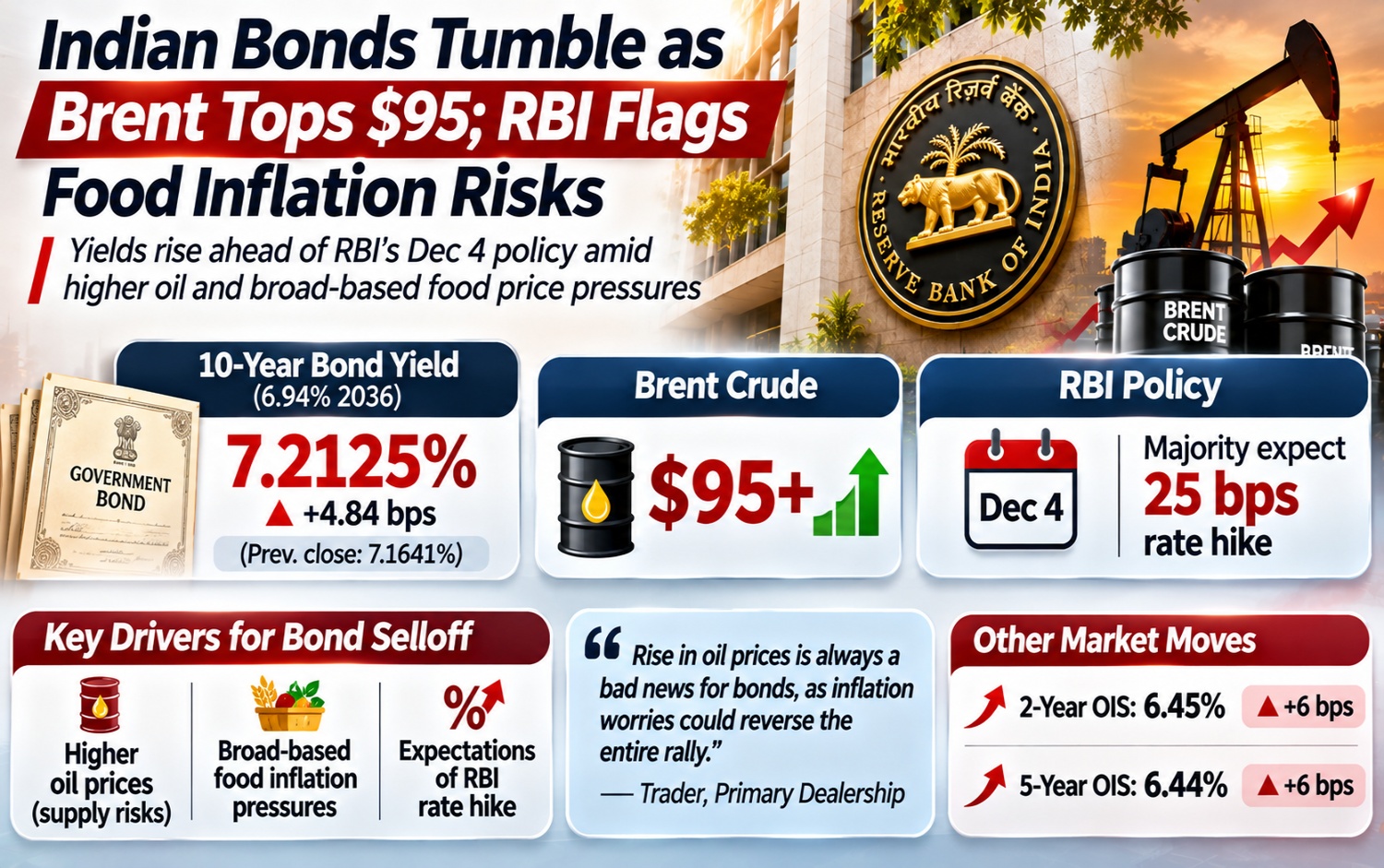
Indian government bonds faced fresh selling pressure on Thursday as Brent crude oil prices surged above $95 per barrel, raising concerns about inflation and the Reserve Bank of India’s upcoming monetary policy decision.
The benchmark 6.94% government bond maturing in 2036 saw its yield climb to 7.2125% by 10:05 am IST, compared with 7.1641% at Wednesday’s close.
The reversal came after investors had enjoyed gains in the bond market during the previous session. However, rising crude oil prices and the RBI’s latest warning about food inflation have changed market sentiment.
For investors, the immediate concern is whether higher inflation could force the central bank to adopt a more hawkish monetary policy stance in December.
Track Live : NSE Option Chain — Live | BSE Option Chain — Live Sensex & Bankex Options Data Today
RBI Raise Rates flags broader food inflation risks ahead of December policy
Crude oil is not the only inflation concern facing the Indian economy. The RBI has also highlighted persistent food-price pressures in its monthly bulletin.
According to the central bank, high-frequency data available through November 19 showed that food-price momentum remained strong. Prices of major cereals and pulses continued to increase, suggesting that inflationary pressures were becoming more widespread.
The RBI noted “higher generalisation of price pressures”, indicating that rising prices were no longer restricted to a limited number of food items.
Weak monsoon rainfall has also contributed to tighter food supplies and higher prices. Retail inflation had already crossed the RBI’s upper tolerance limit of 6% in October.
For bond investors, this combination of higher food inflation and expensive crude oil creates additional uncertainty around India’s inflation outlook.
| Market indicator | November 26 movement |
|---|---|
| Benchmark 6.94% 2036 bond yield | 7.2125% |
| Previous closing yield | 7.1641% |
| Yield increase | 4.84 basis points |
| Brent crude | Above $95/barrel |
| 2-year overnight index swap | 6.45% |
| 2-year OIS change | +6 basis points |
| 5-year overnight index swap | 6.44% |
| 5-year OIS change | +6 basis points |
The increase in overnight index swap (OIS) rates indicates that traders were also adjusting their expectations for future interest rates.
Track Live : NSE F&O Lot Size | FII DII Data Today
RBI December 4 policy decision puts bond traders on alert
The RBI’s monetary policy announcement scheduled for December 4 has become a major trigger for financial markets.
A majority of economists surveyed by Reuters expect the central bank to increase the policy rate by 25 basis points. However, some economists have not ruled out a larger increase.
If the RBI delivers a rate hike or signals further monetary tightening, government bond prices could face additional pressure.
Higher interest rates generally reduce the attractiveness of existing bonds carrying lower coupon rates, pushing their market prices down and yields higher.
Track Live : Nifty Levels Today | Sensex Levels Today | Bank Nifty Levels Today
What are economists expecting?
A Reuters poll conducted between November 13 and November 20 found that 56 out of 61 economists expected the RBI to increase the repo rate by another 25 basis points to 5.75% on December 4.
Two economists expected a larger 50-basis-point increase, while three expected no change.
Furthermore, 34 out of 46 economists expected the RBI to raise rates again to 6% in February 2027.
| RBI policy expectation | Economist responses |
|---|---|
| 25 bps hike to 5.75% in December | 56 out of 61 |
| 50 bps hike in December | 2 out of 61 |
| No rate change | 3 out of 61 |
| Further hike to 6% in February | 34 out of 46 |
Read More : PhonePe H1 Net Profit Could Push Its Valuation Above Paytm’s $11 Billion as IPO Plans Restart
Bond yields and overnight swap rates rise across maturities
The pressure was also visible in the overnight index swap market as traders reversed their recent receiving positions.
The two-year OIS rate increased 6 basis points to 6.45%, while the liquid five-year rate also climbed 6 basis points to 6.44%. The one-year rate had not been traded at the time of reporting.
The simultaneous increase in government bond yields and swap rates indicates that traders are reassessing interest-rate expectations.
Track Live : NSE Commodity Option Chain — Live MCX Options Data for Crude Oil, Gold, Silver & More
India’s dependence on imported crude oil makes the situation more complicated
An additional important factor is India’s high dependence on imported petroleum.
According to government data based on the Petroleum Planning and Analysis Cell (PPAC), India’s crude oil import dependence reached approximately 88.7% in FY26.
| Financial year | Crude oil import dependence |
|---|---|
| FY22 | 85.5% |
| FY23 | 87.4% |
| FY24 | 87.8% |
| FY25 | 88.3% |
| FY26 | 88.7% |
Brent crude crosses $95 after reported Houthi attack on Saudi oil infrastructure
The immediate trigger for the latest bond-market weakness was the sharp increase in international crude oil prices.
Brent crude rose above $95 per barrel during Asian trading hours on Thursday, extending gains from Wednesday.
The price increase followed reports that Yemen’s Houthi group had attacked Saudi Arabia’s largest oil refinery, raising concerns about possible disruptions to energy supplies from the Middle East.
Which food items have become more expensive?
The RBI’s November bulletin data showed the following price movements between the average prices recorded in November 1–19 and the corresponding period in October.
| Food commodity | Price increase |
|---|---|
| Tur dal | 5.1% |
| Gram dal | 5.0% |
| Moong dal | 2.0% |
| Rice | 3.2% |
| Wheat | 2.2% |
| Mustard oil | 2.5% |
| Potato | 1.3% |
| Onion | 0.9% |
| Tomato | -8.8% |
The increase in pulses is particularly important because these are essential food items for Indian households.
Onion prices also remain elevated compared with last year. The average onion price was reportedly around ₹53 per kg in November, compared with ₹25.60 per kg a year earlier.
Why is the RBI concerned about broad-based food inflation?
Food inflation becomes more difficult to control when price increases spread across several categories.
For example:
-
A temporary increase in vegetable prices may reverse when fresh supplies reach markets.
-
Higher cereal and pulse prices can indicate more persistent supply-side pressures.
-
Rising edible oil prices can reflect international commodity-price movements and import costs.
-
Higher food costs can influence household inflation expectations and wage demands.
The RBI is therefore monitoring whether food inflation is becoming more persistent rather than treating the latest increase as a temporary seasonal development.
India’s retail inflation crosses the RBI’s 6% upper tolerance limit
Another important development is the October 2026 retail inflation reading.
According to the National Statistics Office (NSO), India’s headline CPI inflation increased to 6.09% in October, crossing the RBI’s upper tolerance limit of 6%.
Food inflation increased to 8.94% during the same month.
This represents a significant deterioration from September, when headline inflation was 5.54% and food inflation stood at 7.74%.
September versus October 2026 inflation
| Inflation indicator | September 2026 | October 2026 |
|---|---|---|
| Headline CPI inflation | 5.54% | 6.09% |
| Food inflation | 7.74% | 8.94% |
| Rural CPI inflation | 6.08% | 6.63% |
| Urban CPI inflation | 4.88% | 5.41% |
Weak monsoon rainfall adds to food supply concerns
One of the underlying reasons behind India’s food inflation concerns is deficient and uneven monsoon rainfall.
Agricultural production depends heavily on seasonal rainfall, particularly for crops grown in rain-fed areas.
When rainfall is below normal or unevenly distributed, agricultural output and market arrivals can be affected.
This can create tighter supplies and push up food prices.
The RBI’s November bulletin also highlighted that initial rabi sowing remained lower than the previous year, although rainfall associated with recent cyclonic activity provided some support to sowing prospects.
Why is the rabi season important?
India’s agricultural calendar is broadly divided into three crop seasons:
| Crop season | Sowing period | Major crops |
|---|---|---|
| Kharif | June–July | Rice, maize, cotton, soybean |
| Rabi | October–December | Wheat, gram, mustard, barley |
| Zaid | March–June | Watermelon, cucumber, seasonal vegetables |
The rabi season is particularly important for wheat, pulses and oilseeds.
What should investors watch in the coming sessions?
Investors should closely monitor Brent crude prices, the rupee, upcoming inflation indicators and the RBI’s December policy commentary.
A sustained rise in crude oil could complicate India’s inflation outlook and create further volatility in government securities.
For bond investors, rising yields may mean short-term mark-to-market losses, particularly for portfolios holding longer-duration government bonds. Banks and other financial institutions could also face valuation pressure on their bond holdings.