Synopsis: The United States is reportedly preparing fresh tariffs on India, China and other trading partners over alleged industrial subsidies and excess manufacturing capacity. The development comes as India’s merchandise exports to the US surged 39.25% in October 2026 and bilateral trade negotiations approach completion. The proposed duties could create fresh uncertainty for Indian exporters, although final tariff rates, product coverage and exemptions remain unconfirmed.
The United States is preparing another round of tariffs on India, China and several other economies, alleging that government support for domestic manufacturing has created excessive industrial capacity and undermined American producers.
According to a November 24 report by The Wall Street Journal, US Trade Representative Jamieson Greer could announce the findings of a months-long investigation as early as this week, although the timing remains subject to change.
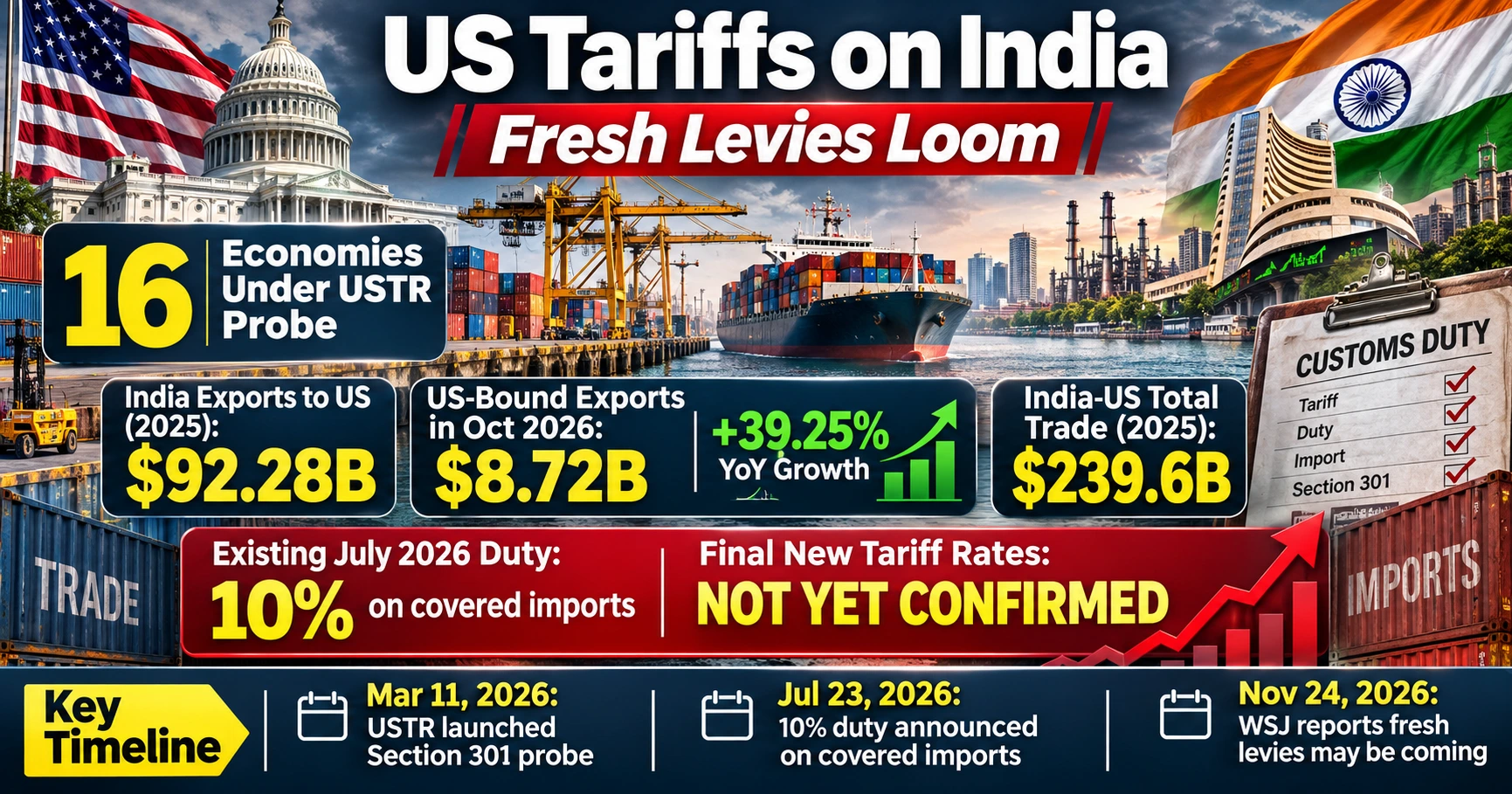
The development comes at a critical moment for India. Merchandise exports to the United States increased 39.25% year-on-year in October 2026, while negotiations on the first tranche of the India-US bilateral trade agreement are nearing completion.
However, Washington has yet to officially announce the proposed tariff rates, implementation dates or product-specific exemptions.
Track Live: NSE Option Chain — Live | BSE Option Chain — Live Sensex & Bankex Options Data Today
USTR Investigation Puts India in the Tariff Spotlight
The proposed measures stem from investigations launched by the Office of the US Trade Representative on March 11, 2026, under Section 301(b) of the Trade Act of 1974.
The investigations cover 16 economies:
| India | China | European Union |
| Japan | South Korea | Taiwan |
| Vietnam | Thailand | Malaysia |
| Indonesia | Cambodia | Bangladesh |
| Singapore | Mexico | Switzerland |
| Norway |
Washington is examining whether industrial policies in these economies encourage excessive production, distort international competition and restrict US commercial activity.
USTR invited public comments, sought consultations and scheduled hearings beginning May 5, 2026.
The March investigation did not itself impose additional duties. Any new tariffs would require separate formal action following the investigation.
How High Could the New US Tariffs on India Be?
According to the WSJ report, potential tariff rates could differ across economies depending on existing trade arrangements and Washington’s assessment of their industrial policies.
| Economy | Reported tariff outlook |
|---|---|
| European Union | Potentially 15% or lower |
| Japan | Potentially 15% or lower |
| South Korea | Potentially 15% or lower |
| India | Could face higher rates |
| Vietnam | Could face higher rates |
| China | Comparatively steeper duties expected |
These are reported possibilities, not officially confirmed tariff rates.
Products already covered by separate national-security tariffs, including steel, aluminium and automobiles, could be excluded. Washington may also retain the option of increasing duties if industrial imbalances worsen or negotiations fail to deliver policy changes.
India’s export competitiveness will depend not only on its own tariff rate but also on the duties imposed on competing manufacturing economies. Relatively higher tariffs on China could preserve some opportunities for Indian manufacturers, even if overall US import costs increase.
India’s US-Bound Exports Surge 39.25% Despite Trade Uncertainty
The fresh tariff threat comes at a time when India’s exports to the United States are recording strong growth.
According to Commerce Ministry data released on November 13, India’s overall merchandise exports increased 45.06% year-on-year to $49.47 billion in October 2026. More significantly, merchandise exports to the United States climbed 39.25% to $8.72 billion from $6.26 billion in October 2025.
India’s latest export performance
| Export indicator | Value | YoY growth |
|---|---|---|
| October 2026 merchandise exports | $49.47 billion | 45.06% |
| October 2026 merchandise exports to US | $8.72 billion | 39.25% |
| October 2026 total exports, including services (estimated) | $89.99 billion | 29.90% |
| April–October FY27 merchandise exports to US | $59.52 billion | 14.48% |
| April–October FY27 total exports (estimated) | $568.84 billion | 16.66% |
Sources: Ministry of Commerce and Industry, Indian Express and Moneycontrol.
The figures highlight a significant contrast: Indian shipments to the US continue to expand even as Washington considers additional trade restrictions.
Higher duties could test this momentum by increasing landed costs, triggering pricing renegotiations and putting pressure on exporters’ profit margins.
India’s $92 Billion Export Market Faces Fresh Uncertainty
The United States remains India’s largest merchandise export destination.
According to the Department of Commerce’s Trade Intelligence and Analytics portal, based on DGCIS data, India’s merchandise exports to the US reached $92.28 billion in calendar year 2025, accounting for 20.75% of the country’s total merchandise exports.
Electrical machinery, equipment and related parts represented the largest export commodity group, valued at approximately $25.77 billion.
Separately, USTR estimates show that bilateral goods and services trade reached approximately $239.6 billion in 2025.
India-US bilateral trade in 2025
| Trade indicator | Value |
|---|---|
| Total goods and services trade | $239.6 billion |
| Merchandise trade | $149.1 billion |
| Services trade | $90.4 billion |
| US merchandise imports from India | $103.8 billion |
| US merchandise exports to India | $45.4 billion |
| US merchandise trade deficit with India | $58.4 billion |
Source: United States Trade Representative. Figures are independently rounded.
Existing US Tariffs Add Another Layer of Uncertainty
India is already subject to a separate Section 301 tariff action arising from a US investigation into whether 60 economies have adequately prohibited and enforced restrictions on imports of goods produced using forced labour.
Under the final measures announced on July 23, 2026, Washington imposed an additional 10% duty on covered imports from India, subject to specified exemptions.
The duty applies broadly to covered imports rather than exclusively to individual products proven to have been manufactured using forced labour.
According to India’s Commerce Ministry, the final rate was lower than the initially proposed 12.5%.
| July Section 301 tariff treatment | Status |
|---|---|
| Initially proposed additional duty | 12.5% |
| Final additional duty on covered Indian goods | 10% |
| Estimated share of Indian exports covered | 55% |
| Estimated share outside the additional duty | 45% |
Generic pharmaceuticals, smartphones and certain specified products remained outside the additional duty. Products already covered by Section 232 measures, including steel, aluminium and auto parts, were also excluded.
July tariffs face a legal challenge
On July 24, 2026, two American businesses, Burlap & Barrel and Collective Horology, filed a legal challenge before the US Court of International Trade, questioning the administration’s authority to impose the duties under Section 301.
The litigation concerns the separate forced-labour tariff action rather than the new industrial-overcapacity investigation.
Why Washington Is Pursuing Section 301 Tariffs
The latest tariff proposal follows a significant legal setback for President Donald Trump’s earlier trade policy.
On February 20, 2026, the US Supreme Court ruled that the International Emergency Economic Powers Act (IEEPA) did not authorise the president to impose tariffs.
US tariff timeline in 2026
| Date | Development |
|---|---|
| February 6 | India-US interim trade framework announced |
| February 20 | Supreme Court ruled against IEEPA-based tariffs |
| February 24 | Temporary 10% Section 122 surcharge took effect |
| March 11 | Industrial-overcapacity investigations launched |
| July 23 | Forced-labour Section 301 tariffs announced |
| July 24 | Section 122 surcharge expired; separate Section 301 duties took effect |
| November 24 | WSJ reported possible fresh industrial-subsidy tariffs |
The proposed November measures rely on a different legal mechanism and should not be interpreted as an automatic restoration of the invalidated reciprocal tariffs.
India-US Trade Negotiations Face a Fresh Test
On February 6, 2026, the White House announced an interim trade framework envisaging an 18% reciprocal tariff on covered Indian-origin goods.
The arrangement included textiles, apparel, footwear, chemicals and machinery, with potential tariff relief for generic pharmaceuticals, diamonds and certain aircraft components, subject to the successful conclusion of the agreement.
However, the subsequent Supreme Court ruling complicated implementation of the earlier tariff framework.
On November 18, Commerce Secretary Rajesh Agrawal indicated that negotiations on the first tranche of the bilateral trade agreement were nearing completion. Signing, however, would depend on Washington finalising its revised tariff structure and providing clarity on ongoing trade investigations.
Could India’s PLI Schemes Come Under Scrutiny?
India’s Production Linked Incentive (PLI) programme has supported domestic manufacturing expansion across several strategic industries.
Government data published on November 13 highlighted the following achievements as of June 30, 2026:
| PLI programme indicator | Achievement |
|---|---|
| Sectors covered | 14 |
| Approved applications | 791 |
| Cumulative actual investment | Over ₹2.58 lakh crore |
| Cumulative production and sales | Over ₹23.79 lakh crore |
Source: Press Information Bureau.
Washington’s investigation could bring India’s manufacturing incentives into sharper focus. However, USTR has not publicly established that India’s PLI programme constitutes an actionable unfair trade practice under the latest investigation.
Which Indian Stock Market Sectors Could Be Affected?
Export-oriented industries could face renewed uncertainty, depending on the final tariff schedule.
| Sector | Potential impact |
|---|---|
| Textiles and apparel | Pricing and profitability pressure |
| Electronics | Changes in global manufacturing supply chains |
| Engineering goods | Export competitiveness and order volumes |
| Specialty chemicals | International demand and margins |
| Gems and jewellery | Higher landed costs |
| Pharmaceuticals | Uncertainty over product exemptions |
| Seafood | Export costs and competitive positioning |
These are potential exposure areas, not confirmed targets of the proposed tariffs.
Track Live : FII DII Data Today | NSE F&O Lot Size
Gokaldas Exports: Corporate Filing Highlights Historical Tariff Risks
In its November 5 stock exchange filing, apparel manufacturer Gokaldas Exports acknowledged that earlier US tariffs had affected its performance in the corresponding quarter of the previous financial year.
| Financial metric | Q2 FY27 | Q2 FY26 |
|---|---|---|
| Total income | ₹1,135 crore | ₹1,003 crore |
| EBITDA | ₹127 crore | ₹84 crore |
| EBITDA margin | 11.2% | 8.3% |
| Profit after tax | ₹41 crore | ₹8 crore |
Improved productivity, product mix and a favourable comparison base supported the company’s earnings recovery.
The disclosure illustrates historical tariff-related risks for Indian exporters. However, these financial results predate the November tariff report and do not establish the impact of the proposed measures.
US Stock Futures React to Fresh Tariff Report
Financial markets showed immediate sensitivity to the development.
According to MarketWatch, front-month S&P 500 futures declined from 7,186.50 to 7,172.50 within two minutes of the WSJ report, recording a 14-point decline.
What Should Investors Watch Next?
-
Official USTR findings and India’s proposed tariff rate.
-
Product-specific exemptions and implementation dates.
-
Progress towards signing the India-US trade agreement.
-
Cumulative duties and tariff differences between competing economies.
-
Corporate commentary on export orders, customer negotiations and profit margins.
Bottom Line: India’s US-bound merchandise exports surged 39.25% in October despite an uncertain global trade environment. The proposed tariffs could test this growth and complicate bilateral negotiations. Even if India receives relatively favourable treatment compared with China, product exemptions and cumulative import duties will ultimately determine the impact on Indian exporters.
Read Next: Nifty’s 16% Rally Decoded: Five Stocks, 1,613 Points and the Weightage Factor
Disclaimer: This article is for informational and educational purposes only and does not constitute investment advice. The proposed US tariffs remain subject to official confirmation, and their potential economic and market impact may change. Readers should verify the latest developments before making investment decisions.