Indian Rupee Gains Over Rs 1 Against Dollar to Hit Seven-Month High
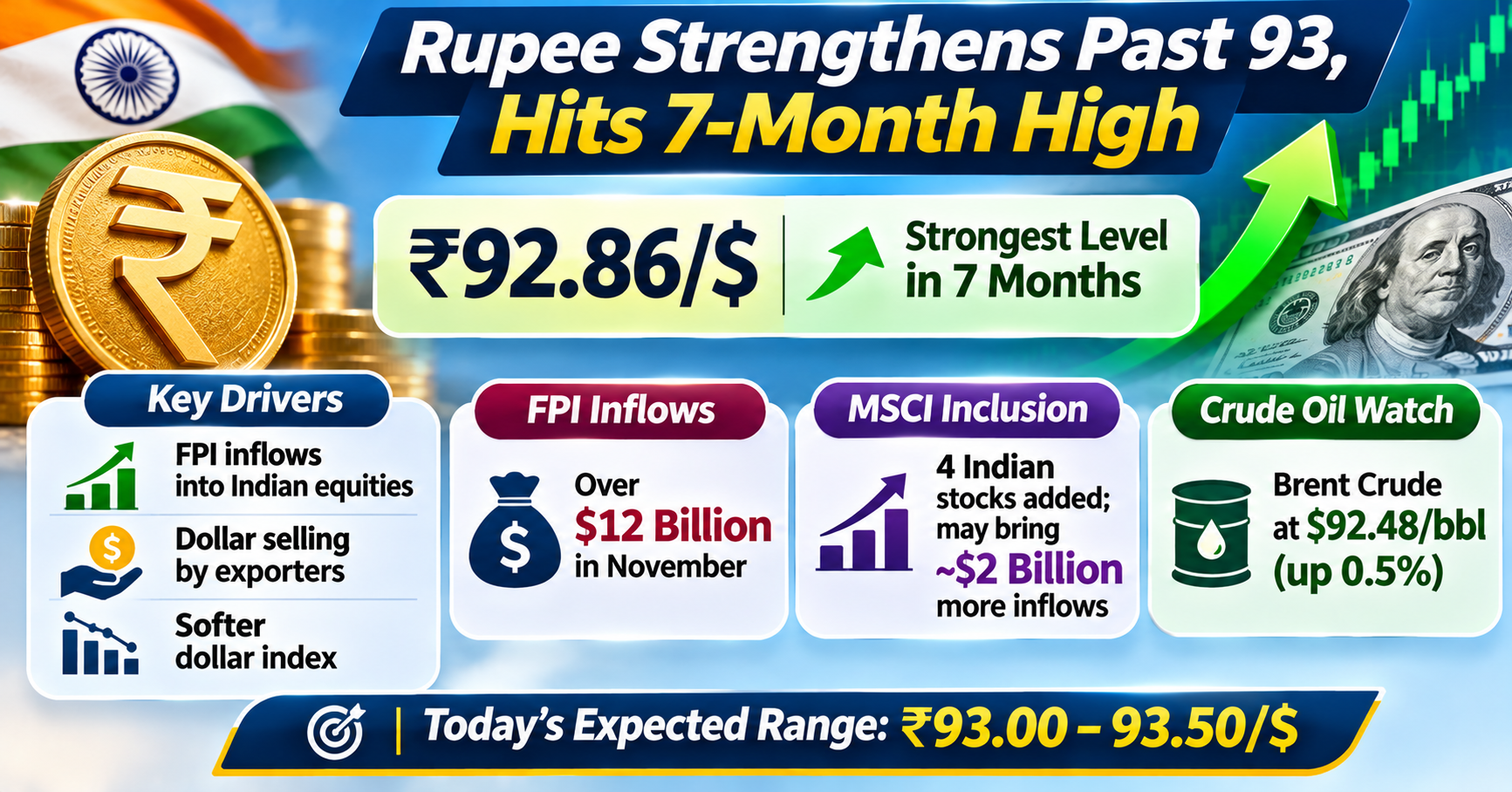
The Indian rupee is showing renewed strength against the US dollar, crossing the crucial 93 mark for the first time since April and reaching a seven-month high. Strong foreign investor inflows into Indian equities and increased dollar selling by exporters have provided significant support to the domestic currency.
On Friday, November 20, the rupee extended its gains to 92.8650 against the US dollar, compared with its previous closing level of 93.2900 on Thursday.
Earlier during the session, the currency touched 92.9950, breaking below the psychologically important 93-per-dollar level.
The rupee has appreciated by more than Re 1 against the dollar this week, indicating improving sentiment towards Indian financial markets.
Track Live : Nifty Levels Today | Sensex Levels Today | Bank Nifty Levels Today
Strong FPI Inflows and Exporter Dollar Selling Support Rupee Gains
One of the biggest reasons behind the rupee’s recent appreciation is the return of foreign portfolio investors to Indian equities.
Overseas investors have pumped more than $12 billion into Indian stocks so far in November, supporting demand for the domestic currency.
According to Informist, foreign portfolio investors purchased Indian shares worth $641.99 million on Thursday alone. Their net purchases for November have reached approximately Rs 1.15 trillion.
Dollar selling by exporters has also contributed to the rupee’s appreciation.
When exporters convert their foreign currency earnings into rupees, the increased supply of dollars in the domestic market can support the Indian currency.
Meanwhile, the US Dollar Index declined to 103.83 at 9:37 AM IST on Friday, compared with 103.92 in the previous session, providing additional support to the rupee.
Track Live : NSE Commodity Option Chain — Live MCX Options Data for Crude Oil, Gold, Silver & More
Rupee Strengthens Past 93 Against US Dollar
The Indian rupee extended its recovery on Friday, November 20, strengthening to around 92.86 against the US dollar during morning trade.
The currency had closed at approximately 93.29 on Thursday, November 19.
It crossed the psychologically important 93-per-dollar mark for the first time since April 20, 2026, marking a seven-month high.
The rupee has appreciated by more than ₹1 against the dollar this week, supported by strong foreign investment inflows and increased dollar selling by exporters.
Key Factors Supporting the Rupee Rally
Three major factors have supported the domestic currency:
-
Strong FPI inflows: Foreign investors have purchased more than $12 billion worth of Indian equities in November.
-
Exporter dollar selling: Exporters are converting their dollar earnings into rupees, increasing demand for the domestic currency.
-
Softer dollar index: The US Dollar Index declined to 103.83 from 103.92 in the previous session, according to the reported morning data.
Track Live : NSE F&O Lot Size | FII DII Data Today
Foreign Investors Pump More Than $12 Billion Into Indian Equities
Foreign portfolio investor buying has emerged as one of the strongest drivers of the rupee’s recovery.
Important figures:
| Particulars | Details |
|---|---|
| November FPI equity inflows | More than $12 billion |
| Estimated net purchases | Approximately ₹1.15 lakh crore |
| November 19 purchases | $641.99 million |
| Rupee appreciation in November | Around 2% |
The foreign buying has improved demand for the rupee because overseas investors need to convert foreign currency into Indian currency when purchasing domestic assets.
MSCI Index Inclusion Could Bring Another $2 Billion into Indian Stocks
Another important development supporting market sentiment is the potential inflow of foreign investment following MSCI’s November 2026 index review.
Four Indian stocks are set to be included in the MSCI Global Standard Index.
A dealer at a brokerage firm estimated that these additions could attract approximately $2 billion in additional investments, according to Informist.
Such inflows could create further demand for Indian equities and potentially support the rupee.
However, the actual investment amount will depend on fund allocations, portfolio adjustments and market conditions.
Track Live : NSE Option Chain — Live | BSE Option Chain — Live Sensex & Bankex Options Data Today

Why Crude Oil Prices Remain Important for the Rupee
India imports a substantial portion of its crude oil requirements.
Higher oil prices increase India’s import bill and dollar demand, potentially putting pressure on the rupee.
On November 20:
-
Brent crude January futures traded around $92.48 per barrel in the reported morning session.
-
Supply disruption concerns remained a risk.
-
Higher crude prices could limit further rupee appreciation.
Therefore, crude oil movements remain an important factor for currency traders.
Read More : Why an APL Apollo Control Sale Would Trigger an Open Offer for at Least 26% More Shares
What Is the Rupee’s Next Target?
Currency analysts have indicated a positive near-term bias, although further appreciation may face resistance.
| Technical level | USD/INR |
|---|---|
| Lower trading range | ₹92.85 |
| Immediate reference level | ₹93.00 |
| Upper trading range | ₹93.40–93.50 |
Anuj Choudhary of Mirae Asset Sharekhan expected USD/INR to trade between ₹92.85 and ₹93.40.
Finrex Treasury Advisors also highlighted ₹93.50 as an important level for exporter dollar selling.
Indian Rupee in 2026: From Record Low of 97.12 to Seven-Month High of 92.86 Against US Dollar
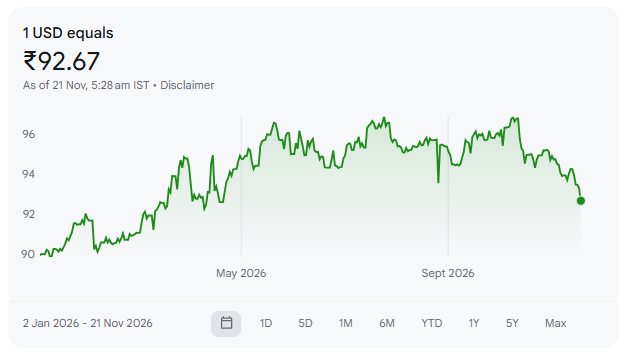
The Indian rupee experienced significant volatility between January 1 and November 20, 2026. It started the year near ₹89.98 per US dollar, weakened sharply to almost ₹97 in May and subsequently recovered to ₹92.865 on November 20.
The November recovery was supported by strong foreign investment inflows, exporter dollar selling, reduced speculative dollar demand and improved currency-market sentiment.
1. How the Rupee Moved During 2026
Rupees per US dollar; November average through November 20. A lower reading means a stronger rupee.
2. Phase-by-Phase Breakdown of the Rupee’s Performance
January–February: Relative Stability
-
January average: ₹90.73/$.
-
February average: ₹90.77/$.
-
The rupee traded around the 90–91 range.
-
Early-year currency stability was followed by increasing global pressure.
March–May: Sharp Depreciation
The rupee weakened significantly amid:
-
Rising crude oil prices.
-
US-Iran geopolitical tensions.
-
Foreign portfolio investor outflows.
-
Stronger dollar demand.
-
Concerns about India’s import bill and external balance.
On May 20, Reuters reported that the rupee touched a record low of approximately ₹96.96/$ in intraday trading and closed around ₹96.82. Other historical exchange-rate datasets record a high of approximately ₹97.11.
Reuters+1
April 2: RBI Measures Trigger Sharp Recovery
The Reserve Bank of India tightened restrictions on speculative currency positions.
The rupee surged approximately 1.8% on April 2, closing at ₹93.10 after touching ₹92.835 intraday.
It was the currency’s strongest single-day performance since 2013.
MarketScreener
June–October: Prolonged Weakness and Consolidation
The rupee traded largely between ₹94 and ₹97.
Higher oil prices, foreign investment movements and dollar demand continued influencing the currency.
November: Strong Recovery
The rupee recovered sharply, supported by:
-
More than $12 billion in November foreign equity inflows.
-
Exporters selling dollars.
-
Reduced bearish positions against the rupee.
-
Lower oil prices.
-
RBI measures limiting speculative dollar demand.
On November 20, the rupee touched approximately ₹92.865/$, its strongest level since April.
3. Monthly Average USD/INR Exchange Rates
| Month | Average rate |
|---|---|
| January | ₹90.73 |
| February | ₹90.77 |
| March | ₹92.90 |
| April | ₹93.40 |
| May | ₹95.44 |
| June | ₹95.00 |
| July | ₹95.92 |
| August | ₹95.43 |
| September | ₹95.45 |
| October | ₹95.55 |
| November (to 20th) | ₹94.29 |
What Should Currency Traders and Equity Investors Watch Next?
For the remainder of Friday’s trading session, dealers expect the rupee to move within the 93.00-93.50 range against the US dollar, according to Informist.
Currency traders will closely monitor FPI flows, crude oil prices, dollar index movements and developments surrounding the Federal Reserve’s interest rate outlook.
For equity investors, a stronger rupee can offer relief to companies dependent on imported raw materials, particularly those with significant dollar-denominated input costs.
However, exporters, including information technology and pharmaceutical companies, could face pressure on the rupee value of their overseas earnings if the currency continues appreciating.
The coming sessions will be important in determining whether the rupee can sustain its recovery. Continued foreign investment inflows could provide support, but elevated crude prices and global monetary uncertainty remain key risks.