SEBI Considers New Margin Trading Restrictions as Angel One and BSE Shares Fall
Could tighter regulations on margin trading change the growth outlook for India’s stockbroking industry? Shares of Angel One and BSE came under selling pressure on Wednesday, November 18, after SEBI Chairman Tuhin Kanta Pandey said the regulator is considering linking Margin Trading Facility (MTF) limits to a stock’s free float.
Angel One and BSE shares declined up to 2% during afternoon trading, while Groww shares remained largely flat. The development has drawn investors’ attention towards the potential impact of SEBI’s proposed MTF restrictions on brokerage companies, stock exchanges and depositories.
However, investors should note that SEBI has not taken any final decision on the proposal.
Track Live : NSE F&O Lot Size | FII DII Data Today
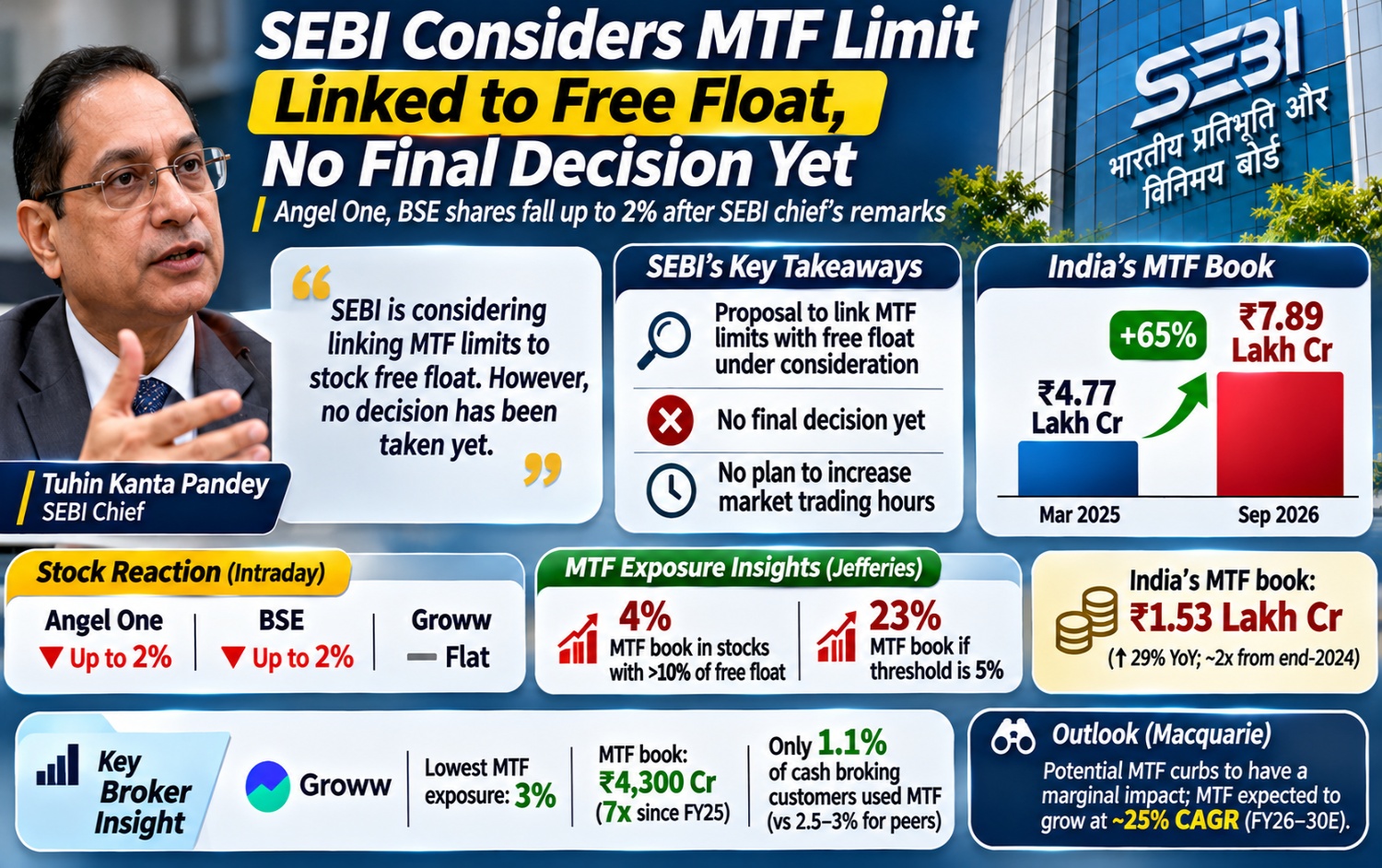
SEBI Chairman Clarifies No Final Decision on Linking Margin Trading Limits to Free Float
Speaking to CNBC-TV18 on the sidelines of an event at the National Stock Exchange (NSE), Pandey clarified that the regulator is examining the proposal but has not finalised any changes.
“The thought process is always there in our things, in different ways but whenever there is a concretised issue, we bring it up. No such decision has been taken yet,” Pandey said.
He also clarified that SEBI has no plans to increase trading hours for any market segment.
The clarification is important because any restriction on Margin Trading Facility could affect brokers that generate revenue through margin funding, particularly as leveraged trading has expanded rapidly in recent years.
What Is SEBI’s Proposed MTF Restriction?
The proposal could restrict fresh margin-funded purchases when MTF exposure in a particular stock crosses a specified percentage of its free float.
Free float refers to shares available for public trading, excluding promoter holdings and other restricted holdings.
The reported proposal includes possible thresholds of 5% to 10% of a company’s free float.
However, these figures are still under consideration and are not approved regulatory limits.
SEBI Committee Discusses Market-Wide MTF Position Limits
An important development missing from the initial report is that SEBI’s secondary market committee has discussed introducing market-wide position limits for MTF.
The proposed framework could consider:
-
Average Daily Traded Volume (ADTV).
-
Median Daily Traded Volume (MDTV).
-
Individual stock free float.
-
Quality of securities used as collateral.
-
Restrictions on fresh MTF exposure in stocks under ASM, ESM and GSM surveillance measures.
No final recommendation has been adopted. Wider consultation has been suggested.
Track Live : NSE Option Chain — Live | BSE Option Chain — Live Sensex & Bankex Options Data Today
India’s MTF Book Reaches Rs 1.5 Lakh Crore as Leverage Rises
The proposed SEBI MTF restrictions come at a time when margin-funded stock purchases are increasing significantly.
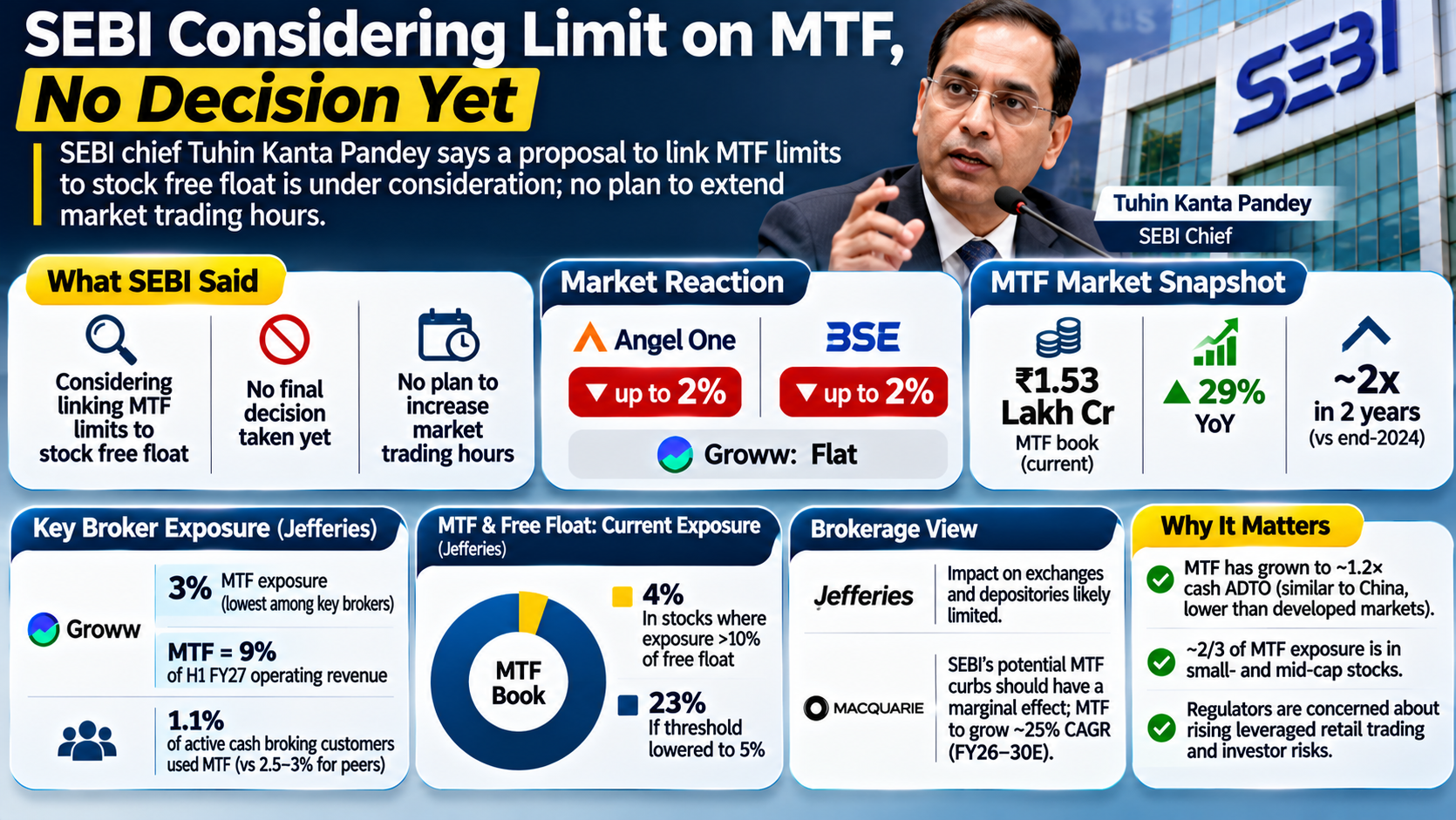
According to brokerage estimates cited in the market, India’s MTF book has nearly doubled over the past two years, reaching approximately Rs 1.5 lakh crore.
Reuters had earlier reported that SEBI was considering restrictions on fresh margin-funded purchases when leverage in an individual stock crosses a threshold linked to its free float.
MTF allows investors to purchase shares by paying only a portion of the total investment, while brokers finance the remaining amount. Brokers can offer leverage of up to four times an investor’s capital, generally charging interest rates of 9% to 18%.
Such leveraged positions have climbed to Rs 1.53 lakh crore, up 29% year-on-year and nearly double their level at the end of 2024. Around two-thirds of this exposure is linked to small-cap and mid-cap stocks.
Key figures include:
| Particulars | Details |
|---|---|
| Outstanding MTF book | ₹1.53 lakh crore |
| Annual growth | 29% |
| Growth over two years | Nearly 2 times |
| Small-cap and mid-cap exposure | Around two-thirds |
| MTF/free-float market capitalisation | Approximately 0.7% |
The rapid expansion has raised concerns about excessive leverage in relatively illiquid stocks.
Track Live : Nifty Levels Today | Sensex Levels Today
Jefferies Highlights Limited Exposure to Highly Leveraged Stocks
Global brokerage Jefferies believes the immediate impact of potential restrictions could remain manageable.
According to its analysis, only 4% of the MTF book is invested in stocks where exposure exceeds 10% of free float. This proportion increases to 23% if the threshold is reduced to 5%.
Jefferies also highlighted that the MTF book is approximately 1.2 times India’s cash average daily turnover, comparable with China and below developed markets.
For exchanges and depositories, MTF growth contributes to trading turnover and pledge-related income.
CDSL generates around 2-3% of its consolidated revenue from pledge income, while cash market turnover contributes approximately 7-11% of revenue for NSE and BSE.
Jefferies expects the shift in MTF exposure towards more liquid stocks to limit the potential impact on exchanges and depositories.
Read More : Amazon’s India Clean Energy Projects Could Power 3.5 Million Homes a Year: Where Are They?
| Potential threshold | Share of MTF book |
|---|---|
| Above 10% of free float | 4% |
| Above 5% of free float | 23% |
According to the brokerage, only a relatively small portion of existing MTF exposure exceeds the 10% threshold.
However, the affected exposure increases substantially under a 5% threshold.
Groww’s Lower MTF Exposure Could Offer Some Protection
Jefferies noted that Billionbrains Garage Ventures, the parent company of Groww, has the lowest MTF exposure among key discount brokers, at 3% of the overall MTF book.
Groww’s MTF book reached Rs 4,300 crore in the first half of FY27, growing sevenfold since FY25. MTF contributed 9% of its operating revenue during the period.
Interestingly, only 1.1% of Groww’s active cash broking customers used MTF in Q2 FY27, compared with 2.5-3% for peers.
Meanwhile, Macquarie believes potential SEBI restrictions could have a limited impact on the industry’s growth.
“Brokers have been taking proactive steps to reduce speculative behaviour to manage risk,” Macquarie said.
The brokerage expects MTF to remain a growth opportunity, projecting a 25% CAGR between FY26 and FY30.
How Could the Proposed Rules Affect Angel One, Groww and BSE?
Angel One: Tighter MTF restrictions could affect its margin-lending business and associated interest income.
Groww: Jefferies estimates that MTF accounts for approximately 9% of its H1 FY27 operating revenue.
Its MTF book has grown sevenfold since FY25 to approximately ₹4,300 crore.
BSE and NSE: Changes in leveraged trading activity could influence cash-market turnover and transaction-related revenue.
CDSL: Pledge-related income could be affected if MTF growth slows. Jefferies estimates that pledge income contributes approximately 2–3% of CDSL’s consolidated revenue.
Brokers Offer Leverage of Up to Four Times Investors’ Capital
MTF allows investors to purchase shares by paying an initial margin, while brokers finance the remaining amount.
For example:
-
Investor’s capital: ₹1 lakh.
-
Borrowed amount: ₹3 lakh.
-
Total share purchase: ₹4 lakh.
Brokers generally charge interest rates of approximately 9–18% on the borrowed amount.
More than 220 stocks could be affected
Reuters reported the following exchange-data figures:
| Potential MTF threshold | Number of stocks |
|---|---|
| Above 10% of free float | At least 36 |
| Above 5% of free float | More than 220 |
Some prominent companies mentioned include:
-
Jio Platforms
-
Nazara Technologies
-
Zee Entertainment Enterprises
SEBI is examining additional restrictions beyond free float
This is an important missing development.
A SEBI secondary market committee discussed:
-
Market-wide MTF position limits.
-
Average Daily Traded Volume (ADTV).
-
Median Daily Traded Volume (MDTV).
-
Stock free-float-based exposure limits.
-
Restrictions on fresh MTF exposure in ASM, ESM and GSM stocks.
The potential impact on Groww could be quantified
Jefferies’ analysis provides an additional financial detail.
| Groww metric | Details |
|---|---|
| MTF book | ₹4,300 crore |
| Share of industry MTF book | 3% |
| H1 FY27 operating revenue contribution | 9% |
| MTF book growth since FY25 | 7 times |
| Active cash customers using MTF | 1.1% |
An additional estimate reported by Business Today suggests that in a worst-case scenario, a 23% reduction in Groww’s MTF book could affect its estimated FY28 earnings by approximately 4%.
Here’s What Happened Today and Why Traders Reacted
The immediate selling pressure in Angel One and BSE reflects concerns about possible regulatory changes rather than an announcement of implemented restrictions.
Investors are worried that linking MTF exposure to stock free float could restrict margin funding in certain stocks, potentially affecting brokerage income, trading activity and investor participation.
However, Jefferies and Macquarie have indicated that the broader impact could remain limited.
What Should Investors Watch in the Coming Trading Sessions?
For investors tracking Angel One, BSE, Groww and CDSL, the next important trigger will be SEBI’s final decision on MTF regulations.
Any restrictions on leveraged stock purchases could affect brokers differently depending on their MTF exposure and revenue contribution.
Investors should monitor upcoming regulatory announcements, MTF growth figures, brokerage revenue trends and cash market turnover.