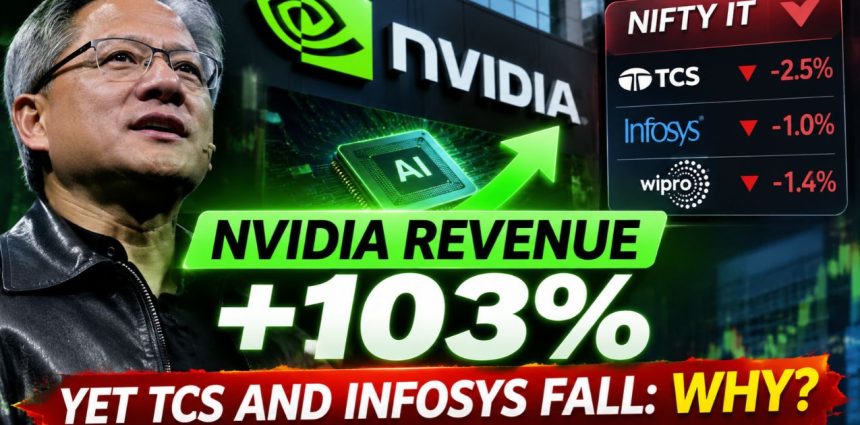
Nvidia reported record Q3 FY27 revenue of $115.8 billion, up 103% year-on-year, and forecast $130 billion in fourth-quarter sales. Yet Nifty IT fell more than 1.2% during early trading on November 18, with TCS and Infosys also declining. Currency risks, weak global technology sentiment and uncertainty over AI investment returns remain in focus.
Nvidia Q3 results and Indian IT stocks: US artificial intelligence chipmaker Nvidia reported a 103% year-on-year surge in quarterly revenue to $115.8 billion and issued a stronger-than-expected sales forecast. However, Indian IT stocks, including Tata Consultancy Services (TCS), Infosys, Wipro and HCLTech, came under selling pressure during Wednesday’s morning trading session.
The Nifty IT index declined more than 1.2% in early trade on November 18, with all 10 constituents trading in negative territory, according to an NDTV Profit report published at 9:50 AM IST.
TCS shares fell approximately 2.5% to ₹2,382, while Infosys declined nearly 1% to ₹1,113, according to an Economic Times report updated at 9:36 AM IST.
The contrasting developments highlight an important distinction for Indian investors: strong global investment in AI computing infrastructure does not automatically translate into immediate revenue growth or higher share prices for Indian IT services companies.
Track Live: Nifty IT Sector Analysis: Live Performance & Drivers
Nifty IT Falls Despite Nvidia’s Strong Q3 Earnings
Indian technology stocks started Wednesday’s session under pressure even as Nvidia’s earnings indicated continued demand for AI infrastructure.
Mphasis was among the weakest Nifty IT constituents, falling more than 2% during morning trading. Wipro, LTIMindtree, Persistent Systems, Infosys, TCS and HCLTech also traded lower.
Indian IT market snapshot — November 18
| Indicator | Reported movement | Source timestamp |
|---|---|---|
| Nifty IT | Down more than 1.2% | 9:50 AM IST |
| Mphasis | Down more than 2% | 9:50 AM IST |
| TCS | ₹2,382, down approximately 2.5% | 9:36 AM IST |
| Infosys | ₹1,113, down nearly 1% | 9:36 AM IST |
Sources: NDTV Profit and Economic Times reports dated November 18, 2026. The figures are separate morning observations, not simultaneous live quotes or closing prices.
Global technology stocks faced selling pressure
US technology stocks had already experienced selling pressure during Tuesday’s session ahead of Nvidia’s earnings announcement.
According to Associated Press closing data for November 17, the Nasdaq Composite declined 0.7%, the S&P 500 fell 1%, and the Dow Jones Industrial Average dropped 1.6%.
Asian equities also struggled to sustain their initial gains on Wednesday despite Nvidia’s upbeat forecast.
Reuters reported that concerns about returns on AI investments, the sustainability of infrastructure financing and leadership uncertainty continued to weigh on regional sentiment.
The market reaction demonstrated that even stronger-than-expected earnings from one of the world’s largest AI chipmakers were not sufficient to remove broader concerns surrounding technology valuations and future investment returns.
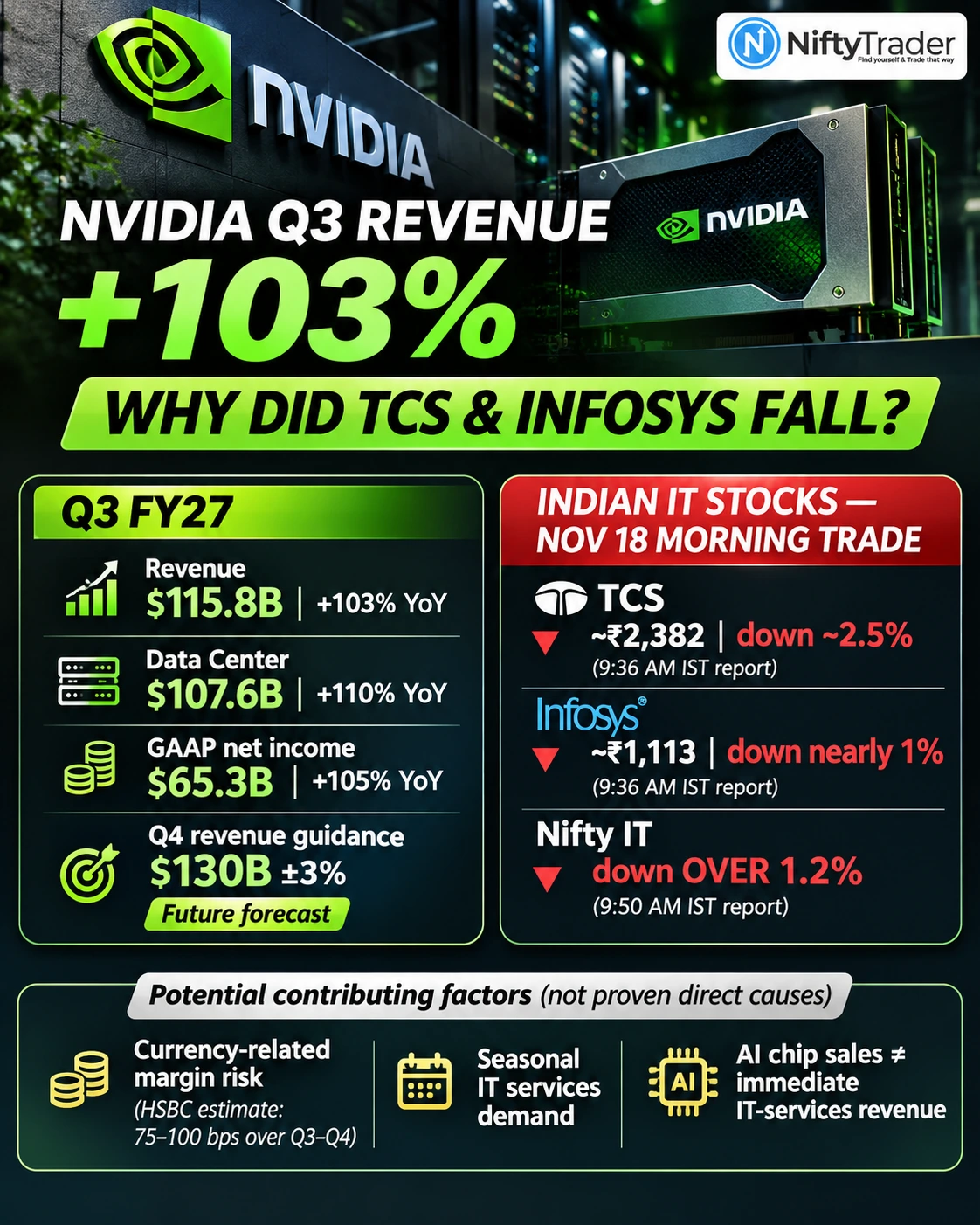
Nvidia Q3 FY27 Results: Revenue Surges 103% to $115.8 Billion
Nvidia’s official earnings release dated November 17 showed substantial growth in quarterly revenue, profitability and its Data Center business.
The company’s third quarter of fiscal 2027 ended on October 25, 2026.
Nvidia Q3 financial performance
| Financial metric | Q3 FY27 | YoY change |
|---|---|---|
| Revenue | $115.8 billion | +103% |
| Data Center revenue | $107.6 billion | +110% |
| GAAP operating income | $77.5 billion | +115% |
| GAAP net income | $65.3 billion | +105% |
| GAAP diluted EPS | $2.70 | +108% |
| Non-GAAP diluted EPS | $2.68 | +111% |
| GAAP gross margin | 74.8% | +1.4 percentage points |
Source: Nvidia’s official November 17, 2026, earnings release.
Revenue also increased 20% sequentially from $96.2 billion in Q2 FY27.
Nvidia’s Data Center business contributed approximately 93% of total quarterly revenue, underlining the company’s dependence on global demand for AI computing systems.
The company began shipping Vera Rubin NVL72 computing systems during the quarter, supporting the expansion of its next-generation AI infrastructure platform.
However, Nvidia’s revenue growth and the financial performance of Indian IT services companies are driven by different business models and demand conditions.
Why Are TCS, Infosys and Other Indian IT Stocks Falling?
The weakness in Indian IT stocks cannot be attributed to one factor alone.
Market reporting and brokerage assessments point to currency movements, seasonal demand, global technology-sector sentiment and uncertainty surrounding the profitability of AI-related investments.
1. Rupee appreciation could pressure IT company margins
Indian IT companies earn substantial revenue from international customers, particularly in the United States and Europe.
Changes in exchange rates can influence rupee-denominated revenue and operating profitability.
According to HSBC research reported by NDTV Profit on November 18, currency movements could create a cumulative margin headwind of approximately 75–100 basis points for Indian IT companies across the third and fourth quarters of FY27.
The brokerage highlighted the effects of recent rupee appreciation and cross-currency movements.
These are estimates of potential pressure, not confirmed margin declines for every IT company.
Actual financial effects will depend on currency hedging arrangements, geographic revenue exposure, employee costs and contract structures.
2. Seasonal weakness remains a concern
The December quarter is typically affected by holiday-related slowdowns and differences in billable working days for Indian IT services companies.
HSBC indicated that seasonality combined with unfavourable currency movements could weigh on near-term profitability.
Consequently, Nvidia’s strong AI chip sales do not independently offset short-term earnings challenges for Indian software exporters.
3. AI hardware spending is not the same as IT services revenue
This is one of the most important distinctions for Indian investors.
Nvidia primarily supplies AI processors, networking systems and computing infrastructure used by cloud providers, enterprises and AI developers.
TCS, Infosys, HCLTech and Wipro primarily generate revenue through software services, consulting, systems integration and enterprise technology solutions.
A large investment in Nvidia’s AI hardware does not automatically create an equivalent increase in outsourcing revenue for Indian IT companies.
For example, a global cloud provider could expand its AI computing capacity substantially without immediately increasing its spending on third-party application development or traditional IT maintenance.
Indian technology firms may benefit from AI implementation, systems integration, cloud transformation and enterprise adoption. However, these opportunities must translate into client contracts, billable work and sustainable margins.
AI adoption could also change demand for conventional software services through greater automation.
Therefore, investors need to assess how individual Indian IT companies monetise AI rather than assuming the entire sector will benefit equally from higher global AI spending.
Nvidia Forecasts $130 Billion in Q4 Revenue, Raises FY28 Growth Outlook
Nvidia expects fourth-quarter fiscal 2027 revenue of approximately $130 billion, plus or minus 3%.
This implies a projected range of approximately $126.1 billion to $133.9 billion, above the LSEG consensus estimate of roughly $125.25 billion cited in market reporting.
The company expects GAAP and non-GAAP gross margins between 71% and 72%, compared with 74.8% and 74.9%, respectively, in Q3.
Nvidia’s fourth fiscal quarter includes an additional week, which is important when evaluating sequential revenue growth.
FY28 revenue growth forecast raised to 75%
During the November 17 earnings call, interim CEO Colette Kress said Nvidia now expects revenue to grow approximately 75% year on year in fiscal 2028, compared with its earlier expectation of around 70%.
The revised forecast reflects management’s confidence in continued AI infrastructure demand and the company’s ability to increase supply capacity.
However, this remains a forward-looking management projection rather than guaranteed growth.
For investors, the contrast between stronger revenue expectations and lower near-term gross-margin guidance makes profitability an important area to monitor.
Nvidia’s $118 Billion Guarantee Exposure Raises AI Financing Questions
Another important development concerns Nvidia’s expanding financial commitments across the AI infrastructure ecosystem.
According to its Q3 CFO commentary, the company had approximately $32 billion in future commitments associated with neocloud agreements as of October 25, 2026.
These arrangements are conditional on partners securing financing, deploying the required infrastructure and meeting other specified operating conditions.
Nvidia also disclosed maximum gross guarantee exposure of $118 billion, including $105 billion in conditional credit support associated with SB Energy’s PORTS-Pike Technology Campus in Ohio.
The project is expected to provide infrastructure for approximately 4.25 gigawatts of computing capacity across nine buildings under long-term lease arrangements involving OpenAI.
Importantly, the $118 billion figure represents the maximum gross amount under the disclosed guarantee arrangements. It is not an immediate cash payment, a recognised loss or conventional outstanding borrowing.
Nvidia said the PORTS-Pike guarantees would become effective in phases as the relevant data centre buildings are completed and ready for service.
The company also disclosed that it had made no payments related to these guarantees as of its Q3 reporting.
The arrangements highlight the increasing connection between Nvidia’s growth and the availability of financing for the wider AI infrastructure industry.
For investors, the question is whether the demand for AI computing capacity will translate into sufficient commercial returns to support the scale of infrastructure investment.
China Export Restrictions Remain a Key Risk
Nvidia’s financial outlook also comes amid ongoing US restrictions on exports of advanced AI computing technology.
The company reported approximately $2.4 billion in shipments of Hopper Data Center products to China during Q3 FY27.
However, management said Nvidia was no longer shipping certain licensed Hopper Data Center products to China.
Its fourth-quarter revenue guidance assumes no Data Center compute revenue from China.
The development highlights how regulatory restrictions can affect access to international markets even when demand for AI infrastructure remains strong elsewhere.
It does not establish that Nvidia has exited every segment of the Chinese market.
Jensen Huang’s Exit: Nvidia’s CEO Search Continues
Nvidia’s November 17 earnings report was its first since co-founder Jensen Huang resigned as president, chief executive officer and a board member.
The company announced Huang’s resignation on November 12 and appointed Chief Financial Officer Colette Kress as interim CEO.
Nvidia’s board subsequently indicated that it did not intend to reinstate Huang.
The latest financial results demonstrate that the company’s operations continued expanding during the leadership transition.
However, the appointment of a permanent CEO, continuity in the technology roadmap and relationships with major customers and supply-chain partners remain important governance considerations.
For Indian market participants, the management transition is primarily a global technology-sector development rather than a direct driver of Indian IT companies’ earnings.
What Nvidia’s Q3 Earnings Mean for Indian Investors
Nvidia’s quarterly results provide an indication of the scale and momentum of global AI infrastructure investment.
However, the implications vary across different areas of the Indian equity market.
| Indian market segment | Potential relevance |
|---|---|
| TCS, Infosys, HCLTech and Wipro | AI integration opportunities, balanced against traditional services and margin pressures |
| Indian data centre businesses | Possible long-term demand for computing capacity and related services |
| Electronics and semiconductor businesses | Exposure to global hardware supply-chain investment |
| Power and infrastructure companies | Potential demand linked to data centre expansion |
| Nifty IT | Sensitive to IT earnings, currencies, valuations and global technology sentiment |
These are sector-level relationships, not evidence of guaranteed revenue growth or share-price gains for individual Indian companies.
Investors directly holding Nvidia through overseas investment arrangements also face US stock-price movements and USD/INR currency exposure.
For NiftyTrader readers, the more immediate market indicators remain Nifty IT performance, constituent-level price trends, sector breadth and the earnings outlook of major Indian software exporters.
What Should Nifty IT Traders Watch Next?
Wednesday’s contrasting market developments illustrate why a strong global earnings announcement should not be treated as a standalone trading signal.
Traders can monitor whether weakness persists across the Nifty IT constituents, whether TCS and Infosys stabilise relative to the sector index, and whether broader market sentiment improves.
Currency movements, institutional activity, global technology-sector performance and Indian IT companies’ future guidance will remain relevant.
Nvidia’s earnings may influence sentiment, but they do not establish a reliable directional outcome for Nifty IT futures or options.
Bottom Line
Nvidia’s Q3 FY27 results confirmed continued growth in global AI computing demand, with quarterly revenue rising 103% to $115.8 billion and Data Center revenue increasing 110%.
Management also raised its fiscal 2028 revenue-growth expectation to approximately 75%.
Yet Indian IT stocks declined during Wednesday’s morning session as currency-related margin concerns, seasonal weakness and uncertainty surrounding technology investment returns remained relevant.
The central takeaway for Indian investors is that the rapid expansion of AI infrastructure does not automatically guarantee immediate earnings growth for Indian IT services companies.
Whether Indian technology firms benefit from global AI investment will depend on their ability to convert new opportunities into profitable contracts, manage operating costs and adapt their business models to changing customer demand.
Read Next: Crystal Crop IPO Opens Today: ₹136-Cr Anchor Book, 33% Cash Flow Drop
Disclaimer: This article is intended for financial news and market awareness only. It does not constitute investment advice or a recommendation to buy or sell securities. The reported Indian share prices reflect separate morning observations on November 18, 2026, and are not live or closing quotes.