
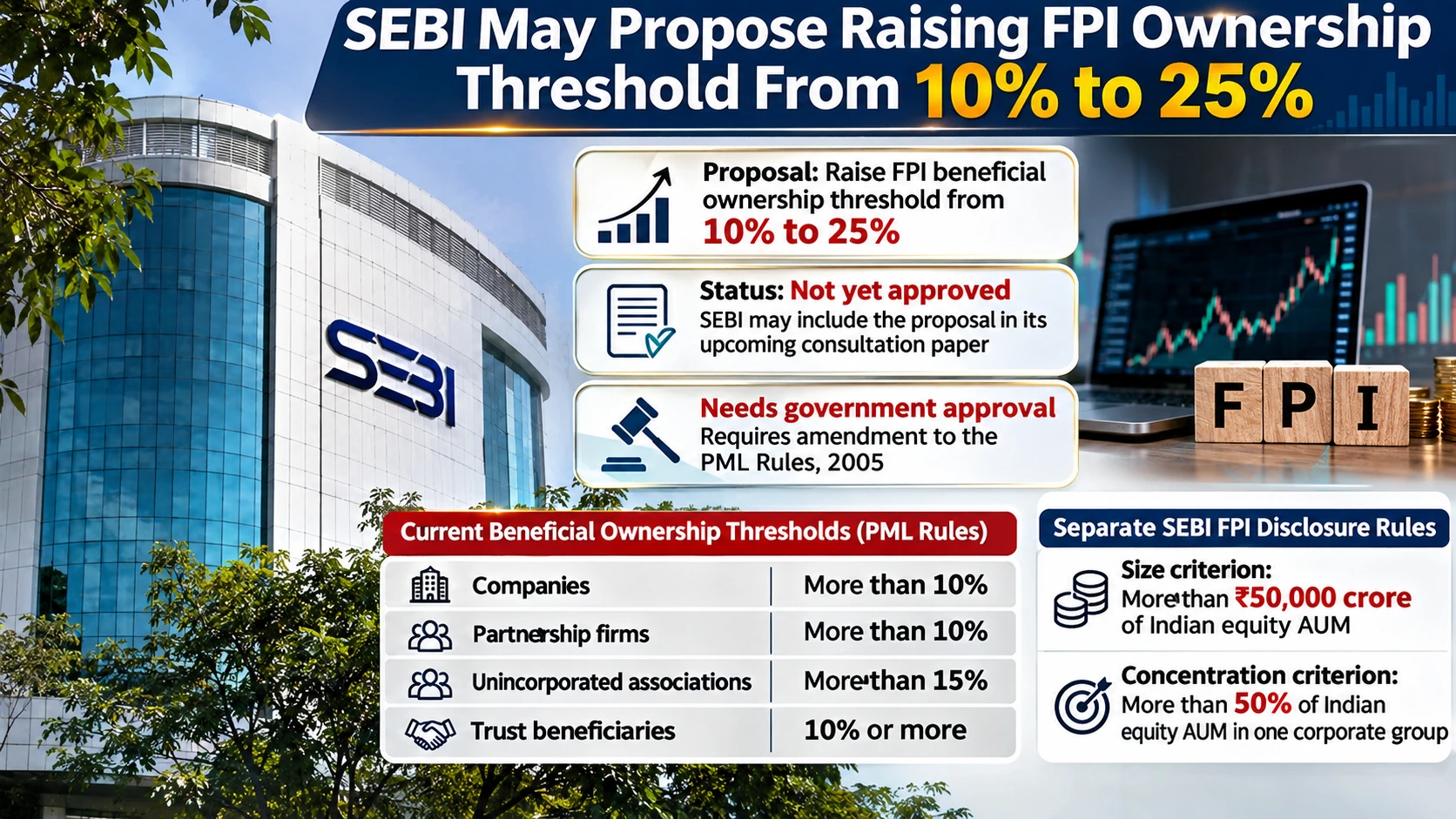
India’s existing beneficial ownership rules require identification of individuals holding more than 10% of a company’s shares, capital or profits. SEBI may now seek to raise the threshold applicable to foreign portfolio investors (FPIs) to 25%, potentially reducing ownership-related disclosure and verification requirements for overseas investment funds.
According to a Moneycontrol report published on November 16, citing sources familiar with the discussions, SEBI may include the proposal in its upcoming consultation paper on easing compliance requirements for foreign investors.
The proposed relaxation could particularly affect international investment funds operating through multiple holding companies, trusts and investment vehicles. However, the 25% threshold has not been officially announced or approved. Implementing the change would require amendments to the Prevention of Money Laundering (Maintenance of Records) Rules, 2005, administered by the Department of Revenue under the Ministry of Finance.
Track Live: Participant-Wise Open Interest — FII, DII, Client & Pro Positions
How a 25% Threshold Could Change FPI Disclosures
The potential impact can be understood through the ownership structure of an overseas investment fund.
Consider an FPI structured as a company in which an individual ultimately holds a 15% ownership interest. Under the current company-level beneficial ownership test, a holding exceeding 10% can trigger identification, subject to applicable exceptions.
If the relevant threshold were increased to more than 25%, the same investor would no longer meet the ownership-percentage test solely on that 15% holding. However, identification could still be required if the individual exercises control through management rights, voting arrangements or other qualifying mechanisms.
The proposed relaxation would therefore affect ownership-based identification, not necessarily every disclosure obligation applicable to foreign investors.
For international funds with multiple investment vehicles and widely distributed ownership, the difference could be significant. FPIs have reportedly argued that India’s lower threshold requires them to trace and verify more investors, increasing documentation and compliance costs.
Moneycontrol reported that SEBI is sympathetic to these concerns. However, the precise scope of the proposed relaxation remains unconfirmed.
What India’s Existing Beneficial Ownership Rules Require
Rule 9(3) of the Prevention of Money-laundering (Maintenance of Records) Rules, 2005, establishes different beneficial ownership identification thresholds depending on the legal structure of an entity.
| Entity structure | Current identification threshold |
|---|---|
| Companies | More than 10% of shares, capital or profits |
| Partnership firms | More than 10% of capital or profits |
| Unincorporated associations or bodies of individuals | More than 15% of property, capital or profits |
| Trust beneficiaries | 10% or more interest |
Ownership percentages are not the only consideration under the rules. Control-based identification also applies independently of the ownership thresholds.
For companies, this includes the right to appoint a majority of directors or influence management and policy decisions through management rights, shareholder agreements or voting arrangements.
For companies, partnerships and unincorporated associations, the relevant senior managing official is identified when no natural person is established under the applicable ownership or control tests. Trusts are subject to separate identification requirements covering the author, trustee, qualifying beneficiaries and other natural persons exercising ultimate effective control.
Why the Government Lowered the Thresholds in 2023
The current framework reflects the government’s efforts to strengthen beneficial ownership transparency under India’s anti-money laundering regulations.
Before the 2023 amendments, the general company ownership threshold was more than 25%, while the general trust beneficiary threshold was 15%. Lower thresholds applied to certain entities in high-risk jurisdictions.
The 2023 amendments brought the company threshold down to more than 10% and the trust beneficiary threshold to 10% or more. The partnership threshold was also reduced to more than 10%, while the unincorporated association threshold remains more than 15%.
These changes expanded the range of individuals potentially covered by ownership-based identification requirements.
For overseas investment funds, the compliance implications can extend beyond direct shareholders because the framework requires tracing relevant ownership through intermediary entities to identify natural persons.
Separate FPI Disclosure Rules: The ₹50,000 Crore Threshold
The proposed PML beneficial ownership change must be distinguished from SEBI’s separate enhanced disclosure framework for certain foreign portfolio investors.
SEBI introduced this framework through its August 24, 2023, circular to address potential circumvention of minimum public shareholding requirements, takeover regulations and restrictions under Press Note 3.
Under the original framework, specified FPIs were required to provide granular information about entities and individuals holding ownership, economic interests or control rights in the fund on a full look-through basis.
The framework originally covered two categories of FPIs:
- Concentration criterion: FPIs holding more than 50% of their Indian equity assets under management (AUM) in a single Indian corporate group.
- Size criterion: FPIs individually, or along with their investor group, holding more than ₹25,000 crore of Indian equity AUM.
However, SEBI subsequently revised the size criterion.
On April 9, 2025, SEBI increased the size-based threshold for enhanced FPI disclosures from ₹25,000 crore to ₹50,000 crore through its circular, Amendment to Circular for Mandating Additional Disclosures by FPIs That Fulfil Certain Objective Criteria.
The revised threshold took immediate effect. The separate concentration criterion remained in place, subject to exemptions and conditions introduced through subsequent SEBI circulars.
The two disclosure triggers are therefore distinct:
| Disclosure criterion | Applicable threshold |
|---|---|
| Size-based criterion | More than ₹50,000 crore of Indian equity AUM |
| Concentration criterion | More than 50% of Indian equity AUM in a single corporate group |
Sources: SEBI August 24, 2023 circular and SEBI April 9, 2025 amendment circular.
These enhanced disclosure obligations operate separately from ordinary beneficial ownership identification under the PML Rules. Consequently, increasing the ordinary ownership threshold would not automatically remove the additional disclosure requirements applicable to qualifying FPIs.
SEBI’s Wider Effort to Simplify Foreign Investor Compliance
The reported 25% proposal comes alongside other regulatory measures introduced by SEBI to improve market access and reduce operational requirements for overseas investors.
SWAGAT-FI framework
On January 16, 2026, SEBI introduced the Single Window Automatic and Generalised Access for Trusted Foreign Investors (SWAGAT-FI) framework for eligible FPIs and foreign venture capital investors.
The framework provides a unified registration process across eligible investment routes while reducing repeated documentation and compliance requirements. Its provisions became effective on June 1, 2026.
SEBI official SWAGAT-FI announcement.
Net settlement of FPI cash-market transactions
On April 24, 2026, SEBI issued a framework permitting net settlement of funds for eligible FPI transactions in the cash market.
The measure is intended to reduce funding requirements and improve operational efficiency. Implementation is scheduled on or before December 31, 2026, meaning the April circular did not make the facility immediately operational.
Longer KYC review intervals
On October 30, 2026, SEBI announced changes to KYC review periodicity for FPIs.
The revised framework extends applicable review intervals from one year to two years and from three years to eight years, depending on the investor category and jurisdiction. The 10-year interval for SWAGAT-FI investors remains unchanged.
The revised requirements are scheduled to take effect from December 1, 2026.
SEBI official FPI regulatory circular listing.
SEBI Chairman’s Comments Provide the Broader Context
The reported proposal follows remarks by SEBI Chairman Tuhin Kanta Pandey at the Business Standard BFSI Insight Summit on October 28, 2026.
Pandey said the regulator would review compliance requirements that could make Indian markets more onerous for foreign investors and issue a consultation paper seeking feedback on aligning domestic requirements with global standards.
He also acknowledged that SEBI had held discussions with foreign portfolio investors and other global market participants about their concerns regarding market access, settlement and onboarding.
Although Pandey indicated that a broader regulatory review was underway, he did not specifically announce or confirm the proposed 25% beneficial ownership threshold.
What Happens Next?
SEBI may publish the proposed relaxation for stakeholder consultation as part of its broader review of FPI compliance requirements.
Any change to the statutory beneficial ownership thresholds would require the competent government authority to amend the PML Rules. The scope and timing remain unconfirmed.
The eventual framework will also need to clarify how indirect ownership, different legal structures and control-based identification requirements would be treated.
Until a formal amendment is notified, FPIs must continue complying with the existing beneficial ownership rules.
Bottom Line
SEBI’s reported plan to increase the FPI beneficial ownership threshold from 10% to 25% could reduce the number of individuals requiring identification under ownership-based disclosure tests, particularly in international investment funds with complex structures.
The potential benefit is simpler documentation and lower compliance costs. The regulatory challenge is ensuring that a higher ownership threshold does not weaken transparency over individuals who exercise effective control through other arrangements.
The proposal must also be viewed separately from SEBI’s enhanced FPI disclosure framework, whose size-based threshold was increased to ₹50,000 crore in April 2025.
For now, the 25% threshold remains an unconfirmed proposal, not an approved policy change. Its eventual impact will depend on SEBI’s consultation process, the government’s decision on the PML Rules and the safeguards included in the final framework.
Read Next: Kaynes Technology Shares Crash 20% to ₹2,744 as Q2 Profit Falls 66%; Debt and Audit Concerns Grow
Disclaimer: This article is for informational and educational purposes only and does not constitute investment or legal advice. The proposed FPI ownership threshold change is unconfirmed and subject to regulatory and government approval. Readers should refer to official SEBI and Ministry of Finance notifications for updates.