RBI Seeks Review of YES Bank AT-1 Bond Verdict as Rs 8,415 Crore Dispute Returns to Court
The legal battle over YES Bank’s Rs 8,415 crore Additional Tier-1 (AT-1) bonds has taken another turn, bringing the banking sector back into focus. The Reserve Bank of India (RBI) has approached the Supreme Court seeking a review of its October 15, 2026, judgment that upheld the Bombay High Court’s decision to quash the bond write-down.
The development is significant because the dispute goes beyond YES Bank. It raises questions about how banks can use AT-1 bonds to absorb losses during financial distress and how regulatory reconstruction schemes should be implemented.
For investors, the outcome could have implications for YES Bank’s capital structure, banking sector confidence and the regulatory framework governing these financial instruments.
Track Live : NSE Option Chain — Live | BSE Option Chain — Live Sensex & Bankex Options Data Today
Why RBI Believes the YES Bank AT-1 Bond Verdict Needs Reconsideration
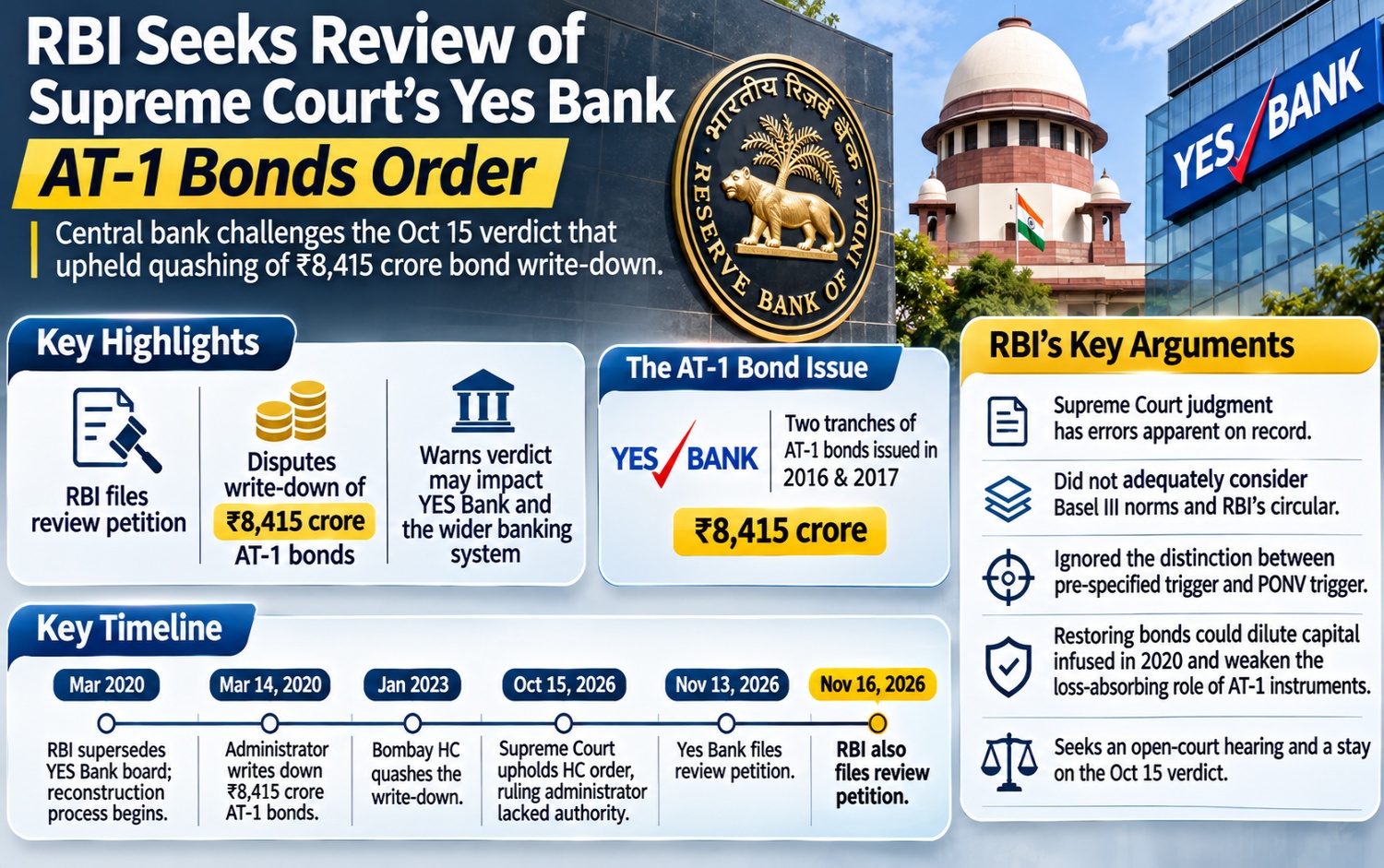
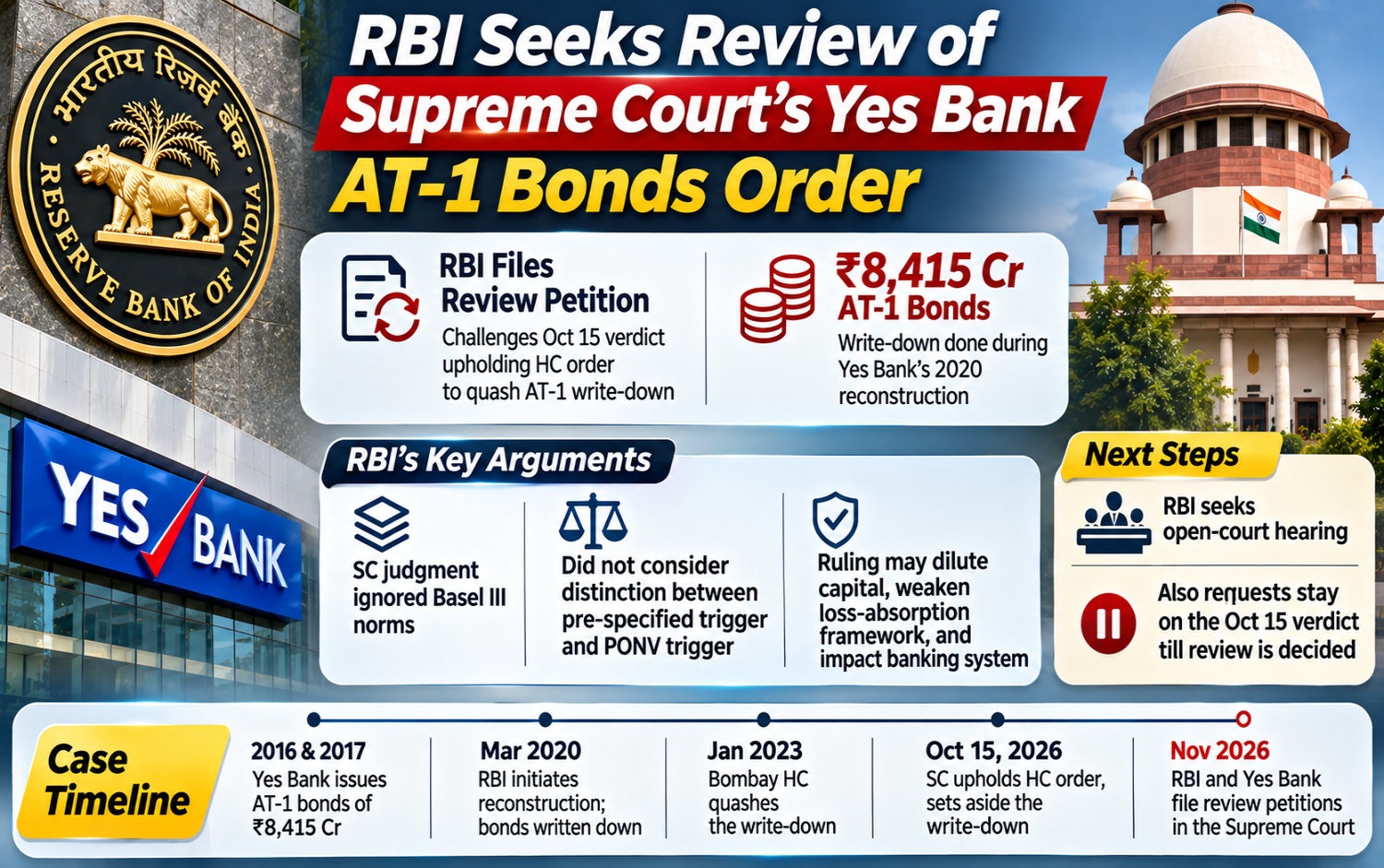
A key argument raised by the RBI concerns the distinction between the pre-specified trigger and the point of non-viability (PONV) trigger under Basel III regulations.
The central bank has maintained that AT-1 bonds are designed to absorb losses during financial stress and that the instruments were required to be written down or converted in the event of YES Bank’s reconstruction.
The RBI has warned that restoring the bonds could dilute the capital infused into YES Bank during its 2020 reconstruction.
It has also argued that the ruling could weaken the loss-absorbing role of AT-1 instruments across the wider banking system, potentially affecting depositors and financial stability.
These are the RBI’s arguments in its review petition; the Supreme Court has yet to decide whether to reconsider its earlier judgment.
Track Live : Nifty Levels Today | Sensex Levels Today
How the Rs 8,415 Crore YES Bank AT-1 Bond Dispute Started
The controversy dates back to YES Bank’s financial crisis in 2020.
The bank had issued two tranches of Basel III-compliant AT-1 bonds: Rs 3,000 crore in 2016 and Rs 5,415 crore in 2017.
Following a deterioration in the bank’s financial position, the RBI initiated a reconstruction exercise in March 2020. The Central Government imposed a moratorium on March 5, while the RBI superseded the bank’s board and appointed an administrator.
The RBI’s draft reconstruction scheme proposed permanently writing down the AT-1 bonds. However, this provision was removed from the final scheme notified by the government on March 13, 2020.
Despite the removal, the administrator wrote down the entire Rs 8,415 crore worth of bonds on March 14.
Its key arguments include:
-
The Supreme Court did not adequately consider the RBI’s Basel III Master Circular.
-
The judgment did not properly examine the contractual loss-absorption provisions of AT-1 bonds.
-
The distinction between the pre-specified trigger and Point of Non-Viability (PONV) was not adequately considered.
-
The ruling could affect future bank-reconstruction exercises and the banking industry’s capital framework.
The RBI has also reportedly requested an open-court hearing and a stay on the October 15 judgment while its review petition is considered.
Why Is the RBI Challenging the Judgment?
The RBI’s primary concern is that the Supreme Court’s decision could weaken the effectiveness of AT-1 bonds as loss-absorbing capital instruments.
AT-1 bonds are designed to absorb losses when a bank experiences severe financial difficulties.
Under applicable regulatory and contractual conditions, these instruments can be permanently written down or converted into equity when specified trigger events occur.
The RBI believes that overturning the YES Bank write-down could create uncertainty about whether such instruments can be relied upon during future banking crises.
According to reports, the regulator is particularly concerned that investors could become less willing to provide capital to troubled banks if reconstruction decisions can be challenged years after they are implemented.
The RBI has also argued that the 2020 rescue protected depositors and helped restore YES Bank’s financial stability. Reinstating the bonds could complicate the capital arrangements made during that exercise.
Read More : Mahanadi Coalfields IPO Opens Nov 19: GMP Slips to Rs 5, H1 Profit Up 6.7%. Should You Apply?
What Are AT-1 Bonds and Why Are They Important?
Additional Tier-1 bonds are perpetual debt instruments that banks issue to strengthen their regulatory capital.
Unlike ordinary bonds, AT-1 instruments have special loss-absorption features.
Their key characteristics include:
-
They generally do not have a fixed maturity date.
-
They carry higher investment risks than conventional bank deposits.
-
They can absorb losses through permanent write-downs or conversion into equity.
-
Interest payments may be cancelled under applicable contractual and regulatory conditions.
-
Investors may lose some or all of their principal when specified trigger conditions occur.
AT-1 bonds form part of a bank’s Tier-1 regulatory capital, which helps absorb losses while the bank continues operating.
What the Bombay High Court and Supreme Court Said About the Write-Down
Bondholders, represented by Axis Trustee Services, challenged the decision before the Bombay High Court.
In January 2023, the High Court quashed the write-down, ruling that the administrator could not exercise the power after the reconstruction scheme had already come into force.
The RBI, YES Bank and the Union Government subsequently challenged the decision before the Supreme Court.
On October 15, 2026, the apex court dismissed their appeals and upheld the High Court’s judgment. It held that the final reconstruction scheme did not contain a specific provision authorising the administrator to write down the bonds after the scheme became effective.
The RBI and YES Bank have now sought a review of that decision.
What Is the Difference Between Pre-Specified Trigger and PONV?
This is one of the most important technical issues in the RBI’s review petition.
The Basel III framework provides two separate triggers for AT-1 bond loss absorption.
| Particulars | Pre-Specified Trigger | Point of Non-Viability |
|---|---|---|
| Meaning | Bank’s capital falls below a specified threshold | Bank becomes non-viable or approaches non-viability |
| Trigger threshold | CET1 ratio below prescribed level | Determined under RBI’s regulatory framework |
| Decision-making authority | Bank has contractual discretion | RBI determines the trigger and loss-absorption action |
| Possible action | Write-down or conversion, as permitted by bond terms | Write-down or conversion under RBI’s direction |
In YES Bank’s case, the relevant pre-specified CET1 threshold was 6.125% of risk-weighted assets from March 31, 2019.
The Supreme Court examined these two triggers while deciding whether the administrator had the authority to write down the bonds.
YES Bank’s ₹8,415 Crore AT-1 Bond Dispute: Complete Timeline
The dispute dates back to YES Bank’s financial crisis in 2020.
-
December 23, 2016
YES Bank issued its first tranche of Basel III-compliant AT-1 bonds worth ₹3,000 crore, carrying a 9.5% coupon.
-
October 18, 2017
The bank issued another tranche worth ₹5,415 crore, carrying a 9% coupon.
-
March 5, 2020
The Central Government imposed a moratorium on YES Bank, while the RBI superseded its board and appointed an administrator.
-
March 6, 2020
The RBI published a draft reconstruction scheme, which initially included provisions for writing down AT-1 bonds.
-
March 13, 2020
The final reconstruction scheme was notified by the Central Government without the specific AT-1 write-down provision.
-
March 14, 2020
YES Bank’s administrator wrote down the entire ₹8,415 crore worth of AT-1 bonds.
-
January 20, 2023
The Bombay High Court quashed the write-down, ruling that the administrator lacked authority under the final reconstruction scheme.
-
October 15, 2026
The Supreme Court dismissed appeals by YES Bank, RBI and the Union Government, upholding the Bombay High Court judgment.
-
November 13, 2026
YES Bank and the RBI separately filed review petitions before the Supreme Court.
-
November 16, 2026
The RBI’s review petition was listed on the Supreme Court website.
Why Did the Supreme Court Cancel the ₹8,415 Crore Write-Down?
The Supreme Court’s October 15 judgment focused primarily on the legal authority of the administrator and the final reconstruction scheme.
The draft reconstruction scheme initially contained an AT-1 bond write-down provision. However, that provision was removed from the final scheme notified on March 13, 2020.
The administrator nevertheless proceeded with the permanent write-down on March 14.
The Supreme Court held that the administrator could not exercise powers that were not authorised under the final reconstruction scheme.
It also examined the distinction between the RBI’s regulatory powers and the administrator’s authority under Section 36ACA of the Banking Regulation Act, 1949.
The court found that the PONV-related decision-making authority rested with the RBI, not the administrator.
The judgment also questioned the actions of the RBI, YES Bank and the administrator during the reconstruction process.
How Could the Verdict Affect YES Bank’s Financial Position?
One of the most important investor-related aspects is the potential impact of restoring the ₹8,415 crore AT-1 bonds.
According to YES Bank’s earlier disclosures and financial estimates reported after the Supreme Court judgment, recognising the principal amount could materially affect its capital position.
| Financial indicator | Reported pro forma position |
|---|---|
| September-quarter reported net profit | ₹1,080 crore |
| Estimated pro forma net loss | ₹5,217 crore |
| Reported net worth | ₹53,268 crore |
| Estimated pro forma net worth | ₹46,970 crore |
| Reported borrowings | ₹77,734 crore |
| Estimated pro forma borrowings | ₹86,149 crore |
YES Bank had also indicated that reinstatement could affect its Common Equity Tier-1 (CET1) capital ratio by approximately 240 basis points, based on its September 30, 2026 position.
These are previously reported illustrative estimates, not a fresh assessment of the bank’s current financial position or a confirmed cash payment obligation.
What Happens to the Bondholders?
The Supreme Court’s October 15 judgment was favourable to the affected AT-1 bondholders.
The judgment upheld the Bombay High Court’s decision to quash the permanent write-down.
The implications include:
-
Bondholders have a basis to seek restoration of their investments.
-
The ₹8,415 crore principal amount is central to the dispute.
-
Associated bond rights and outstanding interest obligations are also relevant.
-
The Supreme Court held that annual coupon payments would remain governed by the respective bond information memorandums.
However, the RBI and YES Bank’s review petitions could prolong the legal proceedings and create uncertainty about the timing of implementation.