Synopsis: India’s crude oil import bill surged 88% year-on-year to $19.5 billion in October 2026, as Brent crude averaged $123.93 per barrel and import volumes increased 11%. The seven-month import bill has already reached $111 billion. The development puts IOC, BPCL and HPCL under the spotlight because of their refining and fuel-marketing exposure, while Reliance Industries could benefit from stronger refining margins. IndiGo and Asian Paints face a different challenge through fuel and crude-linked raw material costs.
New Delhi: India’s crude oil import bill has surged to $19.5 billion in October 2026, raising concerns about the impact of elevated international energy prices on the country’s economy and stock market.
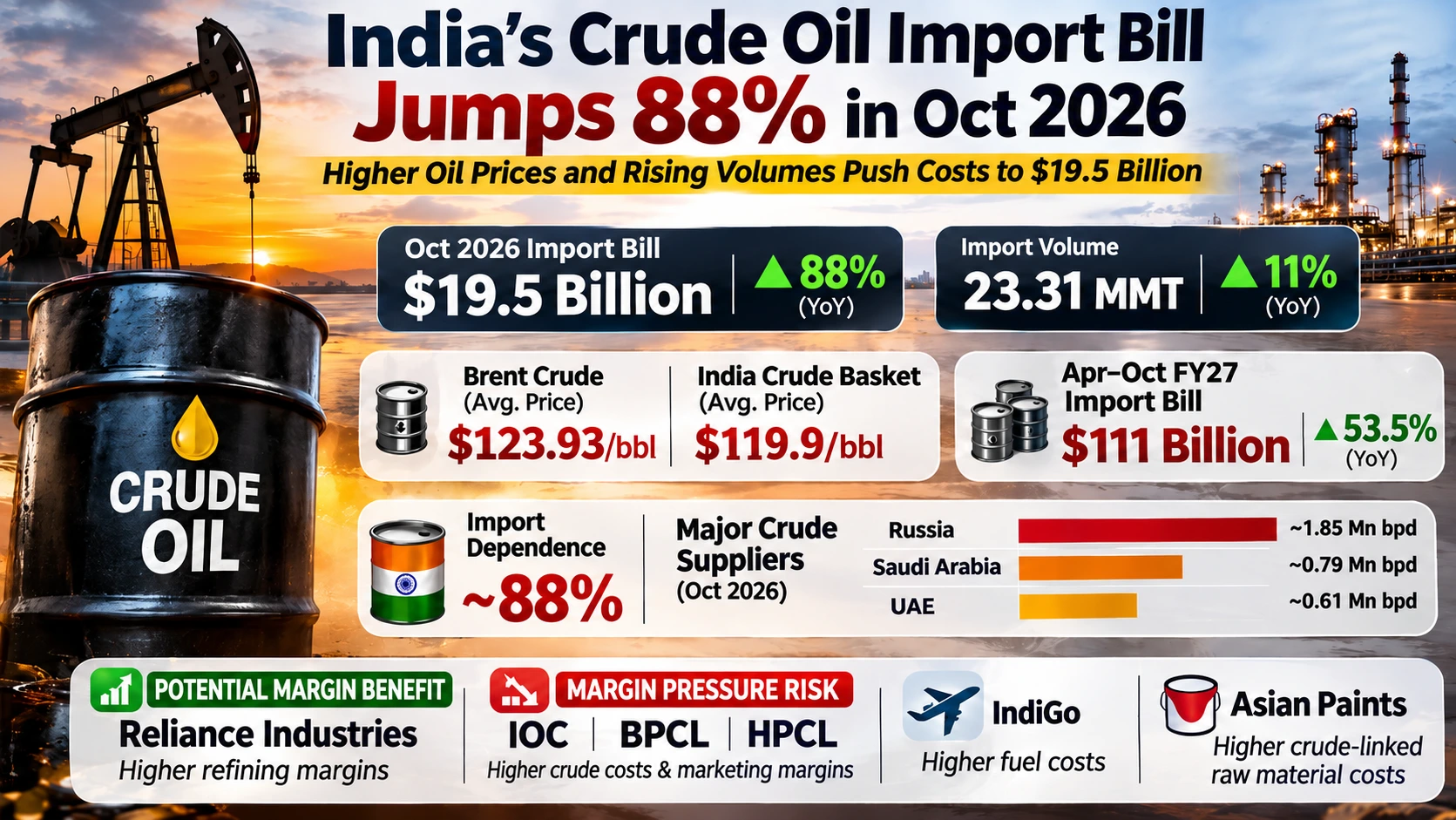
The 87.5% year-on-year increase came as Brent crude averaged $123.93 per barrel, its highest monthly average since March 2012. At the same time, India’s crude imports increased approximately 11% to 23.31 million metric tonnes (MMT), according to provisional government data reported by Reuters.
The development has brought oil marketing companies, refiners, airlines and paint manufacturers into focus. However, the impact is not uniform. Higher crude prices can increase procurement costs for fuel marketers and airlines, while integrated refiners may benefit from stronger transportation fuel margins and export opportunities.
For investors tracking oil-sensitive stocks, the more important question is how much of the crude-price increase companies can absorb, pass on to customers or offset through refining and operating margins.
India’s crude import bill rises 88% as Brent averages $123.93
The sharp increase in India’s October crude import expenditure was primarily driven by higher international oil prices, although rising import volumes also contributed.
Brent crude averaged $123.93 per barrel in October, compared with $64.54 in October 2025. India’s crude oil basket, which reflects the grades purchased by domestic refiners, averaged approximately $119.9 per barrel during the month.
The difference between the two benchmarks is important because Indian refiners procure several crude grades from different countries, rather than relying exclusively on Brent.
The pressure is not limited to October.
According to provisional Petroleum Planning and Analysis Cell (PPAC) data, India’s crude oil import bill increased 53.5% year-on-year to $111 billion during April-October FY27. Import volumes rose just 2.7% to 146.6 MMT during the same period.
The average landed price of imported crude consequently increased to approximately $103.3 per barrel, compared with around $69 per barrel in the corresponding period last year.
India’s crude oil import dependence has remained around 88%, according to the Ministry of Petroleum and Natural Gas. This leaves the domestic economy exposed to international oil-price movements, geopolitical developments and changes in shipping costs.
Russia remains India’s biggest oil supplier; Saudi Arabia moves to second position
The changing composition of India’s crude oil suppliers is another important development for energy companies.
According to Reuters, Saudi Arabia overtook the UAE to become India’s second-largest crude supplier in October, while Russia retained its position as the largest supplier.
Russian shipments increased 3.5% month-on-month to approximately 1.85 million barrels per day (bpd), accounting for roughly one-third of India’s total crude imports.
Saudi Arabian shipments climbed to around 790,000 bpd, an eight-month high, supported by discounted crude and increased exports through the Red Sea port of Yanbu.
Meanwhile, UAE supplies declined to approximately 612,000 bpd, their lowest level in seven months.
This shift reflects how refiners are adjusting their procurement strategies amid shipping disruptions and uncertainty surrounding the Strait of Hormuz.
For Indian oil companies, the availability of discounted crude and diversified sourcing can help manage procurement costs. However, transportation expenses, insurance premiums, crude quality and geopolitical risks remain important variables.
6 stocks that could be affected by India’s higher crude import costs
The increase in India’s crude import expenditure has different implications for companies depending on their exposure to refining, fuel marketing, aviation and petroleum-linked raw materials.
1. Indian Oil Corporation (IOC)
NSE: IOC | Refining and fuel marketing exposure
Indian Oil Corporation is among the most directly exposed listed companies because it operates across crude procurement, refining, petroleum product marketing and pipelines.
Higher international crude prices can increase the company’s working-capital requirements and put pressure on marketing margins when domestic petrol and diesel prices do not immediately adjust.
However, stronger refining margins and inventory gains can partly offset this pressure.
Indian Oil reported standalone profit after tax of ₹21,630 crore in Q2 FY27, compared with ₹7,610 crore in Q2 FY26, after reporting a loss of ₹2,661 crore in the preceding quarter.
Its reported gross refining margin was $18.52 per barrel, excluding the special additional excise duty (SAED) impact. Management also disclosed a combined refining and marketing inventory benefit of approximately ₹6,948 crore during Q2 FY27, without providing a segment-wise breakdown.
Inventory gains are sensitive to crude-price movements and may not recur at the same level in subsequent quarters.
The company also indicated that marketing margins remain a major factor affecting profitability.
Consequently, investors need to track inventory gains and losses, refining margins, fuel-marketing margins and crude procurement costs rather than treating higher crude prices as an automatically positive or negative trigger for IOC shares.
2. Bharat Petroleum Corporation (BPCL)
NSE: BPCL | Refining margins versus marketing profitability
Bharat Petroleum Corporation is another important stock to watch as rising crude prices influence procurement expenses, refining profitability and retail fuel marketing margins.
BPCL’s standalone Q2 FY27 net profit stood at ₹4,993.17 crore, compared with ₹6,442.53 crore in the corresponding quarter last year.
More importantly, its first-half FY27 standalone profit declined to ₹1,031.04 crore from ₹12,566.46 crore in the previous corresponding period.
The company’s financial disclosures indicated that lower first-half profitability was mainly due to suppressed marketing margins on certain petroleum products, partly offset by higher refining margins.
This highlights the importance of the difference between refining and marketing economics.
Higher crude prices can support refining revenue when international product cracks remain favourable. However, if retail fuel prices fail to adjust adequately, the marketing business can face margin pressure.
Investors will therefore need to monitor BPCL’s gross refining margins, marketing inventory movements, retail fuel pricing and government compensation relating to LPG under-recoveries.
3. Hindustan Petroleum Corporation (HPCL)
NSE: HINDPETRO | Refinery and retail fuel exposure
Hindustan Petroleum Corporation is particularly relevant because its latest results demonstrate how strong refining margins do not necessarily translate into equally strong overall profitability.
HPCL reported a gross refining margin of $32.15 per barrel before export cess in Q2 FY27, compared with $8.80 per barrel in Q2 FY26.
Its standalone Q2 profit after tax stood at ₹3,483 crore. However, the company had reported a standalone loss of ₹11,526 crore in Q1 FY27. Consequently, its cumulative first-half FY27 performance remained in the red, with a standalone net loss of ₹8,044 crore, compared with a profit of ₹8,201 crore in the corresponding period last year.
This difference makes HPCL an important stock to monitor during periods of crude-price volatility.
Its earnings depend on the combined performance of refining, marketing, inventory valuation and other operating factors.
A sustained improvement in refining margins could support profitability, but elevated procurement costs and suppressed marketing margins could limit the benefit.
4. Reliance Industries (RIL)
NSE: RELIANCE | Integrated refining and petroleum exports
Reliance Industries has a different exposure compared with state-owned oil marketing companies.
Its large integrated oil-to-chemicals (O2C) business includes refining, petrochemicals, fuel retailing and petroleum product exports.
Higher international transportation fuel prices can benefit the company when product cracks and refining spreads improve.
Reliance’s Q2 FY27 O2C segment revenue increased 44.2% year-on-year to ₹2,31,601 crore, while segment EBITDA surged 67.9% to ₹25,203 crore.
The company reported that stronger transportation fuel cracks and favourable energy-market conditions supported its O2C performance.
Its O2C exports also increased 46.9% to ₹1,04,250 crore.
However, Reliance should not be considered an automatic beneficiary of rising crude prices. Its profitability depends on the relationship between crude procurement costs and the selling prices of refined products and petrochemicals.
Changes in crude discounts, product spreads, feedstock availability and international demand will determine the actual earnings impact.
5. InterGlobe Aviation (IndiGo)
NSE: INDIGO | Aviation fuel cost sensitivity
IndiGo is among the more directly exposed non-oil companies because aviation turbine fuel (ATF) is a major operating expense.
Higher crude prices can increase aviation fuel prices, potentially putting pressure on airline operating margins.
The company’s Q2 FY27 consolidated financial results provide a clear indication of its fuel-cost exposure.
Aircraft fuel expenses increased to ₹9,966.8 crore during Q2 FY27, compared with ₹5,961.8 crore in Q2 FY26.
That represents an increase of approximately 67.2% year-on-year.
Importantly, IndiGo’s exchange filing disclosed that it did not participate in the government’s Price Stabilisation Fund scheme introduced from June 9, 2026. It consequently accounted for aircraft fuel expenses at prevailing market prices under its contractual arrangements.
The potential impact of elevated oil prices will depend on ATF pricing, passenger demand, the airline’s ability to increase fares, aircraft utilisation and currency movements.
For investors, sustained increases in aviation fuel expenditure could become a margin concern if airlines cannot pass the higher costs on to passengers.
6. Asian Paints
NSE: ASIANPAINT | Indirect crude-linked raw material exposure
Asian Paints has a different and more indirect connection with crude oil prices.
The paint industry uses several petroleum-linked raw materials, including solvents, resins and other chemical intermediates. Higher input costs can therefore affect manufacturing expenses and operating margins.
Asian Paints’ Q2 FY27 results already highlighted the pressure from raw material inflation and geopolitical disruptions.
The company reported a standalone PBDIT margin of 17.1% during the September quarter and said that raw material inflation and material availability constraints had affected operating conditions.
Management also indicated that the company had calibrated price increases while absorbing part of the cost inflation to protect consumer demand. The company implemented staggered price increases in its decorative paints business to counter raw material inflation.
However, it would be incorrect to attribute all of Asian Paints’ raw material inflation to crude oil alone. The impact depends on the prices of individual chemical inputs, supplier availability, inventory costs and the company’s ability to pass higher expenses on to consumers.
Brent crude correction: Is the pressure on Indian stocks easing?
There has been a notable correction in international crude prices since October.
Brent crude was trading at $92.77 per barrel at 0404 GMT on November 20, approximately 25% below its October monthly average of $123.93. The benchmark was up 0.9% on the day but was heading towards a weekly decline of around 3.5%.
The correction followed easing concerns about further escalation in the West Asia conflict and improving shipping flows through the Strait of Hormuz. Oil shipments through the strait had recovered to roughly pre-war levels, easing some immediate supply concerns.
Nevertheless, renewed Houthi attacks on Riyadh and reports of tanker incidents in the Strait have revived concerns about potential supply interruptions.
The November 29 OPEC+ meeting will also be important for the crude price outlook as producers discuss their supply strategy for 2027.
For Indian companies, a sustained reduction in crude prices could lower procurement costs, reduce pressure on fuel marketing margins and ease the aviation industry’s fuel expenses.
However, companies that benefited from high refining margins could see those margins normalise if international product cracks weaken.
The timing and extent of any benefit will also depend on the rupee-dollar exchange rate, domestic fuel prices and inventory adjustments.
Bottom Line
India’s $19.5-billion October crude import bill puts the oil-price impact on Indian companies firmly in focus.
IOC, BPCL and HPCL remain sensitive to the balance between crude procurement costs, refining margins and fuel marketing economics. Reliance Industries has an opportunity to benefit from strong refining and export spreads, while IndiGo faces direct pressure through aviation fuel expenses. Asian Paints has a more indirect exposure through petroleum-linked raw materials.
The next direction for these stocks will depend less on India’s import bill alone and more on how international crude prices, product cracks, domestic pricing policies and company-specific margins evolve.
For investors, the important distinction is between companies that process expensive crude, companies that sell fuel to customers and businesses that consume petroleum-linked products. Their earnings can react very differently to the same movement in oil prices.
Read Next: Stocks to Watch Today Nov 20: NLC India, Paytm, Coal India, Voltas and 14 More