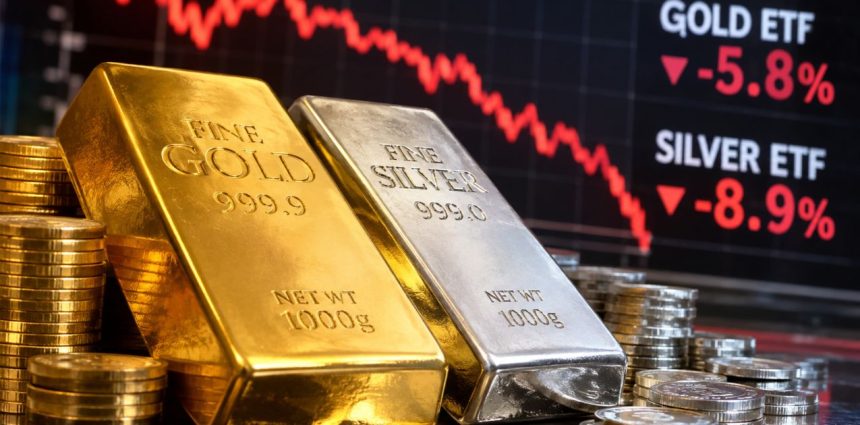
Gold and silver ETFs plunged up to 9% on November 20, with SBI Silver ETF hitting a fresh 52-week low of ₹142.64. A stronger US dollar, elevated US Treasury yields and 99.3% market-implied odds of a December Federal Reserve rate hike pressured bullion prices. However, AMFI data show continued October inflows into both ETF categories despite declining AUM. Here’s what investors should know before buying, holding or selling.
Gold and silver exchange-traded funds (ETFs) witnessed sharp selling on Friday, November 20, as a global bullion sell-off triggered losses across India’s precious metal ETFs. Silver ETFs bore the brunt, with several schemes falling 6–9% during the session, while gold ETFs declined around 5–6%.
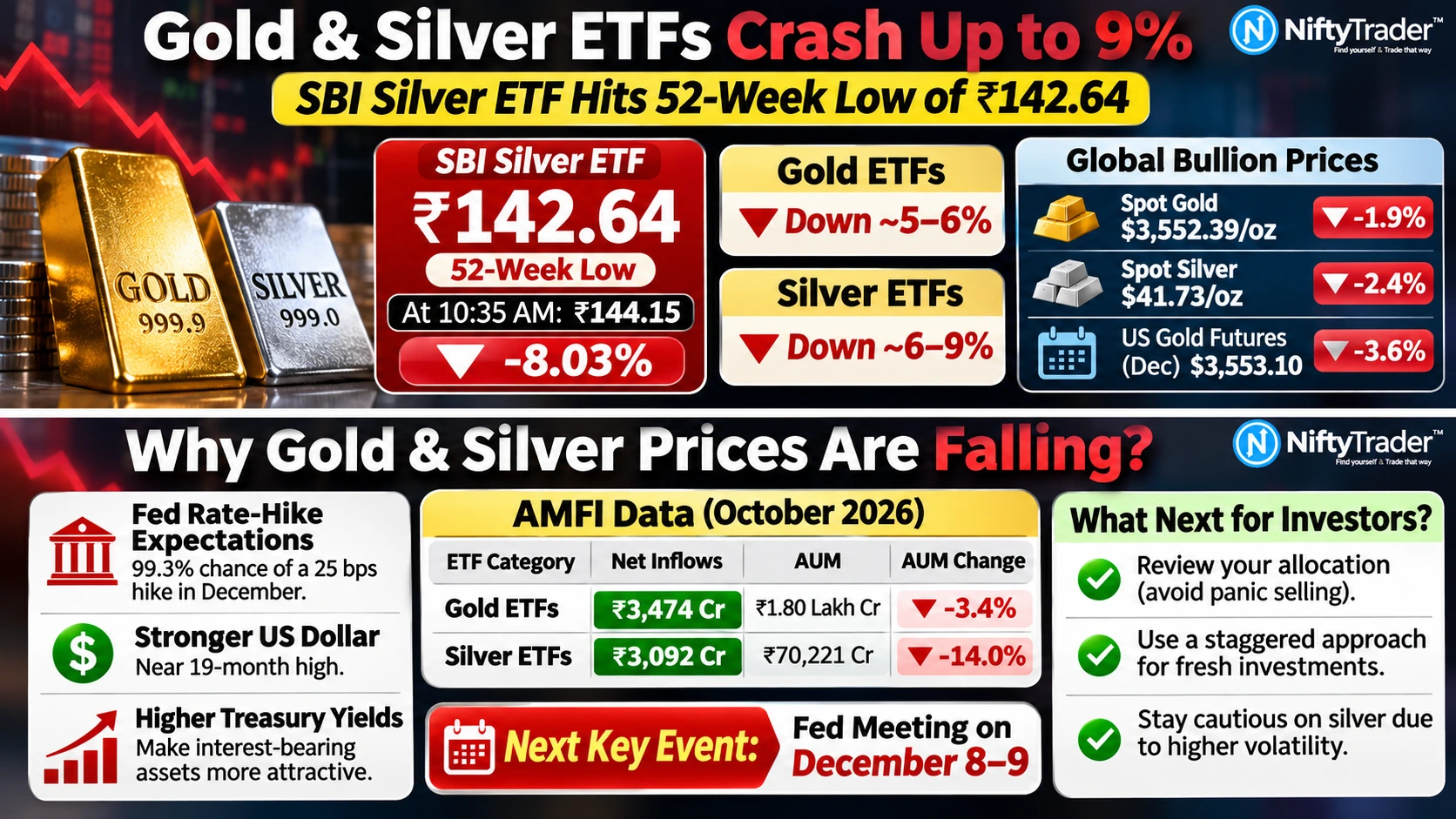
The sharpest fall was seen in SBI Silver ETF, which touched ₹142.64 on the NSE, marking a fresh 52-week low. At 10:35 a.m. IST, it was trading at ₹144.15, down 8.03% against its previous close of ₹156.74.
The correction followed a steep decline in international bullion prices. According to Reuters, spot gold fell 1.9% to $3,552.39 an ounce by 0730 GMT on Friday, November 20, and was down approximately 8.5% for the week, its steepest weekly decline in eight months. December US gold futures dropped 3.6% to $3,553.10.
Spot silver declined 2.4% to $41.73 an ounce. The US dollar remained near a 19-month high, while markets priced in a 99.3% probability of a 25-basis-point Federal Reserve rate increase in December.
Track Live: NSE Commodity Option Chain — Live MCX Options Data for Crude Oil, Gold, Silver & More
Why are gold and silver prices falling?
Three developments are driving the current correction: expectations of higher US interest rates, dollar strength and investor liquidation.
1. Fed rate-hike expectations are hurting bullion
The possibility of another US Federal Reserve rate increase in December has emerged as the biggest immediate concern for precious metal investors.
The Federal Reserve’s October 27–28 meeting minutes, released on November 18, revealed that almost all participants considered further increases in interest rates likely to be appropriate under their baseline economic outlooks.
Two policymakers had also preferred a 25-basis-point increase at the October meeting, although the majority supported maintaining the existing 3.75–4% target range.
The minutes also stressed that future decisions would depend on incoming economic data and the evolving inflation outlook.
Higher interest rates increase the opportunity cost of holding gold and silver because neither metal generates interest income. If the Fed continues tightening, investors could favour interest-bearing assets over bullion.
2. Strong dollar and elevated Treasury yields add pressure
The US dollar’s proximity to a 19-month high has made dollar-priced precious metals more expensive for international buyers using other currencies.
Elevated US Treasury yields have added another headwind by making interest-bearing investments relatively attractive.
Reuters also highlighted possible forced liquidation across financial markets, suggesting that investors are reducing positions amid broader financial-market weakness.
3. Currency movements amplify the impact on Indian investors
Indian gold and silver prices are influenced by international bullion prices and the rupee-dollar exchange rate.
Consequently, a decline in international prices can translate into additional pressure on domestic bullion when accompanied by rupee appreciation.
This is also why Indian ETF returns may differ from the percentage change in international spot gold or silver. Currency conversion, domestic pricing and ETF market-price movements all matter.
AMFI data reveal a surprising trend: Investors continued buying
Despite the correction in precious metals, Indian investors continued putting fresh money into gold and silver ETFs during October.
According to AMFI’s October 2026 Monthly Note, gold ETFs attracted net inflows of ₹3,474 crore, compared with ₹4,451 crore in September. Silver ETFs received ₹3,092 crore, up 56.6% from ₹1,974 crore in September.
However, both categories recorded declines in assets under management (AUM).
| ETF category | October inflows | October AUM | Monthly AUM change |
|---|---|---|---|
| Gold ETFs | ₹3,474 Cr | ₹1.80 lakh Cr | -3.4% |
| Silver ETFs | ₹3,092 Cr | ₹70,221 Cr | -14.0% |
Source: AMFI October 2026 Monthly Note.
The divergence is important. Both categories received fresh investments even as their AUM declined. This is because AUM reflects not only investor flows but also changes in the market value of underlying holdings.
Falling bullion prices can therefore reduce ETF AUM even when investors continue purchasing units. However, October’s inflows do not guarantee continued buying during November’s correction.
Gold versus silver: Which has stronger fundamentals?
Gold and silver have different investment drivers, making it important to assess them separately.
Gold: Central-bank demand continues to provide a longer-term support factor. According to the World Gold Council, central banks purchased 321 tonnes of gold in Q3 2026, up 42% year-on-year. Physically backed global gold ETFs also recorded inflows of 211 tonnes, taking holdings to a record 4,256 tonnes.
However, strong institutional demand does not guarantee an immediate price recovery when dollar strength and interest-rate expectations are unfavourable.
Silver: The metal has an additional industrial-demand component, making its outlook more sensitive to manufacturing and investment trends.
According to the Silver Institute’s November outlook, the global silver market is expected to record its sixth consecutive annual supply deficit in 2026, with demand exceeding supply by 35 million ounces.
However, total silver demand is projected to decline 5% to 1.08 billion ounces, while industrial demand is expected to fall 3% to approximately 640 million ounces.
This creates an important market tension: a projected supply deficit remains supportive, but weakening demand and investment sentiment can still put pressure on silver prices.
World Gold Council | Silver Institute.
What should gold and silver ETF investors do now?
Friday’s correction does not automatically make precious metal ETFs attractive purchases. Investors should consider their existing allocation, investment horizon and ability to withstand further volatility.
- Existing gold ETF investors: Those holding gold for long-term diversification can review their allocation instead of reacting emotionally to one sharp correction. Rebalancing may be preferable to making abrupt portfolio changes.
- Fresh gold ETF investors: Staggered investments can help manage entry-timing risk instead of committing the entire amount immediately. However, investors should assess their overall asset allocation first.
- Existing silver ETF investors: Exercise greater caution because silver generally experiences sharper price swings and has additional industrial-demand exposure. Avoid increasing exposure simply because prices have fallen.
- Short-term investors: Do not assume a technical rebound is guaranteed. A steep correction does not necessarily mean the market has formed a bottom, and leveraged positions can magnify losses.
Investors should also compare an ETF’s exchange-traded price with its indicative net asset value (iNAV), alongside its liquidity, bid-ask spread, expense ratio and tracking difference.
For example, SBI Silver ETF traded at ₹144.15 against an iNAV of ₹143.34 at 10:35 a.m. on November 20, representing an approximately 0.57% premium, according to NSE data.
What next for gold and silver prices?
The December 8–9 Federal Reserve meeting will be a crucial near-term event. A hawkish policy stance, persistent inflation and continued dollar strength could extend pressure on precious metals. Softer inflation data or a less hawkish Fed outlook could support a recovery.
For silver, investors must additionally monitor industrial consumption and investment flows.
Bottom line
The sharp decline in gold and silver ETFs reflects a combination of Fed rate-hike expectations, dollar strength, elevated Treasury yields and investor liquidation. SBI Silver ETF’s fresh 52-week low highlights the extent of the correction.
However, October’s AMFI data show that investors continued allocating fresh money to both categories despite falling AUM. Gold retains support from central-bank purchases, while silver faces a more complicated outlook because its projected supply deficit is accompanied by weakening demand.
Investors should assess gold and silver separately, avoid panic selling and resist the temptation to treat every sharp correction as a buying opportunity.
Read Next: India’s $19.5-Billion Crude Oil Shock: 6 Stocks to Watch
Disclaimer: This article is for informational purposes only and is not investment advice. Precious metal ETFs carry market, currency and liquidity risks. Investors should assess their financial objectives and risk tolerance before investing.