US Inflation Was 3.6% :Trump Uses India’s 7% GDP Growth to Demand Lower US Interest Rates
Can the US economy grow at 20% if the Federal Reserve cuts interest rates? US President Donald Trump has made an extraordinary growth claim, pointing to India’s approximately 7% GDP expansion and lower borrowing costs to argue that the American economy could grow significantly faster under an easier monetary policy.
Speaking to reporters at the White House on Friday, Trump criticised the Federal Reserve for maintaining relatively high interest rates despite what he described as strong economic performance.
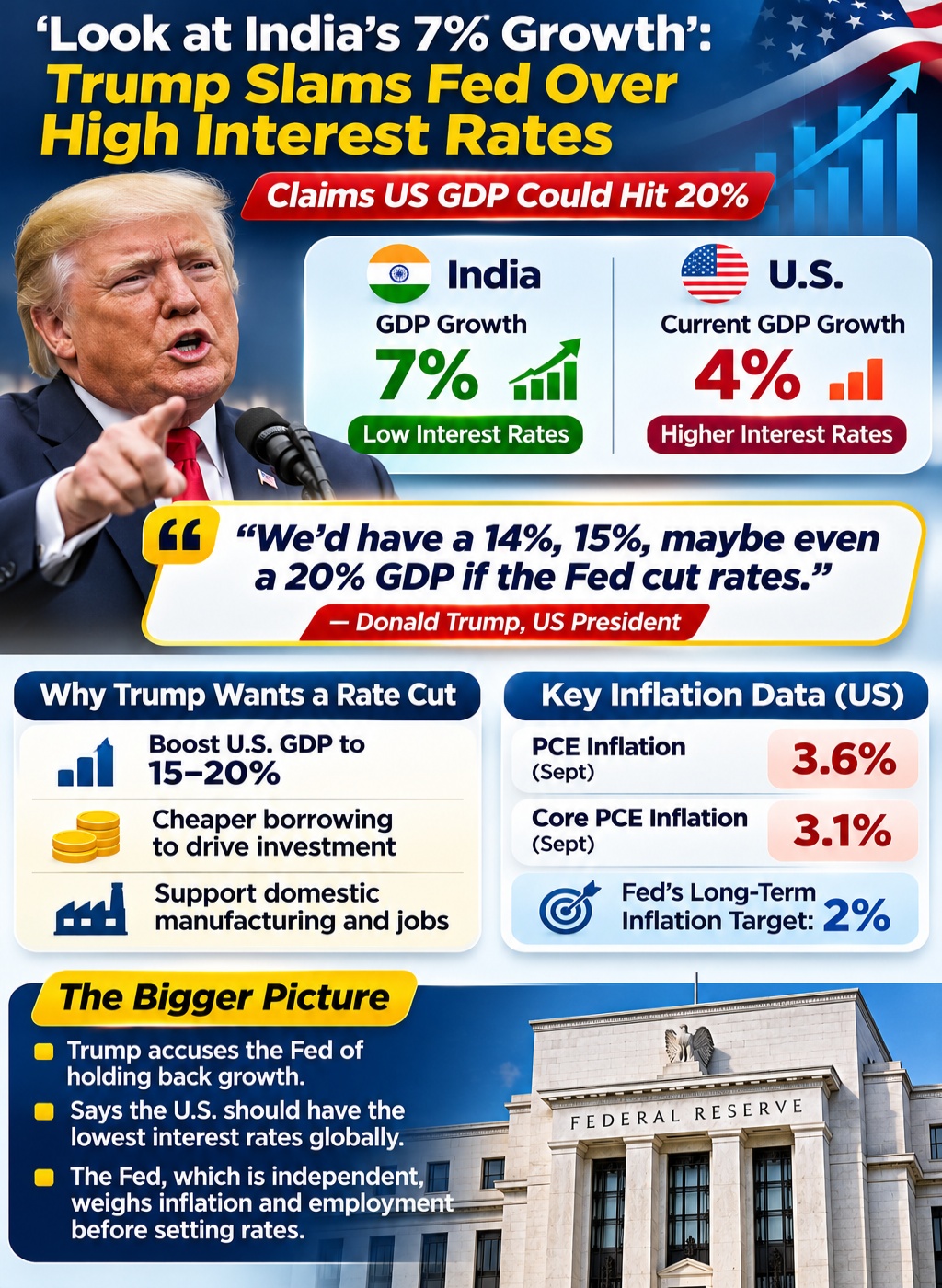
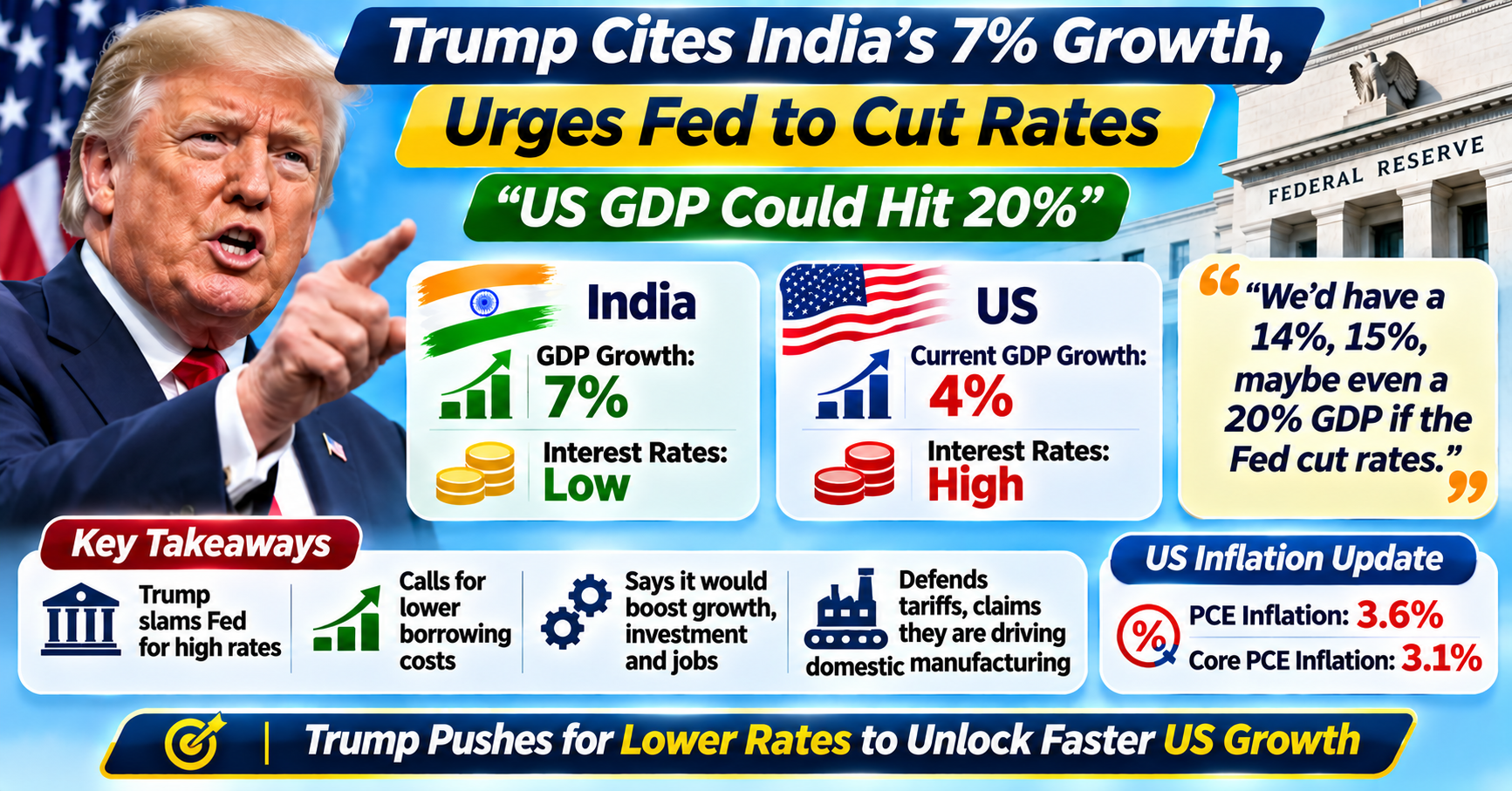
“If you look at India, they have low interest rates, and they have a 7 percent GDP. We’d have a 14%, 15%, maybe even a 20% GDP,” Trump said.
His remarks have brought the US Federal Reserve’s interest rate policy, India’s economic growth and the outlook for global financial markets back into focus.
Track Live : GIFT Nifty Live – Today Price, Chart, Timings and Nifty Opening Signal
US Inflation Was 3.6% : Trump Accuses Federal Reserve of Holding Back US Economic Growth
Trump argued that strong economic numbers should encourage the Federal Reserve to reduce borrowing costs rather than maintain restrictive monetary conditions.
He claimed that lower interest rates would support business investment, encourage economic activity and help the government manage its debt burden.
“We do just the opposite. We do it to destroy the country,” Trump said, criticising the central bank’s approach.
He also questioned why the United States should not have the lowest interest rates globally, given its economic influence and role in supporting other countries.
Trump added that the US should benefit from cheaper borrowing because of its position in the global financial system.
His comments reflect continuing differences between the White House and the Federal Reserve over the appropriate pace of monetary easing.
What Exactly Did Donald Trump Say?
Trump compared India’s approximately 7% economic growth with its relatively lower interest rates and questioned why the US could not achieve substantially faster growth.
He told reporters:
“If you look at India, they have low interest rates, and they have a 7 percent GDP. We’d have a 14%, 15%, maybe even a 20% GDP.”
He also accused the Federal Reserve of restricting economic expansion by maintaining high borrowing costs.
His main arguments were:
-
Strong economic data should encourage lower interest rates.
-
Lower borrowing costs could encourage business investment.
-
Cheaper credit could support economic expansion.
-
Faster economic growth could help the US reduce its national debt.
-
The US should have some of the world’s lowest borrowing costs because of its economic influence.
Trump also described the Federal Reserve as “very political”, although he clarified that his criticism was directed at the institution rather than specifically at its chairman.
Track Live : Nifty Levels Today | Sensex Levels Today | Bank Nifty Levels Today
Why India’s 7% GDP Growth Has Become Part of Trump’s Argument
India’s economic expansion has become an important reference point in Trump’s criticism of US monetary policy.
The Indian economy has maintained relatively strong growth compared with several major developed economies, supported by domestic consumption, infrastructure investment and services activity.
Trump used India’s growth performance and borrowing costs to argue that the US could achieve much faster economic expansion.
However, GDP growth cannot be directly compared through interest rates alone. Economic growth also depends on productivity, demographics, investment, consumption, inflation and government policies.
Therefore, Trump’s suggestion that US GDP could reach 14-20% following interest rate cuts remains a political and economic claim rather than an established forecast.
The latest available figures and projections provide important context:
| Economic indicator | India |
|---|---|
| Q1 FY27 GDP growth | 7.8% |
| Q2 FY27 GDP growth | 7.6% projected by Reuters poll |
| FY27 RBI GDP growth projection | 7.1% |
| RBI repo rate | 5.50% |
The 7.6% Q2 figure was an economist forecast, not an officially released GDP result as of November 21.
Track Live : NSE Commodity Option Chain — Live MCX Options Data for Crude Oil, Gold, Silver & More
US Inflation Complicates Trump’s Demand for Federal Reserve Rate Cuts
The Federal Reserve faces a different challenge: supporting economic growth while keeping inflation under control.
According to figures cited in the ANI report, annual personal consumption expenditures (PCE) inflation stood at 3.6% in September, while core PCE inflation, which excludes food and energy prices, was 3.1%.
Both readings remain above the Federal Reserve’s long-term 2% inflation target.
The central bank uses interest rates as one of its main tools to control inflation. Higher borrowing costs can moderate consumer spending, business investment and overall demand, helping reduce price pressures.
The Federal Reserve operates independently of the US government and considers both price stability and maximum employment when setting monetary policy.
This makes the decision to reduce interest rates more complicated than simply targeting faster GDP growth.
According to the US Bureau of Economic Analysis (BEA), September 2026 inflation figures were:
| Inflation indicator | September 2026 |
|---|---|
| Headline PCE inflation | 3.6% |
| Core PCE inflation | 3.1% |
| Monthly headline PCE increase | 0.5% |
| Monthly core PCE increase | 0.3% |
| Federal Reserve inflation target | 2.0% |
Track Live : NSE F&O Lot Size | FII DII Data Today
Trump Also Invokes Former Fed Chairman Alan Greenspan
An additional detail from Trump’s remarks is his reference to former Federal Reserve Chairman Alan Greenspan.
Trump praised Greenspan’s monetary policy approach, arguing that interest rates should be reduced when economic indicators are strong.
He suggested that better economic performance should improve the country’s creditworthiness and create room for cheaper borrowing.
This provides additional context to his criticism: Trump is advocating a monetary-policy approach that places greater emphasis on encouraging growth when economic conditions are favourable.
Federal Reserve Has Kept Interest Rates at 3.75–4%
Another important development is the Federal Reserve’s October 28, 2026 monetary policy decision.
The Federal Open Market Committee (FOMC) decided to maintain its federal funds target range at 3.75%–4%.
The decision was taken with a 10–2 vote.
Interestingly, two members, Lisa Cook and Beth Hammack, preferred a 25-basis-point rate increase rather than holding rates steady.
The Fed highlighted that:
-
Economic activity was expanding at a strong pace.
-
Domestic consumer spending remained resilient.
-
Productivity growth was strong.
-
Capital investment was robust.
-
Inflation remained above its 2% objective.
This directly challenges Trump’s suggestion that the Fed automatically raises rates whenever economic figures improve. Its October decision was to hold rates, while two policymakers actually favoured an increase because of inflation concerns.
Read More : Anthropic Traded 7x More Than Nvidia on Vested: Inside India’s Day-One Buying Rush
What Could Trump’s Comments Mean for Global Financial Markets?
The disagreement between the US President and Federal Reserve could have implications beyond the American economy.
| Market | Potential impact |
|---|---|
| US stock market | Lower borrowing costs could support corporate valuations |
| US dollar | Rate-cut expectations could put downward pressure on the dollar |
| Gold | Dollar weakness and lower real yields could support prices |
| Emerging markets | Potentially stronger foreign investment flows |
| Indian equities | Could benefit from improved global liquidity |
| Indian rupee | Dollar weakness could support the domestic currency |
These are potential market reactions, not guaranteed outcomes. Inflation surprises and changes in Fed expectations could produce the opposite effect.
What Should Indian Investors and Global Market Traders Watch?
For Indian investors, the key takeaway is the potential impact of changing US interest rate expectations on foreign portfolio investment, the rupee and domestic equity valuations.
If US borrowing costs decline, emerging markets could benefit from improved global liquidity and stronger foreign investor interest.
However, higher-for-longer interest rates could strengthen the dollar and create pressure on emerging-market currencies and capital flows.
Investors should monitor US inflation data, Federal Reserve policy announcements, Treasury yields and foreign investment activity in Indian equities.
Ultimately, Trump’s comparison with India’s 7% growth has intensified the debate over US interest rates. However, whether lower borrowing costs can significantly accelerate American economic growth will depend on much more than monetary policy alone.