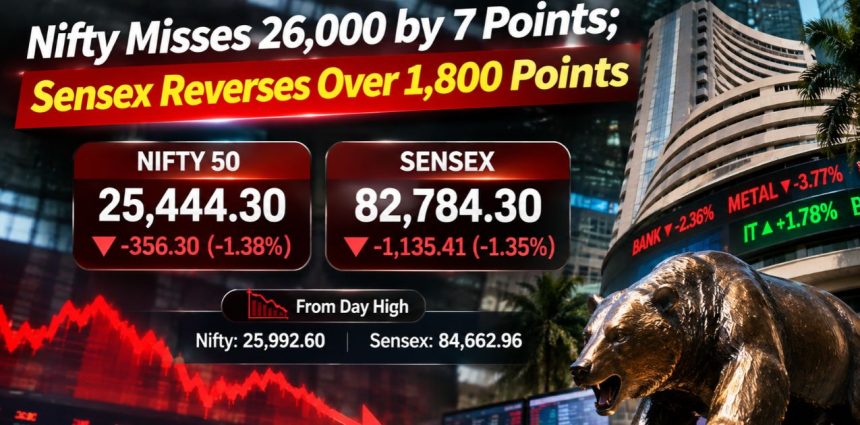
Synopsis: Nifty came within just 7.40 points of 26,000 on November 23 before plunging more than 500 points from its intraday high. Sensex reversed over 1,800 points as banking and metal stocks dragged markets lower. NiftyTrader data showed weakening options positioning, while IT stocks bucked the selloff. Here’s what changed and the levels investors are watching.
Indian stock markets witnessed a sharp reversal on Monday, November 23, 2026, as the Nifty 50 came within touching distance of 26,000 before a wave of selling sent the index below 25,500.
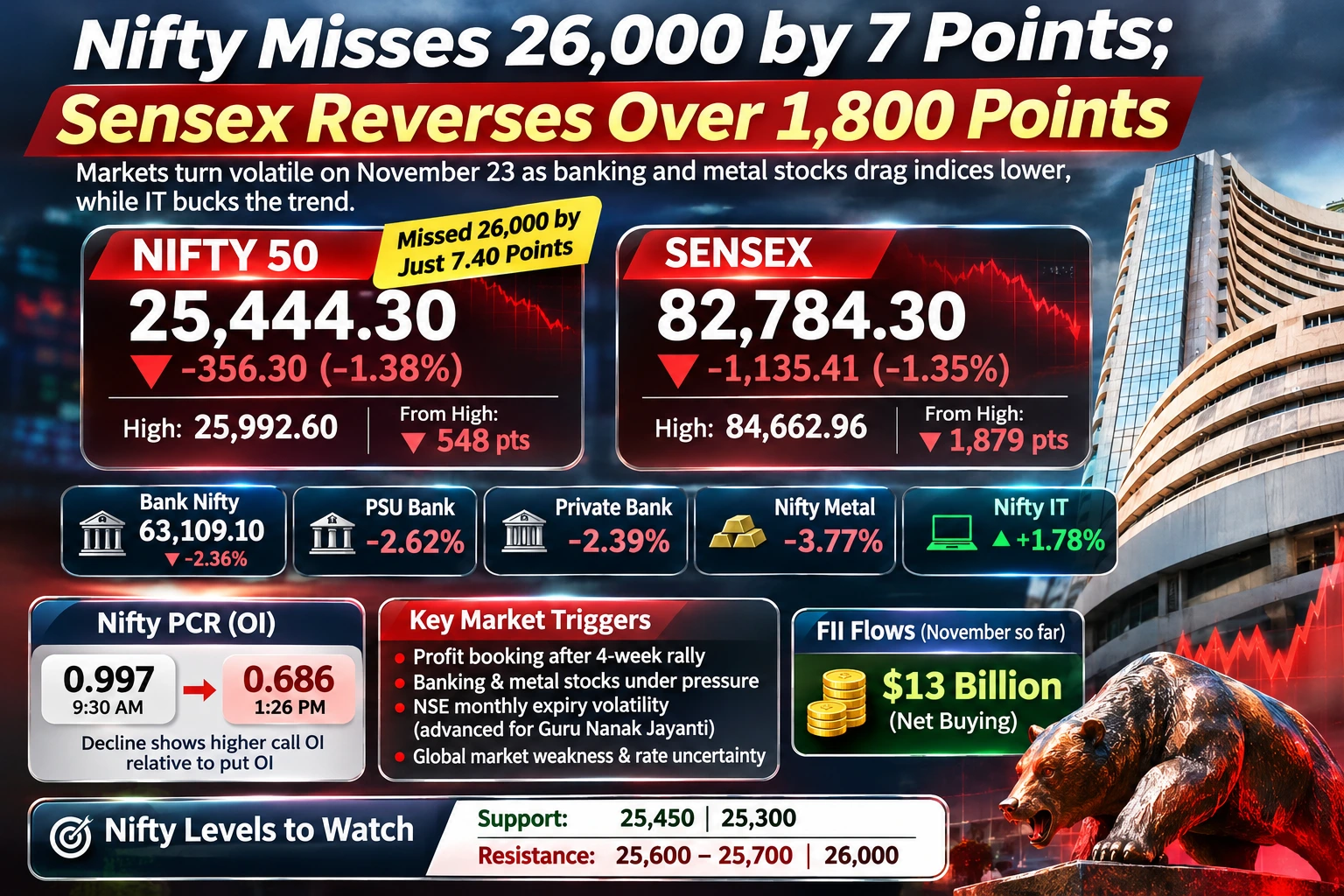
The Nifty climbed to an intraday high of 25,992.60, missing 26,000 by just 7.40 points. However, the early optimism quickly faded.
At 1:26 pm IST, NiftyTrader’s intraday data showed Nifty at 25,444.30, down 356.30 points or 1.38% from Friday’s close. That represented a reversal of approximately 548 points from the session’s high.
The Sensex followed a similar pattern. After touching 84,662.96, the index was quoted at 82,784.30 in NiftyTrader’s 1:23 pm market snapshot, a decline of approximately 1,879 points from its intraday peak.
This was a high-to-quoted-price reversal, not the Sensex’s loss from the previous closing level. Compared with Friday’s close of 83,919.71, the index was down approximately 1,135 points at that snapshot.
The sudden selloff came after four consecutive weeks of market gains and substantial foreign institutional investment. Banking and metal stocks led the decline, while IT shares showed surprising resilience.
Track Live: Nifty 50 Today | Sensex Option Chain Live — OI, IV & LTP by Strike
How Nifty’s 26,000 Attempt Turned Into a 500-Point Selloff
The Nifty opened at 25,929.15 and quickly approached the psychological 26,000 mark.
But the index failed to cross that level, and selling intensified as the session progressed.
By early afternoon, Nifty had slipped below 25,500, erasing more than 500 points from its intraday high.
The decline was not limited to a few heavyweight stocks.
At 11:47 am, only 15 Nifty 50 constituents were advancing against 35 declining, according to Angel One. Reuters had separately reported that 14 of India’s 16 major sectoral indices were trading lower at 10:16 am.
Market volatility also increased. India VIX surged as much as 7.6% to an intraday high of 18.65, according to Upstox, indicating greater expectations of near-term price fluctuations.
The broad weakness suggested investors were becoming more cautious after the market’s extended rally.
Banks and Metals Lead the Selling Pressure
Banking stocks emerged as one of Monday’s biggest drags.
According to NiftyTrader’s 1:23 pm sector snapshot, Bank Nifty was down 2.36%, while the PSU Bank and Private Bank indices had declined 2.62% and 2.39%, respectively.
The weakness followed an exceptionally strong run.
Reuters reported that Nifty Bank had gained 19.1% over the previous four weeks, while the PSU Bank index had advanced 22.4%.
Such rapid gains can leave heavily owned stocks vulnerable to profit booking.
Selling in major financial stocks weighed heavily on the benchmark indices because of the banking sector’s significant index weight.
Metals faced even sharper pressure.
The Nifty Metal index was down approximately 3.77% in NiftyTrader’s early-afternoon snapshot, making it one of the session’s weakest sectors.
Tata Steel was among the notable losers, falling 7.93% to ₹163.89 at 11:47 am, according to Angel One.
Its decline coincided with a major transaction announcement involving APL Apollo Tubes.
Tata Steel disclosed plans to acquire up to 26.38% of APL Apollo’s expanded voting share capital for approximately ₹15,510.61 crore, alongside a mandatory open offer for an additional 26% at ₹2,301.40 per share.
Separately, APL Apollo agreed to acquire Tata Steel’s tubes and colour-coated steel businesses for a combined consideration of ₹28,000 crore.
The proposed transactions, subject to regulatory approvals and other conditions, raise important questions about financing, valuation and execution alongside their potential long-term benefits.
NiftyTrader PCR Data Shows a Shift in Options Positioning
Monday’s derivatives data provided another important clue about changing market sentiment.
According to NiftyTrader’s intraday put-call ratio history for the November 23 expiry, the Nifty open-interest PCR declined from 0.997 at 9:30 am to 0.686 at 1:26 pm.
The change indicates that outstanding call open interest had become substantially larger relative to put open interest during the session.
At the same time, Nifty fell below 25,500, reflecting a weakening price trend.
However, a declining PCR does not automatically prove fresh call writing or establish the market’s next direction. The change can result from different combinations of position creation and unwinding.
Monday also marked the November monthly NSE F&O expiry, advanced because exchanges will remain closed on Tuesday, November 24, for Guru Nanak Jayanti.
Expiry-related position adjustments may have intensified the volatility, although they cannot be established as the direct cause of the decline without more detailed transaction and open-interest evidence.
Why Is the Market Falling Despite $13 Billion in FII Buying?
One of Monday’s biggest contradictions was the sharp selloff despite substantial foreign investment during November.
Reuters reported that foreign investors had purchased a record approximately $13 billion of Indian equities so far during the month.
Those inflows helped support a four-week rally, with Nifty and Sensex gaining approximately 11.4% and 12.2%, respectively, during November through Reuters’ morning reporting snapshot.
However, strong foreign buying does not prevent short-term corrections.
After a rapid rally, investors may reduce profitable positions when markets encounter selling pressure around important price levels.
Global uncertainty surrounding US interest rates, technology valuations and the recent weakness in international equity markets added to the cautious environment.
Monday’s decline does not, by itself, establish that foreign investors have reversed their buying trend.
The final institutional trading data will provide greater clarity about their activity during the session.
Why Were IT Stocks Rising While Banks and Metals Fell?
An interesting feature of Monday’s market was the divergence between technology stocks and the broader indices.
While banks and metals faced heavy selling, the Nifty IT index remained positive.
NiftyTrader’s 1:23 pm sector snapshot showed IT shares gaining approximately 1.78%, compared with losses of 3.77% in metals and 2.36% in Bank Nifty.
Earlier, ICICI Direct had reported a 2.67% rise in the Nifty IT index, with all 10 constituents trading higher at its morning observation.
The divergence suggests Monday’s correction was not a uniform selloff across every sector.
Instead, weakness was concentrated more heavily in banking and metal stocks, while some technology shares continued attracting buyers.
That difference could become important in assessing whether the market is experiencing broad risk aversion or a period of sector rotation and profit booking.
Nifty Outlook: What Should Investors Watch Next?
After the sharp intraday reversal, attention has shifted towards whether Nifty can regain the 25,500 level.
With the index trading below that mark during early afternoon, a recovery above 25,500 followed by sustained buying through 25,600–25,700 could suggest easing selling pressure.
The 26,000 level remains a major psychological hurdle following Monday’s unsuccessful attempt to reach it.
On the downside, traders may monitor price behaviour around 25,450 and 25,300, although these are reference zones rather than independently confirmed support levels.
Banking-sector stability, market breadth, foreign-investor activity and changing options positioning will be important indicators in the next trading session.
The biggest takeaway from Monday’s selloff is not simply that Sensex and Nifty fell sharply. It is that Nifty came within seven points of 26,000 after weeks of gains and substantial foreign inflows, yet quickly lost more than 500 points as selling spread through the market.
Whether buyers return after the sudden reversal or profit booking extends into the next session will help determine whether November’s rally resumes or enters a deeper consolidation phase.
Read Next: APL Apollo Shares Fall 14% Despite Tata Steel’s ₹2,301 Open Offer
Disclaimer: This article uses time-specific intraday market observations from November 23, 2026. NiftyTrader quotations reflect website-displayed snapshots, not independently audited exchange tick records. These are not closing prices. Technical observations are informational and do not constitute investment advice.