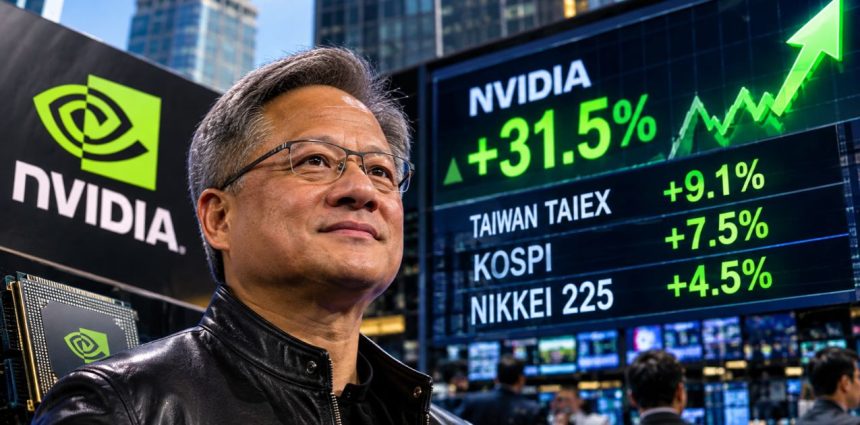
Synopsis: Asian stock markets surged on November 24 after Jensen Huang’s return as Nvidia CEO reignited confidence in artificial intelligence stocks. Nvidia jumped 31.5%, recovering nearly $1 trillion in market value, while the Nasdaq Composite gained 6.5%. However, rising US Treasury yields, Federal Reserve rate hike expectations and unresolved governance concerns could test the recovery. Indian investors will have to wait until Wednesday for domestic markets to react.
November 24, 2026 | Tuesday
Asian stock markets witnessed a powerful recovery on Tuesday, November 24, after Nvidia co-founder Jensen Huang’s reinstatement as chief executive triggered a sharp rebound in global technology and artificial intelligence (AI) stocks.
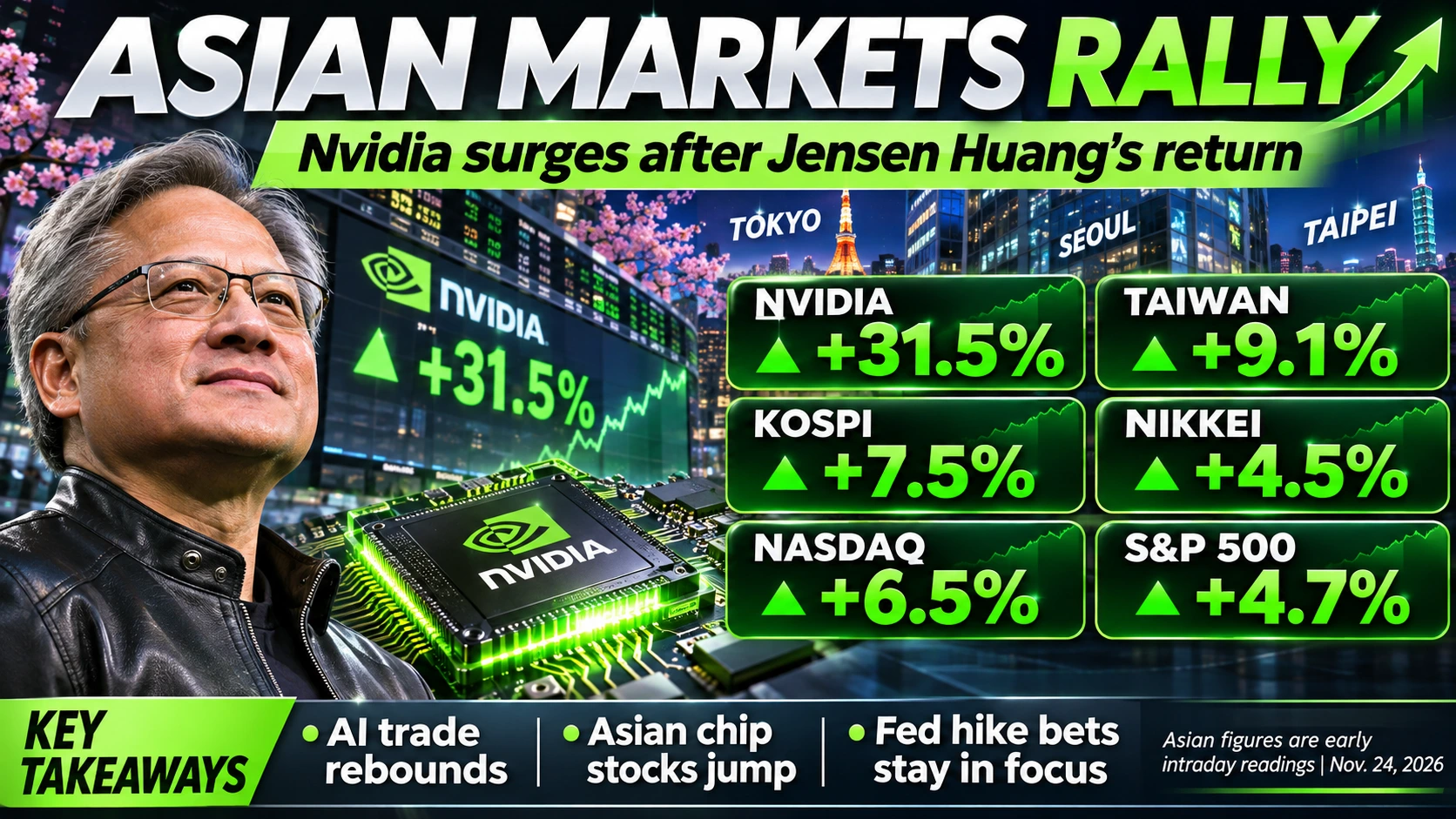
Taiwan’s benchmark TAIEX surged 9.1%, South Korea’s KOSPI advanced 7.5%, and Japan’s Nikkei 225 gained 4.5% in early trading, according to Reuters.
The gains followed an extraordinary session on Wall Street, where Nvidia shares jumped 31.5%, recording their strongest daily percentage gain since 2003 and recovering nearly $1 trillion in market capitalisation.
The rally marks a significant shift in investor sentiment following last week’s technology sell-off. However, renewed expectations of higher US interest rates and concerns over the sustainability of AI spending remain potential obstacles to a broader market recovery.
Track Live: GIFT Nifty Live – Today Price, Chart, Timings and Nifty Opening Signal
Asian Markets Today: Semiconductor Stocks Lead the Recovery
The recovery extended across Asia’s major semiconductor markets as investors reassessed the outlook for AI infrastructure following Nvidia’s leadership announcement.
MSCI’s broad Asia-Pacific index excluding Japan advanced 4.6%, rebounding from an eight-month low and heading towards its biggest daily gain since July 31.
Global market performance on November 23–24
| Index / Stock | Change | Session |
|---|---|---|
| Taiwan TAIEX | +9.1% | November 24 |
| South Korea KOSPI | +7.5% | November 24 |
| Japan Nikkei 225 | +4.5% | November 24 |
| MSCI Asia-Pacific ex-Japan | +4.6% | November 24 |
| Nvidia | +31.5% | November 23 |
| Nasdaq Composite | +6.5% | November 23 |
| S&P 500 | +4.7% | November 23 |
| Dow Jones | +3.0% | November 23 |
Source: Reuters and Associated Press. Asian market figures are early intraday readings, while US figures represent Monday’s closing performance.
Taiwan Semiconductor Manufacturing Company (TSMC) plays a central role in advanced chip manufacturing, while South Korea’s Samsung Electronics and SK Hynix are major suppliers of memory technology used in AI computing systems.
Japanese companies, including Advantest and Tokyo Electron, operate in semiconductor testing and manufacturing equipment. Bloomberg reported that Advantest surged 15% during Tuesday’s early recovery.
These commercial relationships explain why improving confidence in Nvidia’s business outlook can influence technology stocks across multiple Asian economies, even without an immediate change in their underlying orders or earnings.
Why Did Jensen Huang Return as Nvidia CEO?
Nvidia announced on November 23 that its board had unanimously approved the reinstatement of Jensen Huang as president, chief executive officer and board director.
According to the company’s filings with the US Securities and Exchange Commission (SEC), Nvidia’s board accepted Huang’s resignation on November 11, effective immediately. The company publicly announced his departure on November 12.
Colette Kress, Nvidia’s chief financial officer, subsequently assumed additional responsibilities as interim CEO.
The board reinstated Huang on November 22, with the decision publicly communicated on November 23. Kress will continue as CFO, while Harvey C. Jones remains chairman.
Nvidia said the decision followed discussions with Huang and input from senior US government officials. Based on that input, the board expressed confidence that his reinstatement did not pose a national security risk.
Nvidia’s investigation remains ongoing
Despite Huang’s return, Nvidia’s corporate governance concerns have not been fully resolved.
The company confirmed that an independent investigation into reports that Huang had been targeted by a foreign intelligence effort would continue. Nvidia said Huang supports the investigation and intends to cooperate.
The board has also formed a National Security and Export Control Committee comprising independent directors to oversee trade compliance and national security matters.
Additionally, Nvidia has begun searching for a Chief Compliance Officer and will continue cooperating with ongoing government investigations and inquiries.
The leadership decision therefore reduces immediate management uncertainty without bringing the wider investigation to an end.
Nvidia Share Price Surges 31.5%, Recovers Nearly $1 Trillion
Nvidia shares closed at $165.05 on November 23, compared with $125.53 in the previous trading session.
| Nvidia stock performance | Details |
|---|---|
| Previous closing price | $125.53 |
| Latest closing price | $165.05 |
| Absolute gain | $39.52 |
| Percentage gain | 31.48% |
| Market value recovered | Nearly $1 trillion |
Source: Historical market data and Reuters.
The sharp recovery demonstrates Nvidia’s influence over global technology valuations and expectations surrounding AI investment.
Under Huang’s leadership, the company has expanded beyond traditional graphics processors into accelerated computing, networking, enterprise software and integrated data centre infrastructure.
Its commercial ecosystem connects semiconductor manufacturers, cloud computing providers, AI developers and businesses investing in large-scale computing capacity.
Leadership stability is particularly important for such a business because major infrastructure projects involve multiyear investment commitments and coordination across numerous suppliers.
However, Monday’s increase in market capitalisation reflects a change in investors’ valuation of Nvidia. It does not represent an equivalent increase in the company’s cash reserves, revenue or operating profit.
Nvidia Q3 FY27 Results Highlight Continued AI Demand
While Huang’s return was the immediate catalyst for Monday’s rally, Nvidia’s latest earnings provide important context for investor confidence in the company’s underlying business.
On November 17, Nvidia reported its third-quarter FY2027 financial results for the period ended October 25, 2026.
Nvidia Q3 FY27 financial performance
| Financial metric | Q3 FY27 | YoY growth |
|---|---|---|
| Revenue | $115.8 billion | 103% |
| Data centre revenue | $107.6 billion | 110% |
| GAAP operating income | $77.5 billion | 115% |
| GAAP net income | $65.3 billion | 105% |
| GAAP diluted EPS | $2.70 | 108% |
| GAAP gross margin | 74.8% | +1.4 percentage points |
Source: Nvidia’s official Q3 FY2027 financial results.
Data centre operations accounted for approximately 93% of quarterly revenue, demonstrating Nvidia’s growing dependence on AI infrastructure demand.
The company expects fourth-quarter revenue of $130 billion, plus or minus 3%. Its guidance includes an additional fiscal week and assumes no data centre compute revenue from China.
Nvidia also confirmed that production and shipments of its Vera Rubin NVL72 computing platform had begun.
However, its fourth-quarter gross margin guidance of 71%–72% is below the third quarter’s reported GAAP gross margin of 74.8%.
While strong revenue growth supports expectations of continued AI investment, profitability, product execution and customer spending will remain important factors in determining whether the company’s valuation is sustainable.
Wall Street Ends Seven-Day Losing Streak
The Nvidia-led recovery helped the S&P 500 break a seven-session losing streak on Monday.
The benchmark had entered correction territory during the previous week, while technology stocks faced considerable pressure amid concerns over AI spending, valuations and corporate leadership.
US stock market closing levels
| Index | Closing level | Change |
|---|---|---|
| Nasdaq Composite | 24,089.56 | +6.5% |
| S&P 500 | 7,237.17 | +4.7% |
| Dow Jones | 49,595.31 | +3.0% |
| Russell 2000 | 2,669.66 | +3.4% |
Source: Associated Press, November 23 US market close.
Although Monday’s gains were substantial, the S&P 500 recovered only slightly more than half of its losses from the previous week.
The distinction matters because a strong relief rally does not necessarily confirm the beginning of a sustained market recovery. Investors will continue assessing whether future earnings justify current technology valuations.
Federal Reserve Rate Hike Expectations Pose Fresh Risks
Even as technology stocks recovered, expectations of tighter US monetary policy strengthened.
The Federal Reserve maintained its benchmark interest rate at 3.75%–4.00% during its October 28 policy meeting.
Following Monday’s equity rally, Reuters reported that CME FedWatch-derived futures pricing indicated an almost certain expectation of a December rate increase, compared with approximately 89% on Friday.
These probabilities reflect financial market expectations rather than an announced Federal Reserve decision.
The next important economic release is the US Bureau of Economic Analysis’ October Personal Income and Outlays report, which includes the Personal Consumption Expenditures (PCE) price index.
The report is scheduled for November 25 at 8:30 AM US Eastern Time, or 7 PM IST.
The Federal Reserve’s final monetary policy meeting of 2026 is scheduled for December 8–9.
Higher borrowing costs could increase financing expenses for companies undertaking capital-intensive AI infrastructure projects. Rising bond yields may also place pressure on growth-stock valuations, even when corporate earnings remain strong.
Gold, Crude Oil and US Bond Yields in Focus
Global investors are also monitoring developments in commodities, currencies and government bonds.
| Global indicator | November 24 morning reading |
|---|---|
| US 10-year Treasury yield | 4.94% |
| US 2-year Treasury yield | 4.69% |
| Brent crude oil | $89.50 per barrel |
| Spot gold | $3,657.97 per ounce |
Source: Reuters. Intraday market readings are subject to change.
Brent crude remained near a three-month low, while gold recovered from its recent weakness.
For India, lower crude prices could provide some relief on imported energy costs. However, elevated US Treasury yields and a stronger dollar could complicate foreign investment flows and currency stability.
These competing factors mean that improving global equity sentiment alone may not determine the direction of emerging markets.
What Does the Nvidia Rally Mean for Nifty and Sensex?
Indian equity markets are closed on Tuesday, November 24, for Guru Nanak Jayanti. Trading on the NSE and BSE is scheduled to resume on Wednesday, November 25.
The global rebound follows a sharp reversal in Indian equities on Monday, when selling across banking, financial services and metal stocks dragged benchmark indices lower.
| Indian benchmark | November 23 close | Change |
|---|---|---|
| Nifty 50 | 25,349.65 | −450.95 points |
| BSE Sensex | 82,435.99 | −1,483.72 points |
NiftyTrader data shows widespread short buildup
NiftyTrader’s November 23 stock-and-index F&O scanner, updated at 4:08 PM IST, showed bearish positioning signals across a substantial proportion of tracked instruments.
| F&O classification | Instruments |
|---|---|
| Short buildup | 149 |
| Long buildup | 42 |
| Long unwinding | 9 |
| Short covering | 6 |
| Neutral | 16 |
| Total instruments | 222 |
Short-buildup signals accounted for approximately 67.1% of the scanner universe, compared with 18.9% for long buildup.
These classifications reflect NiftyTrader’s analysis of price and open interest movements across tracked instruments. They do not directly establish institutional positions or the direction of the next trading session.
The international recovery could improve the external backdrop when domestic markets reopen. However, its sustainability, foreign investment flows and fresh derivatives positioning will determine whether the improvement extends to Indian equities.
Source: NiftyTrader F&O Buildup Report, November 23.
Why the AI Sell-Off May Not Be Over
Jensen Huang’s reinstatement has reduced immediate uncertainty surrounding Nvidia’s leadership, but the broader challenges facing global technology markets remain.
Investors must continue evaluating the returns on AI infrastructure spending, corporate borrowing requirements, semiconductor demand and the impact of tighter monetary policy.
Nvidia’s ongoing investigation and regulatory compliance measures also remain relevant to its long-term risk profile.
For Indian investors, GIFT Nifty, global semiconductor stocks, US bond yields, crude oil prices and foreign institutional activity will be important indicators ahead of Wednesday’s market reopening.
The November 24 rally demonstrates how quickly confidence can return to the global AI industry. Whether it develops into a sustained recovery will ultimately depend on earnings growth, investment returns and monetary policy rather than leadership developments alone.
Read Next: F&O Buildup Report Nov 23: 149 Short Signals as Nifty Falls 451 Points
Disclaimer: This article is for informational and educational purposes only and does not constitute investment advice or a recommendation to buy or sell securities. Market data reflects the reported trading session and may change. Investors should conduct independent research and consult a SEBI-registered investment adviser before making investment decisions.