
Gold and Silver ETFs Plunge as stock market rally surprises investors
Gold and silver ETF investors faced a sharp setback on November 25 as precious metal prices extended their decline, even while Indian equities staged a strong recovery. Silver ETFs plunged as much as 5.6%, while gold ETFs declined nearly 3%, highlighting the growing divergence between bullion and equity markets.
The selloff raises an important question for investors: Is this a temporary correction in gold and silver prices, or could precious metals face further pressure in the coming sessions?
The weakness in international bullion prices, a stronger US dollar, concerns over potential US tariffs and expectations surrounding Federal Reserve interest rates contributed to the selling pressure.
Track Live : NSE Commodity Option Chain — Live MCX Options Data for Crude Oil, Gold, Silver & More
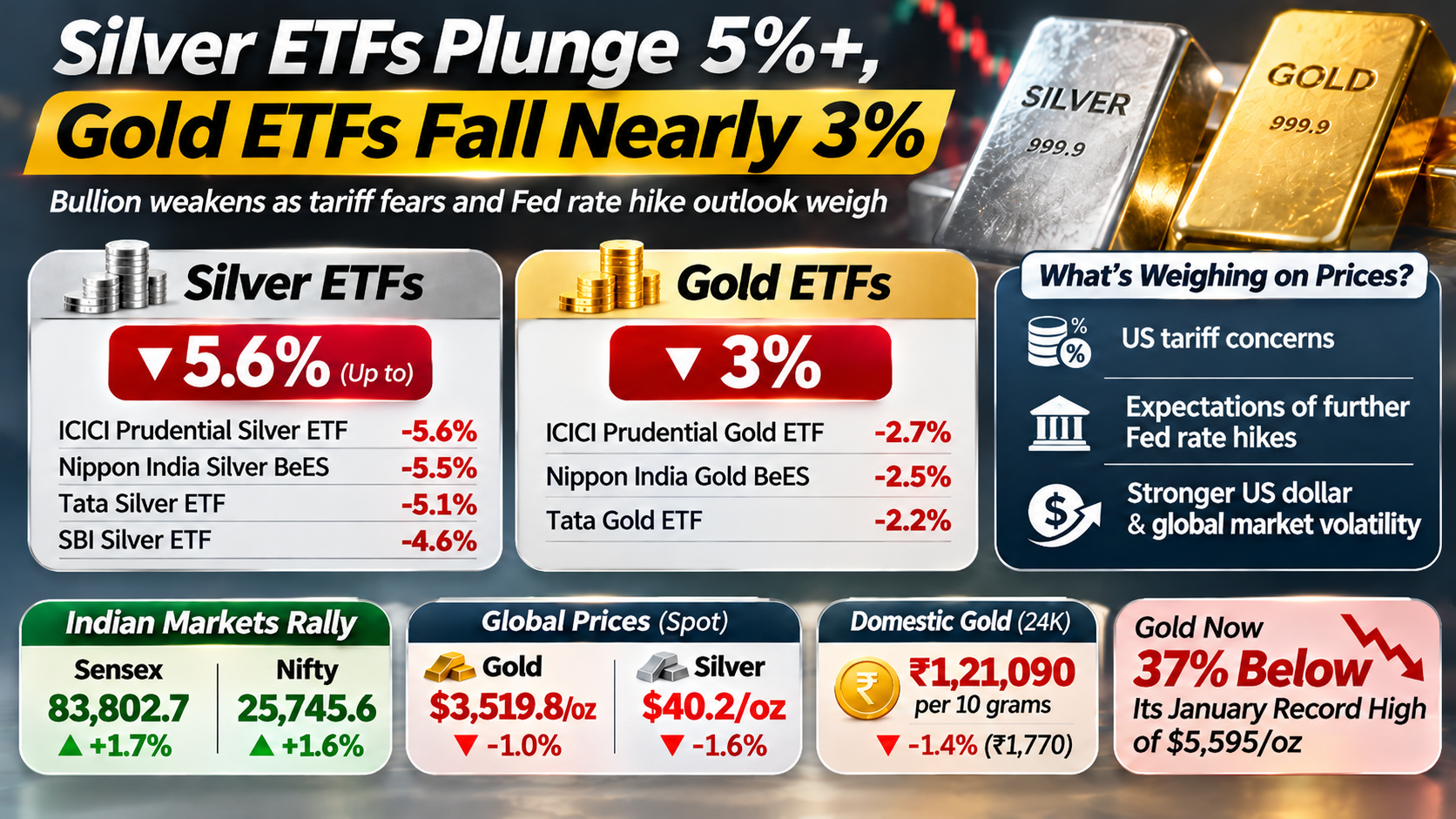
Silver ETFs Plunge up to 5.6% while gold ETFs decline nearly 3%
Several silver ETFs recorded substantial losses during Wednesday’s trading session.
ICICI Prudential Silver ETF and Nippon India Silver ETF were among the notable losers, while gold ETFs also extended their declines.
Silver ETF performance on November 25
| Silver ETF | Reported price | Decline |
|---|---|---|
| ICICI Prudential Silver ETF | ₹143.70 | 5.6% |
| Nippon India Silver ETF (Silver BeES) | ₹138.30 | 5.5% |
| Tata Silver ETF | ₹14.10 | 5.1% |
| SBI Silver ETF | ₹142.60 | 4.6% |
Gold ETF performance
| Gold ETF | Reported price | Decline |
|---|---|---|
| ICICI Prudential Gold ETF | ₹103.90 | 2.7% |
| Nippon India ETF Gold BeES | ₹100.50 | 2.5% |
| Tata Gold ETF | ₹11.80 | 2.2% |
Prices and percentage declines above are from the supplied market report. ETF prices fluctuate during trading and may differ across exchanges and observation times.
The broader market data also confirms significant weakness in the precious-metal funds. For example, ICICI Prudential Silver ETF was trading around ₹142–145 during the morning session, while ICICI Prudential Gold ETF was around ₹103.60 at 11:58 am, down 2.90%.
Track Live : GIFT Nifty Live – Today Price, Chart, Timings and Nifty Opening Signal
Why did gold and silver ETFs fall despite a strong stock market rally?
The divergence between equities and precious metals is one of the most important aspects of Wednesday’s trading session.
At 2:47 pm IST, the Sensex and Nifty were reportedly trading substantially higher.
| Indian market index | Reported level | Gain |
|---|---|---|
| BSE Sensex | 83,802.7 | 1.7% |
| NSE Nifty 50 | 25,745.6 | 1.6% |
However, a rising stock market does not automatically mean that gold and silver must decline. Different asset classes respond to different economic and financial factors.
Three developments are particularly relevant:
-
Equity allocation: Investors may be shifting some capital towards stocks when they see opportunities in equities.
-
Interest-rate expectations: Higher expected US interest rates reduce the relative attractiveness of gold and silver.
-
Liquidity requirements: Investors facing losses or margin calls in other markets may sell liquid assets, including bullion ETFs, to raise cash.
A similar pattern was visible during the November 20 selloff, when gold and silver ETFs declined sharply amid US rate-hike concerns.
International gold and silver prices extend their losses
Global bullion prices continued to weaken after a sharp decline in the previous session.
International gold prices fell as much as 1.2% to just above $3,500 per ounce on Wednesday. Spot gold was trading 1% lower at $3,519.8 per ounce at 3:28 pm in Singapore.
Silver prices declined another 1.6% to $40.2 per ounce after plunging more than 5% on Tuesday.
A stronger US dollar and concerns over potential tariff increases by Washington on imports from China, the European Union and other economies have weighed on precious metals.
Additionally, weakness in global technology stocks amid concerns about the sustainability of the artificial intelligence boom has prompted some investors to sell gold holdings to cover losses elsewhere.
International silver also remained under pressure, although the precise intraday quote varied across reporting times.
| Precious metal | November 25 market indication |
|---|---|
| Spot gold | $3,531.09 per ounce |
| Gold intraday movement | -0.6% |
| Spot silver | Around $40–41 per ounce |
| Gold previous-session decline | More than 2% |
Track Live : NSE Option Chain — Live | BSE Option Chain — Live Sensex & Bankex Options Data Today
Gold prices remain under pressure after falling from record highs
The correction in gold prices has become increasingly significant. International gold is trading approximately 37% below its January record high of $5,595 per ounce.
Gold has declined around 8% so far in November, following a 7% fall in October.
Domestic prices have also weakened. The price of 24-karat gold declined Rs 1,770, or 1.4%, to Rs 1,21,090 per 10 grams on Wednesday afternoon, compared with its January peak of approximately Rs 1.8 lakh.
On the Multi Commodity Exchange (MCX), December gold futures traded at Rs 1,20,401 per 10 grams, down approximately 15% over one month and 27% over three months.
Stronger US dollar puts additional pressure on precious metals
One of the biggest reasons behind the latest bullion correction is the appreciation of the US dollar.
Gold and silver are internationally priced in dollars. When the dollar strengthens, precious metals become more expensive for buyers using other currencies, potentially reducing international demand.
A stronger dollar can also encourage investors to move towards dollar-denominated financial assets rather than commodities.
For Indian investors, the currency impact is particularly important.
How the dollar affects Indian bullion prices:
-
International gold and silver prices are converted into Indian rupees.
-
A stronger dollar generally increases the landed cost of imported bullion, all else being equal.
-
A stronger Indian rupee can offset some of the international price decline.
-
A weaker rupee can cushion domestic bullion prices against a global fall.
Therefore, international bullion prices and Indian ETF prices do not always move by exactly the same percentage.
Gold’s monthly correction
The correction has extended across several months, with November witnessing another substantial decline.
| Period | Gold price movement |
|---|---|
| January 2026 | Record high of approximately $5,595/oz |
| October 2026 | Significant monthly correction |
| November 2026 | Approximately 8% decline, as reported in the supplied story |
| November 25, 2026 | Around $3,531/oz |
The correction has affected both international gold prices and domestic gold ETFs.
Track Live : Nifty Levels Today | Sensex Levels Today | Bank Nifty Levels Today
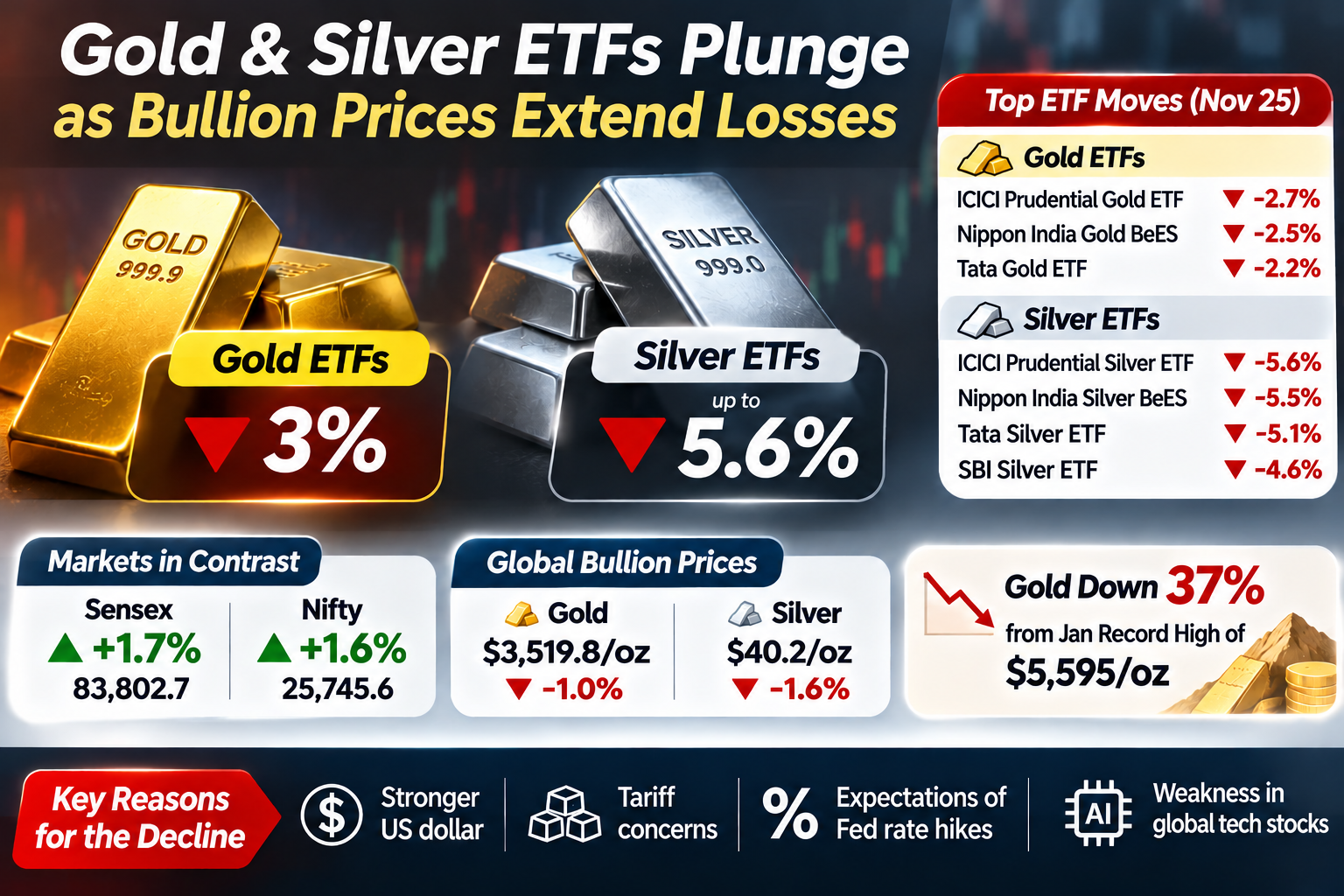
Silver’s correction is even sharper than gold’s
Silver has experienced an especially steep decline from its January 2026 record.
According to November 20 market reporting, silver had fallen from approximately $121.63 per ounce to around $41 per ounce, representing a decline of approximately 66%.
| Particulars | Silver |
|---|---|
| January 2026 record | $121.63/oz |
| November 25 indicative price | Around $40–41/oz |
| Decline from record | Approximately 66% |
| Recent trend | Continued weakness
|
Domestic gold prices and MCX futures also witness a correction
The international selloff has affected domestic bullion prices as well.
According to the supplied report, 24-karat gold declined by ₹1,770, or 1.4%, to ₹1,21,090 per 10 grams on November 25.
Gold prices have corrected considerably from their January peak of approximately ₹1.81 lakh per 10 grams.
Domestic bullion price comparison
| Particulars | Price |
|---|---|
| 24-karat gold on November 25 | ₹1,21,090/10g |
| January 2026 peak | Approximately ₹1,80,986/10g |
| December MCX gold futures quoted in supplied report | ₹1,20,401/10g |
| December futures decline over one month | Approximately 15% |
| December futures decline over three months | Approximately 27% |
The MCX December gold contract was also under pressure. However, intraday prices differed across observation times: another November 25 market snapshot showed December gold futures around ₹1,21,702 per 10 grams in the morning.
Read More : Vodafone Idea: Better Network Coming? Why a Rs 25,000 Crore Bank Loan Matters for FY28
Here’s what happened today and why traders reacted
Silver ETFs witnessed heavier selling compared with gold ETFs on Wednesday.
ICICI Prudential Silver ETF plunged 5.6% to Rs 143.7, while Nippon India Silver ETF (Silver BeES) declined 5.5% to Rs 138.3. Tata Silver ETF dropped 5.1% to Rs 14.1, and SBI Silver ETF slipped 4.6% to Rs 142.6.
Gold ETFs also traded lower. ICICI Prudential Gold ETF declined 2.7% to Rs 103.9, while Nippon India ETF Gold BeES fell 2.5% to Rs 100.5. Tata Gold ETF lost 2.2% to Rs 11.8.
Interestingly, the broader stock market moved in the opposite direction. At 2:47 pm IST, the Sensex rallied 1,366.7 points, or 1.7%, to 83,802.7. The Nifty 50 advanced 395.9 points, or 1.6%, to 25,745.6.
This contrasting performance suggests that investors were shifting their attention towards equities while precious metals remained under pressure.
Track Live : NSE F&O Lot Size | FII DII Data Today
What should gold and silver ETF investors watch next?
Investors are awaiting key US inflation data for further clues about the Federal Reserve’s interest-rate decisions.
Expectations of higher interest rates can weigh on gold and silver because precious metals do not generate interest income. Any further strengthening of the US dollar could also create additional pressure on international bullion prices.
For investors holding gold ETFs and silver ETFs, the latest correction highlights the importance of monitoring global interest-rate expectations, currency movements and bullion prices before making fresh investment decisions.